People

Mencius

Mencius, or Mengzi, was a Warring States Chinese philosopher and major Confucian thinker. He argued for human moral potential, benevolent rule and government grounded in the people's welfare.

Born
c. 372 BCE
Died
c. 289 BCE
Role
Confucian philosopher

Confucian philosopher (c. 372 BC-c. 289 BC)

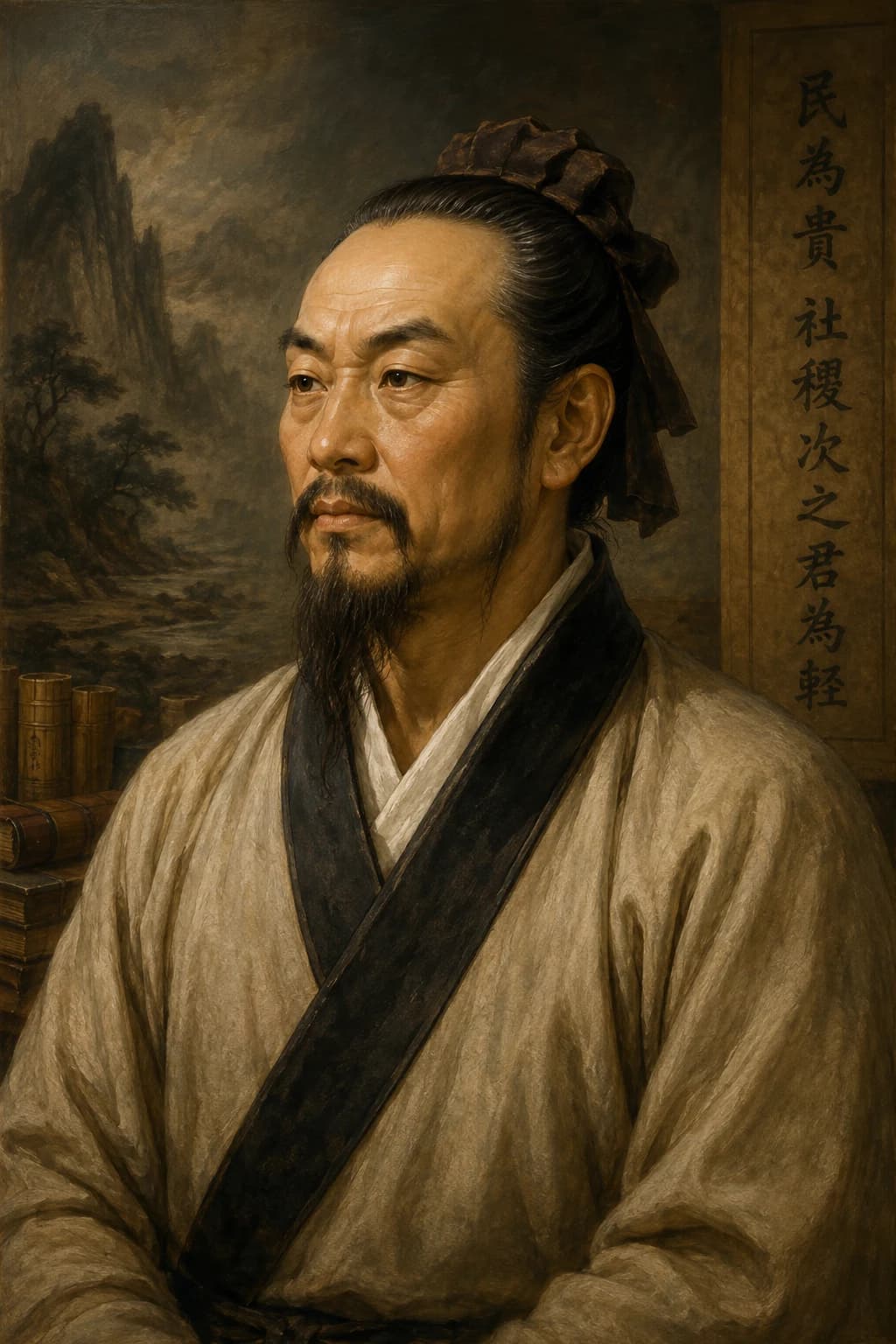
AI-generated portrait of Mencius in scholar robes with bamboo books and mountain scenery
AI-assisted historical reconstruction

An illustrative reconstruction based on historical context. It is not a photograph or documentary likeness. Image policy

Quick answer

Mencius, or Mengzi, was a Warring States Chinese philosopher and major Confucian thinker. He argued for human moral potential, benevolent rule and government grounded in the people's welfare.

Born
c. 372 BCE
Died
c. 289 BCE
Role
Confucian philosopher
Years
c. 372-c. 289 BCE
Quick facts

Profile details

Additional identity and tagging details that are not already covered in the introduction.

Full name
Meng Ke
Also known as
Mengzi, Master Meng, Meng-tzu
Region
China, Warring States China, East Asia, Warring States China
Facts

Mencius timeline facts

Selected specifics from this profile's life story.

c. 372 BC
Born in the Warring States age

Mencius was born during the Warring States period, when Chinese rulers competed through armies, reforms and rival schools of thought.

4th century BC
Advising rulers

Mencius travelled among rulers, urging them to govern through benevolence rather than force alone.

4th century BC
Against harsh rule

Mencius challenged rulers and rival thinkers who treated order as a matter of force, law or self-interest alone.

After c. 289 BC
Second Sage

After his death, Mencius became one of the central voices of Confucianism and later gained the title Second Sage.

Life Journey

The philosopher of moral sprouts and humane rule

Follow Mencius from Warring States disorder to one of the most influential arguments in Confucian thought.

Complete chronology

c. 372 BC

Born in the Warring States age

Mencius, known in Chinese as Meng Ke or Mengzi, was born around 372 BC in the region of Zou, near the old state of Lu. His lifetime belonged to the Warring States period, when Zhou royal authority had become mostly symbolic and rival states fought for survival. This violent setting matters because Mencius was not writing for a peaceful academy. He was asking what kind of rule could rescue people from war, hunger and predatory government.


4th century BC

Confucian heir

Mencius belonged to the tradition that looked back to Confucius and the early Zhou as sources of moral order. He did not simply repeat Confucius. He sharpened the tradition by arguing that people possess beginnings of virtue: compassion, shame, respect and a sense of right and wrong. These beginnings needed cultivation, education and a healthy social world. For Mencius, good government was not only efficient command. It was the political environment in which human moral potential could grow.

4th century BC

Advising rulers

Like many thinkers of his age, Mencius travelled between courts seeking rulers willing to listen. He argued that a ruler who cared for the people's livelihood would gain deeper legitimacy than one who relied only on punishment and military advantage. He spoke in practical terms: farmers needed stable conditions, families needed security, and rulers who exhausted the people undermined their own authority. His advice was morally demanding, but it was also strategic. Benevolence could make a state stronger by making its people less desperate.

4th century BC

Human nature is good

Mencius's best-known claim is that human nature is good. He did not mean that people always behave well automatically. He meant that humans have moral tendencies that can develop when supported by the right conditions. His famous examples point to spontaneous compassion and the beginnings of virtue. These moral sprouts can be damaged by poverty, fear, greed and bad rule, but they reveal that goodness is not alien to human beings. Politics therefore matters because it can either nourish or deform human nature.

4th century BC

Against harsh rule

The Warring States age rewarded rulers who could mobilise armies and enforce law. Mencius did not deny that states needed order, but he rejected the idea that fear alone could create legitimate rule. He criticised those who reduced politics to profit or coercion and insisted that the people's welfare was a sign of Heaven's favour. In that sense, his thought developed the Mandate of Heaven in a sharper moral direction: rulers could lose legitimacy by harming the people they were meant to protect.

After c. 289 BC

Second Sage

Mencius died around 289 BC. His influence grew over centuries as later Confucian scholars treated the Mengzi as one of the tradition's essential texts. He became known as the Second Sage, second only to Confucius in the Confucian lineage. Later imperial states did not always govern as Mencius wished, but his language of humane rule, moral cultivation and the people's welfare gave Chinese political thought one of its most durable standards for judging power.

Continue in context

Connected stories

Move from the profile into the wider events and settings this figure belongs to.

Tertiary paths

Content note

This profile is written for educational use and connects to related Stories of History pages. The main portrait is an AI-assisted historical reconstruction, included as an illustrative aid rather than documentary evidence. Image policy

References

Sources & Further Reading

Reliable reference works, archives and reading paths connected to this profile.

Further reading

  1. Encyclopaedia Britannica, Search results for Mencius,” accessed June 2026.Open source
  2. WorldCat, Books and library holdings for Mencius,” accessed June 2026.Open source

Primary sources

  1. Library of Congress, Search results for Mencius,” accessed June 2026.Open source

Reviewed claim sources

Loading reviewed claim sources...

A weekly route through history

Find out first about the latest published stories, feature notes and occasional Premium offers in one weekly email.