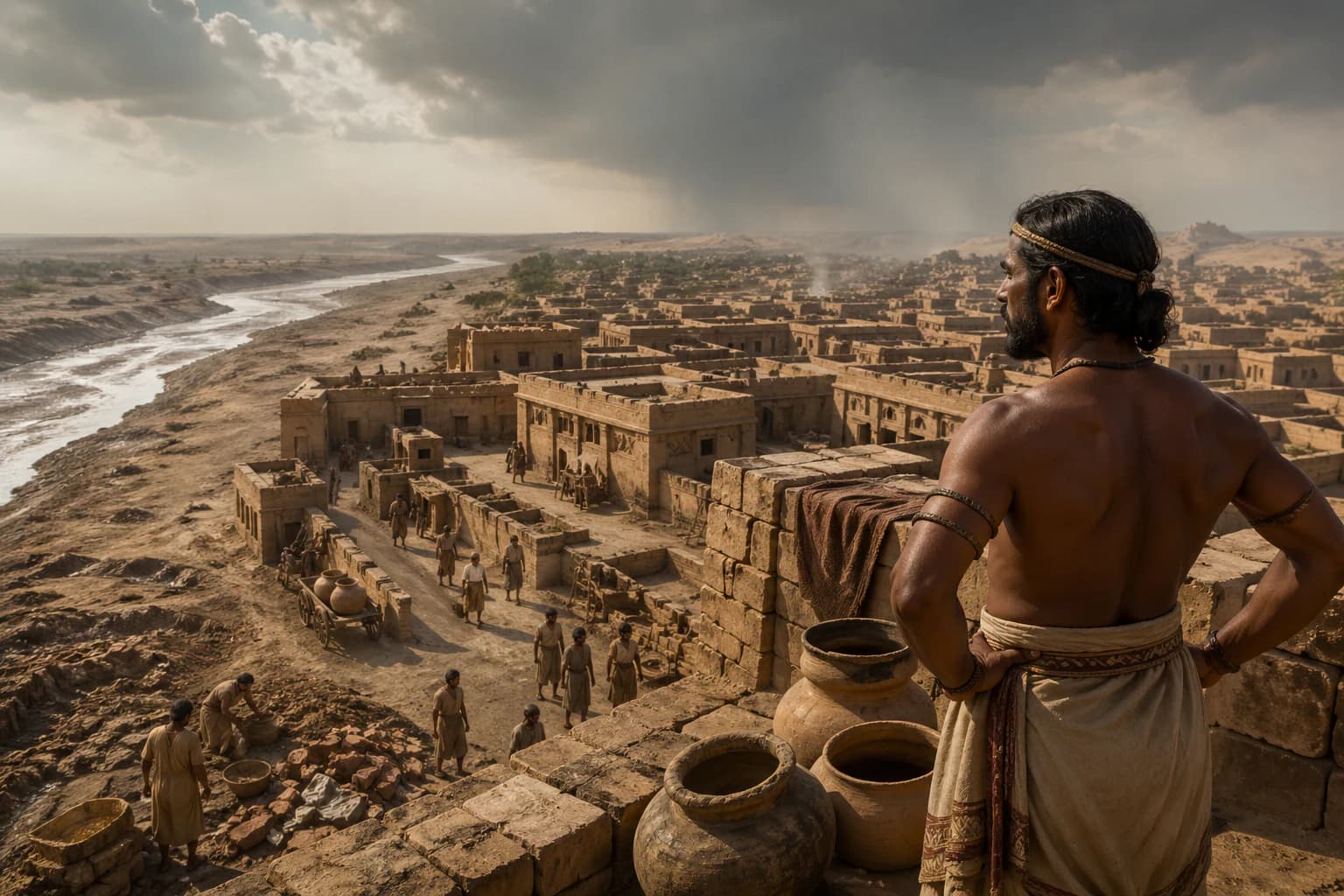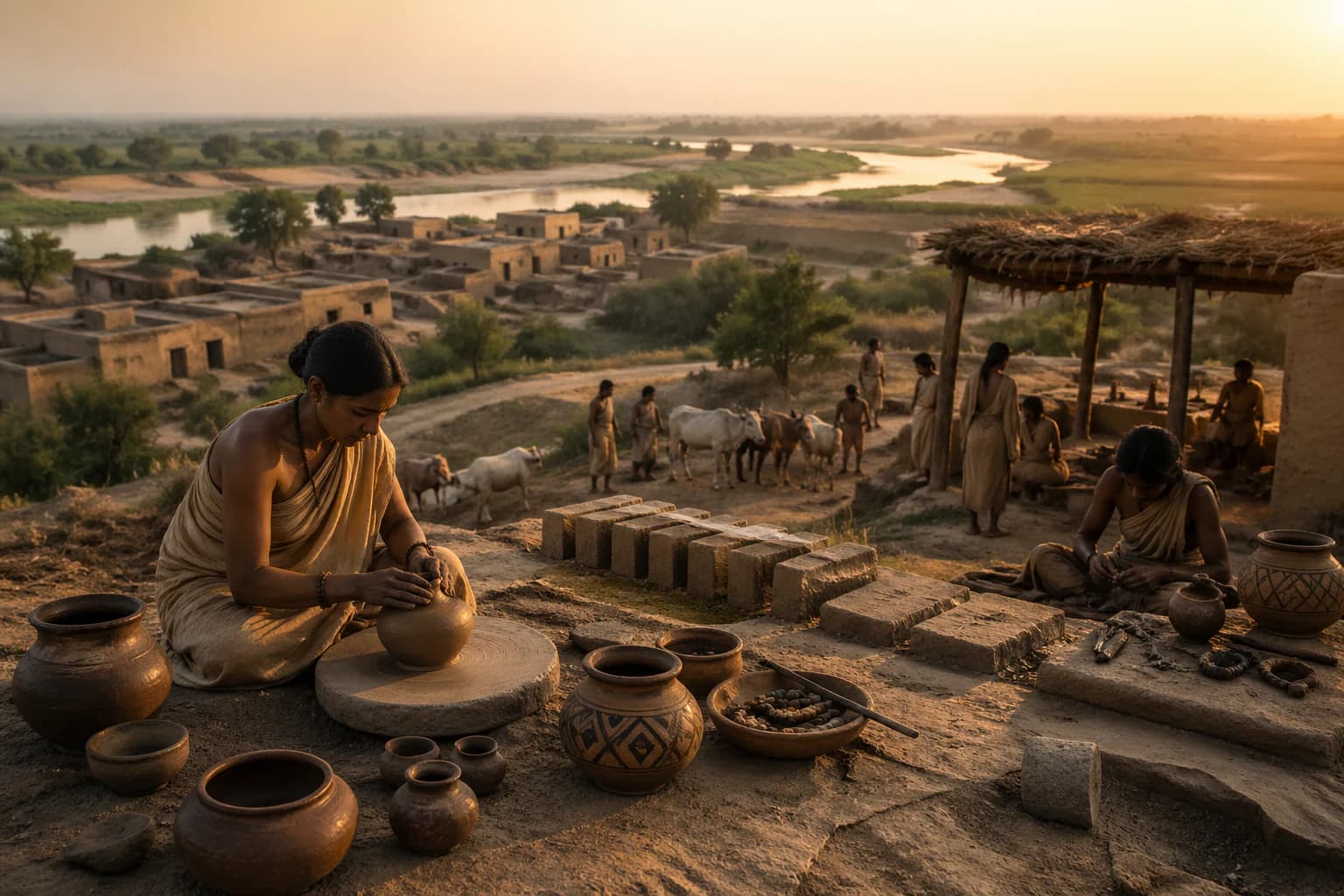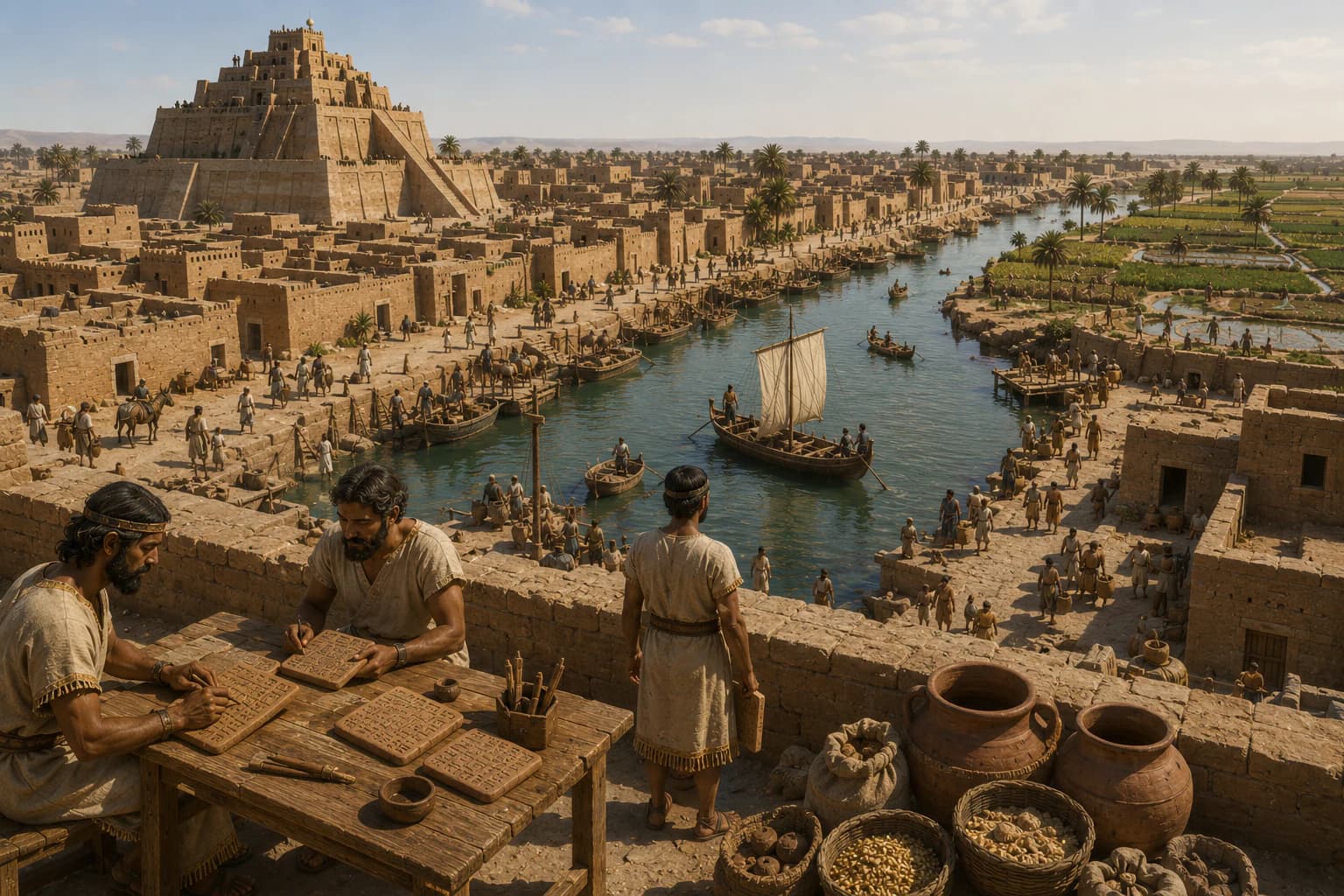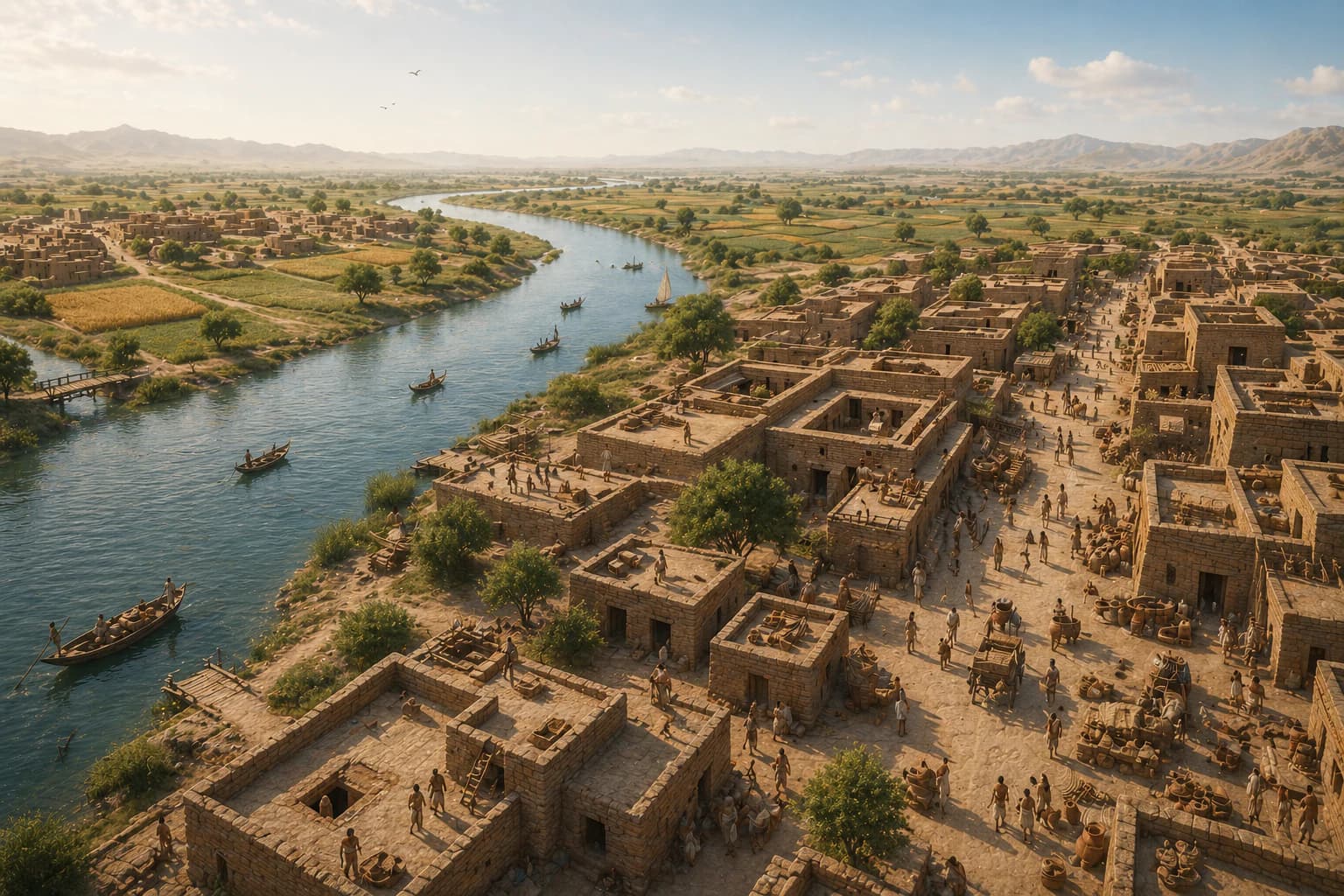
The planned cities and river plains of the ancient Indus Valley civilisation.
Free Story

The Indus Valley

Uncover the Indus Valley civilisation, its planned cities, trade networks, undeciphered script, and mysterious decline.

10 chapters

Next
Context

Introduction

Overview

The Civilization, also known as the Harappan Civilization, was one of the great urban cultures of the ancient world. From its planned cities and long-distance trade networks to its undeciphered script and mysterious decline, the reveals a society that was sophisticated, connected, and still partly hidden from view.

What you'll learn: You will follow how farming villages became great cities, how craftspeople and traders connected a vast civilisation, and why the Indus world remains one of history's most studied and most mysterious ancient societies.

Key forces

The Roots of Urban Life
7000 BCE
Step 1 of 107000 BCEAccessible mode

The Roots of Urban Life

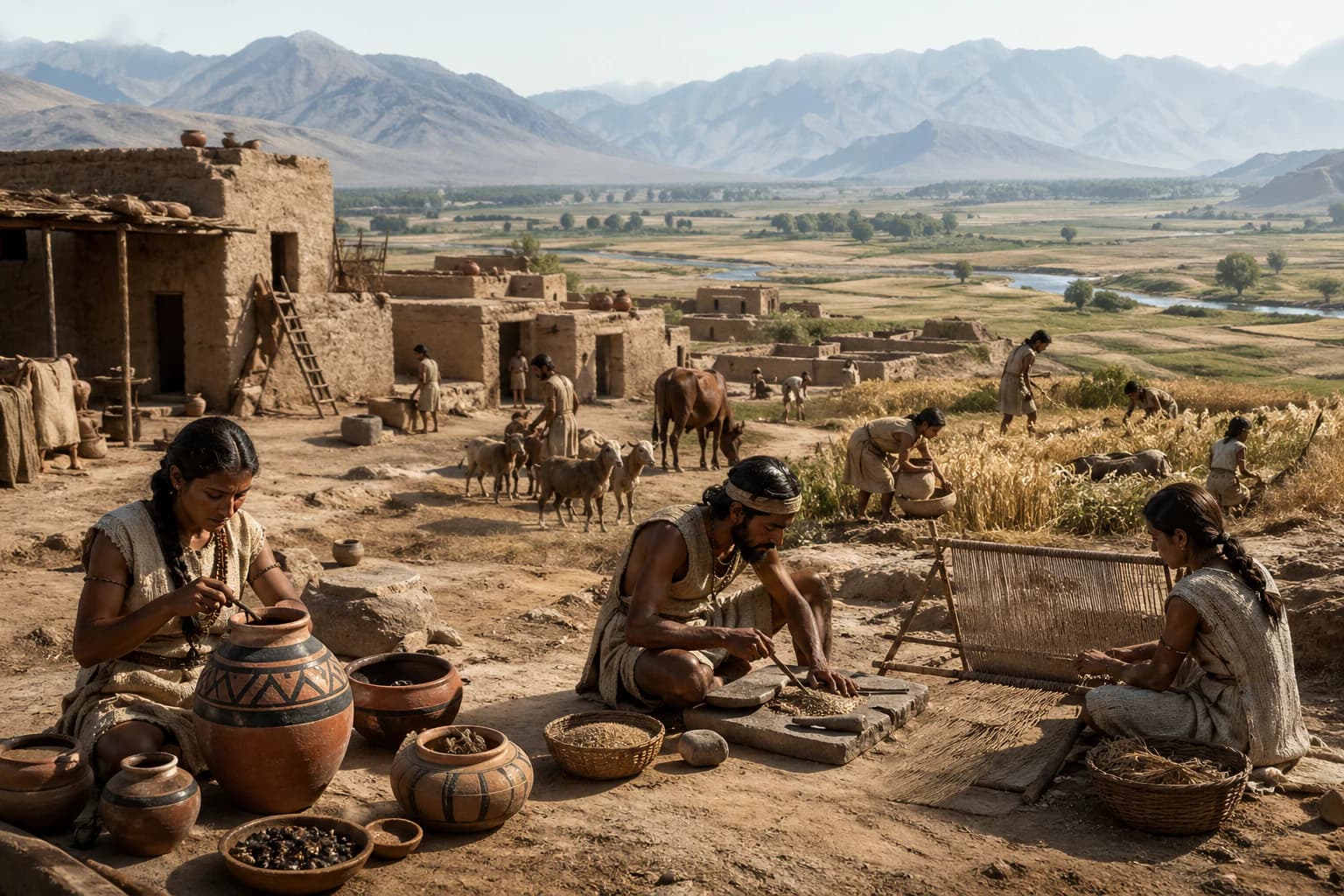
Around 7000 BCE, the first settled farming communities in the northwestern subcontinent appeared at sites like , in what is now Pakistan.

These were not yet cities. But they were something new: permanent places where people grew crops, kept animals, and built lasting homes from mud brick.

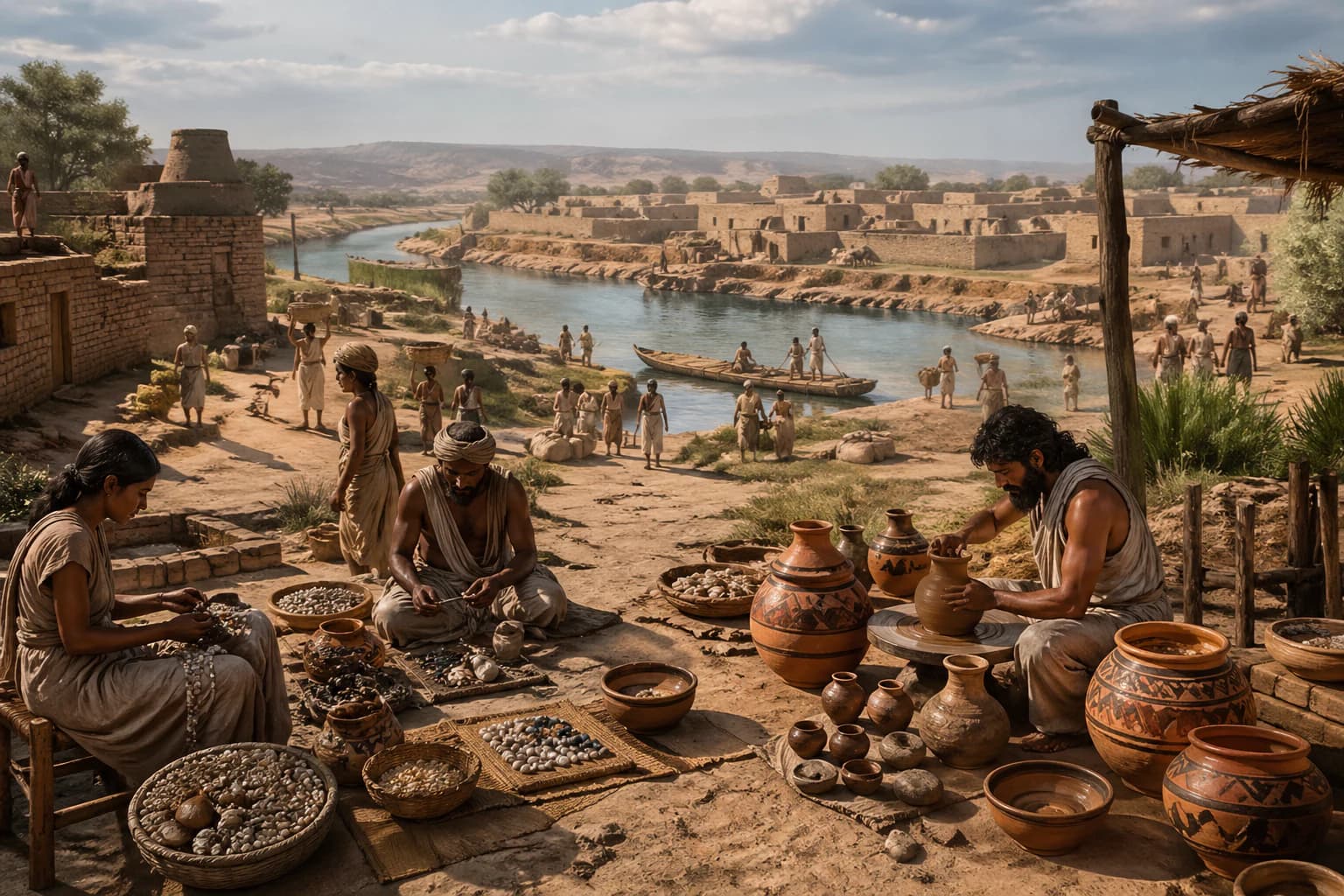
At , farmers cultivated wheat and barley and kept herds of cattle and goats. Craftspeople produced tools, pottery, and beads from shells and semi-precious stone.

Over thousands of years, this knowledge accumulated. Cattle were put to work as well as eaten, extending what communities could grow and transport.

was occupied for thousands of years before large cities appeared. That long period of patient growth made later urban life possible.

Civilisations do not appear suddenly. The great Indus cities had deep roots in centuries of farming, craft, and social learning.

These quiet foundations matter. Without them, the world's most extensive Bronze Age urban network could not have taken shape.

The Rise of Regional Networks
3300 BCE
Step 2 of 103300 BCEAccessible mode

The Rise of Regional Networks

By around 3300 BCE, the Indus region entered a period of growing connection. Villages grew, crafts diversified, and shared cultural patterns began linking communities across a wide area.

This phase is called the Early Harappan period. Towns grew larger and more organised, and exchange between communities became more regular.

Similar pottery styles and decorative forms appeared at sites separated by hundreds of kilometres. This was not coincidence. It reflected the movement of goods, ideas, and people along established routes.

Craft specialists produced beads, copper objects, and distinctive pottery for exchange. Some settlements began focusing on particular materials or skills, making them nodes in a wider network.

Growing trade required more organisation. Communities needed people to manage goods, store resources, and maintain relationships with distant settlements.

The Early Harappan phase was not yet the age of great cities. But it built the shared networks and cultural habits that would make those cities possible.

The First Great Cities
2600 BCE
Step 3 of 102600 BCEAccessible mode

The First Great Cities

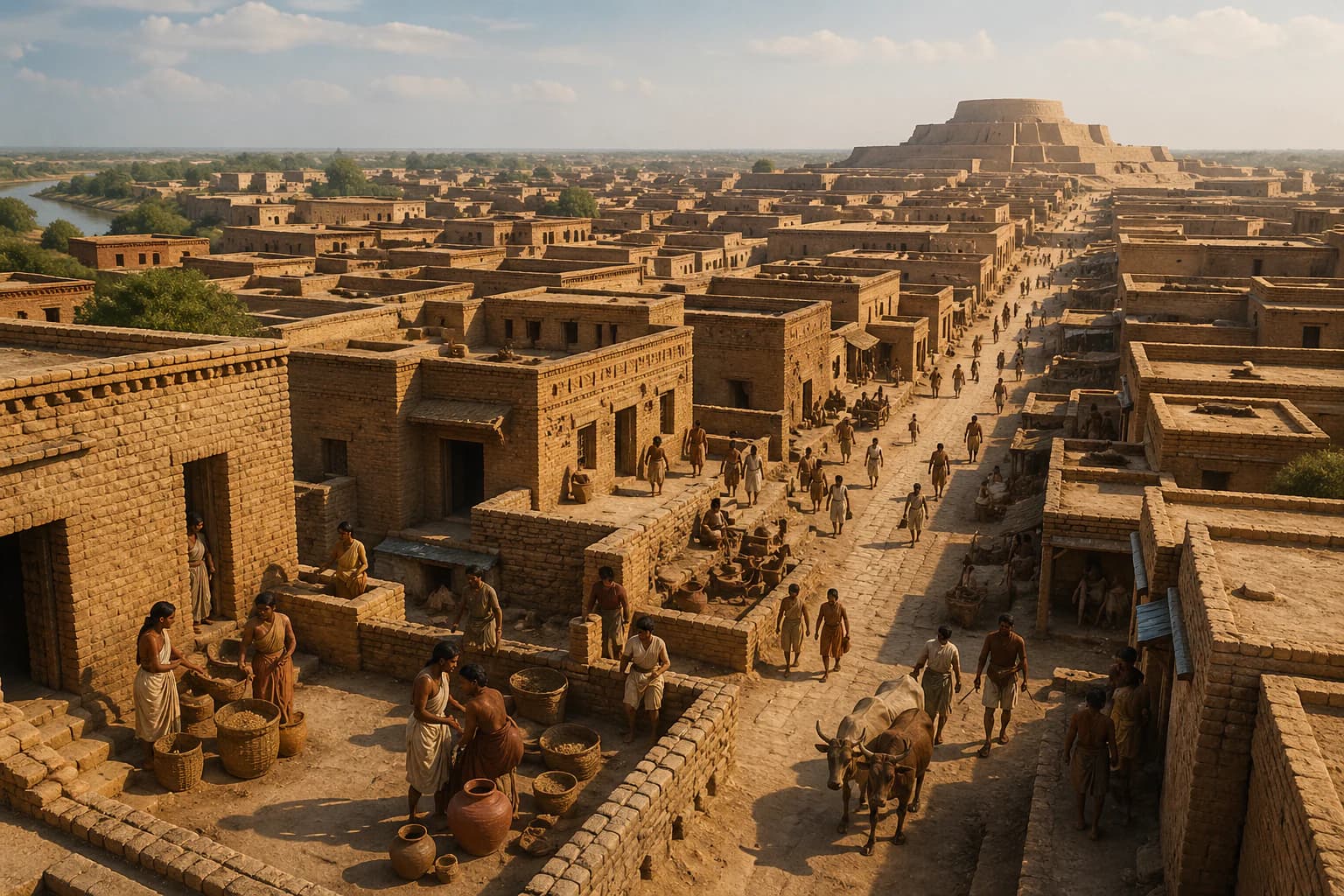
Around 2600 BCE, the entered its most dramatic phase. Large cities appeared, including and , making it one of the largest civilisations of the ancient world.

These were genuine cities with tens of thousands of residents. They had neighbourhoods, roads, drainage systems, and large public buildings.

At its peak, the Indus civilisation covered an area larger than ancient Egypt and Mesopotamia combined. It stretched from what is now Pakistan into northwestern India.

No single city dominated the others. Several major centres functioned simultaneously, each connected to hundreds of smaller towns across the same civilisation.

Feeding and managing populations of this size required organised food supply, trade, water management, and dispute resolution. These were urban challenges on a new scale.

The stood alongside and Mesopotamia as one of only three primary centres of urban life in the ancient world. Its cities were something entirely new in South Asian history.

The Logic of Planned Streets
2500 BCE
Step 4 of 102500 BCEAccessible mode

The Logic of Planned Streets

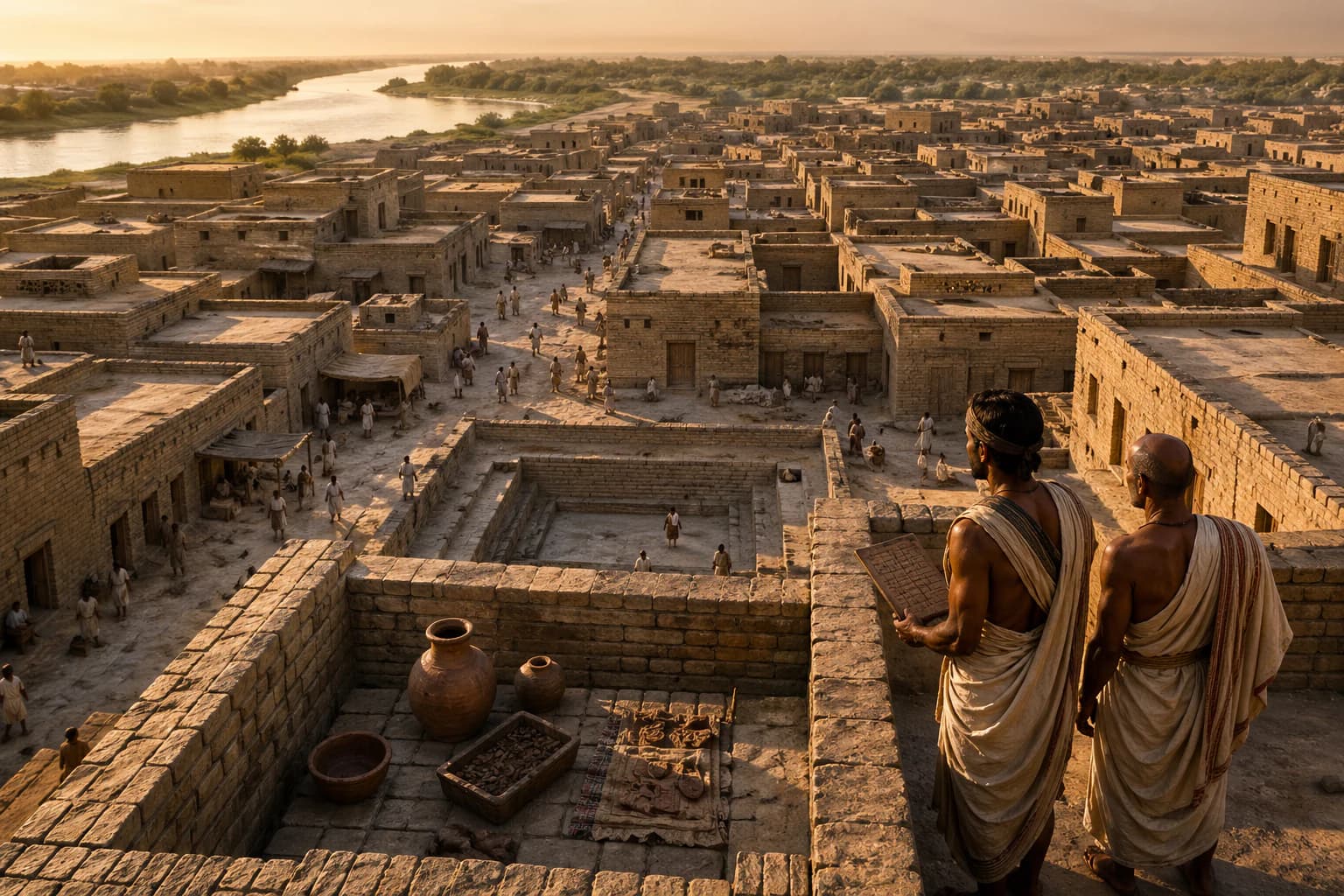
The cities of the were not built randomly. They followed planning principles that suggest coordinated decision-making and shared urban standards.

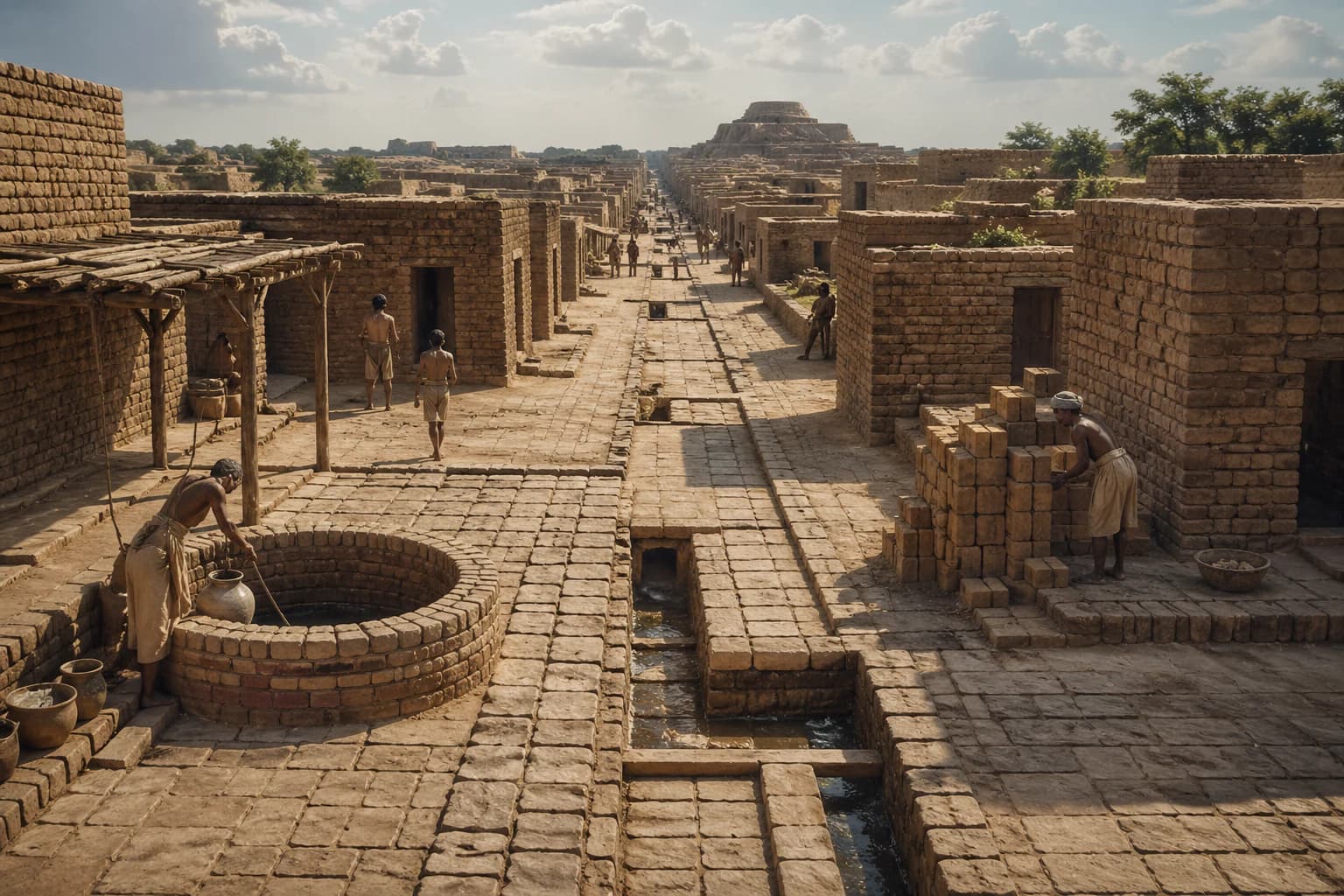
Streets ran in grid patterns, with main roads meeting at right angles. This made movement and drainage more predictable and easier to manage.

A sophisticated drainage system ran beneath the streets. Covered brick channels carried wastewater from homes into larger street drains, among the most advanced sanitation systems of the Bronze Age.

Bricks across the civilisation shared consistent proportional ratios. The same standard appeared at sites hundreds of kilometres apart, indicating a shared system enforced across the entire region.

Large public structures, wells, and assembly areas were built and maintained through collective effort. They served entire communities rather than individual rulers.

Who directed these plans is unknown. The Indus civilisation left no royal inscriptions and no named rulers. Planning clearly happened. Who organised it remains one of history's enduring mysteries.

The World of Indus Craft
2450 BCE
Step 5 of 102450 BCEAccessible mode

The World of Indus Craft

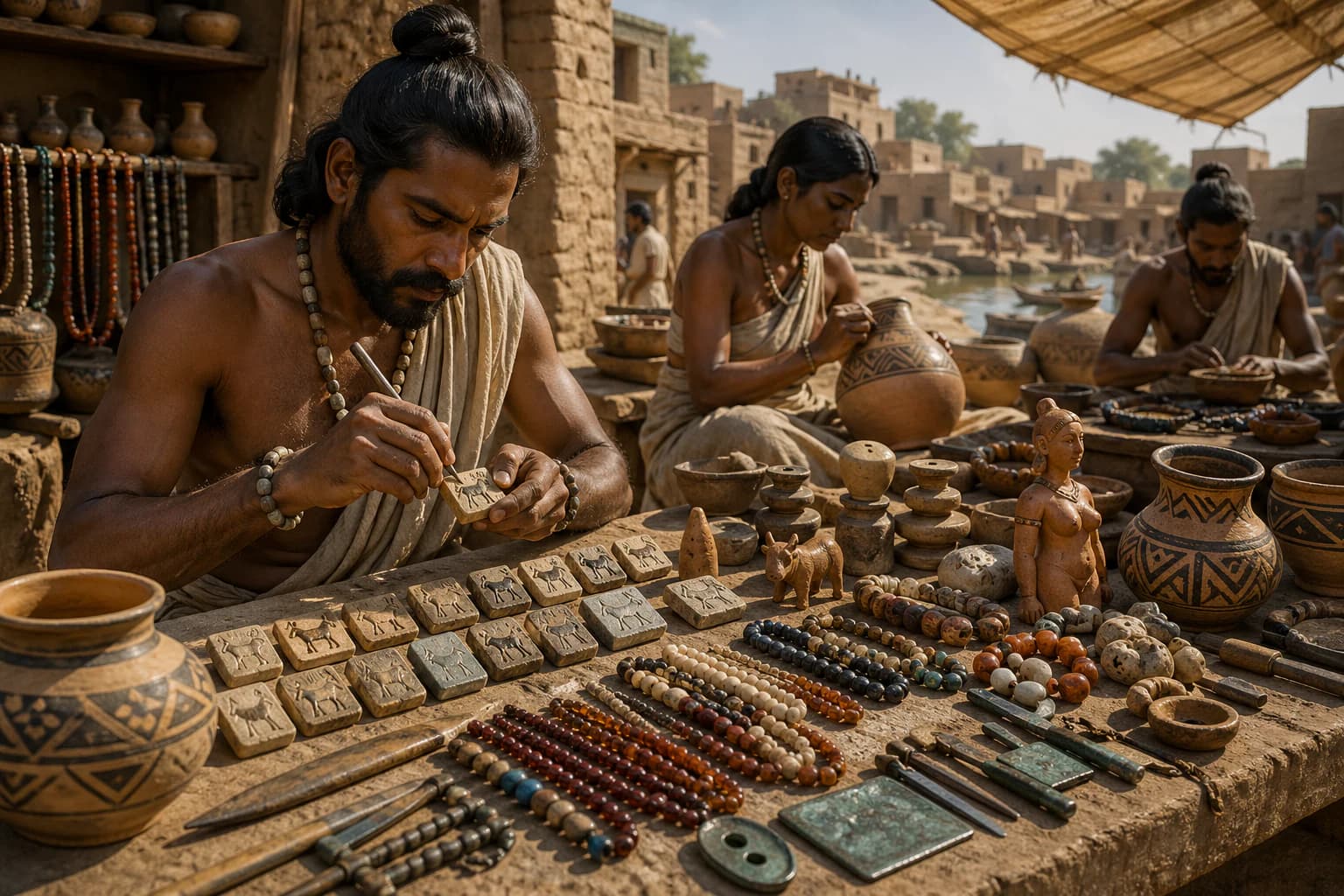
The craftspeople of the produced some of the finest objects of the Bronze Age. Their work both expressed remarkable skill and connected communities across the civilisation.

Artisans carved steatite seals bearing animal images and undeciphered signs. Used to mark ownership or verify goods, these seals appeared across the civilisation and in foreign trading ports.

Bead-makers created jewellery from carnelian, lapis lazuli, gold, and shell. Long carnelian beads required controlled heating and precision drilling achievable only by trained specialists.

Potters made wheel-thrown vessels in consistent forms. Bronze and copper tools and figurines show that metalworking was equally sophisticated. The famous dancing girl from is among the most striking objects of the ancient world.

The consistency of these craft objects across distant sites shows that shared standards linked the civilisation together. Craft was not just individual skill. It was a social and economic system spanning thousands of kilometres.

Trade Across Land and Sea
2400 BCE
Step 6 of 102400 BCEAccessible mode

Trade Across Land and Sea

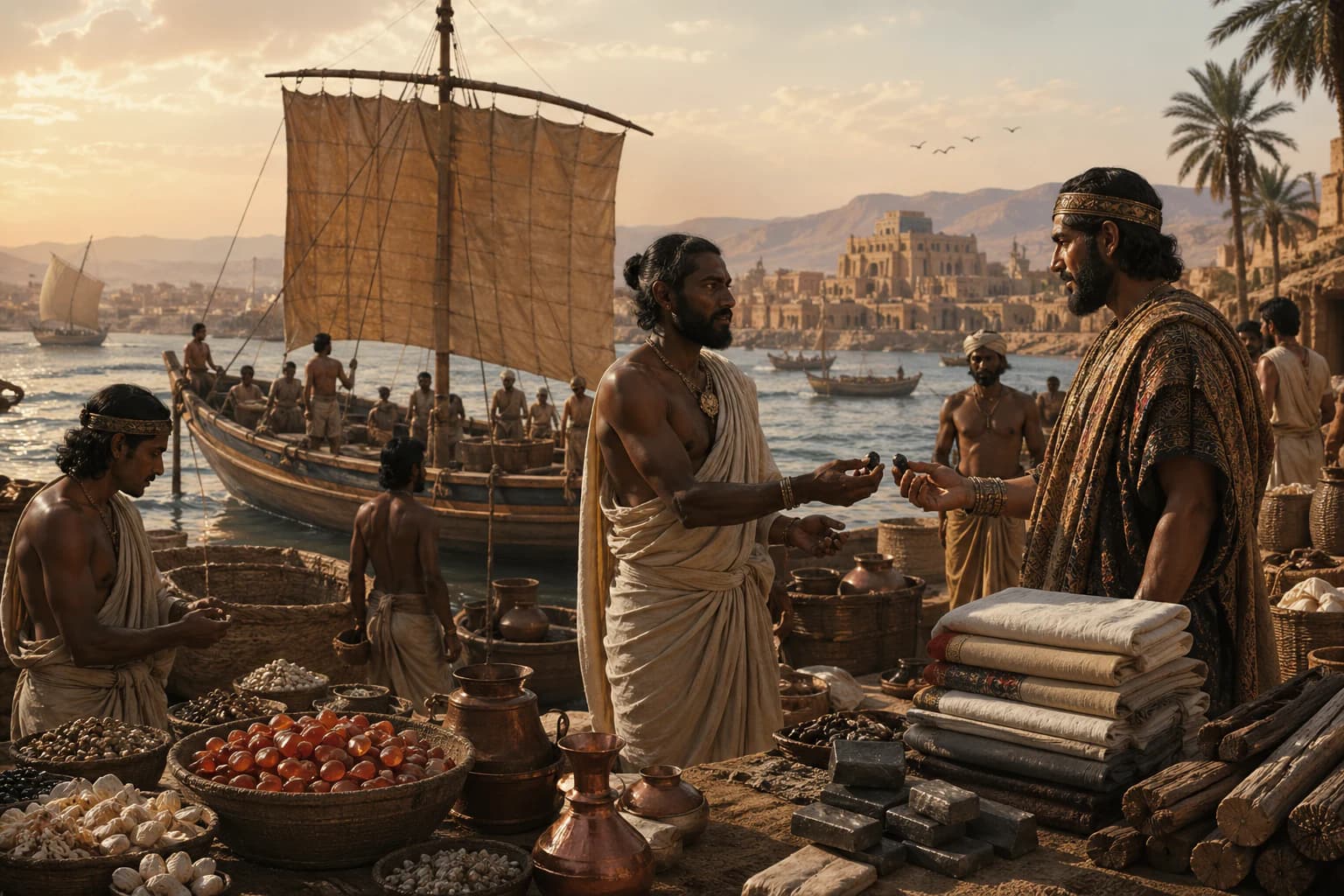
The Indus civilisation was not isolated. Its merchants and goods reached across South Asia, , and into the cities of Mesopotamia.

Carnelian beads, shell ornaments, and copper objects have been found at sites including , pointing to sustained commercial contact rather than occasional exchange.

Indus merchants sailed from ports on and into , possibly reaching as far as .

records from around 2350 BCE mention a land called , described as a source of copper, carnelian, and wood. Most scholars connect this to the Indus region.

The Indus traded craft goods outward and received tin, silver, and wool from the west, and lapis lazuli from . It was part of an ancient global supply chain.

This trade connected the Indus world to a Bronze Age international economy. It was not a regional curiosity but a recognised and valued commercial partner in the widest exchanges of the ancient world.

The Unread Signs
2350 BCE
Step 7 of 102350 BCEAccessible mode

The Unread Signs

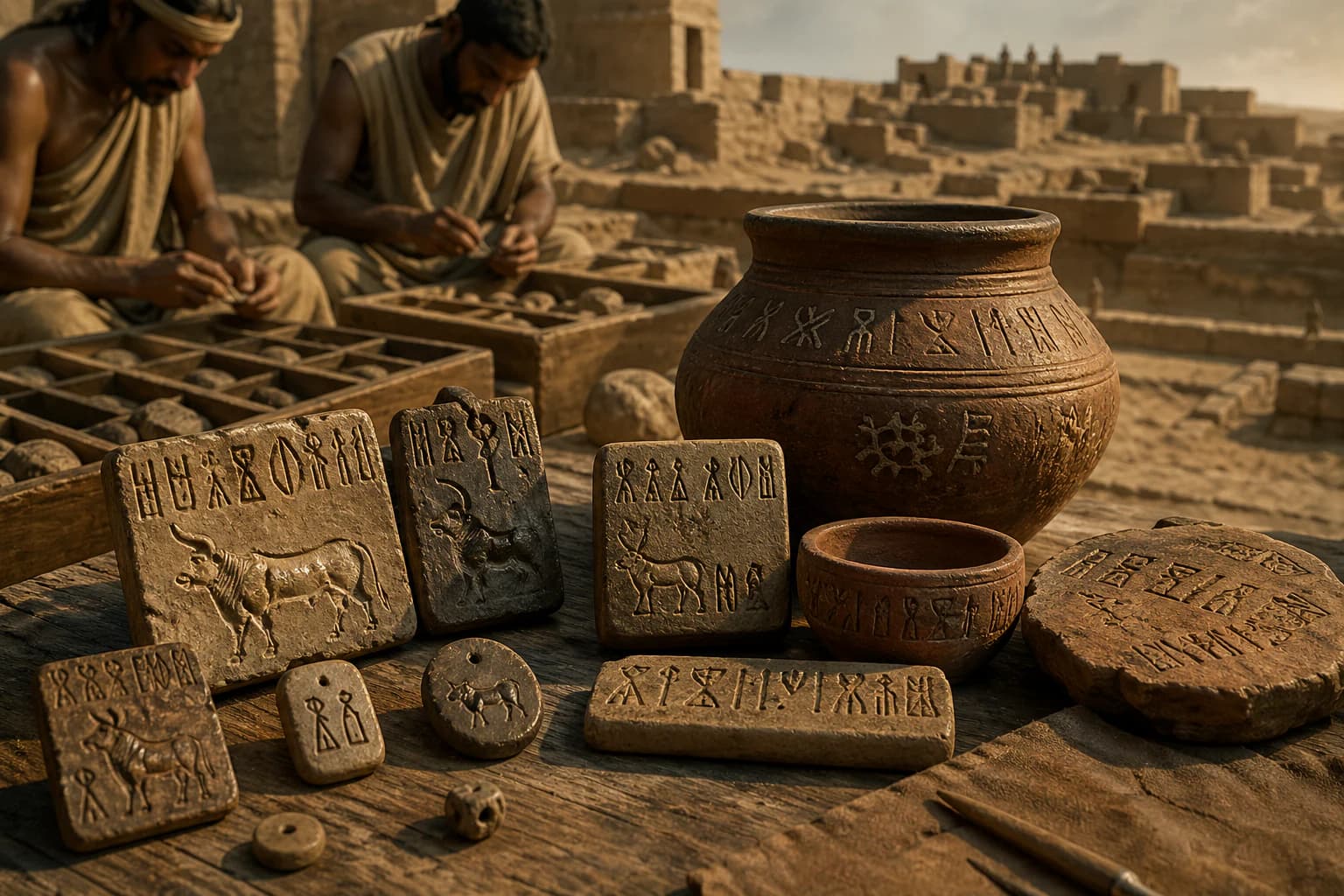
The Indus civilisation had a writing system. It appears on thousands of seals, tablets, and pottery fragments. But after more than a century of study, nobody has been able to read it.

The script uses several hundred distinct signs arranged in short sequences, usually fewer than ten signs per inscription.

Scholars have studied it for over a hundred years. Without a bilingual text like the Rosetta Stone, it has resisted every decipherment attempt.

The language it recorded is unknown. We cannot even confirm which language family it belongs to.

Because of this, we cannot name a single Indus ruler, god, official, or city in its own language. We cannot read their laws, stories, or records.

This is historically significant. The Indus is one of the only major ancient civilisations whose written record remains entirely closed to us. That gap is permanent unless decipherment succeeds.

Power Without Palaces
2300 BCE
Step 8 of 102300 BCEAccessible mode

Power Without Palaces

One of the most puzzling things about the Indus civilisation is what is missing. There are no royal palaces, no warrior tombs, and no obvious monuments to political power.

In and Mesopotamia, power left unmistakable marks. Pharaohs built pyramids. kings left inscriptions claiming divine authority. Their identity is well known.

The Indus civilisation built sophisticated cities with standardised planning, shared measurements, and extensive trade networks. All of that required coordination. But the coordinators left no trace.

No named ruler has been found. No royal tomb. No army depicted in art. The cities appear to have functioned without the visible theatre of kingship.

Some scholars suggest power was held by merchant elites, civic councils, or religious specialists. Others think it may have been distributed in ways that left few material traces.

This mystery makes the Indus one of history's most intriguing questions. It was clearly organised on a vast scale. How it was organised remains unknown.

Strain on the Urban System
2000 BCE
Step 9 of 102000 BCEAccessible mode

Strain on the Urban System

Around 2000 BCE, the great Indus cities began to decline. The process was gradual, not sudden. No single event brought the civilisation down.

Rivers in the Indus system shifted course over time. When a river moved away from a city, the water and farmland that sustained it became less reliable.

Climate evidence suggests that monsoon rainfall declined across parts of South Asia during this period. Less rain meant smaller harvests and populations that cities could no longer sustain at their former scale.

Trade connections with Mesopotamia also weakened as empires there collapsed or contracted. The external markets that had absorbed Indus goods and supplied imported materials shrank.

Populations redistributed. People moved away from declining cities toward smaller eastern settlements closer to the better-watered regions of .

The decline was not a catastrophe. It was a transformation. Cities shrank or were abandoned, but life continued across the wider region in different, more dispersed forms.

The Afterlife of Harappan Worlds
1900 BCE
Step 10 of 101900 BCEAccessible mode

The Afterlife of Harappan Worlds

By around 1900 BCE, the large Indus cities were no longer functioning as major urban centres. But the civilisation did not simply disappear.

Smaller settlements across South Asia continued to use Harappan crafts, agricultural methods, and material traditions for centuries after the great cities had declined.

Agricultural crops developed or refined during the Harappan period became permanently embedded in South Asian farming. Cotton, sesame, and improved wheat varieties spread outward as populations dispersed.

Craft traditions in bead-making, shell-working, and pottery survived in regional cultures long after the cities had ceased to function.

What did not survive was the Indus script, the urban institutions, or the administrative systems. The civilisation retreated from the legibility it had briefly achieved in the wider ancient world.

The end of cities is not the end of a people or their knowledge. The Indus civilisation achieved a different kind of permanence through the dispersal of agricultural and craft knowledge across South Asian life.

Continue reading

Finished The Indus Valley?

Choose the next story, explore the people behind this one, or trace the line of power that shaped this world.

Browse stories

References

Sources & Further Reading

Reliable sources, primary-source collections and reading paths connected to this page.

Sources used

  1. Encyclopaedia Britannica, Indus Civilization,” Open source
  2. The British Museum, China and South Asia,” Open source

Further reading

  1. Rita P. Wright, The Ancient Indus, Cambridge University Press.

Primary sources

  1. Harappa, Indus Civilization resources,” Open source

A weekly route through history

Find out first about the latest published stories, feature notes and occasional Premium offers in one weekly email.