People

Thomas Jefferson

Thomas Jefferson was the 3rd U.S. President, principal author of the Declaration of Independence, founder of the University of Virginia and architect of the Louisiana Purchase.

Born
1743 CE
Died
1826 CE
Role
President of the United States

3rd President of the United States (1743–1826)

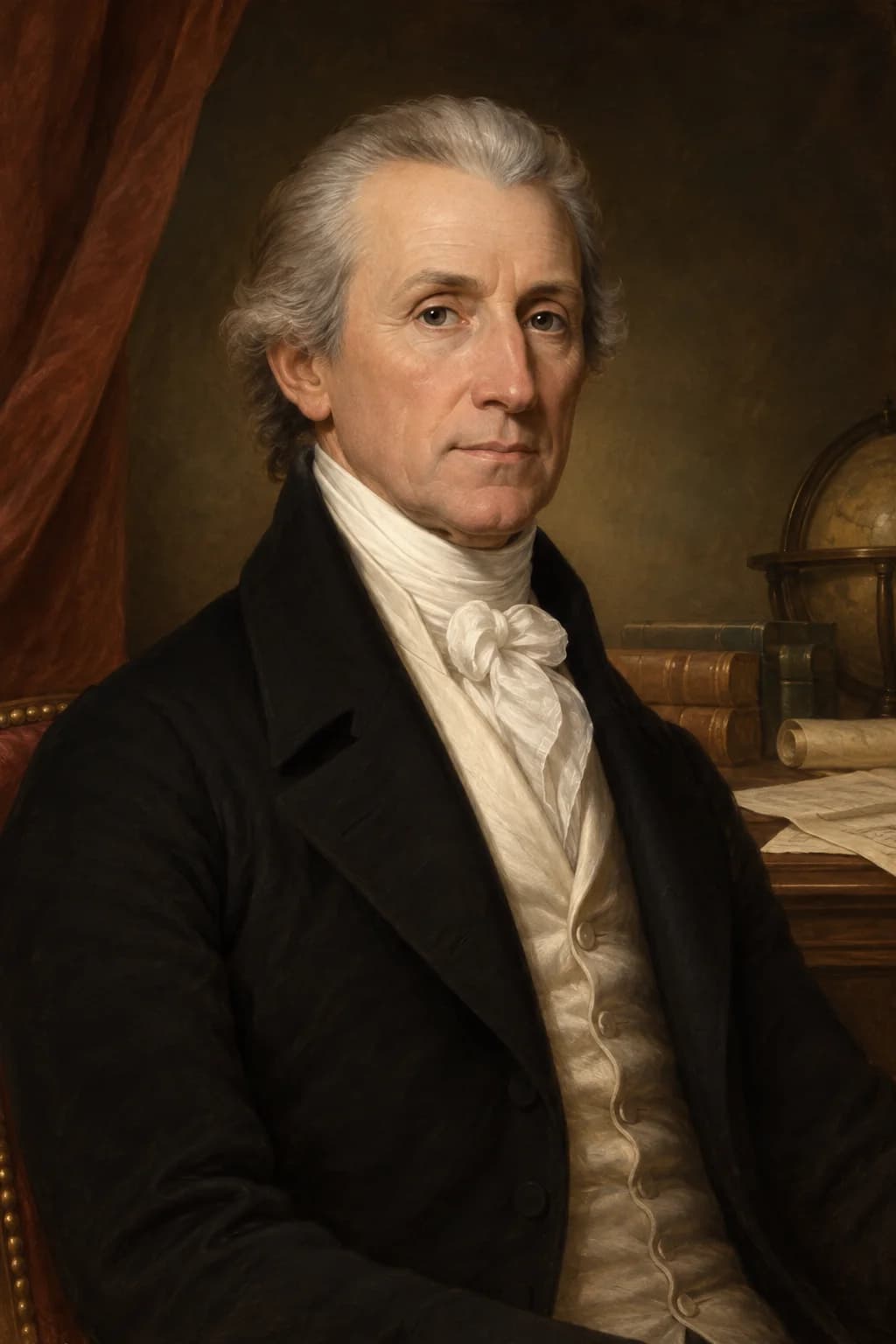
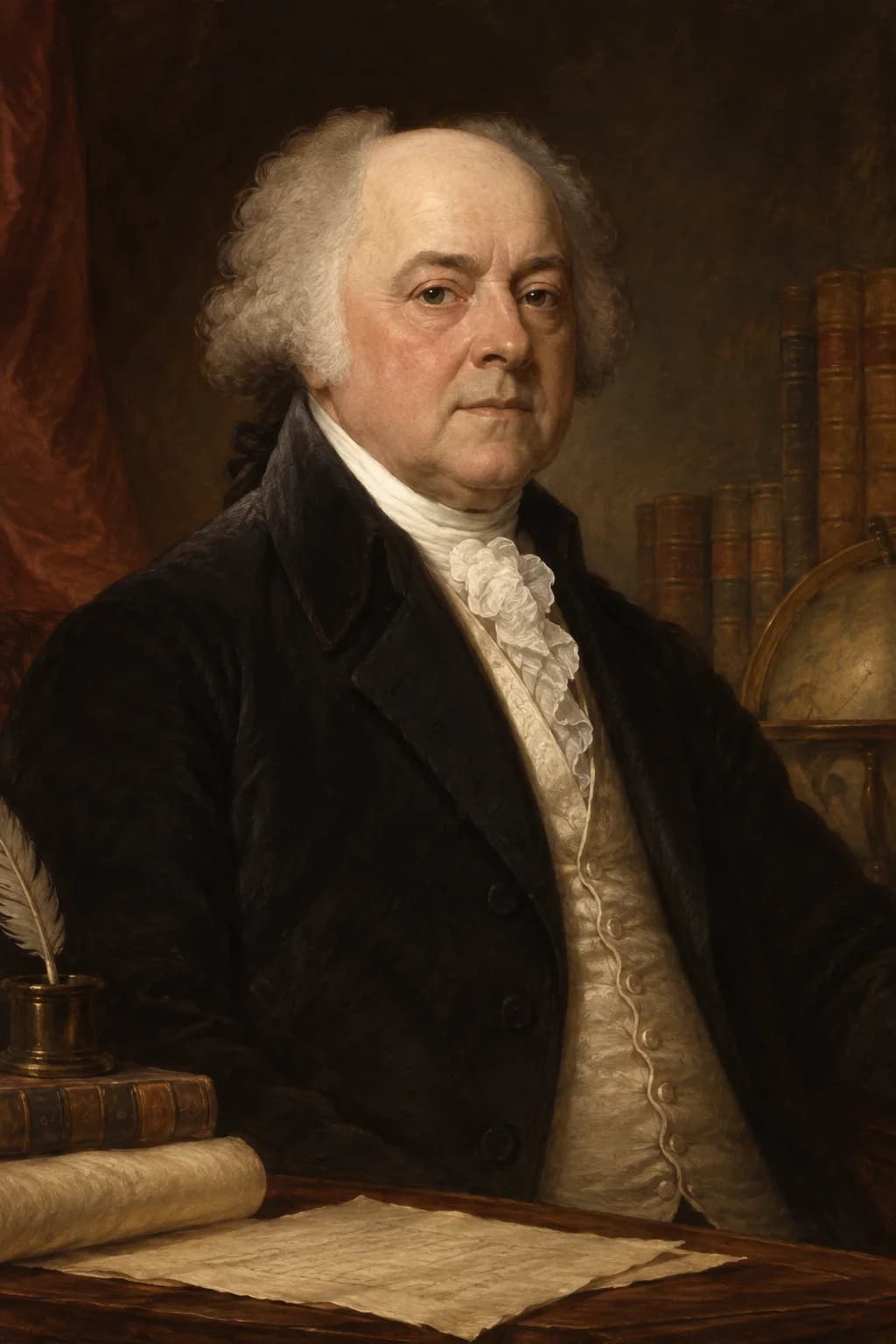
AI-generated portrait of Thomas Jefferson in formal presidential attire
AI-assisted historical reconstruction

An illustrative reconstruction based on historical context. It is not a photograph or documentary likeness. Image policy Attribution

Quick answer

Thomas Jefferson was the 3rd U.S. President, principal author of the Declaration of Independence, founder of the University of Virginia and architect of the Louisiana Purchase.

Born
1743 CE
Died
1826 CE
Role
President of the United States
Years
1743-1826 CE
Facts

Thomas Jefferson timeline facts

Selected specifics from this profile's life story.

1743–1760
Virginia upbringing

Thomas Jefferson was born in Virginia in 1743 into the plantation elite, gaining education, land and status in a society built on enslaved labour.

1776
Declaration author

In 1776, Jefferson drafted the Declaration of Independence, giving the American break with Britain its most enduring language of equality and rights.

1801–1809
Presidential expansion

As president from 1801 to 1809, Jefferson cut taxes and ceremony, bought Louisiana from France and sent Lewis and Clark west.

1820–1826
Complex legacy

Jefferson died on 4 July 1826, the same day as John Adams, leaving a legacy of revolutionary language and unresolved contradiction.

Life Journey

Liberty, empire, slavery, and the American contradiction

Follow the story in a more continuous narrative, with a reading mode that matches how much depth you want.

Complete chronology

1743–1760

Virginia upbringing

Jefferson's childhood at Shadwell placed him inside the world of Virginia's planter class. His father Peter was a surveyor and landowner; his mother Jane Randolph connected him to one of the colony's prominent families. Books, tutors, classical learning and land inheritance opened doors early. So did slavery. Enslaved people worked the fields and households that made elite independence possible. Jefferson's later language of natural rights did not emerge from poverty or exclusion but from privilege sharpened by Enlightenment reading. The contradiction was present from the beginning: the thinker of liberty was formed in a world where liberty for some rested on bondage for others.
1760–1767

Education and law

Jefferson's education in Williamsburg widened his intellectual world. At the College of William and Mary he encountered the mathematician William Small, the lawyer George Wythe and the colonial official Francis Fauquier, mentors who helped shape his appetite for law, science, philosophy and public life. Legal training taught him how authority was constructed in documents, precedents and property systems. Enlightenment writing gave him a language of reason, rights and improvement. Jefferson's genius was not always originality of doctrine; it was expression. He could arrange familiar republican and natural-rights ideas into sentences with extraordinary political force.

1769–1775

Entering politics

Jefferson entered the House of Burgesses in 1769, as disputes over taxation, representation and imperial sovereignty intensified. He was not the Revolution's loudest battlefield figure; he was one of its clearest pens. In writings such as A Summary View of the Rights of British America, he argued that the colonies possessed rights not as favours from Parliament but as rooted in law, history and natural justice. His radicalism was still that of a Virginia gentleman defending self-government. Yet his language helped turn colonial grievance into constitutional argument, making separation from Britain imaginable before it became inevitable.

1776

Declaration author

The Declaration was a committee document revised by Congress, but Jefferson's draft gave it its voice. He framed independence not merely as a practical rebellion but as an appeal to self-evident truths: equality, rights, consent and the right of a people to alter government. The power of those words has always exceeded the reality of 1776. Women, enslaved people, Native nations and many poor men were outside the political community the founders built. Jefferson himself enslaved people as he wrote against tyranny. That does not empty the Declaration of meaning. It makes it a contested promise, a text later Americans would use against exclusions Jefferson accepted.

1779–1784

State leadership

Jefferson's revolutionary work in Virginia included some of his most durable reforms. He sought to revise the legal code, weaken entail and primogeniture, and separate church from state. The Virginia Statute for Religious Freedom, drafted by Jefferson and later carried through by James Madison, became a landmark for liberty of conscience. His governorship during the Revolutionary War was less successful. British raids exposed administrative weakness, and his flight from Monticello during Tarleton's raid fed criticism from enemies. Jefferson was often better at designing republican principles than commanding crisis government. Even so, his legal reforms reshaped Virginia's public order.

1784–1789

Diplomat abroad

Jefferson's years in France deepened his cosmopolitanism and his republican confidence. He admired French culture, architecture, science and conversation, but also saw aristocratic privilege and rural poverty at close range. As the financial and political crisis of the monarchy worsened, he sympathised with reformers and believed liberty could be advanced through reasoned constitutional change. The violence that later consumed the French Revolution complicated that hope, but Jefferson remained more sympathetic to France than many Federalists. His diplomacy also shaped his view of America: the United States, he believed, could avoid Europe's corruption by preserving republican simplicity, landholding independence and limited government.

1801–1809

Presidential expansion

Jefferson's presidency began with the Revolution of 1800, the first peaceful transfer of power between rival American parties. He reduced military spending, repealed internal taxes and tried to model republican simplicity. Then opportunity forced boldness. Napoleon's sale of Louisiana in 1803 doubled the size of the United States, even though Jefferson privately worried that the Constitution did not clearly authorise such an acquisition. The purchase opened vast possibilities for settlement, science and power, while accelerating dispossession of Native nations and the expansion of slavery's political question. His second term was darker, dominated by the Embargo Act, a failed attempt to defend neutral rights without war.

1809–1820

Retirement pursuits

Jefferson's retirement was intellectually rich and financially troubled. At Monticello he remained a national oracle, exchanging letters on politics, science, religion and education. His proudest late achievement was the University of Virginia, which he designed as a secular public institution devoted to knowledge useful for republican citizenship. He planned buildings, curriculum and governance with characteristic detail. Yet the estate around him depended on enslaved labour and was burdened by debt. The lives of the Hemings family, including Sally Hemings and the children most historians conclude Jefferson fathered, make the private contradictions of his public philosophy impossible to ignore.

1820–1826

Complex legacy

Jefferson's death on the fiftieth anniversary of independence gave his life an almost scripted symbolic ending, especially because John Adams died the same day. The symbolism should not flatten the man. Jefferson helped articulate ideals that reshaped the world: equality, consent, religious liberty, public education and republican government. He also enslaved human beings, profited from their labour, expressed racist assumptions and avoided confronting slavery with the urgency his own principles demanded. His legacy is not a balance sheet where brilliance cancels contradiction. It is a central American argument: how a nation founded in the language of liberty could be built through exclusion, conquest and bondage.

Continue in context

Connected stories

Move from the profile into the wider events and settings this figure belongs to.

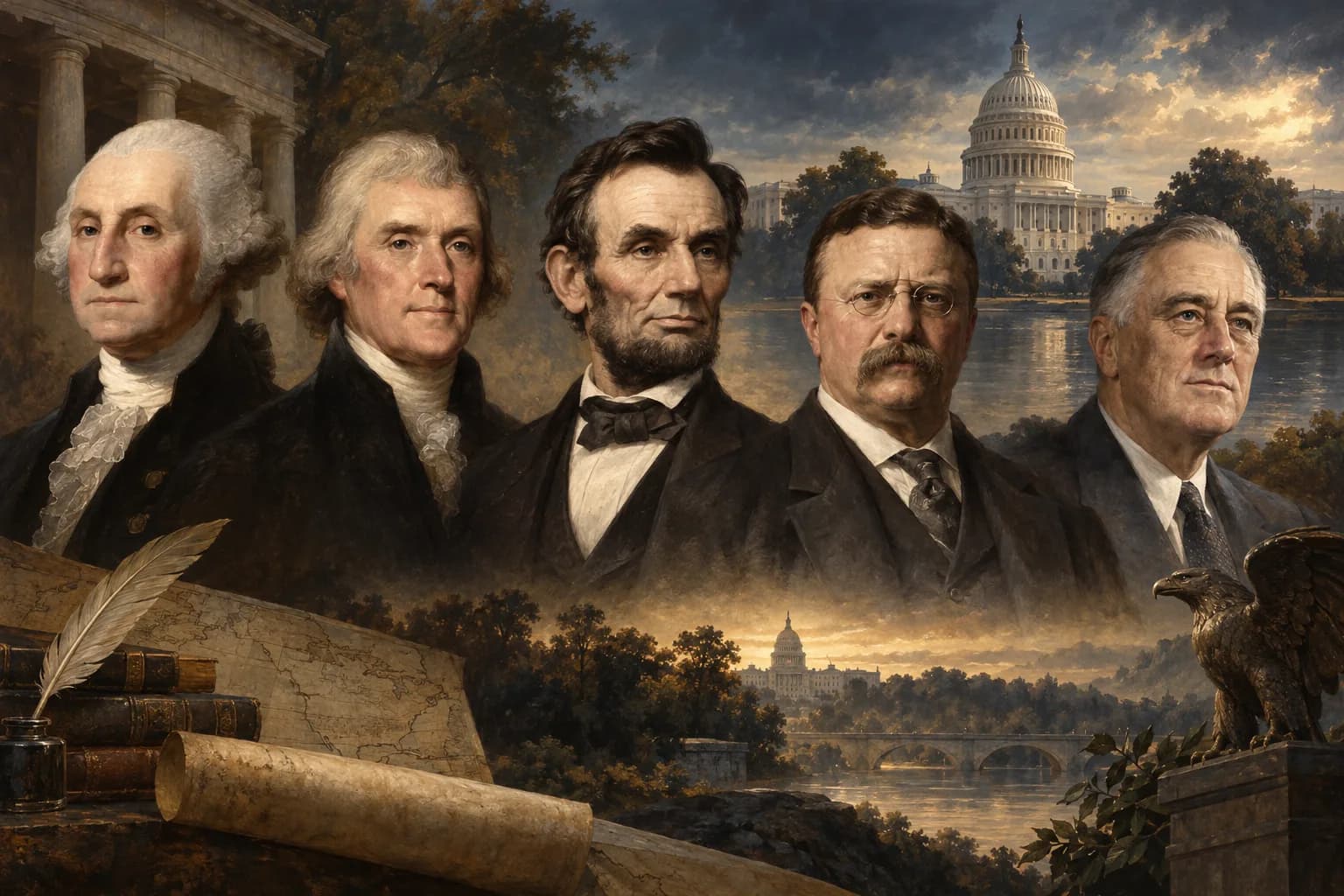
American Presidents lineage
Lineage47 presidents
American Presidents
1789 CE–present

The succession of American presidents from George Washington to today.

View lineage
Tertiary paths

Content note

This profile is written for educational use and connects to related Stories of History pages. The main portrait is an AI-assisted historical reconstruction, included as an illustrative aid rather than documentary evidence. Image policy Image attribution

References

Sources & Further Reading

Reliable reference works, archives and reading paths connected to this profile.

Further reading

  1. Encyclopaedia Britannica, Search results for Thomas Jefferson,” accessed June 2026.Open source
  2. WorldCat, Books and library holdings for Thomas Jefferson,” accessed June 2026.Open source

Primary sources

  1. Library of Congress, Search results for Thomas Jefferson,” accessed June 2026.Open source

Reviewed claim sources

Loading reviewed claim sources...

A weekly route through history

Find out first about the latest published stories, feature notes and occasional Premium offers in one weekly email.