People

John Adams

John Adams was the 2nd U.S. President, a Founding Father, diplomat, constitutional thinker and defender of independence and the rule of law.

Born
1735 CE
Died
1826 CE
Role
2nd President of the United States and Founding Father

2nd President of the United States and Founding Father (1735–1826)

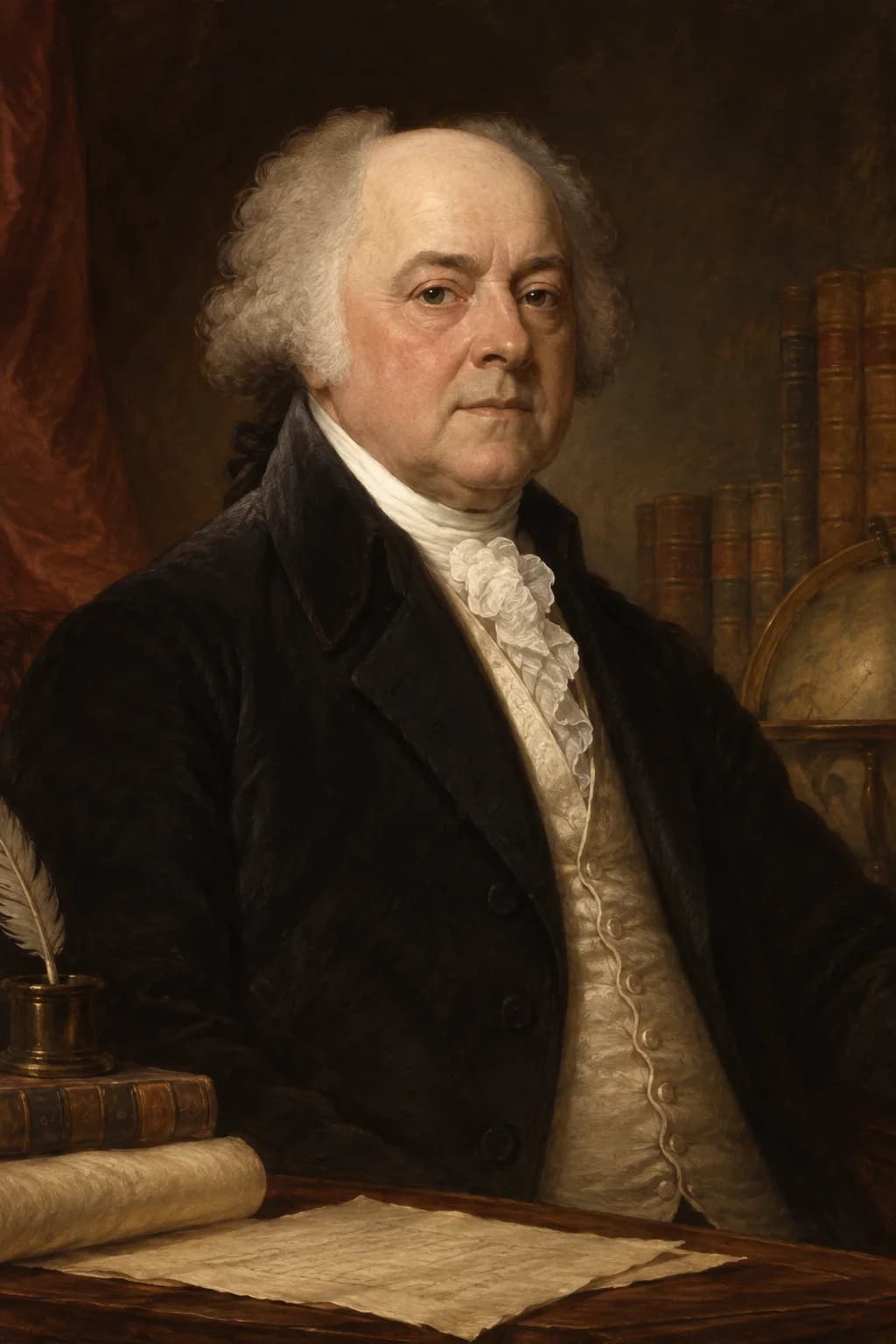
AI-generated portrait of John Adams in formal colonial attire
AI-assisted historical reconstruction

An illustrative reconstruction based on historical context. It is not a photograph or documentary likeness. Image policy Attribution

Quick answer

John Adams was the 2nd U.S. President, a Founding Father, diplomat, constitutional thinker and defender of independence and the rule of law.

Born
1735 CE
Died
1826 CE
Role
2nd President of the United States and Founding Father
Years
1735-1826 CE
Facts

John Adams timeline facts

Selected specifics from this profile's life story.

1735–1755
New England roots

John Adams was born in Braintree, Massachusetts, in 1735, raised in a New England world of farms, churches, schools and civic duty.

1778–1783
Diplomatic efforts

During and after the Revolution, Adams served as a diplomat in Europe, helping secure Dutch support and peace with Britain.

1797–1801
Presidency challenges

As president from 1797 to 1801, Adams navigated the Quasi-War with France and controversially signed the Alien and Sedition Acts.

1820–1826
Enduring legacy

Adams died on 4 July 1826, the fiftieth anniversary of independence, leaving a legacy of law, diplomacy and difficult principle.

Life Journey

A life of conviction, diplomacy and early nation-building

Follow the story in a more continuous narrative, with a reading mode that matches how much depth you want.

Complete chronology

1735–1755

New England roots

John Adams was born on 30 October 1735 in Braintree, Massachusetts, into a family that was respectable rather than wealthy. His father farmed, served locally and expected seriousness from his son. Adams absorbed the New England habits of education, moral argument and town politics, then carried them through Harvard and into law. He was ambitious, prickly, insecure, brilliant and often painfully honest about his own vanity. Those traits mattered. Adams did not glide into greatness. He argued his way there, driven by a belief that liberty required law, virtue and institutions strong enough to resist both tyranny and mob emotion.


1755–1770

Legal career

Adams built his reputation at the bar before he became a revolutionary. His most famous legal act came in 1770, when he defended British soldiers charged after the Boston Massacre. The choice was politically dangerous, but Adams believed the accused deserved counsel and evidence mattered more than rage. Several soldiers were acquitted; two were convicted of manslaughter rather than murder. The case became a cornerstone of Adams's identity because it showed the principle that would define him at his best: a free society must restrain its passions through law. He opposed British power, but not by abandoning justice.

1770–1776

Revolutionary voice

By the mid-1770s, Adams had moved from constitutional resistance to open independence. In the Continental Congress he was tireless, argumentative and essential. He pressed for separation when others hesitated, helped secure George Washington's appointment as commander of the Continental Army and served on the committee that drafted the Declaration of Independence. Thomas Jefferson wrote the famous text, but Adams was one of its fiercest congressional defenders. He understood that independence required persuasion as much as principle. The colonies had to be moved from grievance to revolution, and Adams helped push them across that line.

1778–1783

Diplomatic efforts

Adams's diplomatic service was exhausting and often thankless. He worked in France, the Dutch Republic and Britain, sometimes clashing with Benjamin Franklin and other American envoys whose style he distrusted. His greatest diplomatic achievement was securing Dutch recognition and loans, vital support for the struggling United States. He then helped negotiate the Treaty of Paris in 1783, which recognized American independence. Adams was not always graceful abroad. He could be blunt, suspicious and socially awkward. Yet he grasped that the new republic needed credit, recognition and hard-headed negotiation as much as battlefield courage.

1783–1789

Founding governance

Adams thought more deeply about constitutional design than most founders. His Massachusetts constitution of 1780 influenced later American government with its separation of powers, bicameral legislature and written rights protections. In A Defence of the Constitutions of Government of the United States, he argued that liberty required balanced institutions because unchecked power, whether royal, aristocratic or popular, would become dangerous. After independence he served as the first American minister to Britain, an awkward role in the former imperial capital. Adams's political imagination was conservative in temperament but revolutionary in result: he wanted a republic strong enough to survive human weakness.

1789–1797

Vice presidency

Adams served as vice president from 1789 to 1797, a role he famously found frustrating. The Constitution gave the vice president little executive power beyond presiding over the Senate and casting tie-breaking votes. Adams took that duty seriously, casting many important votes, but he disliked being politically peripheral while Washington received near-universal reverence. The period also exposed him to the rise of faction. Federalists and Democratic-Republicans were becoming organized political forces despite founders' hopes that parties might be avoided. Adams entered the presidency with experience, but also with enemies, sensitivities and no Washingtonian aura.

1797–1801

Presidency challenges

Adams's presidency was dominated by the crisis with revolutionary France. French attacks on American shipping, the XYZ Affair and Federalist pressure for war pushed the United States toward open conflict. Adams strengthened the navy and fought the undeclared Quasi-War, but his greatest presidential decision was to pursue peace against members of his own party who wanted escalation. That choice likely spared the young republic a disastrous war. At home, however, his administration supported the Alien and Sedition Acts, which restricted dissent and became a lasting stain on Federalist claims to liberty. Adams preserved peace abroad while damaging civil liberty at home.

1801–1820

Retirement years

The election of 1800 ended Adams's presidency and brought a peaceful transfer of power to Jefferson's Democratic-Republicans, a vital test for the new republic. Adams left Washington bitter, especially after appointing Federalist judges in his final days. In retirement at Quincy, he watched his son John Quincy Adams rise and reflected on the Revolution's meaning. His reconciliation with Jefferson produced an extraordinary correspondence, full of memory, philosophy, irritation, affection and historical self-defense. Adams wanted recognition, but he also wanted the revolutionary generation to explain itself before it vanished.

1820–1826

Enduring legacy

John Adams died on 4 July 1826, the fiftieth anniversary of the Declaration of Independence, the same day as Thomas Jefferson. The coincidence became instantly symbolic, but Adams's importance does not depend on poetry. He defended legal principle when it was unpopular, argued independence into being, helped secure foreign support, shaped constitutional thinking, served as Washington's vice president and made the lonely presidential decision to avoid full war with France. He could be vain, thin-skinned and politically clumsy. He was also often right about the dangers of unchecked power and revolutionary excess. To ask why John Adams was important is to see a founder whose greatness lay not in charm, but in the hard discipline of republican government.

Continue in context

Connected stories

Move from the profile into the wider events and settings this figure belongs to.

American Presidents lineage
Lineage47 presidents
American Presidents
1789 CE–present

The succession of American presidents from George Washington to today.

View lineage
Tertiary paths

Content note

This profile is written for educational use and connects to related Stories of History pages. The main portrait is an AI-assisted historical reconstruction, included as an illustrative aid rather than documentary evidence. Image policy Image attribution

References

Sources & Further Reading

Reliable reference works, archives and reading paths connected to this profile.

Further reading

  1. Encyclopaedia Britannica, Search results for John Adams,” accessed June 2026.Open source
  2. WorldCat, Books and library holdings for John Adams,” accessed June 2026.Open source

Primary sources

  1. Library of Congress, Search results for John Adams,” accessed June 2026.Open source

Reviewed claim sources

Loading reviewed claim sources...

A weekly route through history

Find out first about the latest published stories, feature notes and occasional Premium offers in one weekly email.