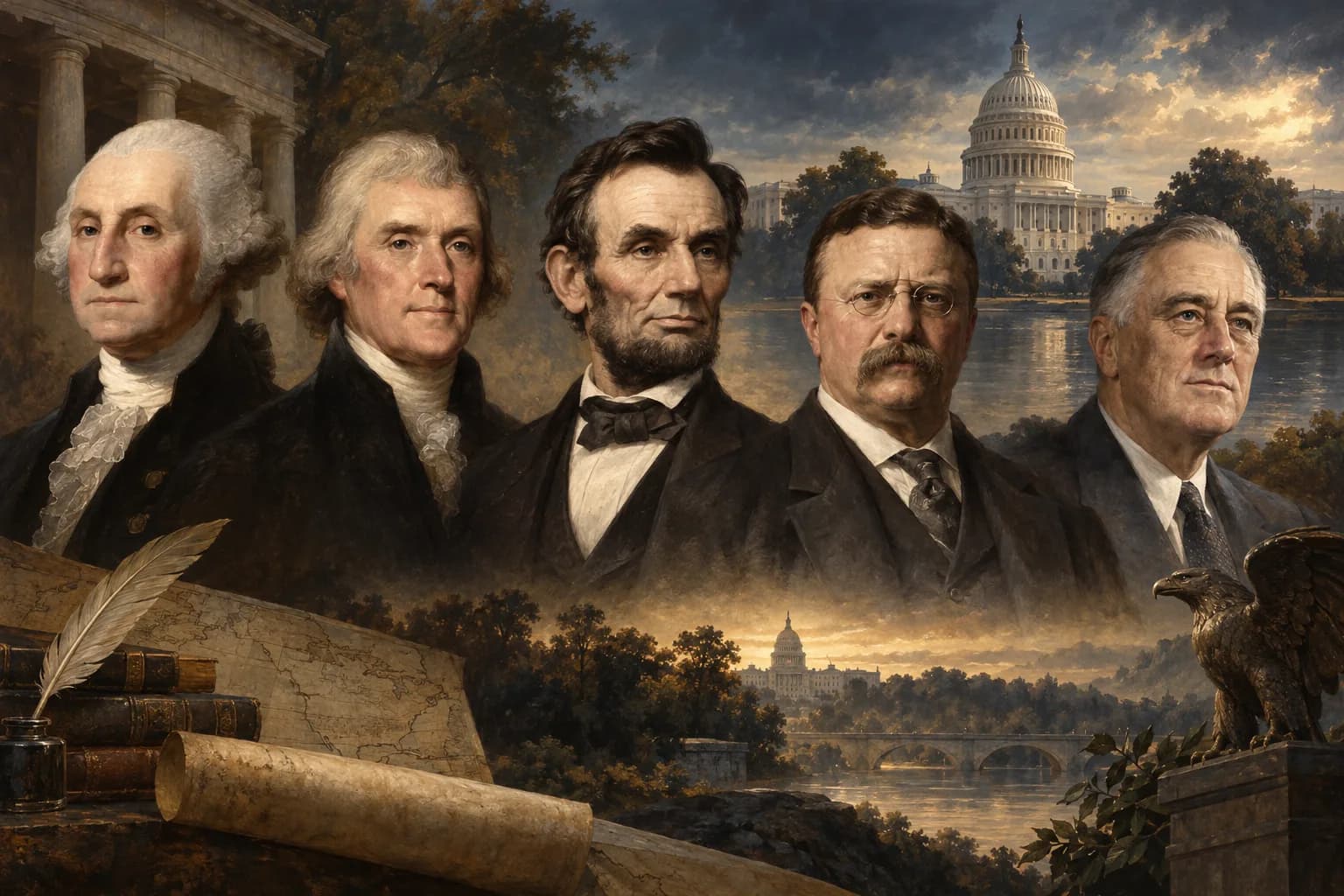
People

George Washington

George Washington was commander of the Continental Army and the first President of the United States. His leadership in the American Revolution, Constitutional Convention and presidency set precedents for American democracy.

Born
1732 CE
Died
1799 CE
Role
President of the United States

1st President of the United States (1732–1799)

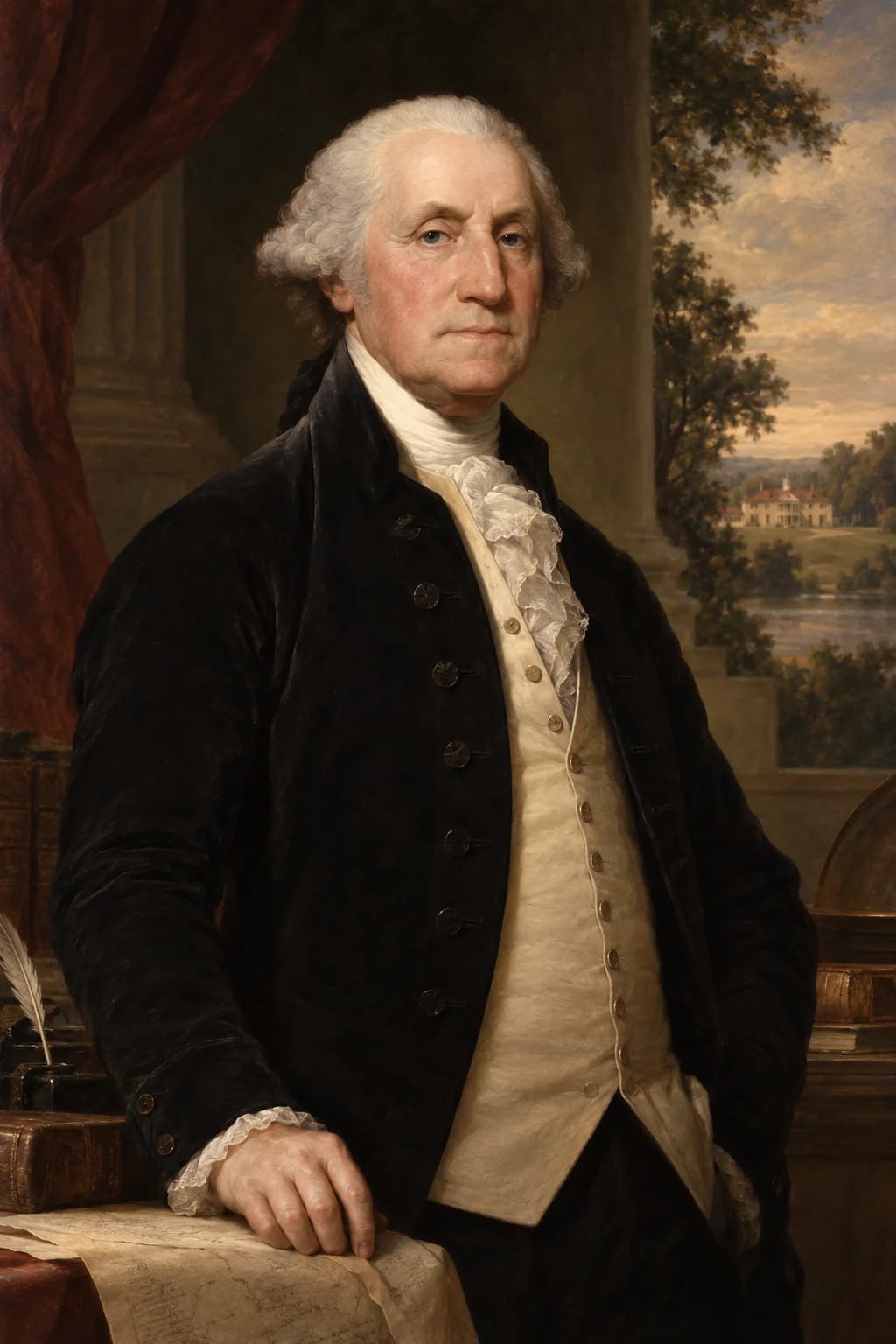
AI-generated portrait of George Washington in formal revolutionary attire
AI-assisted historical reconstruction

An illustrative reconstruction based on historical context. It is not a photograph or documentary likeness. Image policy Attribution

Quick answer

George Washington was commander of the Continental Army and the first President of the United States. His leadership in the American Revolution, Constitutional Convention and presidency set precedents for American democracy.

Born
1732 CE
Died
1799 CE
Role
President of the United States
Years
1732-1799 CE
Facts

George Washington timeline facts

Selected specifics from this profile's life story.

1732–1752
Colonial upbringing

Born into a Virginia family of modest wealth, he grew up learning land management and discipline that shaped his early ambitions.

1775
Revolutionary command

He was appointed commander of the Continental Army, taking on the immense task of leading colonial forces against a powerful empire.

1783–1789
Shaping a nation

After the war, he supported efforts to form a stable government, helping guide the transition from conflict to national structure.

After 1799
Enduring influence

His leadership left a lasting framework for governance, influencing how the United States developed politically and institutionally.

Life Journey

From colonial officer to founding leader

Follow the story in a more continuous narrative, with a reading mode that matches how much depth you want.

Complete chronology

1732–1752

Colonial upbringing

George Washington was born on 22 February 1732 in Westmoreland County, Virginia, into a planter family of middling gentry status. He did not receive the classical English education available to richer colonial elites after his father's death limited family resources. Instead, he learned surveying, land management, mathematics, manners and the practical geography of Virginia's frontier. Surveying gave him a young man's route into land, status and ambition. It also trained his eye for terrain, distance and logistics, skills that later mattered in war. Washington's rise was inseparable from the plantation world, including enslaved labor. Any honest biography must hold together his public leadership and his participation in slavery.
1753–1758

Early military service

Washington entered military service during the imperial contest that became the French and Indian War. In 1753 he carried Virginia's warning to French forces in the Ohio Country; in 1754 his expedition helped trigger fighting at Jumonville Glen and ended with surrender at Fort Necessity. These early failures were serious, but they made him visible. He later served under British General Edward Braddock and survived the disastrous 1755 defeat near the Monongahela, showing courage under fire. Washington learned how badly regular imperial confidence could fail in frontier conditions. He also learned the frustrations of being a colonial officer denied the status he believed he deserved from the British army.

1759–1774

Growing reputation

After leaving military service, Washington married Martha Dandridge Custis in 1759, gaining wealth, family responsibilities and an expanded plantation world at Mount Vernon. He entered the Virginia House of Burgesses and became part of the colonial elite, though he remained sensitive to slights from British authority and frustrated by imperial trade restrictions. As disputes over taxation and representation intensified after 1763, Washington moved from protest to resistance. He was not the earliest radical theorist of independence, but his reputation for discipline, military experience, wealth and Virginia standing made him a figure other colonies could trust. He looked like command before he held it.

1775

Revolutionary command

In June 1775 the Second Continental Congress appointed Washington commander in chief of the Continental Army. The choice was strategic as well as military: a Virginian leading New England troops helped make the rebellion continental rather than regional. Washington inherited an army short of powder, money, training, uniforms, discipline and political certainty. He had to build a force while facing the world's strongest imperial power. His greatness as commander was not effortless battlefield brilliance. It was endurance, organizational patience, personal authority and the ability to keep civilian leaders, state governments and soldiers committed to a war that often seemed close to failure.

1775–1781

Years of hardship

Washington lost more battles than the legend sometimes admits. New York was nearly catastrophic in 1776, Philadelphia fell in 1777, and the army endured hunger, disease and political frustration at Valley Forge. Yet Washington understood that the Revolution did not require him to destroy Britain outright. It required him to keep an American army alive until British will, French support and imperial costs shifted the balance. The surprise attacks at Trenton and Princeton restored morale after a dark hour. His willingness to retreat, preserve forces and strike selectively kept the cause from collapsing. In revolutionary war, survival can become strategy.

1781

Path to victory

Victory came through alliance as much as American persistence. French money, troops and naval power transformed the war. In 1781 Washington coordinated with the Comte de Rochambeau and Admiral de Grasse to trap Lord Cornwallis at Yorktown. The campaign required secrecy, movement and cooperation across languages, armies and command cultures. Yorktown did not instantly end the war, but it made British victory politically impossible. Washington's leadership reached its most important moral moment afterward. At Newburgh in 1783, when unpaid officers flirted with pressure on Congress, he defused the crisis and defended civilian authority. Then he resigned his commission, shocking a world accustomed to victorious generals seeking power.

1783–1789

Shaping a nation

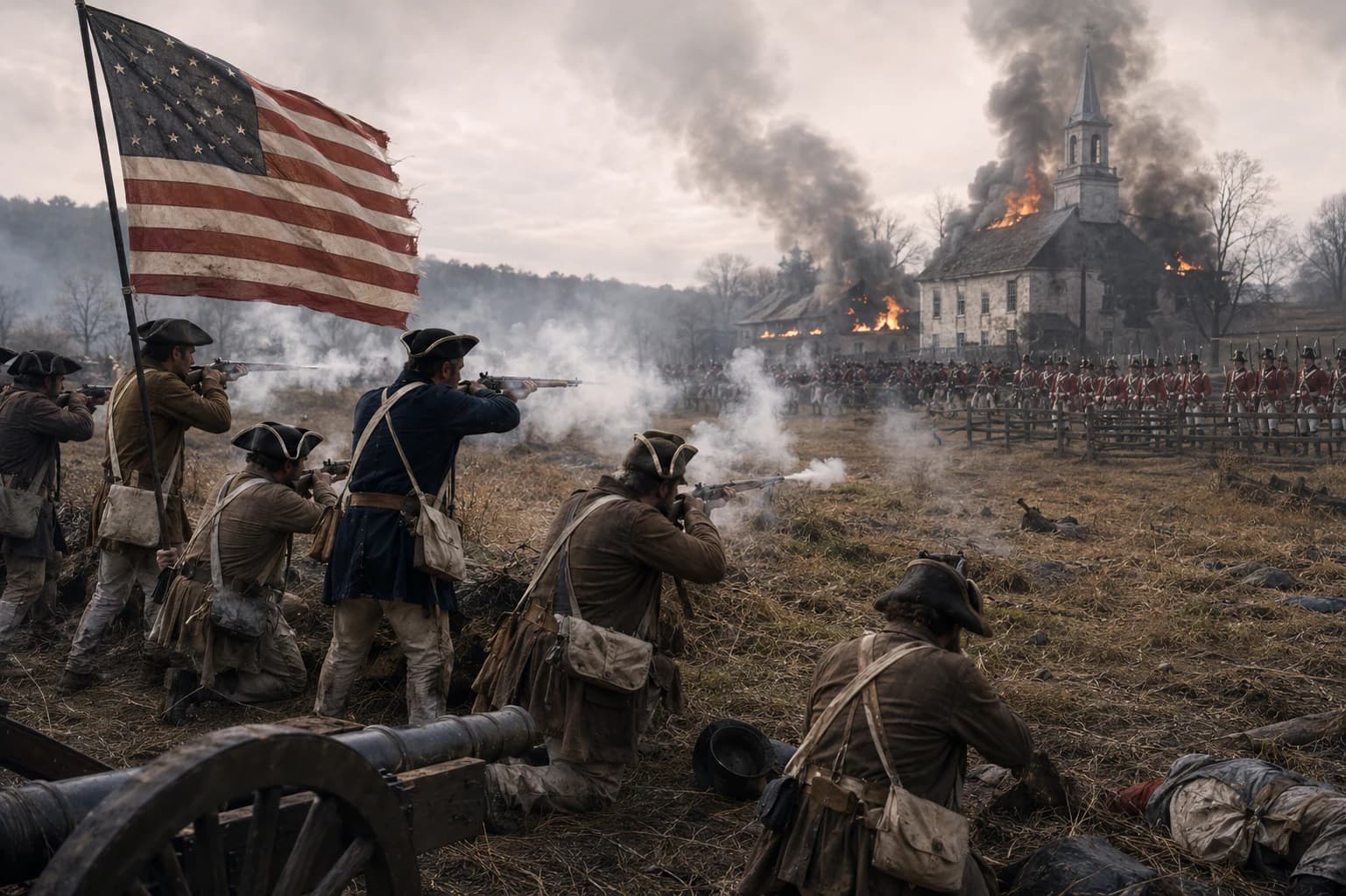
After the war, Washington returned to Mount Vernon, but the weakness of the Articles of Confederation drew him back. Shays' Rebellion, interstate tensions and financial disorder convinced many leaders that independence had produced a dangerously fragile union. Washington presided over the Constitutional Convention in Philadelphia in 1787, lending legitimacy to a process that might otherwise have looked like elite overreach. He spoke little, but his presence mattered enormously because everyone knew the presidency was being designed with him in mind. The Constitution's defenders used his reputation as a guarantee that stronger federal power need not become monarchy. That trust was one of the new nation's most valuable assets.

1789–1797

First presidency

Washington was unanimously elected first president in 1789 and again in 1792. Every action set precedent: cabinet government, executive privilege, federal law enforcement, neutrality in foreign wars, the use of presidential dignity and the peaceful transfer of authority. He backed Alexander Hamilton's financial program, accepted the creation of a national bank, suppressed the Whiskey Rebellion to demonstrate federal authority, and issued the Neutrality Proclamation to keep the United States out of war between Britain and revolutionary France. His presidency also exposed the rise of party conflict between Federalists and Democratic-Republicans. Washington disliked parties, but could not prevent them. His Farewell Address warned against faction and permanent foreign entanglements, while his retirement after two terms became one of the republic's defining traditions.

After 1799

Enduring influence

Washington died at Mount Vernon on 14 December 1799. His legacy is immense and necessarily complicated. He won independence, legitimized the Constitution and defined the presidency through restraint as much as action. He also enslaved people for most of his life, pursued fugitives from Mount Vernon, and only in his will arranged for the eventual emancipation of the people he personally owned, not those controlled through the Custis estate. To ask why George Washington was important is to hold both truths together: he helped create a republic based on liberty and consent, while living inside and benefiting from a system that denied liberty to others. His greatness lies in founding precedents; his contradiction lies in the limits of the freedom he helped build.

Continue in context

Connected stories

Move from the profile into the wider events and settings this figure belongs to.

American Presidents lineage
Lineage47 presidents
American Presidents
1789 CE–present

The succession of American presidents from George Washington to today.

View lineage
Tertiary paths

Content note

This profile is written for educational use and connects to related Stories of History pages. The main portrait is an AI-assisted historical reconstruction, included as an illustrative aid rather than documentary evidence. Image policy Image attribution

References

Sources & Further Reading

Reliable reference works, archives and reading paths connected to this profile.

Sources used

  1. Encyclopaedia Britannica, George Washington,” accessed June 2026.Open source
  2. George Washington's Mount Vernon, George Washington,” accessed June 2026.Open source

Further reading

  1. Joseph J. Ellis, His Excellency: George Washington, Knopf, 2004.

Primary sources

  1. Library of Congress, George Washington Papers,” accessed June 2026.Open source

Reviewed claim sources

Loading reviewed claim sources...

A weekly route through history

Find out first about the latest published stories, feature notes and occasional Premium offers in one weekly email.