Complete chronology
Full overview and deeper context for every journey step.
c. 570-610
Life in Mecca
Muhammad was born in Mecca, probably around 570, into the Quraysh, the tribe associated with the Kaaba and the city's pilgrimage economy. Islamic tradition presents him as orphaned young and later known for trustworthiness in Meccan society. His early world was shaped by clan protection, caravan commerce, sanctuary, poetry, social obligation and varied religious traditions. That setting matters because Muhammad's later message spoke directly to a society where kinship, wealth and sacred status carried enormous weight.
A person's early world can shape the language through which later change becomes possible.
610
The First Revelation
According to Islamic tradition, Muhammad received his first revelation while retreating at the Cave of Hira near Mecca. The experience is remembered as overwhelming rather than comfortable. The angel Jibril, or Gabriel, commanded him to recite, and Muhammad returned shaken to his wife Khadija, whose support became crucial in the earliest phase of the mission. Muslims understand these revelations as the beginning of the Qur'an and as God's call to Muhammad to preach monotheism, judgement, mercy and moral responsibility.
Some turning points begin privately before becoming public movements.
610-622
Preaching in Mecca
Muhammad's preaching challenged Meccan society at several levels. It insisted that there was one God, that idols had no ultimate power, that people would be judged, and that wealth brought responsibility toward the poor, orphaned and vulnerable. The first followers came from his household, companions and people drawn to the force of the message. Opposition grew because the message threatened more than private belief. It questioned the religious prestige of Mecca's existing cults, the moral authority of elite wealth and the assumption that tribe alone defined belonging.
A moral message becomes disruptive when it challenges the systems that benefit from old habits.
622
The Hijra to Medina
Pressure in Mecca pushed Muhammad's movement toward a new political opening in Yathrib, later known as Medina. The Hijra in 622 was more than an escape. It turned a vulnerable group of believers into a community with public responsibilities. In Medina, Muhammad became preacher, arbitrator, judge, diplomat and commander. The emigrants from Mecca joined Medinan supporters in an umma, a community defined by faith and obligation as well as kinship. The later Muslim calendar began from this migration, showing how central community-building was to Islamic memory.
A movement often changes when belief becomes shared organisation.
622-630
Leader in Medina
The Medinan years placed Muhammad at the centre of religious and political life. The community faced conflict with Mecca, internal strains and difficult relations with surrounding groups. Battles such as Badr, Uhud and the Trench became part of the struggle for survival. Muhammad also negotiated, made treaties and shaped communal practice through worship, law and obligation. These years show why his role cannot be reduced to preaching alone. In Islamic history, revelation and leadership developed together inside a community under pressure.
Leadership becomes harder when ideals must be translated into institutions and decisions.
630
Return to Mecca
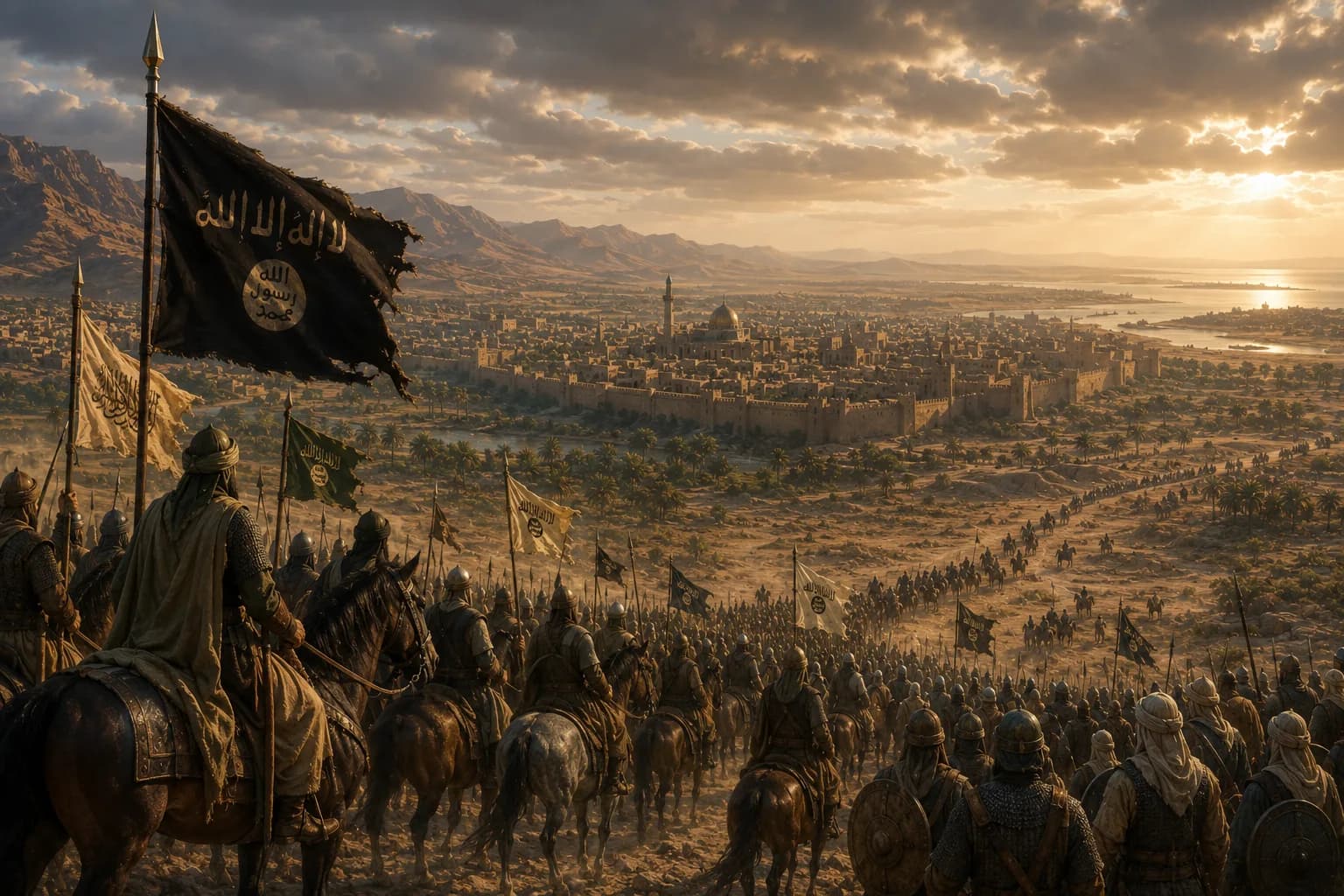
After years of conflict and negotiation, Muhammad's community gained the upper hand over Mecca. In 630, Muslim forces entered the city with limited fighting by the standards of the age. Muhammad offered a broad amnesty, allowing former opponents to be incorporated into the new order. The Kaaba was rededicated to the worship of one God, giving Islam control of Arabia's most important sanctuary while reinterpreting it as a centre of monotheistic worship linked to Abraham.
Victory can become more durable when it incorporates former enemies rather than only punishing them.
630-632
Arabia Reorganised
After the entry into Mecca, delegations from across Arabia came to negotiate, ally, submit or convert. The process was uneven, and local loyalties did not disappear. Still, Muhammad's leadership had changed the peninsula's sacred and political centre of gravity. Islam offered a community deeper than tribe while still operating through Arabian social realities. By Muhammad's death in 632, religious authority, political leadership and sacred geography had been reorganised around a new Muslim community.
Transformational leadership often works by redirecting existing networks instead of pretending they do not exist.
632 onward
Enduring Legacy
Muhammad's death in 632 created the central question of succession: who would lead the community after the prophet? Muslims did not regard later leaders as replacing his prophetic role, but the community still needed authority, defence and organisation. The caliphate emerged from that need. The Qur'an became the central scripture of Islam, while Muhammad's example shaped worship, law, ethics and memory. His legacy is therefore religious, political and civilisational. From a Meccan message and a Medinan community grew a tradition that reshaped Arabia, the Near East and eventually societies across Africa, Asia and Europe.
A legacy endures when a community can carry its founding memory into new circumstances.