People

Ali ibn Abi Talib

Ali ibn Abi Talib was Muhammad's cousin and son-in-law, the fourth Rashidun caliph and the first imam in Shi'a Islam. His caliphate from 656 to 661 was marked by civil war after the murder of Uthman.

Born
c. 600 CE
Died
661 CE
Role
Caliph

Fourth caliph (c. 600-661)

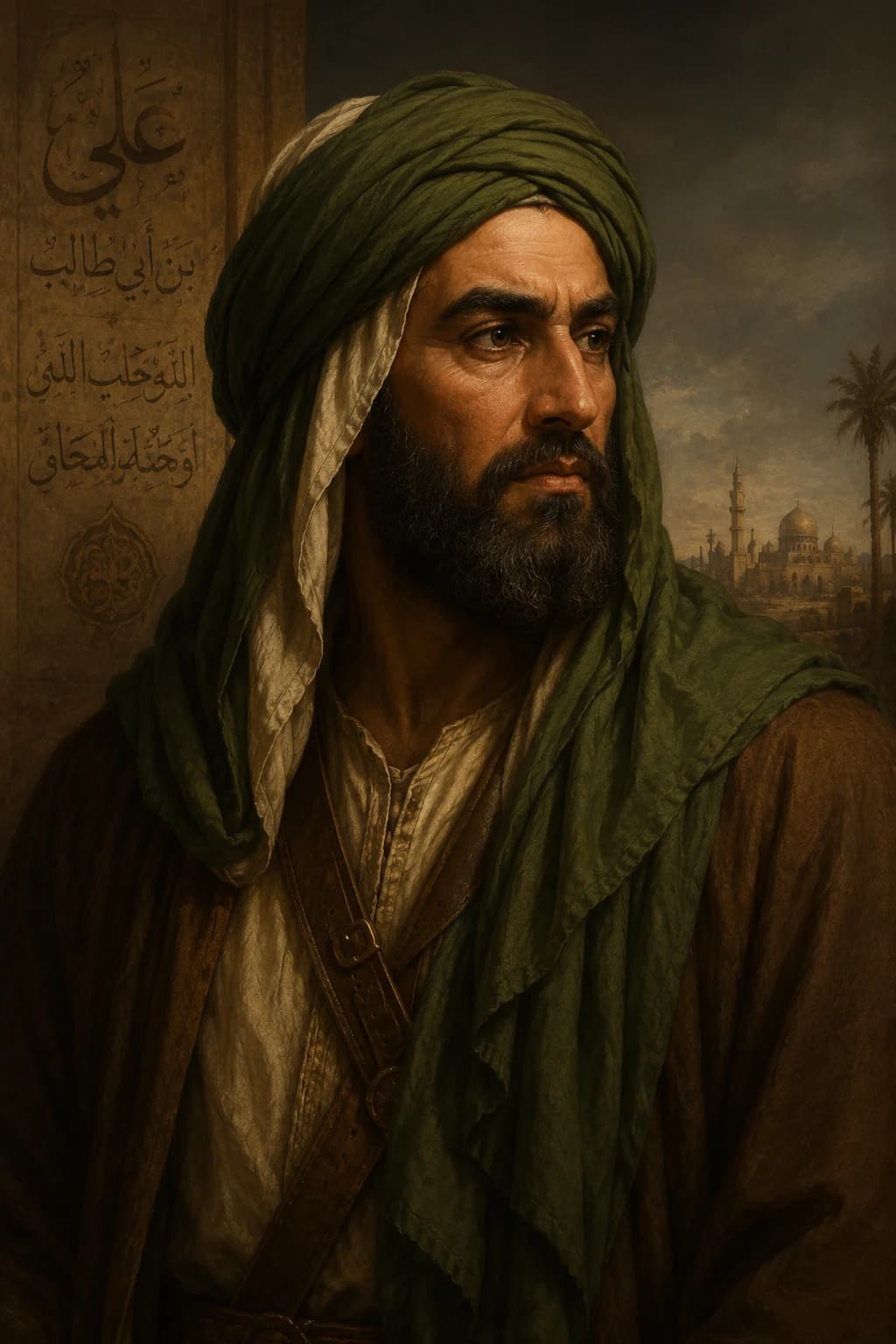
Portrait-style illustration of Ali ibn Abi Talib in a green turban and early Islamic setting

Quick answer

Ali ibn Abi Talib was Muhammad's cousin and son-in-law, the fourth Rashidun caliph and the first imam in Shi'a Islam. His caliphate from 656 to 661 was marked by civil war after the murder of Uthman.

Born
c. 600 CE
Died
661 CE
Role
Caliph
Years
c. 600-661 CE
Quick facts

Profile details

Additional identity and tagging details that are not already covered in the introduction.

Also known as
Ali, Ali ibn Abu Talib
Region
Arabia, Iraq, Syria, Arabia and Iraq
Facts

Ali ibn Abi Talib timeline facts

Selected specifics from this profile's life story.

c. 600-622
Muhammad's household

Ali was Muhammad's cousin and grew up close to the household from which Islam emerged.

622-632
Companion in Medina

In Medina, Ali was part of the early Muslim community as it faced war, alliance and state-building.

656-661
Fourth caliph

Ali became caliph after Uthman's murder, but his rule was dominated by the First Fitna.

661 onward
Death and enduring significance

Ali was assassinated in 661 and remained central to both Sunni respect and Shi'a devotion.

Life Journey

The caliph at the centre of succession memory

Follow Ali from Muhammad's household to the caliphate, civil war and his enduring place in Sunni and Shi'a tradition.

Complete chronology

c. 600-622

Muhammad's household

Ali ibn Abi Talib was born into the Banu Hashim, the same clan as Muhammad within the Quraysh. Islamic tradition places him very close to Muhammad's household from an early age, and remembers him among the first believers. That closeness later mattered enormously. Ali was not simply another companion. He was family, a trusted supporter and eventually Muhammad's son-in-law through his marriage to Fatima. Those ties made him central to later debates about leadership and sacred authority.


622-632

Companion in Medina

After the Hijra, Ali lived through the Medinan years in which Islam became an organised community. He is remembered in Islamic tradition for courage, loyalty and closeness to Muhammad during a period of conflict and rapid change. The early community had to make decisions about worship, justice, defence and relations with other groups. Ali's later importance cannot be separated from this formative experience, because he belonged to the generation that had known Islam before it became an empire.

632-656

A disputed succession world

Muhammad's death in 632 left the community with the problem of leadership after prophecy. Abu Bakr, Umar and Uthman became the first three caliphs. Ali remained a major figure, but later Muslim traditions interpreted these early successions differently. Sunni memory honoured the Rashidun sequence as rightly guided. Shi'a memory placed Ali and the Prophet's family at the heart of rightful leadership. These differences did not appear as fully formed later doctrines at once, but the succession problem became one of Islamic history's deepest dividing questions.

656-661

Fourth caliph

Ali became caliph in 656 after Uthman was killed. His accession did not settle the crisis; it moved it into civil war. The demand for justice over Uthman's murder, the authority of provincial leaders and rival political claims fractured the community. Battles including the Camel and Siffin showed that the caliphate could no longer assume unity simply because it carried the memory of Muhammad's community. Ali's capital shifted to Kufa in Iraq, reflecting how far the centre of gravity had moved beyond western Arabia.

661 onward

Death and enduring significance

Ali was assassinated in Kufa in 661. His death ended the Rashidun period in the conventional Sunni sequence and cleared the way for Umayyad rule under Mu'awiya. Ali's memory became vast and varied. Sunni tradition honoured him as the fourth rightly guided caliph. Shi'a Islam revered him as the first imam and the rightful leader after Muhammad. His life therefore stands at the intersection of devotion, politics, family memory and the painful question of how a religious community should be led.

Continue in context

Connected stories

Move from the profile into the wider events and settings this figure belongs to.

Tertiary paths

Content note

This profile is written for educational use and connects to related Stories of History pages. Visuals are reviewed for educational context and may include historical images, archival material, or interpretive reconstructions. Image policy

References

Sources & Further Reading

Reliable reference works, archives and reading paths connected to this profile.

Further reading

  1. Encyclopaedia Britannica, Search results for Ali ibn Abi Talib,” accessed June 2026.Open source
  2. WorldCat, Books and library holdings for Ali ibn Abi Talib,” accessed June 2026.Open source

Primary sources

  1. Library of Congress, Search results for Ali ibn Abi Talib,” accessed June 2026.Open source

Reviewed claim sources

Loading reviewed claim sources...

A weekly route through history

Find out first about the latest published stories, feature notes and occasional Premium offers in one weekly email.