People

Fu Hao

Fu Hao was a royal consort of the Shang king Wu Ding, a military commander, ritual specialist and elite woman of late Shang China. Oracle bone inscriptions and her rich tomb at Anyang show her unusual authority in warfare, divination, landholding and royal ritual.

Died
1200 BCE
Role
Shang royal consort and military commander

Shang royal consort and military commander (c. 13th century BC)

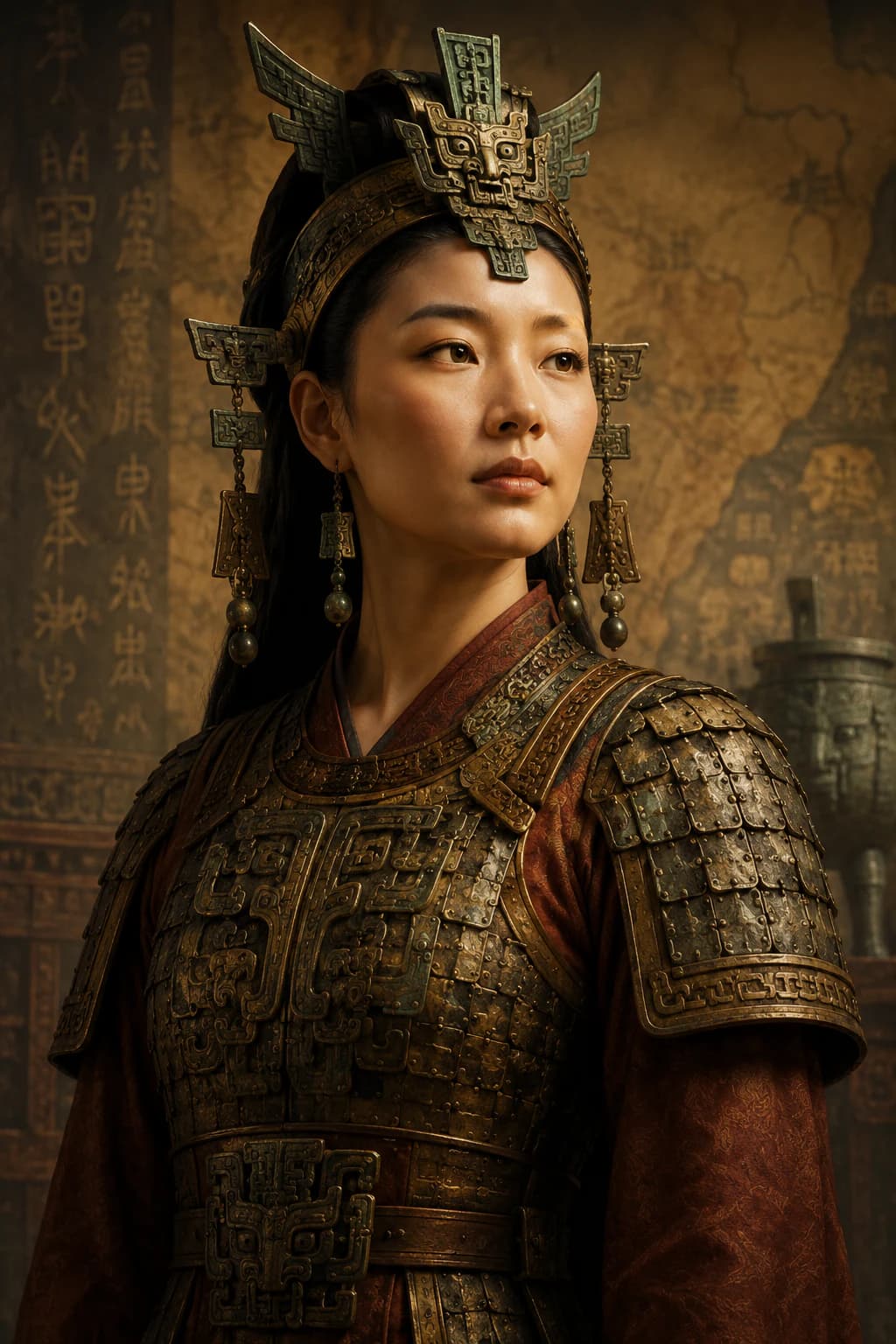
AI-generated portrait of Fu Hao in Shang royal dress with bronze ritual vessels
AI-assisted historical reconstruction

An illustrative reconstruction based on historical context. It is not a photograph or documentary likeness. Image policy

Quick answer

Fu Hao was a royal consort of the Shang king Wu Ding, a military commander, ritual specialist and elite woman of late Shang China. Oracle bone inscriptions and her rich tomb at Anyang show her unusual authority in warfare, divination, landholding and royal ritual.

Died
1200 BCE
Role
Shang royal consort and military commander
Years
c. 13th century BCE
Quick facts

Profile details

Additional identity and tagging details that are not already covered in the introduction.

Also known as
Lady Hao, Queen Fu Hao
Facts

Fu Hao timeline facts

Selected specifics from this profile's life story.

c. 13th century BC
A Shang royal woman

Fu Hao lived during the late Shang dynasty, when the royal court at Anyang used bronze ritual, ancestor worship and oracle bone divination to govern.

c. 1250 BC
Consort of Wu Ding

As a consort of King Wu Ding, Fu Hao stood close to the centre of Shang power and appears repeatedly in royal divination records.

1976
An intact tomb

Fu Hao became far better known after archaeologists discovered her unlooted tomb at Yinxu in 1976.

After c. 1200 BC
Historical significance

Fu Hao is now remembered as one of the clearest examples of female authority in the ancient world.

Life Journey

The warrior queen preserved by bronze and bone

Follow the story in a more continuous narrative, with a reading mode that matches how much depth you want.

Complete chronology

c. 13th century BC

A Shang royal woman

Fu Hao belonged to the world of late Shang kingship, centred at Yin near modern Anyang in Henan. This was a Bronze Age court where political power, military command, ancestral ritual and divination were tightly connected. Her exact birth date and family background are not securely known, but oracle bone inscriptions and the objects buried with her show that she was no ordinary palace figure. She was one of the consorts of King Wu Ding, the Shang ruler whose reign produced some of the richest evidence for early Chinese writing. The Shang royal household was political as well as domestic: marriages could connect the king to powerful lineages, regions and cults. Fu Hao's position within that system gave her access to authority, but her surviving record shows that she also exercised it in strikingly active ways.


c. 1250 BC

Consort of Wu Ding

Wu Ding's reign is one of the best documented periods of the Shang dynasty because thousands of oracle bone inscriptions survive from the Anyang royal centre. Fu Hao appears in those inscriptions as a named person whose health, childbirth, ritual duties, military actions and sacrifices could become matters of royal consultation. That alone is significant. Many ancient women are visible only through later stories or hostile summaries, but Fu Hao is present in the administrative and religious record of her own society. The inscriptions do not give a modern biography, and they leave many emotional details beyond reach. Yet they reveal a woman whose life mattered enough to be repeatedly brought before ancestors and powers through divination. Her relationship with Wu Ding was therefore personal, dynastic and ritual at once.

c. 13th century BC

Commander in war

Fu Hao's military role is one of the most remarkable features of her record. Oracle bone inscriptions associate her with campaigns against several groups hostile to the Shang, including enemies named in the inscriptions as Fang polities or frontier peoples. Some inscriptions ask about raising troops under her command, and later interpretation has made her famous as a warrior queen. The safest conclusion is not that Fu Hao was a symbolic mascot, but that she could hold real command within the Shang political and military system. Shang warfare depended on chariots, infantry, allied lineages, captives, sacrifice and the king's ability to coordinate forces across distance. Fu Hao's participation in that machinery shows that royal women, at least in exceptional cases, could operate in spheres often assumed to be exclusively male.

1976

An intact tomb

The discovery of Fu Hao's tomb in 1976 at Yinxu, the ruins of the late Shang capital, was a landmark in Chinese archaeology. Many royal Shang tombs had been robbed in antiquity, leaving only fragments of their original wealth. Fu Hao's tomb was different. It remained substantially intact, preserving bronze ritual vessels, weapons, jade objects, bone, stone, pottery and other grave goods on an extraordinary scale. Some bronze vessels bore inscriptions naming Fu Hao, linking the burial securely to the woman known from oracle bones. The tomb did not simply add colour to a biography. It gave historians material proof of her status, resources and ritual world. Her burial was elite, carefully furnished and unmistakably connected to the highest levels of Shang society.

After c. 1200 BC

Historical significance

Fu Hao's legacy is unusually strong because it rests on two kinds of evidence that reinforce one another: contemporary oracle bone inscriptions and a richly furnished tomb. Together they show a royal woman who was a consort, mother, military commander, ritual actor and landholder in late Shang China. She should not be treated as proof that all Shang women held similar power; her status was exceptional, and the surviving evidence comes from the royal elite. But exceptional cases are historically valuable precisely because they reveal what a society could imagine and permit under certain conditions. Fu Hao expands the history of ancient power. She shows that Bronze Age kingship was not only a story of male rulers and anonymous queens, but of royal households in which women could wield authority in war, ritual and memory.

Continue in context

Connected stories

Move from the profile into the wider events and settings this figure belongs to.

Tertiary paths

Content note

This profile is written for educational use and connects to related Stories of History pages. The main portrait is an AI-assisted historical reconstruction, included as an illustrative aid rather than documentary evidence. Image policy

References

Sources & Further Reading

Reliable reference works, archives and reading paths connected to this profile.

Further reading

  1. Encyclopaedia Britannica, Search results for Fu Hao,” accessed June 2026.Open source
  2. WorldCat, Books and library holdings for Fu Hao,” accessed June 2026.Open source

Primary sources

  1. Library of Congress, Search results for Fu Hao,” accessed June 2026.Open source

Reviewed claim sources

Loading reviewed claim sources...

A weekly route through history

Find out first about the latest published stories, feature notes and occasional Premium offers in one weekly email.