People

Aristotle

Aristotle was an Ancient Greek philosopher from Stagira, Plato's student, Alexander the Great's tutor, founder of the Lyceum, and author of influential works on logic, ethics, politics, science, and metaphysics.

Born
384 BCE
Died
322 BCE
Role
Ancient Greek philosopher

Ancient Greek philosopher (384 BC–322 BC)

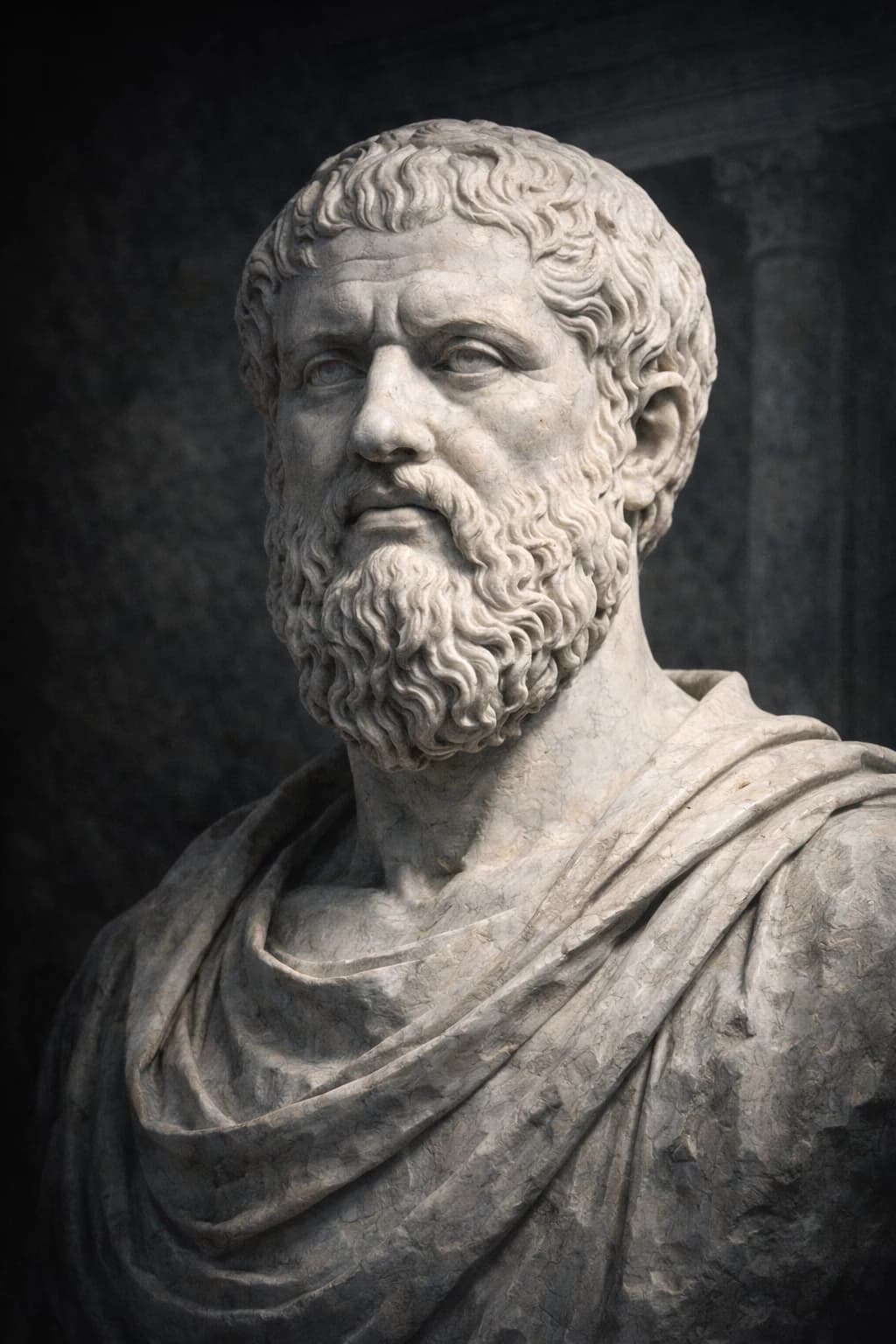
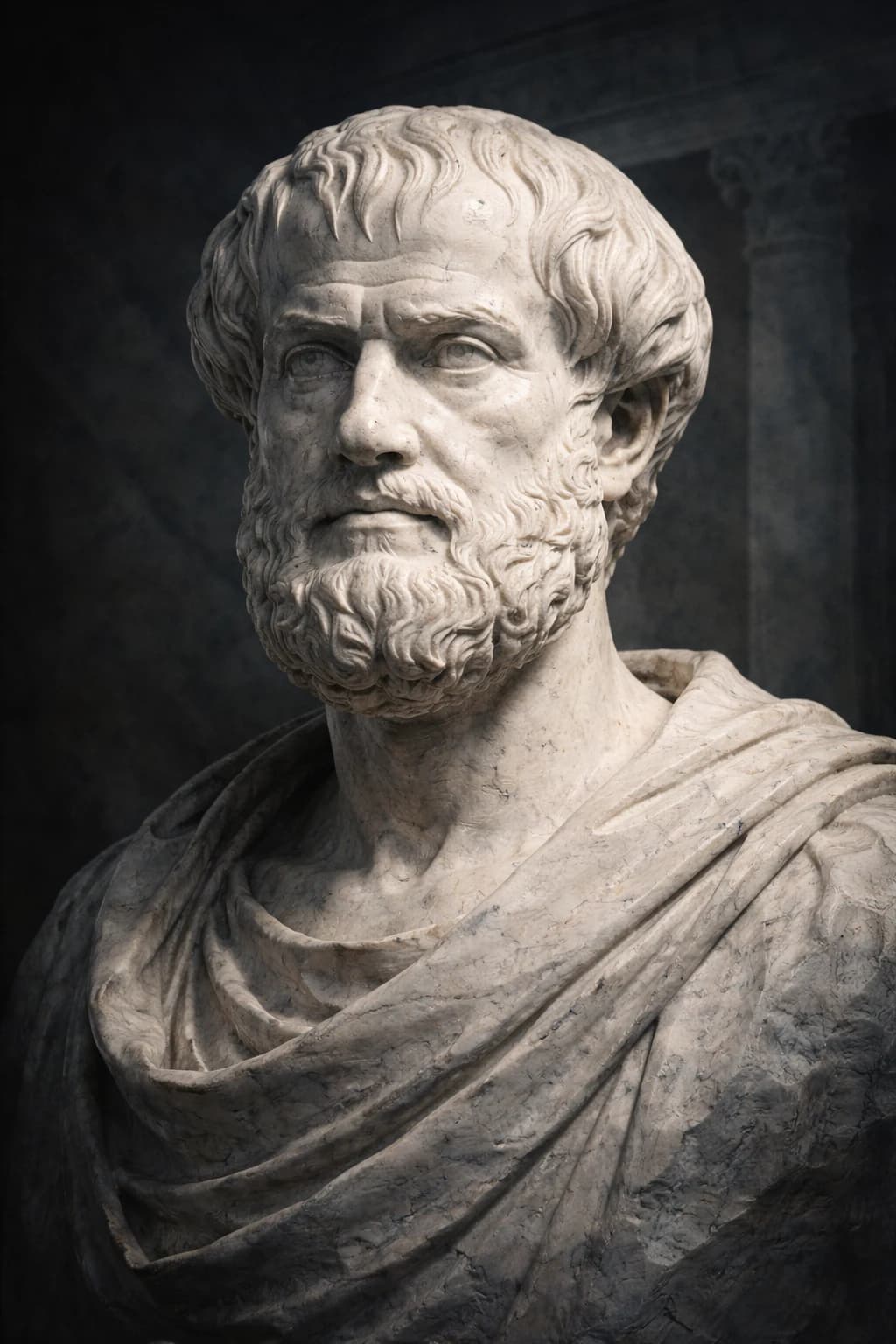
AI-generated portrait of Aristotle in ancient Greek robes
AI-assisted historical reconstruction

An illustrative reconstruction based on historical context. It is not a photograph or documentary likeness. Image policy

Quick answer

Aristotle was an Ancient Greek philosopher from Stagira, Plato's student, Alexander the Great's tutor, founder of the Lyceum, and author of influential works on logic, ethics, politics, science, and metaphysics.

Born
384 BCE
Died
322 BCE
Role
Ancient Greek philosopher
Years
384-322 BCE
Facts

Aristotle timeline facts

Selected specifics from this profile's life story.

-384
Birth in Stagira

Aristotle was born in northern Greece into a family connected to medicine, exposing him early to observation and practical knowledge.

-343
Tutor to Alexander

He was invited to tutor the young Alexander, influencing a future ruler who would reshape much of the known world.

-323
Political Backlash

After Alexander’s death, anti-Macedonian sentiment in Athens put Aristotle at risk, forcing him to leave the city once again.

After -322
Enduring Influence

Aristotle’s ideas shaped philosophy, science, and education for centuries, influencing thinkers across cultures and historical periods.

Life Journey

A lifetime of inquiry shaping reason and knowledge

Follow the story in a more continuous narrative, with a reading mode that matches how much depth you want.

Complete chronology

-384

Birth in Stagira

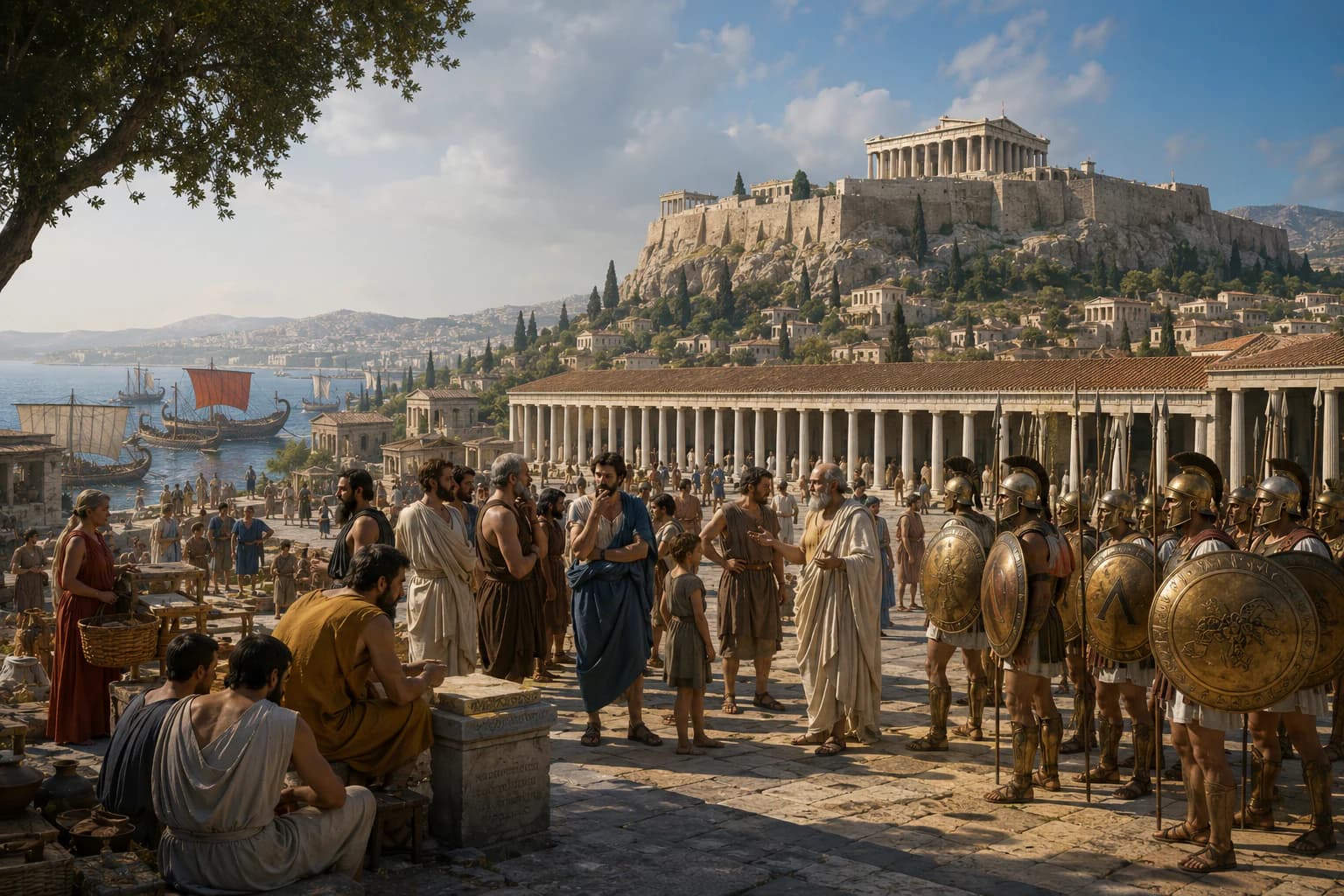
Aristotle was born in 384 BC in Stagira, a Greek city in Chalcidice, on the northern edge of the classical Greek world. His father, Nicomachus, served as physician to the Macedonian royal court, a detail that matters because Aristotle's later philosophy never treated the material world as beneath serious thought. He grew up near the intersection of Greek civic culture, Macedonian power, and medical observation. We should be cautious about drawing too straight a line from father to son, because evidence for Aristotle's childhood is limited. Still, his mature work shows an unusual comfort with classification, anatomy, causation, and the close study of living things. Unlike philosophers remembered mainly for abstract speculation, Aristotle wanted to know how bodies, animals, constitutions, poems, arguments, virtues, and causes actually worked. His origins help explain that range.
-367

Joining Plato’s Academy

At about seventeen, Aristotle traveled to Athens and entered Plato's Academy, the most influential philosophical school in the Greek world. He remained there for roughly twenty years, long enough to absorb its habits of argument and to become one of its outstanding minds. Plato's thought gave Aristotle a demanding intellectual inheritance: questions about reality, knowledge, justice, education, and the relation between changing things and unchanging truth. Aristotle admired Plato, but admiration did not mean obedience. Over time he moved away from the theory of Forms as Plato had developed it, insisting that knowledge must attend more closely to substances, purposes, causes, and the structures found in the world of experience. The Academy gave him discipline and a rival. His philosophy grew from that productive tension between loyalty to a teacher and refusal to stop thinking where the teacher stopped.

-347

Leaving the Academy

After Plato's death in 347 BC, Aristotle left Athens. The reasons were probably mixed: the Academy passed to Speusippus, Aristotle's own views had diverged, and Athens was politically sensitive for anyone associated with Macedonia. He spent time in Assos and on Lesbos, where his work with Theophrastus and others likely deepened his biological studies. This period is important because it shows Aristotle outside Plato's shadow, gathering observations and building methods that were not simply academic exercises. He examined animals, constitutions, language, and argument as objects that could be sorted, compared, and explained. His mature philosophy would ask not only what something is, but what it is for, what it is made of, what brings it into being, and how it changes. Those questions gave his work a systematic architecture unmatched in antiquity.

-343

Tutor to Alexander

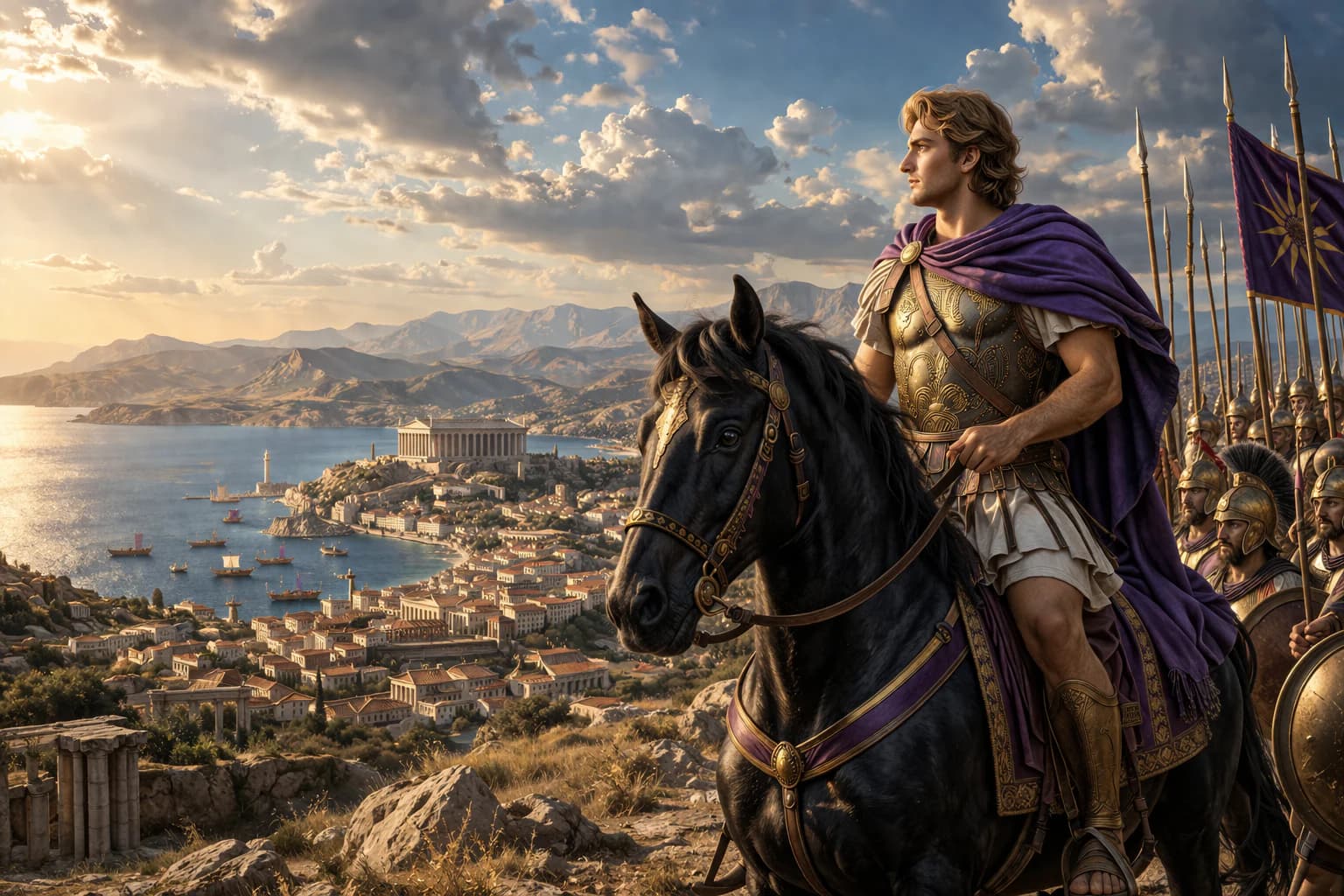
Around 343 BC, Philip II of Macedon invited Aristotle to tutor his son Alexander. The later fame of Alexander the Great has made this relationship irresistible, but its influence is easy to exaggerate. Aristotle likely taught literature, ethics, politics, medicine, and Greek culture, and ancient tradition associated him with Alexander's admiration for Homer. Yet Alexander's conquests cannot be reduced to lessons from a philosopher, and Aristotle's own political thought did not simply celebrate empire. What the appointment certainly did was place Aristotle at the meeting point of knowledge and power. He saw Macedonian monarchy from close range, taught a prince who would soon transform the eastern Mediterranean and Near East, and benefited from royal patronage. The connection later made him vulnerable in democratic Athens, where Macedonian influence was deeply resented.

-335

Founding the Lyceum

Aristotle returned to Athens in 335 BC and founded his own school at the Lyceum. Its members became associated with the Peripatetic tradition, often linked to teaching while walking in covered colonnades. The Lyceum was not merely a place for lectures. It functioned as a research community, collecting constitutions, studying animals, organizing arguments, and treating knowledge as something that could be investigated in ordered fields. Aristotle's surviving works often read like lecture notes or working treatises rather than polished literary dialogues, which makes them demanding but revealing. At the Lyceum, he pursued a remarkable ambition: to map the forms of reasoning, the structures of living nature, the habits of ethical character, the varieties of political life, the principles of poetry, and the deepest questions of being. Few thinkers have tried to make inquiry so comprehensive.

-335 to -323

Systematic Writings

Aristotle's achievement lies less in one doctrine than in the architecture of inquiry he left behind. In logic, later gathered under the title Organon, he analyzed categories, propositions, syllogisms, demonstration, and fallacies, giving scholars tools for disciplined argument. In the Nicomachean Ethics, he asked how human beings flourish, placing virtue in trained character, practical wisdom, and the search for a mean relative to circumstances. In the Politics, he compared constitutions and treated the polis as the setting in which human capacities develop, while also reflecting assumptions about gender, slavery, and hierarchy that modern readers must confront critically. His biological works are astonishing for their observational range, even when conclusions are wrong. In metaphysics and natural philosophy, he explored substance, causation, change, purpose, and the unmoved mover. He did not create modern science, but he created durable habits of explanation.

-323

Political Backlash

Alexander's death in 323 BC changed Aristotle's position overnight. Anti-Macedonian feeling surged in Athens, and Aristotle's long association with Macedonian elites made him politically exposed. A charge of impiety was brought against him, a dangerous accusation in a city whose memory of Socrates' trial still hung over philosophy. Aristotle chose to leave rather than stand trial. Later tradition says he did so to prevent Athens from sinning twice against philosophy, though the exact wording may be literary embroidery. The episode is revealing even if the anecdote is uncertain. Aristotle's life was never insulated from politics. His schools, patrons, travels, and dangers were shaped by the power struggles of the Greek world. A philosopher who analyzed constitutions and civic life was himself vulnerable to the city.

-323 to -322

Last Years in Exile

Aristotle withdrew to Chalcis on Euboea, where he died in 322 BC. His final year was brief and politically constrained, but the school he had built continued through Theophrastus, his student and successor. The survival of Aristotle's writings was uneven and complicated; what later readers received was not a neat collected edition produced under his supervision but a body of works transmitted, arranged, copied, and interpreted over centuries. This matters because Aristotle's influence depended not only on what he wrote but on institutions of preservation and commentary. His death came at the end of the classical Greek world he had known, just as Hellenistic kingdoms were reshaping intellectual life. Yet his methods proved portable. They could travel because they offered tools: definitions, distinctions, categories, arguments, and questions that other cultures could reuse.

After -322

Enduring Influence

Aristotle's legacy is one of the largest in intellectual history. His works shaped Hellenistic scholarship, were studied and transformed by Syriac and Arabic-speaking thinkers, became central to Islamic philosophy through figures such as al-Farabi, Avicenna, and Averroes, and entered medieval Christian scholasticism most famously through Thomas Aquinas. For centuries, to be educated often meant learning to argue with Aristotle, through Aristotle, or against Aristotle. His authority could become restrictive when later scholars treated him as final rather than as a model of inquiry, and modern science overturned many Aristotelian claims about physics, astronomy, and biology. Yet that does not make him obsolete. Aristotle remains important because he asked disciplined questions about almost everything: what exists, how we know, how living things function, what makes action good, why communities form, how persuasion works, and how art moves an audience. His greatest achievement was not being right about all things. It was making thought more organized, ambitious, and answerable to reason.

Continue in context

Connected stories

Move from the profile into the wider events and settings this figure belongs to.

Tertiary paths

Content note

This profile is written for educational use and connects to related Stories of History pages. The main portrait is an AI-assisted historical reconstruction, included as an illustrative aid rather than documentary evidence. Image policy

References

Sources & Further Reading

Reliable reference works, archives and reading paths connected to this profile.

Further reading

  1. Encyclopaedia Britannica, Search results for Aristotle,” accessed June 2026.Open source
  2. WorldCat, Books and library holdings for Aristotle,” accessed June 2026.Open source

Primary sources

  1. Library of Congress, Search results for Aristotle,” accessed June 2026.Open source

Reviewed claim sources

Loading reviewed claim sources...

A weekly route through history

Find out first about the latest published stories, feature notes and occasional Premium offers in one weekly email.