People

Warren G. Harding

Warren G. Harding was the 29th President of the United States from 1921 to 1923. He campaigned on normalcy, hosted the Washington Naval Conference and became linked to Teapot Dome.

Born
1865 CE
Died
1923 CE
Role
29th President of the United States

29th President of the United States (1865–1923)

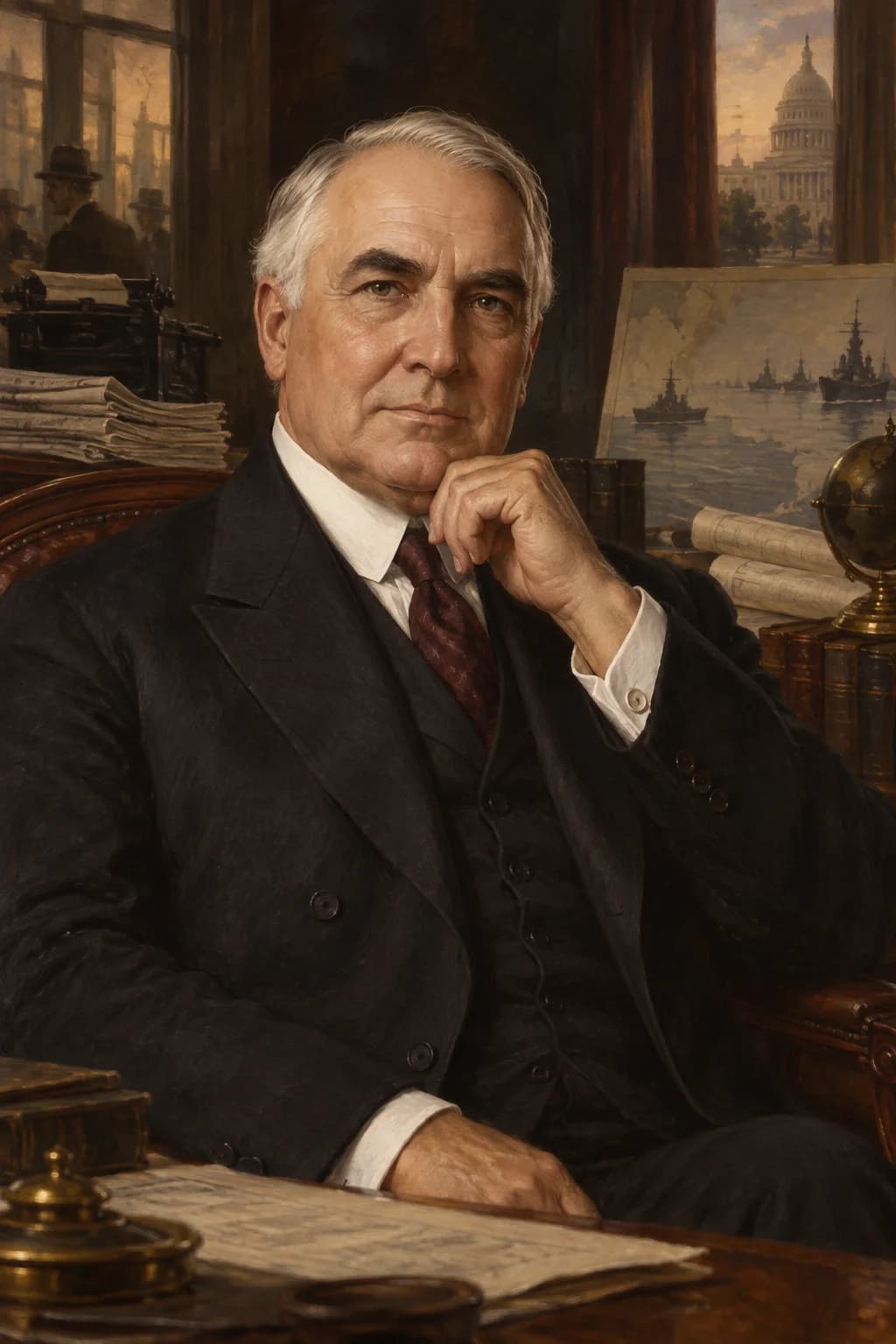
AI-generated portrait of Warren G. Harding in formal presidential attire
AI-assisted historical reconstruction

An illustrative reconstruction based on historical context. It is not a photograph or documentary likeness. Image policy Attribution

Quick answer

Warren G. Harding was the 29th President of the United States from 1921 to 1923. He campaigned on normalcy, hosted the Washington Naval Conference and became linked to Teapot Dome.

Born
1865 CE
Died
1923 CE
Role
29th President of the United States
Years
1865-1923 CE
Facts

Warren G. Harding timeline facts

Selected specifics from this profile's life story.

1865
Small-town roots

Warren G. Harding was born in Ohio in 1865, growing up in a small-town world that shaped his warmth, sociability and political instincts.

1914–1920
National prominence

As U.S. senator from 1915, Harding opposed aspects of Wilsonian internationalism and became a plausible national Republican figure.

1922–1923
Scandals emerge

Corruption inside Harding's circle, especially Teapot Dome and Veterans' Bureau abuses, began to surface near the end of his life and exploded after his death.

Post-1923
Historical assessment

Harding's legacy is shaped by genuine popularity, postwar stabilisation and the corruption scandals that made him a cautionary presidential example.

Life Journey

Normalcy, popularity, scandal, and an unfinished presidency

Follow the story in a more continuous narrative, with a reading mode that matches how much depth you want.

Complete chronology

1865

Small-town roots

Harding was born just after the Civil War, in a rural Ohio society where reputation was built through church, business, family and local talk. His parents valued education and respectability, and Harding developed early the easy charm that later made him a formidable campaigner. He was not a deep ideologue. He was a joiner, listener and reassurer, gifted at making people feel comfortable. That skill can look shallow beside more dramatic presidents, but it was politically powerful in an America tired by war, strikes, Red Scare panic, racial violence and reform battles.
1880s–1890s

Newspaper career

The Marion Star made Harding visible and taught him the rhythms of public opinion. A small-town newspaper was not merely a business; it was a political instrument, a social hub and a daily conversation with voters. Harding learned how to smooth conflict, praise allies, avoid unnecessary enemies and frame public issues in comforting language. His wife, Florence Kling Harding, played an important role in the paper's business success and later in his political career. Newspaper life did not make Harding a policy intellectual, but it made him a communicator who understood tone. His later appeal rested heavily on that talent.

1899–1914

Entry into politics

Harding's move into politics followed naturally from publishing and party work. In Ohio, he became known as a handsome speaker, reliable Republican and man who rarely made colleagues feel threatened. He served in the state senate, became lieutenant governor and ran unsuccessfully for governor in 1910. His politics were conservative but not fiery. He preferred party harmony, business confidence and patriotic language. That moderation made him attractive inside a party often balancing progressives, conservatives and local machines. Harding rose because he was acceptable, and acceptability can be a powerful form of ambition.

1914–1920

National prominence

Harding entered the Senate as the United States moved through neutrality, war and the bitter peace debate after 1918. He was not a legislative giant, but he was well liked by colleagues and useful to party leadership. He criticised Woodrow Wilson's style and resisted the League of Nations in the form Wilson demanded, aligning himself with Republicans who wanted international caution without total isolation. Harding's speeches often preferred emotional reassurance to analytic precision. That weakness became a strength in 1920, when many voters wanted less moral crusading from Washington and more predictable national life.

1920

Presidential election

The 1920 election was a referendum on exhaustion. Americans had endured the First World War, influenza, labour unrest, the Red Scare, racial violence and Wilson's failed League of Nations campaign. Harding's 'normalcy' was grammatically mocked but politically brilliant. It promised emotional demobilisation: less emergency, less moral pressure, less grand reform. The Republican convention chose him after stronger candidates deadlocked, and his front-porch campaign from Marion projected accessibility and calm. He defeated James M. Cox decisively, with Calvin Coolidge as running mate. Harding's victory showed how powerfully a nation can vote for relief.

1921–1922

Early presidency

Harding's presidency was more active than its reputation sometimes suggests. His administration, with Andrew Mellon at Treasury, pursued tax reduction, spending restraint and pro-business recovery after the sharp recession of 1920-1921. The Washington Naval Conference produced arms limitation agreements among major powers, a genuine achievement in postwar diplomacy. Harding also signed restrictive immigration legislation and struggled unevenly with civil rights. In Birmingham in 1921, he spoke unusually directly for a white president about political equality for Black Americans, though he did not translate rhetoric into sweeping protection. His governing style relied heavily on delegation, which created both achievement and danger.

1922–1923

Scandals emerge

Harding's greatest failure was judgment of men. He appointed some able officials, including Mellon, Herbert Hoover and Charles Evans Hughes. He also trusted friends and associates who abused public office. The Teapot Dome scandal involved Interior Secretary Albert Fall secretly leasing naval oil reserves in exchange for bribes. Veterans' Bureau corruption under Charles Forbes was another disgrace. Harding appears to have been distressed by rumours of wrongdoing and was beginning to confront some problems before his death, but he had created the conditions by placing loyalty and comfort above scrutiny. The scandals turned normalcy into a byword for complacency.

1923

Sudden death

Harding's 1923 'Voyage of Understanding' was intended to reconnect with the country and defend his administration. He fell ill during the trip and died in San Francisco on 2 August 1923. The nation mourned sincerely; Harding was still personally popular. His sudden death transferred power to Calvin Coolidge, whose austere image helped separate the presidency from the scandals that followed. Harding never had to answer publicly for Teapot Dome at its full force, but he also never had the chance to repair the damage. His presidency froze at the moment before exposure became historical judgment.

Post-1923

Historical assessment

Harding has often ranked near the bottom of presidential surveys, largely because scandal overwhelmed memory of his achievements. Recent reassessment has been somewhat more nuanced. He helped restore economic confidence, supported important diplomacy and understood the public hunger for calm after national strain. But the central criticism remains strong: he lacked the vigilance and severity required to police his own administration. He wanted to be liked, and corrupt men benefited from that softness. Harding's life shows that warmth and reassurance can win power, but without disciplined oversight they can leave a presidency vulnerable to betrayal from within.

Continue in context

Connected stories

Move from the profile into the wider events and settings this figure belongs to.

American Presidents lineage
Lineage47 presidents
American Presidents
1789 CE–present

The succession of American presidents from George Washington to today.

View lineage
Tertiary paths

Content note

This profile is written for educational use and connects to related Stories of History pages. The main portrait is an AI-assisted historical reconstruction, included as an illustrative aid rather than documentary evidence. Image policy Image attribution

References

Sources & Further Reading

Reliable reference works, archives and reading paths connected to this profile.

Further reading

  1. Encyclopaedia Britannica, Search results for Warren G. Harding,” accessed June 2026.Open source
  2. WorldCat, Books and library holdings for Warren G. Harding,” accessed June 2026.Open source

Primary sources

  1. Library of Congress, Search results for Warren G. Harding,” accessed June 2026.Open source

Reviewed claim sources

Loading reviewed claim sources...

A weekly route through history

Find out first about the latest published stories, feature notes and occasional Premium offers in one weekly email.