People

Tycho Brahe

Tycho Brahe was a Danish astronomer whose observatory, instruments, and precise pre-telescopic observations transformed astronomy and supplied the data Johannes Kepler used to formulate planetary laws.

Born
1546 CE
Died
1601 CE
Role
Astronomer

Danish astronomer (1546-1601)

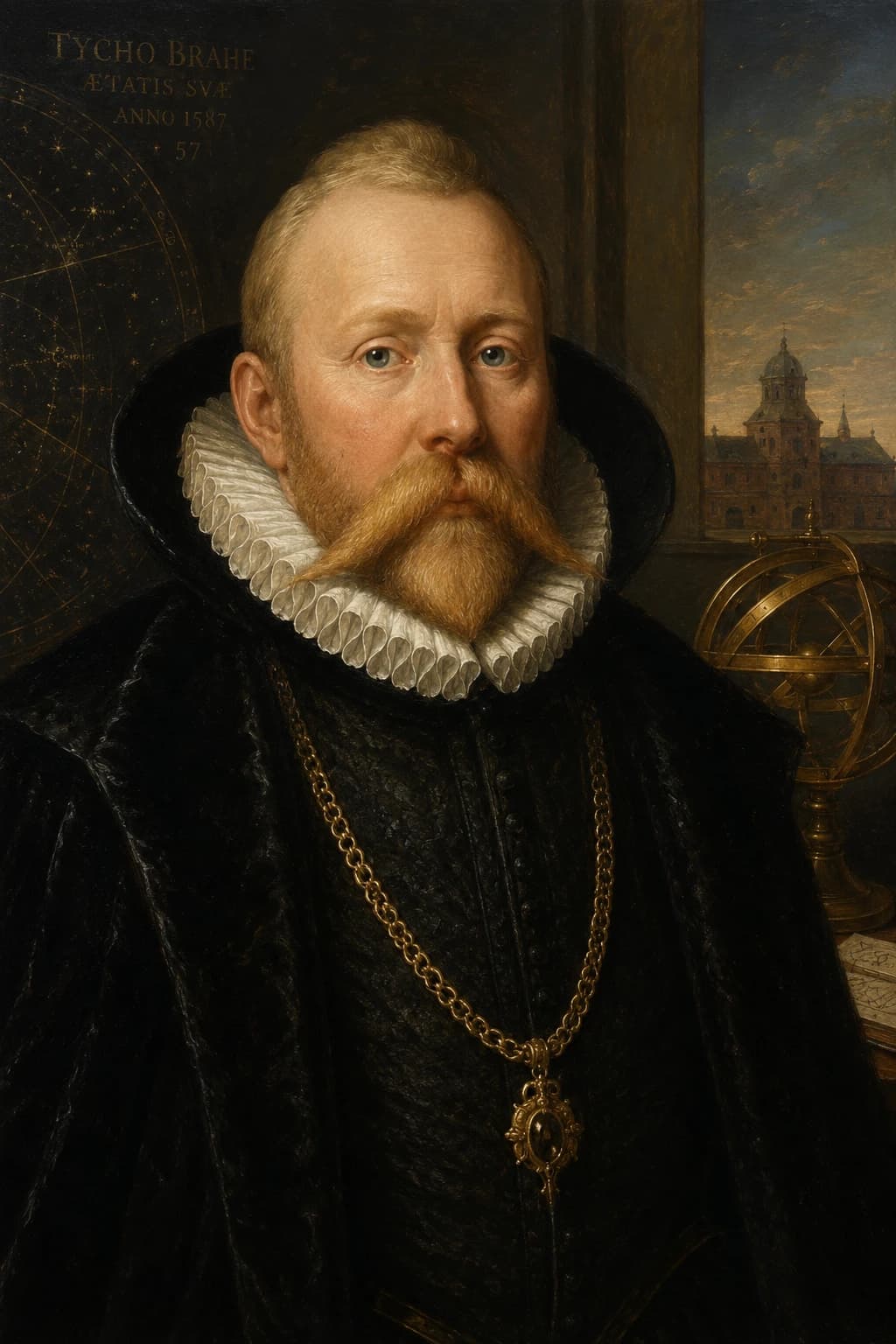
AI-generated portrait of Tycho Brahe with astronomical instruments and Uraniborg in the background
AI-assisted historical reconstruction

An illustrative reconstruction based on historical context. It is not a photograph or documentary likeness. Image policy

Quick answer

Tycho Brahe was a Danish astronomer whose observatory, instruments, and precise pre-telescopic observations transformed astronomy and supplied the data Johannes Kepler used to formulate planetary laws.

Born
1546 CE
Died
1601 CE
Role
Astronomer
Years
1546-1601 CE
Quick facts

Profile details

Additional identity and tagging details that are not already covered in the introduction.

Also known as
Tycho, Tyge Brahe
Region
Denmark, Bohemia, Holy Roman Empire, Denmark and Prague
Facts

Tycho Brahe timeline facts

Selected specifics from this profile's life story.

1546
Danish noble

Tycho Brahe was born into the Danish nobility in 1546, giving him unusual resources for a life in astronomy.

1576
Uraniborg

With royal support, Brahe built Uraniborg on the island of Hven, one of Europe's most advanced observatories.

1580s
A hybrid cosmos

Brahe proposed a model in which Earth stayed still, the Sun orbited Earth, and the other planets orbited the Sun.

1600-1601
Data for Kepler

Brahe spent his final period in Prague, where Johannes Kepler gained access to the observations that would change astronomy.

Life Journey

Precision before the telescope

Follow Brahe from aristocratic Denmark to the observatories and data that changed astronomy.

Complete chronology

1546

Danish noble

Tycho Brahe was born in 1546 into a powerful Danish noble family. His background mattered because astronomy in the sixteenth century required money, instruments, buildings, assistants, books, and time. Brahe's status gave him access to education and patronage, but his path was not conventional noble service. He became obsessed with the accuracy of the heavens. A solar eclipse prediction and later astronomical events convinced him that better observations could expose the weaknesses of inherited tables.
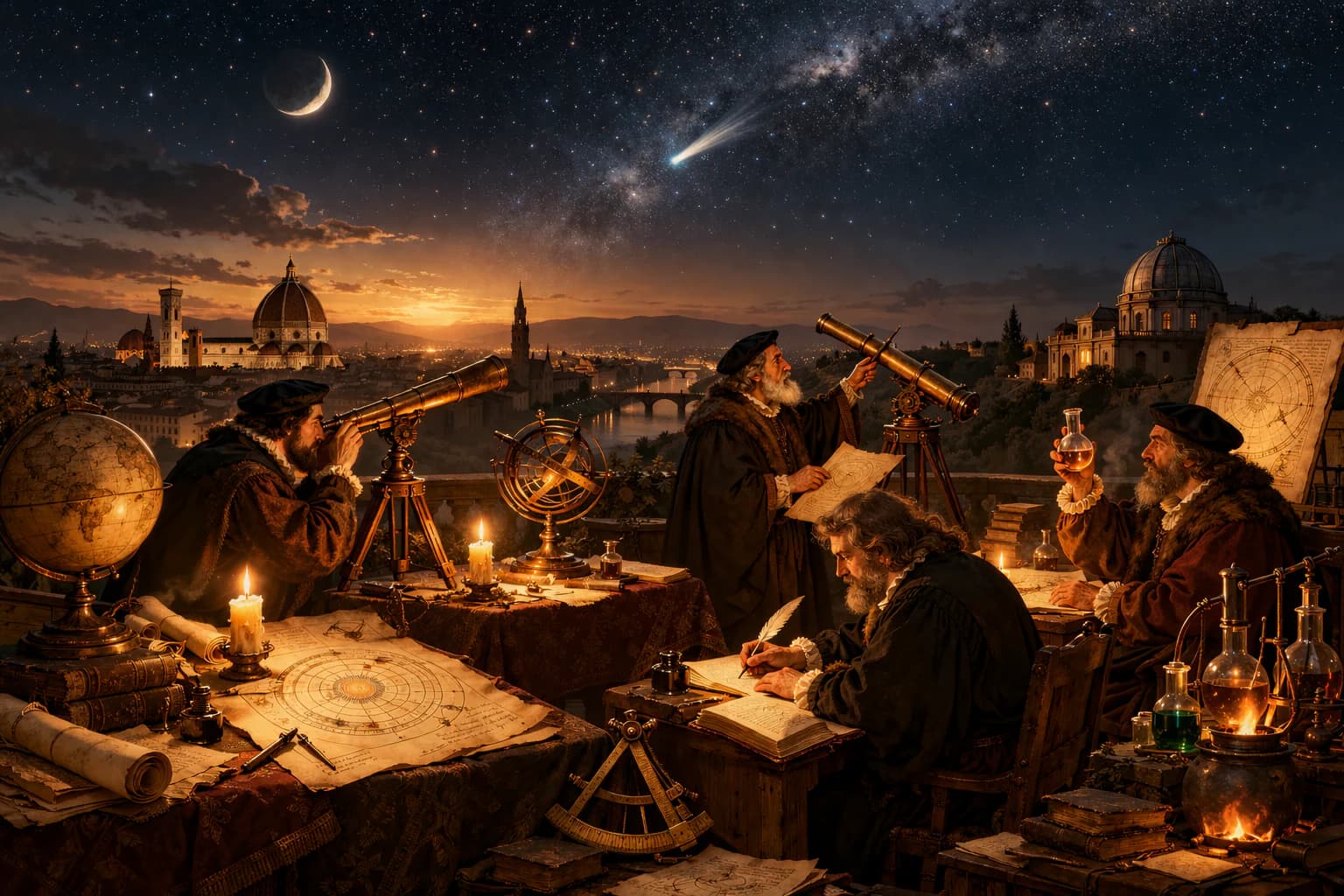

1572

The new star

In 1572 Brahe observed a brilliant new star, now understood as a supernova. Careful measurement showed that it belonged beyond the Moon, in the supposedly perfect and unchanging celestial realm. That mattered enormously. Aristotelian cosmology treated the heavens as incorruptible, unlike the changing world below the Moon. Brahe's new star showed that change could happen in the heavens themselves. It made him famous and strengthened his conviction that exact measurement could overturn ancient assumptions.

1576

Uraniborg

King Frederick II of Denmark granted Brahe the island of Hven, where he built Uraniborg and later Stjerneborg. These were not simple towers for solitary stargazing. They were research institutions, with large instruments, assistants, workshops, records, and routines. Before telescopes, precision depended on the design and calibration of instruments and on repeated observation. Brahe improved both. His observatory made astronomy collaborative, disciplined, and data-rich in a way that anticipated later scientific institutions.

1577

The comet of 1577

Brahe's observations of the comet of 1577 showed that it too moved beyond the Moon. If comets passed through the heavens, then the old idea of nested solid spheres carrying the planets became harder to defend. Brahe did not become a Copernican. He still rejected a moving Earth. But his evidence damaged parts of the inherited cosmic architecture. The Scientific Revolution often moved this way: a thinker could challenge one ancient assumption while preserving another.

1580s

A hybrid cosmos

Brahe's cosmological model tried to solve a sixteenth-century problem. Copernicus had made planetary order more elegant, but a moving Earth seemed physically and scripturally difficult to many readers. Brahe offered a compromise: Earth remained fixed at the center, the Sun revolved around Earth, and the other planets revolved around the Sun. The model preserved common sense while borrowing some Copernican advantages. It was not the future of astronomy, but it shows how seriously Brahe took both observation and the intellectual limits of his age.

1600-1601

Data for Kepler

After conflict with the Danish crown, Brahe moved to Prague under the patronage of Emperor Rudolf II. There he employed Johannes Kepler, whose mathematical imagination was very different from Brahe's observational discipline. Their relationship was tense because Brahe guarded his data, especially the observations of Mars. When Brahe died in 1601, Kepler eventually used those records to discover elliptical orbits and the laws of planetary motion. Brahe did not find those laws himself, but without his precision they may not have appeared when they did.

Continue in context

Connected stories

Move from the profile into the wider events and settings this figure belongs to.

Tertiary paths

Content note

This profile is written for educational use and connects to related Stories of History pages. The main portrait is an AI-assisted historical reconstruction, included as an illustrative aid rather than documentary evidence. Image policy

References

Sources & Further Reading

Reliable reference works, archives and reading paths connected to this profile.

Further reading

  1. Encyclopaedia Britannica, Search results for Tycho Brahe,” accessed June 2026.Open source
  2. WorldCat, Books and library holdings for Tycho Brahe,” accessed June 2026.Open source

Primary sources

  1. Library of Congress, Search results for Tycho Brahe,” accessed June 2026.Open source

Reviewed claim sources

Loading reviewed claim sources...

A weekly route through history

Find out first about the latest published stories, feature notes and occasional Premium offers in one weekly email.