People

Isaac Newton

Isaac Newton was an English mathematician, physicist, and natural philosopher. He formulated the laws of motion and universal gravitation in the Principia, developed calculus, transformed optics, led the Royal Society, and shaped modern science.

Born
1643 CE
Died
1727 CE
Role
English mathematician and physicist

English mathematician and physicist (1643–1727)

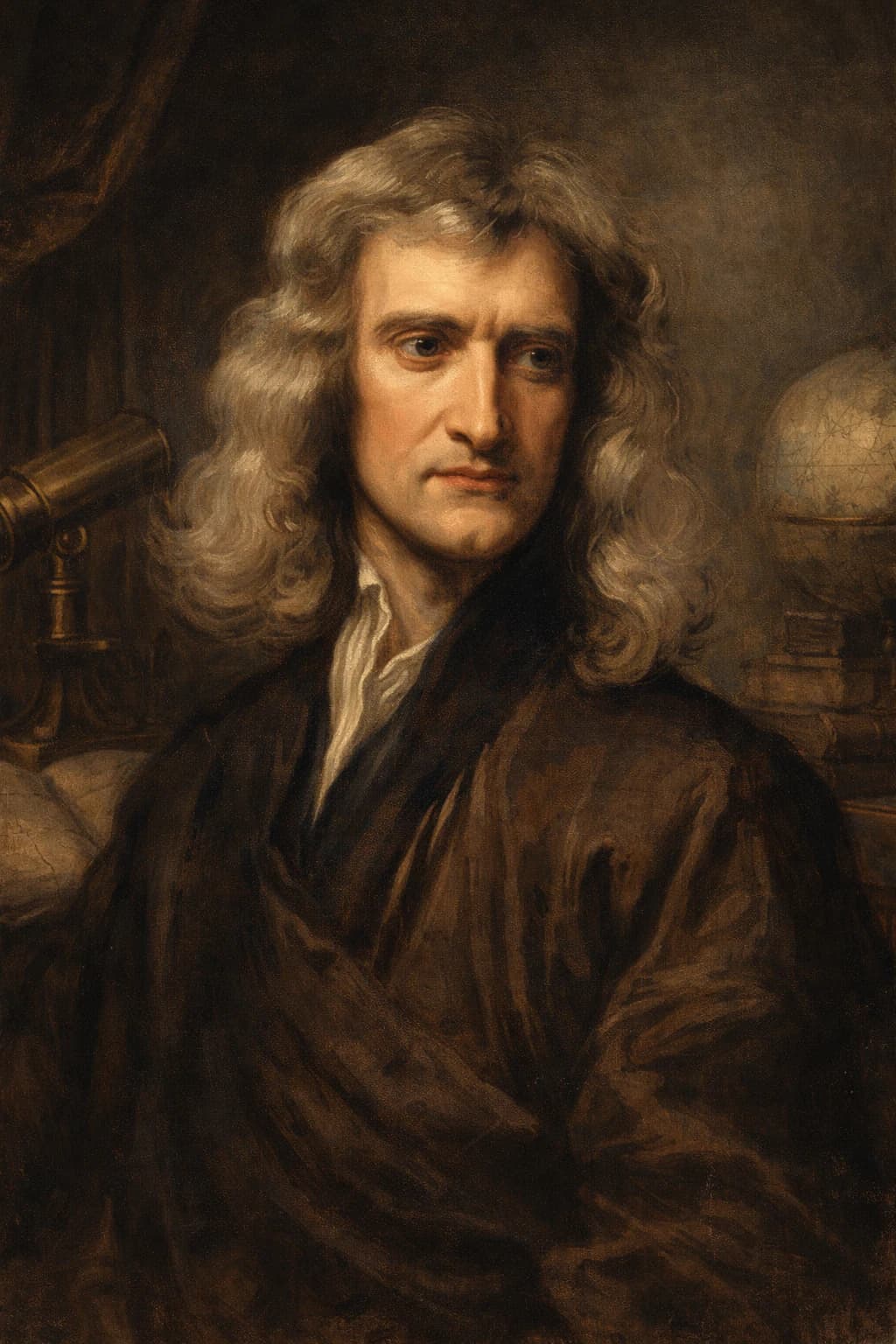
AI-generated portrait of Isaac Newton in 17th-century scholarly attire
AI-assisted historical reconstruction

An illustrative reconstruction based on historical context. It is not a photograph or documentary likeness. Image policy

Quick answer

Isaac Newton was an English mathematician, physicist, and natural philosopher. He formulated the laws of motion and universal gravitation in the Principia, developed calculus, transformed optics, led the Royal Society, and shaped modern science.

Born
1643 CE
Died
1727 CE
Role
English mathematician and physicist
Years
1643-1727 CE
Facts

Isaac Newton timeline facts

Selected specifics from this profile's life story.

1643
Fragile beginnings

Isaac Newton was born prematurely at Woolsthorpe in 1642 Old Style, a fatherless child whose early isolation helped form a fiercely inward mind.

1666
Gravity conceived

Newton's insight was that falling bodies, the Moon, and the planets could be understood through one mathematical account of force and motion.

1690s–1700s
Scientific authority

Newton became a public authority: Lucasian Professor, Royal Society president, and a fierce combatant in disputes over priority and truth.

1727–present
Enduring legacy

Newton's laws dominated science for centuries and remain essential, even after Einstein showed that gravity's deeper story was stranger still.

Life Journey

A mind that uncovered nature’s hidden order

Follow the story in a more continuous narrative, with a reading mode that matches how much depth you want.

Complete chronology

1643

Fragile beginnings

Newton was born on Christmas Day 1642 by the calendar then used in England, or 4 January 1643 in the modern Gregorian reckoning. His father had died before his birth, and his mother later remarried, leaving him for years in the care of his grandmother. The emotional consequences are impossible to measure precisely, but Newton's later notebooks reveal intensity, resentment, self-scrutiny, and a capacity for solitary concentration that could become almost frightening. He was not born into obvious intellectual privilege. He came from a rural Lincolnshire farming background and was initially expected to manage practical life. Instead, he developed a private world of mechanisms, observation, drawing, and calculation.
1661–1665

Cambridge studies

Newton entered Trinity College, Cambridge, in 1661, when university teaching still leaned heavily on Aristotle. Privately, he read the new philosophers and mathematicians who were remaking European thought: Descartes, Galileo, Kepler, Wallis, Boyle, and others. His notebooks show a young man not merely copying ideas but attacking them, testing them, and rebuilding them in his own language. Cambridge gave him access to books and intellectual structure, but much of the transformation was self-directed. Newton learned to treat nature as something that could be expressed mathematically, but also experimentally interrogated. The fusion of calculation and observation became the signature of his genius.

1665–1667

Years of isolation

The so-called annus mirabilis was not a magical year in which finished modern physics appeared overnight, but the plague years were extraordinary. Away from Cambridge, Newton worked privately on what he called fluxions, the mathematical methods later known as calculus. He explored infinite series, the nature of colour, and the mechanics of motion. He also began thinking about whether the force that made objects fall might extend to the Moon. Later memory turned this into the apple story, and Newton himself told versions of it in old age. Whether or not an apple literally sparked the thought, the deeper breakthrough was the question: could the heavens and the Earth obey the same mathematical law?

1666

Gravity conceived

The revolutionary step was unification. Earlier thinkers had made crucial advances: Galileo studied falling bodies, Kepler described planetary orbits, and Descartes offered mechanical visions of nature. Newton brought the pieces into a deeper structure. If inertia, acceleration, and force could be defined mathematically, then the orbit of the Moon and the fall of a stone were not separate kinds of event. They were different expressions of universal law. This did not immediately settle every problem, and Newton took years to refine the mathematics. But the intellectual direction was clear. Nature was no longer divided between earthly imperfection and heavenly order. It was one system.

1670s

Light and color

Newton's work on light was as disruptive as his mechanics. Passing sunlight through prisms, he argued that white light was not pure light modified by glass or shadow, but a mixture of rays with different refrangibility. Colour belonged to light itself. He built a reflecting telescope partly to avoid the chromatic problems of lenses, and his optical discoveries brought him early fame through the Royal Society. They also brought conflict. Robert Hooke and others challenged his conclusions and methods, and Newton reacted badly to criticism, withdrawing and sharpening his suspicion of rivals. The episode revealed both sides of Newton's mind: experimental brilliance and a ferocious need to control interpretation.

1687

Principia published

The Philosophiae Naturalis Principia Mathematica was prompted in part by Edmond Halley's question about planetary motion and supported by Halley's persistence and funding. Published in 1687, it presented three laws of motion and the law of universal gravitation in a geometrical style that was difficult but devastatingly powerful. It explained Kepler's laws, tides, comets, projectiles, and celestial motion within one framework. The Principia did not just add facts. It changed the standard of explanation. A successful science now meant mathematical laws capable of prediction across vast domains. Newton had given Europe a universe that seemed ordered, calculable, and majestic.

1690s–1700s

Scientific authority

Newton's authority expanded beyond discovery. He became Lucasian Professor at Cambridge, entered Parliament briefly, and later presided over the Royal Society. His scientific battles were often bitter. The calculus priority dispute with Gottfried Wilhelm Leibniz became especially damaging, with Newton secretly shaping supposedly impartial reports that favoured his own claim. He pursued intellectual enemies with the relentlessness of a prosecutor. This harshness should not be airbrushed away. Newton's science helped define modern reason, but Newton the man was secretive, combative, and deeply invested in alchemy and biblical chronology as well as physics. His mind did not fit neat modern categories.

1700s–1727

Final decades

Newton's later career moved from Cambridge to London. As Warden and then Master of the Mint, he became a serious public administrator during the great recoinage of the 1690s. He investigated counterfeiting with extraordinary energy, gathering evidence, interrogating witnesses, and helping send offenders to trial. This was not a ceremonial post for him. He brought the same intensity to monetary order that he had brought to celestial order. He was knighted in 1705 and became a national monument while still alive. Yet he continued private theological and chronological studies, convinced that ancient wisdom, prophecy, and nature belonged to one divine design.

1727–present

Enduring legacy

Newton died in 1727 and was buried in Westminster Abbey, honoured like a national hero of the mind. For more than two centuries, Newtonian physics provided the framework through which educated people understood the universe. Engineers, astronomers, navigators, philosophers, and later industrial societies all worked inside the world he had mathematically described. Einstein's relativity did not make Newton irrelevant; it showed the limits of Newton's account under extreme conditions while preserving its extraordinary accuracy for ordinary scales. Newton's legacy is therefore not a single law or anecdote about an apple. It is the demonstration that nature could be rendered intelligible through mathematics, experiment, and disciplined imagination.

Continue in context

Connected stories

Move from the profile into the wider events and settings this figure belongs to.

Tertiary paths

Content note

This profile is written for educational use and connects to related Stories of History pages. The main portrait is an AI-assisted historical reconstruction, included as an illustrative aid rather than documentary evidence. Image policy

References

Sources & Further Reading

Reliable reference works, archives and reading paths connected to this profile.

Sources used

  1. Encyclopaedia Britannica, Isaac Newton,” accessed June 2026.Open source
  2. The Royal Society, Isaac Newton,” accessed June 2026.Open source

Further reading

  1. Richard S. Westfall, Never at Rest: A Biography of Isaac Newton, Cambridge University Press, 1980.

Primary sources

  1. Cambridge University Library, The Newton Papers,” accessed June 2026.Open source

Reviewed claim sources

Loading reviewed claim sources...

A weekly route through history

Find out first about the latest published stories, feature notes and occasional Premium offers in one weekly email.