People

Francis Bacon

Francis Bacon was an English philosopher, lawyer and statesman whose writings on experiment, induction and empirical inquiry helped shape the modern scientific method.

Born
1561 CE
Died
1626 CE
Role
English philosopher and statesman

English philosopher and statesman (1561–1626)

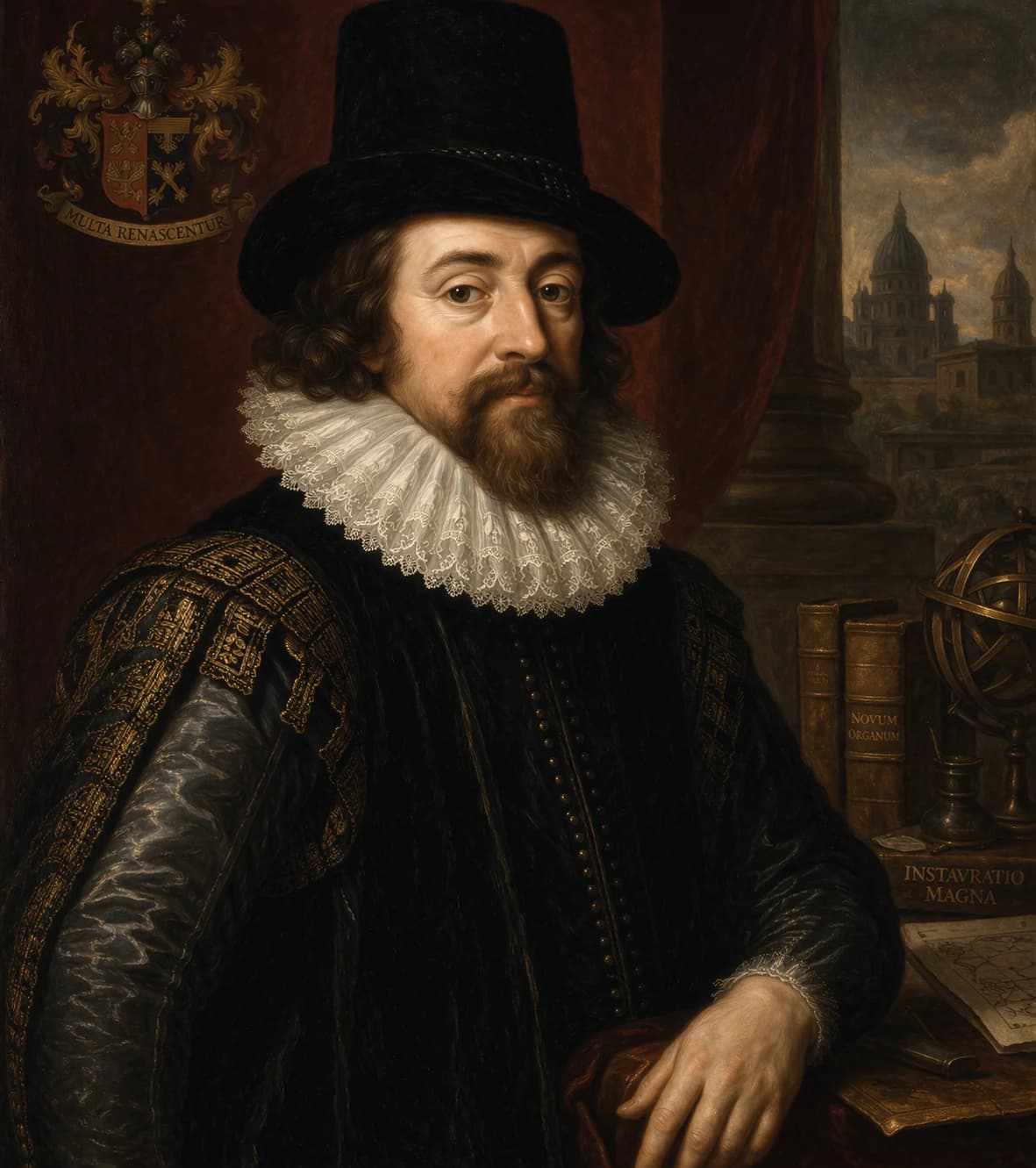
AI-generated portrait of Francis Bacon in formal Jacobean attire
AI-assisted historical reconstruction

An illustrative reconstruction based on historical context. It is not a photograph or documentary likeness. Image policy

Quick answer

Francis Bacon was an English philosopher, lawyer and statesman whose writings on experiment, induction and empirical inquiry helped shape the modern scientific method.

Born
1561 CE
Died
1626 CE
Role
English philosopher and statesman
Years
1561-1626 CE
Facts

Francis Bacon timeline facts

Selected specifics from this profile's life story.

1561
Privileged beginnings

Francis Bacon was born in London in 1561 into a powerful Elizabethan family, giving him early access to politics, scholarship, and the machinery of government.

1590s–1600s
Climbing influence

Under James I, Bacon rose through law and government, becoming a leading Jacobean official while sharpening his case for a new method of inquiry.

1621
Fall from grace

In 1621, Bacon was impeached for corruption, admitted taking gifts from litigants, and lost the offices that had crowned his public career.

Post-1626
Enduring influence

Bacon's legacy lies in making empirical investigation a cultural ideal, even though modern science developed through many methods beyond his own.

Life Journey

From court ambition to intellectual reinvention

Follow the story in a more continuous narrative, with a reading mode that matches how much depth you want.

Complete chronology

1561

Privileged beginnings

Francis Bacon entered the world close to the center of Elizabethan power. His father, Sir Nicholas Bacon, served as Lord Keeper of the Great Seal, and his mother, Anne Cooke Bacon, was a learned woman with strong Protestant intellectual connections. This household mattered. Bacon grew up where law, religion, classical learning, royal service, and political calculation met daily. Knowledge was not a private ornament; it was a tool of statecraft and persuasion. That early environment helps explain the unusual double life he later pursued. Bacon wanted office, influence, and honor, but he also wanted to reorganize the way human beings searched for truth. From the beginning, ambition and intellect were not separate tracks. They fed one another, sometimes productively, sometimes destructively.

1573–1576

Early academic path

Bacon went to Trinity College, Cambridge, as a boy, entering an educational world still shaped by Aristotle, disputation, and reverence for ancient texts. He did not simply reject classical learning; he was deeply formed by it. But he became dissatisfied with a method that often seemed to refine arguments more than expand knowledge. To Bacon, scholars were too willing to begin with accepted principles and reason downward, trapping themselves inside elegant systems. Nature, he believed, had to be questioned more patiently and more practically. This early frustration became the seed of his later program. He wanted learning to move beyond commentary and verbal victory toward experiment, observation, and useful discovery. In that sense, Bacon's scientific importance began as a complaint against a classroom.

1580s

Entering public life

After time in France and the death of his father, Bacon had to make his own way through law and politics. He entered Gray's Inn, sat in Parliament, and pursued patronage with persistent, sometimes anxious energy. Advancement came more slowly than he wanted. He was gifted, connected, and intellectually ambitious, yet he also faced debt, rivalry, and the awkward fact that brilliance did not guarantee royal favor. These years gave his thought a worldly edge. Bacon did not write about knowledge as a cloistered philosopher removed from use. He imagined knowledge as power in the literal sense: a means to improve medicine, agriculture, navigation, industry, and government. His political career taught him how institutions could resist change. His philosophy tried to design a method strong enough to outlast individual careers.

1590s–1600s

Climbing influence

The accession of James I in 1603 changed Bacon's prospects. He advanced through legal office, became Solicitor General, Attorney General, and eventually Lord Chancellor, while also receiving honors including a peerage. His rise was not merely ceremonial. Bacon was now inside the heart of Jacobean governance, dealing with law, royal authority, Parliament, and court politics. At the same time, he continued to present knowledge reform as a national project. England, he argued in effect, could become stronger if it stopped treating learning as a museum of inherited opinions and began organizing inquiry as a collective enterprise. Bacon's career therefore joined two kinds of reform: political service to the crown and intellectual service to future discovery. The union was powerful, but fragile.

1620

New method proposed

Bacon's most important intellectual achievement was methodological rather than experimental. In Novum Organum, published in 1620 as part of his larger unfinished project, he attacked the habits that made human understanding unreliable. People rushed to general principles, bent evidence to favorite explanations, trusted words too much, and allowed custom, authority, and personal preference to distort judgment. Bacon called these distortions 'idols', a memorable diagnosis of intellectual error. His alternative was patient induction: gather particulars, compare cases, test, exclude, and rise carefully toward more reliable conclusions. He did not invent experiment single-handedly, and modern science did not simply follow a Baconian recipe. But he gave the Scientific Revolution one of its great manifestos: knowledge should be built from disciplined engagement with the world, not from reverence for inherited certainty.

1618

Peak authority

Bacon's appointment as Lord Chancellor placed him at the top of the legal system and close to the king's inner world. It seemed the vindication of decades of effort. He had become what he had long wanted to be: a man of office, title, and national consequence. But the position also exposed him to the dangers of court politics and judicial culture. Gift-giving was common, patronage was everywhere, and the line between accepted practice and corrupt influence could become dangerously blurred. Bacon's enemies had reasons to attack him, but his conduct also gave them material. The contrast between his public philosophy and his political vulnerability is stark. The man who warned against the mind's corrupting idols now stood in a system where favor, money, and judgment were entangled.

1621

Fall from grace

Bacon's fall was sudden and humiliating. Parliament accused him of accepting gifts from people whose cases came before him. He admitted taking presents, though he denied that they had changed his judgments. That distinction did not save him. He was fined, imprisoned briefly in the Tower, stripped of office, and barred from public employment. Political enemies and wider tensions between crown and Parliament shaped the moment, but Bacon was not simply an innocent victim of faction. His behavior belonged to a compromised political culture, and his punishment marked the end of his career as a statesman. The fall damaged his reputation permanently. It also forced a separation between Bacon the officeholder and Bacon the thinker. The first had failed. The second now had more room to work.

1621–1626

Return to writing

The final years of Bacon's life were intellectually fertile. Removed from office, he returned to the grand project he called the Great Instauration, a renewal of learning. He wrote history, essays, natural philosophical works, and New Atlantis, an unfinished utopian fiction that imagined a research institution devoted to organized experiment and public benefit. That vision later resonated with the culture of scientific societies, especially the Royal Society founded after his death. Bacon also remained a complex figure: ambitious, morally compromised, intellectually generous, and sometimes overconfident about method. He did not conduct the experiments that made Galileo, Kepler, Harvey, or Newton famous. His importance lay in changing the expectations around inquiry. He made the search for knowledge sound collective, disciplined, useful, and open-ended.

Post-1626

Enduring influence

Bacon died in 1626, traditionally linked to an experimental attempt involving the preservation of meat with snow, though the story should not be made to carry too much symbolism. His posthumous reputation grew because later generations found in him a language for what science might become: empirical, collaborative, skeptical of authority, and directed toward practical improvement. He was not the sole founder of the scientific method, and the phrase can oversimplify a messy history involving mathematics, instruments, institutions, craft knowledge, and many thinkers across Europe and beyond. Yet Bacon mattered profoundly because he gave that transformation a public philosophy. He taught readers to distrust premature certainty and to imagine knowledge as something built by disciplined inquiry over time. His legacy is not a single discovery. It is a change in intellectual posture.

Continue in context

Connected stories

Move from the profile into the wider events and settings this figure belongs to.

Tertiary paths

Content note

This profile is written for educational use and connects to related Stories of History pages. The main portrait is an AI-assisted historical reconstruction, included as an illustrative aid rather than documentary evidence. Image policy

References

Sources & Further Reading

Reliable reference works, archives and reading paths connected to this profile.

Further reading

  1. Encyclopaedia Britannica, Search results for Francis Bacon,” accessed June 2026.Open source
  2. WorldCat, Books and library holdings for Francis Bacon,” accessed June 2026.Open source

Primary sources

  1. Library of Congress, Search results for Francis Bacon,” accessed June 2026.Open source

Reviewed claim sources

Loading reviewed claim sources...

A weekly route through history

Find out first about the latest published stories, feature notes and occasional Premium offers in one weekly email.