People

Johannes Kepler

Johannes Kepler was a German astronomer and mathematician whose three laws of planetary motion transformed astronomy and helped prepare Newtonian physics.

Born
1571 CE
Died
1630 CE
Role
German astronomer

German astronomer (1571–1630)

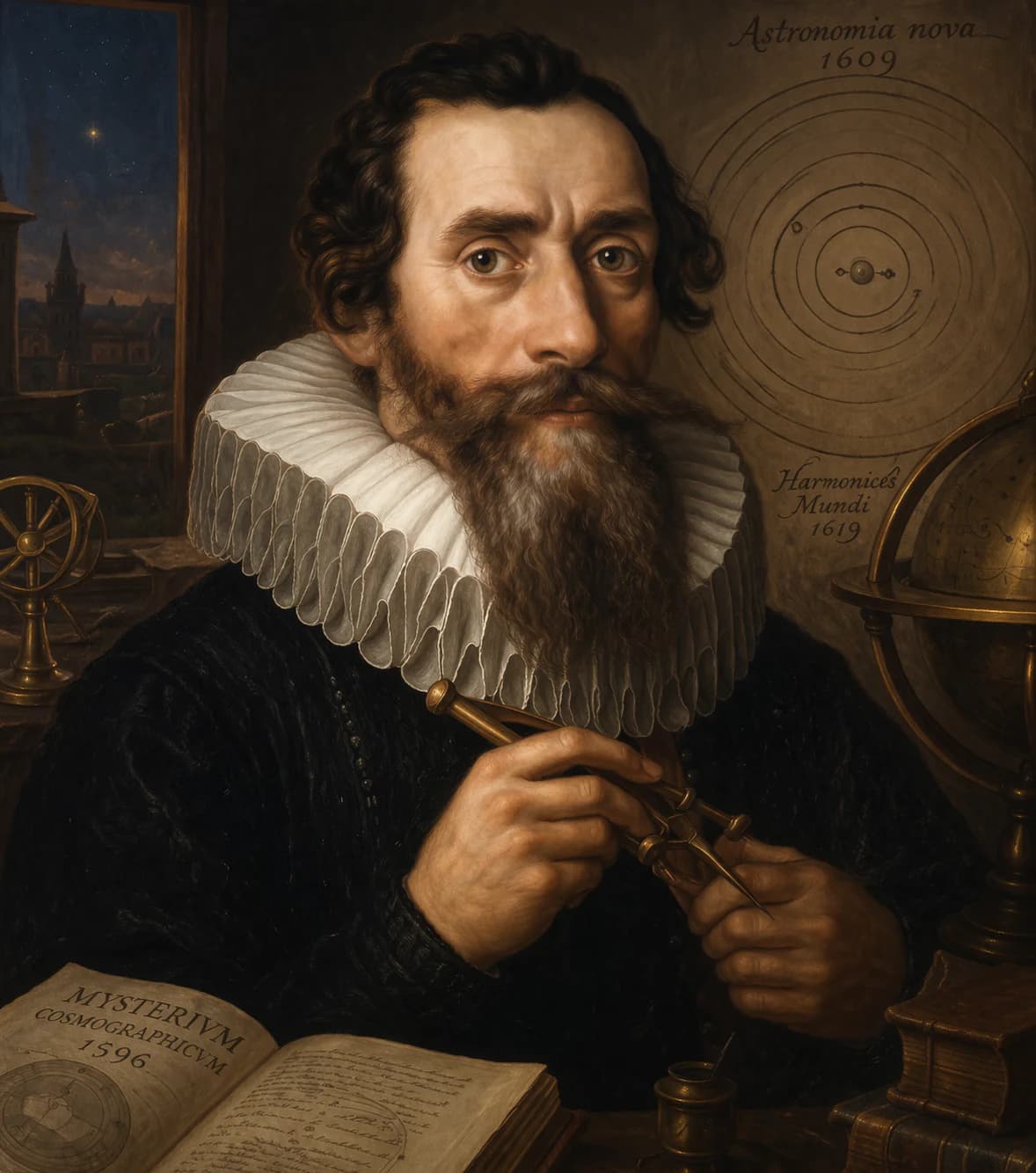
AI-generated portrait of Johannes Kepler in 17th-century scholarly attire
AI-assisted historical reconstruction

An illustrative reconstruction based on historical context. It is not a photograph or documentary likeness. Image policy

Quick answer

Johannes Kepler was a German astronomer and mathematician whose three laws of planetary motion transformed astronomy and helped prepare Newtonian physics.

Born
1571 CE
Died
1630 CE
Role
German astronomer
Years
1571-1630 CE
Facts

Johannes Kepler timeline facts

Selected specifics from this profile's life story.

1571
Humble beginnings

Johannes Kepler was born in Weil der Stadt in 1571, a sickly child in a troubled family who became fascinated by the heavens.

1600
Working with Brahe

Kepler joined Tycho Brahe near Prague in 1600, gaining access to the most accurate pre-telescopic planetary observations in Europe.

1619
Harmonic law

In Harmonices Mundi, Kepler found that planetary periods and distances obey a single mathematical relationship across the solar system.

1630
Enduring influence

Kepler died in 1630, leaving laws of planetary motion that became essential to Newton, modern astronomy and space science.

Life Journey

A search for order in the heavens

Follow the story in a more continuous narrative, with a reading mode that matches how much depth you want.

Complete chronology

1571

Humble beginnings

Johannes Kepler was born on 27 December 1571 in Weil der Stadt, in the Holy Roman Empire. His childhood was marked by illness, poor eyesight, family instability and the religious divisions of Lutheran Germany. None of this suggested an easy path to scientific immortality. Yet Kepler remembered seeing the Great Comet of 1577 and a lunar eclipse in 1580, experiences that helped fix the sky in his imagination. His mother, Katharina, was later accused of witchcraft, a case Kepler would help fight. From the beginning, his life joined cosmic order and earthly disorder. He searched the heavens for harmony while living through poverty, war, religious exclusion and domestic strain.


1589–1594

Education and belief

Kepler studied at the University of Tubingen intending to become a Lutheran pastor. There he learned mathematics and encountered the heliocentric system of Nicolaus Copernicus. For Kepler, Copernicus was not merely a technical improvement. A sun-centered cosmos seemed theologically and mathematically meaningful, because he believed creation had been ordered by a rational God. This conviction made him both bold and vulnerable. He was willing to break with inherited models, but he also looked for harmonies that sometimes carried him into speculative geometry. Kepler's science was not secular in the modern sense. His faith pushed him toward mathematics as the grammar of creation.

1594

First teaching role

Kepler became a mathematics teacher in Graz in 1594, a post that required calendars, astrology and instruction as much as pure astronomy. In 1596 he published Mysterium Cosmographicum, arguing that the spacing of the planets reflected the five Platonic solids nested between their spheres. The theory was wrong, but it was wrong in a productive way. It defended Copernicus, treated the planetary system as a coherent mathematical structure and announced Kepler's lifelong conviction that apparent complexity concealed design. He was not simply collecting observations. He wanted to know why the cosmos had the shape it did.

1600

Working with Brahe

Religious pressure pushed Kepler out of Graz and toward the court of Rudolf II in Prague, where Tycho Brahe had assembled the best observational data in Europe. Brahe was an aristocratic observer; Kepler was a restless mathematical theorist. Their partnership was tense. Brahe guarded his data, especially observations of Mars, while Kepler needed precisely that data to test planetary models. When Brahe died in 1601, Kepler succeeded him as imperial mathematician and gained fuller access. The result was one of the great fusions in scientific history: exact observation meeting a mind willing to abandon beautiful error.

1609

Elliptical orbits

Kepler's work on Mars was exhausting because the planet refused to behave. The inherited assumption from ancient astronomy was that heavenly motion must be circular, because circles seemed perfect. Kepler tried circles, epicycles and variations, but Brahe's data left stubborn errors. Eventually he accepted the unthinkable: Mars moved around the sun in an ellipse, with the sun at one focus. Published in Astronomia Nova in 1609, this first law was a revolution disguised as geometry. It replaced aesthetic perfection with mathematical fidelity to nature. The heavens were still ordered, but not according to the old human preference for circles.

1609

Changing speeds

The second law, also presented in Astronomia Nova, described not just where planets move but how their speed changes. A line from the sun to a planet sweeps out equal areas in equal times, so planets move faster near the sun and slower when farther away. This insight undermined the idea of uniform circular motion even more deeply. Kepler did not possess Newton's concept of gravity, but he sensed that the sun physically mattered in planetary motion. The solar system was becoming dynamic, not a set of polished spheres turning by abstract perfection.

1619

Harmonic law

Kepler's third law appeared in Harmonices Mundi in 1619, a book filled with music, geometry and cosmological ambition. The lasting result was precise: the square of a planet's orbital period is proportional to the cube of its average distance from the sun. Suddenly the planets were not separate puzzles but members of a single mathematical system. This law gave later scientists, especially Isaac Newton, the pattern that a theory of gravity would explain. Kepler still described the cosmos in terms of harmony, but his harmony had become calculable rather than decorative.

1615–1620

Personal struggles

Kepler's life was repeatedly disrupted. As a Lutheran in Catholic territories, he faced exclusion and suspicion; as an imperial mathematician, he often struggled to be paid; as the Thirty Years' War spread, stability collapsed around him. The witchcraft accusation against his mother Katharina in 1615 was a personal crisis as well as a window into the fears of early modern Europe. Kepler helped prepare her legal defense, and she was eventually released, though badly damaged by imprisonment. Amid all this, he produced the Rudolphine Tables, published in 1627, which became the most accurate astronomical tables of their age. His genius was not serene. It worked under pressure.

1630

Enduring influence

Kepler died in Regensburg in 1630 while seeking payment of salary arrears. His grave was later lost during the Thirty Years' War, but his equations survived. The three laws of planetary motion transformed astronomy because they made the solar system mathematically legible without forcing it into ancient ideals. Newton later showed that Kepler's laws followed from universal gravitation, turning Kepler's descriptive breakthroughs into part of a deeper physical theory. Modern spacecraft navigation still depends on principles descended from his work. To ask why Johannes Kepler was important is to see the Scientific Revolution at its most human: mystical, mathematical, stubborn, wrong in fascinating ways, and finally right where the data demanded it.

Continue in context

Connected stories

Move from the profile into the wider events and settings this figure belongs to.

Tertiary paths

Content note

This profile is written for educational use and connects to related Stories of History pages. The main portrait is an AI-assisted historical reconstruction, included as an illustrative aid rather than documentary evidence. Image policy

References

Sources & Further Reading

Reliable reference works, archives and reading paths connected to this profile.

Further reading

  1. Encyclopaedia Britannica, Search results for Johannes Kepler,” accessed June 2026.Open source
  2. WorldCat, Books and library holdings for Johannes Kepler,” accessed June 2026.Open source

Primary sources

  1. Library of Congress, Search results for Johannes Kepler,” accessed June 2026.Open source

Reviewed claim sources

Loading reviewed claim sources...

A weekly route through history

Find out first about the latest published stories, feature notes and occasional Premium offers in one weekly email.