People

Nicolaus Copernicus

Nicolaus Copernicus was a Renaissance astronomer from Royal Prussia whose 1543 work De revolutionibus proposed a heliocentric model with Earth orbiting the Sun, transforming astronomy and helping begin the Scientific Revolution.

Born
1473 CE
Died
1543 CE
Role
Polish astronomer

Polish astronomer (1473–1543)

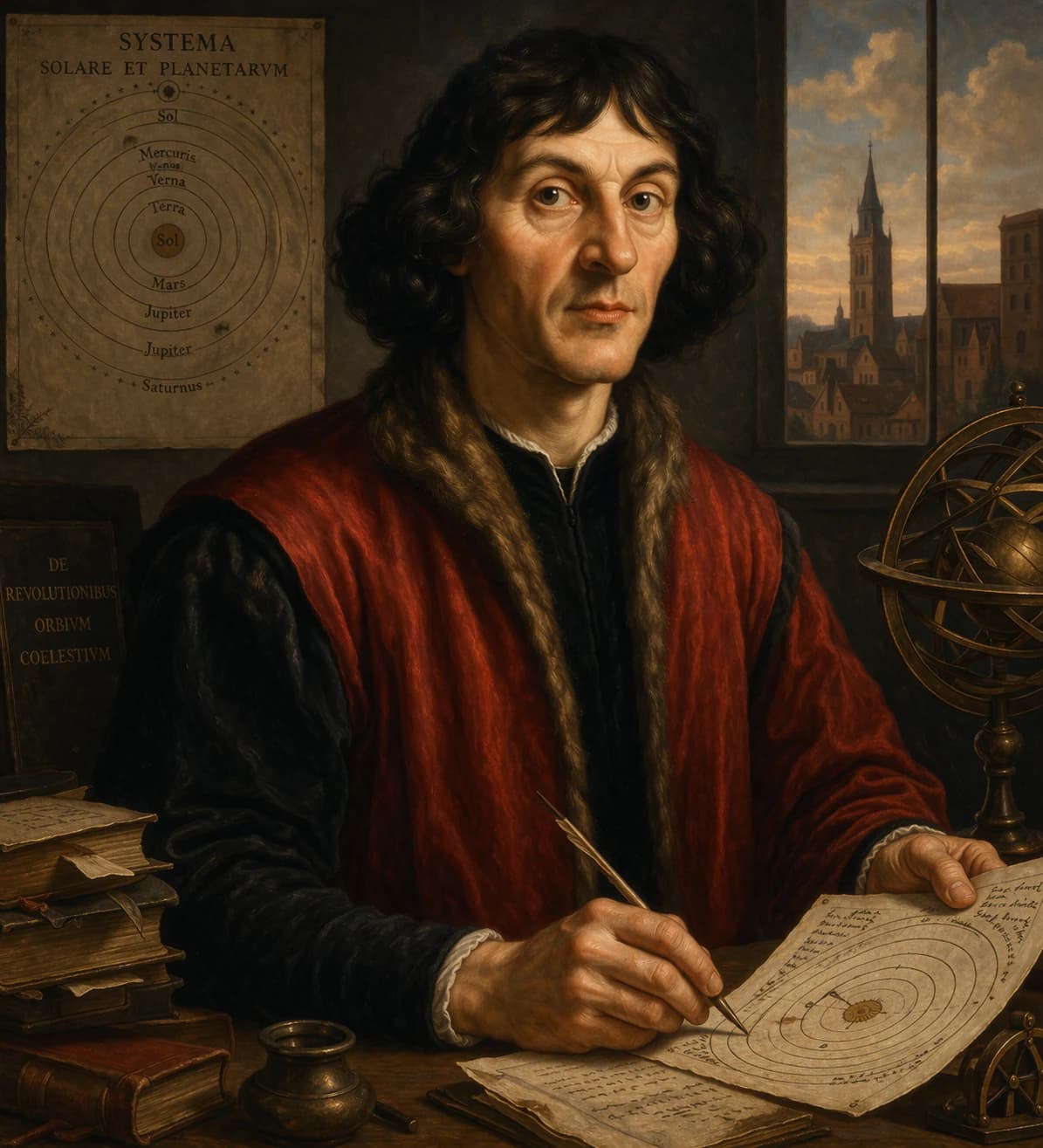
AI-generated portrait of Nicolaus Copernicus in 16th-century clerical attire
AI-assisted historical reconstruction

An illustrative reconstruction based on historical context. It is not a photograph or documentary likeness. Image policy

Quick answer

Nicolaus Copernicus was a Renaissance astronomer from Royal Prussia whose 1543 work De revolutionibus proposed a heliocentric model with Earth orbiting the Sun, transforming astronomy and helping begin the Scientific Revolution.

Born
1473 CE
Died
1543 CE
Role
Polish astronomer
Years
1473-1543 CE
Facts

Nicolaus Copernicus timeline facts

Selected specifics from this profile's life story.

1473
Merchant’s Son

Nicolaus Copernicus was born in the trading city of Toruń, where his early environment exposed him to both commerce and learning.

c.1510
Questioning Earth’s Place

He began to suspect that placing Earth at the center of the universe created unnecessary complexity in explaining planetary motion.

1543
A Risky Publication

His major work was finally published near the end of his life, introducing the heliocentric model to a wider audience.

After 1600
A New Perspective

Copernicus’s work laid the foundation for modern astronomy, permanently altering how humanity understands its place in the universe.

Life Journey

A quiet revolution in how we see the universe

Follow the story in a more continuous narrative, with a reading mode that matches how much depth you want.

Complete chronology

1473

Merchant’s Son

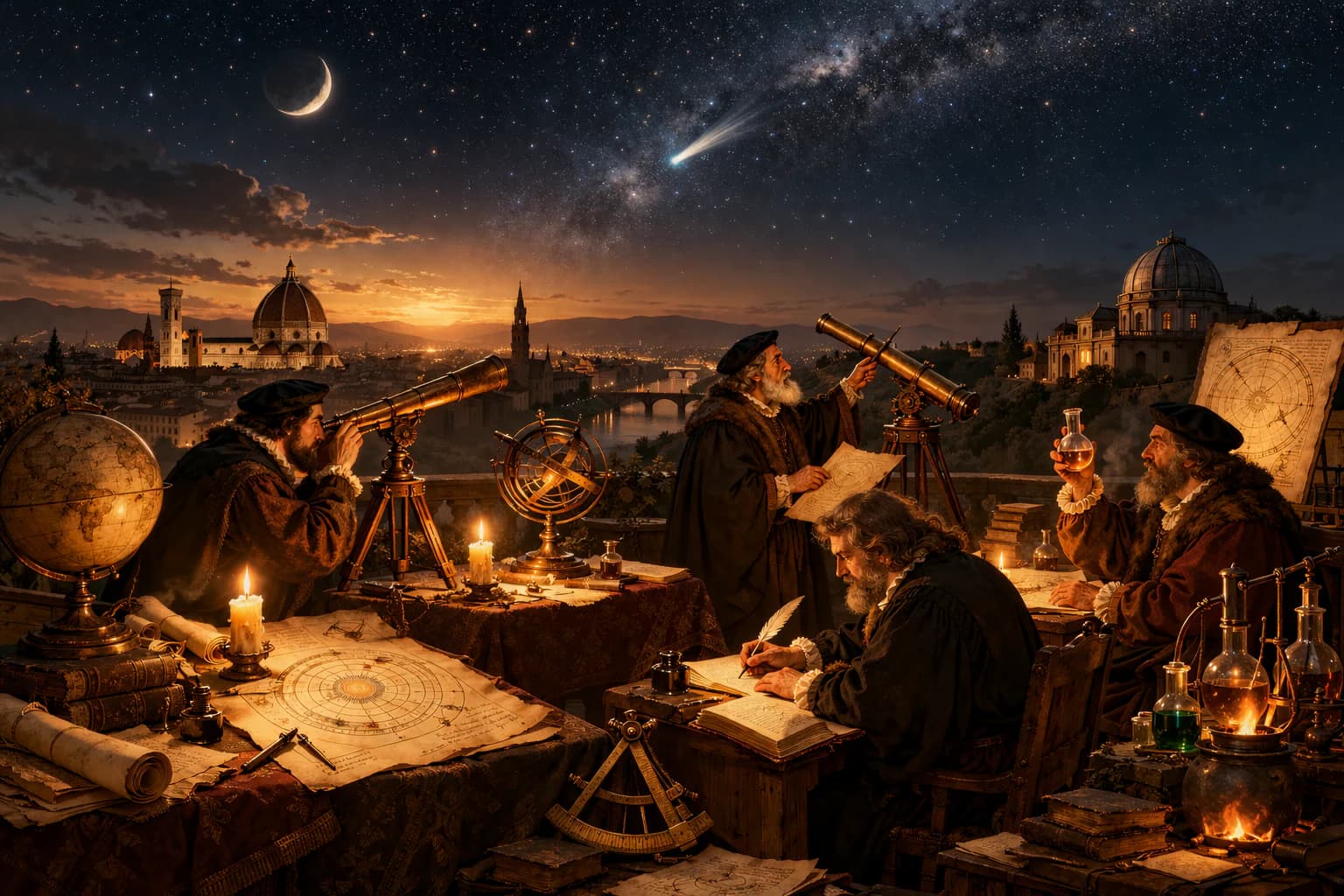
Nicolaus Copernicus was born in Torun in 1473, in Royal Prussia under the Polish crown, into a prosperous merchant family. His world was urban, multilingual and connected by trade as much as by scholarship. After his father's death, his uncle Lucas Watzenrode, later bishop of Warmia, became his patron and protector. That support gave Copernicus access to education and eventually to a secure church position. He was not a wandering rebel against religion, as simplified stories sometimes imply. He was a Renaissance church administrator, mathematician, physician, legal scholar and astronomer whose intellectual life grew inside institutions that valued calendars, learning and order. His revolution began quietly, from within the educated world of late medieval and Renaissance Europe.

1491–1503

Student of Many Fields

Copernicus studied at Krakow, then in Italy at Bologna, Padua and Ferrara, moving through the great educational circuits of Renaissance Europe. His subjects included mathematics, astronomy, canon law, medicine and Greek. Astronomy at the time was bound to calendar reform, astrology, navigation, mathematics and philosophy. The dominant framework came from Aristotle and Ptolemy: Earth stood at the centre while planets moved through complex combinations of circles. Copernicus did not reject this world casually. He learned it deeply. Exposure to ancient texts also showed him that alternative cosmic arrangements had been imagined before, including ideas associated with Aristarchus. His originality lay in turning scattered possibility into a full mathematical programme.

1503

Church Official

Copernicus spent much of his adult life as a canon of Frombork Cathedral in Warmia. The post did not mean he was a priest in the modern popular sense; it was an ecclesiastical office with administrative, legal and financial responsibilities. He managed estates, advised on currency reform, practised medicine for his community and helped defend Warmia during conflict with the Teutonic Order. This practical life gave him security, but not leisure without duties. His astronomy developed in spare hours, through observation, calculation and correspondence. The quietness of his career matters. Copernicus did not set out to become a public revolutionary. He worked like a patient administrator of the heavens, dissatisfied with accounts that no longer seemed orderly enough.

c.1510

Questioning Earth’s Place

The Ptolemaic system could predict planetary positions with impressive sophistication, but it required devices such as epicycles, deferents and the equant to make the heavens work mathematically. Copernicus objected especially to features that seemed to violate the ideal of uniform circular motion. His question was radical because it attacked the assumption beneath the machinery. What if the apparent wandering of the planets was partly caused by Earth's own motion? Retrograde motion, the backward loop planets seem to trace in the sky, became easier to understand if Earth and the other planets moved around the Sun at different speeds. Copernicus was not yet modern in every way. He still loved circles. But he had shifted the centre of explanation.

c.1514

Sun-Centered System

Around 1514 Copernicus circulated a short manuscript now known as the Commentariolus, outlining a heliocentric arrangement. In his model, Earth rotated daily, orbited the Sun yearly, and no longer occupied the privileged centre of planetary motion. The Moon still orbited Earth, and the fixed stars lay at an immense distance. This structure gave a more coherent order to the planets and explained retrograde motion without making planets physically reverse course. Yet the model was not instantly simpler in every detail because Copernicus retained circular motion and still needed epicycles. Its power was conceptual. It turned Earth from the still platform of observation into one moving body among others, changing the observer's place in the universe.

1514–1540

Years of Refinement

Copernicus delayed full publication for decades. Fear of ridicule from mathematicians probably mattered at least as much as fear of church punishment, which became sharper only later in the history of heliocentrism. His model challenged common sense: anyone could feel the Earth standing still, and Scripture, Aristotle and ordinary experience seemed to agree. Copernicus kept refining tables, geometry and arguments while continuing his Warmian duties. Friends and scholars knew something of his theory, and interest grew. His caution was not mere timidity. To move Earth required a system strong enough to survive expert attack. He wanted mathematical order, not a manifesto. That patience helped give his eventual book its authority.

1543

A Risky Publication

The arrival of Georg Joachim Rheticus, a young mathematician from Wittenberg, finally pushed Copernicus toward publication. Rheticus studied with him, promoted the theory and helped arrange the printing of De revolutionibus orbium coelestium, published in 1543. The book was mathematically dense, cautious in tone and dedicated to Pope Paul III. An anonymous preface by Andreas Osiander, added without Copernicus' full approval, framed the model as a calculating device rather than a claim about physical reality, softening its danger but also blurring its ambition. According to tradition, Copernicus saw a finished copy near his death. Whether or not the scene unfolded so neatly, the timing was extraordinary: a lifetime's private order entered print as its author left the world.

1543–1600s

Slow Acceptance

Copernicus did not instantly overthrow the old universe. Many readers treated heliocentrism as a useful mathematical hypothesis rather than a physical truth. The model still lacked a new physics explaining why a moving Earth did not fling objects away, and its predictions were not automatically superior in every respect. The transformation came through later work. Tycho Brahe's observations, Kepler's elliptical orbits, Galileo's telescopic discoveries and Newton's mechanics gradually made a moving Earth part of a stronger explanatory system. Religious controversy intensified in the seventeenth century, especially around Galileo. Copernicus began a revolution, but revolutions in knowledge often move by relay. His book opened a door others had to walk through.

After 1600

A New Perspective

Copernicus' legacy is not that he got everything right. He did not discover elliptical orbits, gravity or the true scale of the universe. His system retained ancient commitments even as it overturned the greatest ancient assumption. His importance is that he changed the question. Instead of asking how to preserve Earth's central stillness, astronomers could ask what arrangement made celestial motions intelligible. That shift helped undermine inherited authority when authority could not match mathematical and observational explanation. The Copernican Revolution became a symbol for any intellectual transformation that displaces humanity from comfortable certainty. To ask why Copernicus was important is to see how a cautious canon in Frombork changed the architecture of reality without leading an army, founding a church or ruling a state.

Continue in context

Connected stories

Move from the profile into the wider events and settings this figure belongs to.

Tertiary paths

Content note

This profile is written for educational use and connects to related Stories of History pages. The main portrait is an AI-assisted historical reconstruction, included as an illustrative aid rather than documentary evidence. Image policy

References

Sources & Further Reading

Reliable reference works, archives and reading paths connected to this profile.

Further reading

  1. Encyclopaedia Britannica, Search results for Nicolaus Copernicus,” accessed June 2026.Open source
  2. WorldCat, Books and library holdings for Nicolaus Copernicus,” accessed June 2026.Open source

Primary sources

  1. Library of Congress, Search results for Nicolaus Copernicus,” accessed June 2026.Open source

Reviewed claim sources

Loading reviewed claim sources...

A weekly route through history

Find out first about the latest published stories, feature notes and occasional Premium offers in one weekly email.