People

Johannes Gutenberg

Johannes Gutenberg was a German printer and innovator whose movable-type printing system, demonstrated in the 1450s, made books cheaper, more reproducible, and central to Renaissance and Reformation Europe.

Born
c. 1400 CE
Died
1468 CE
Role
German printer

German printer (c.1400-1468)

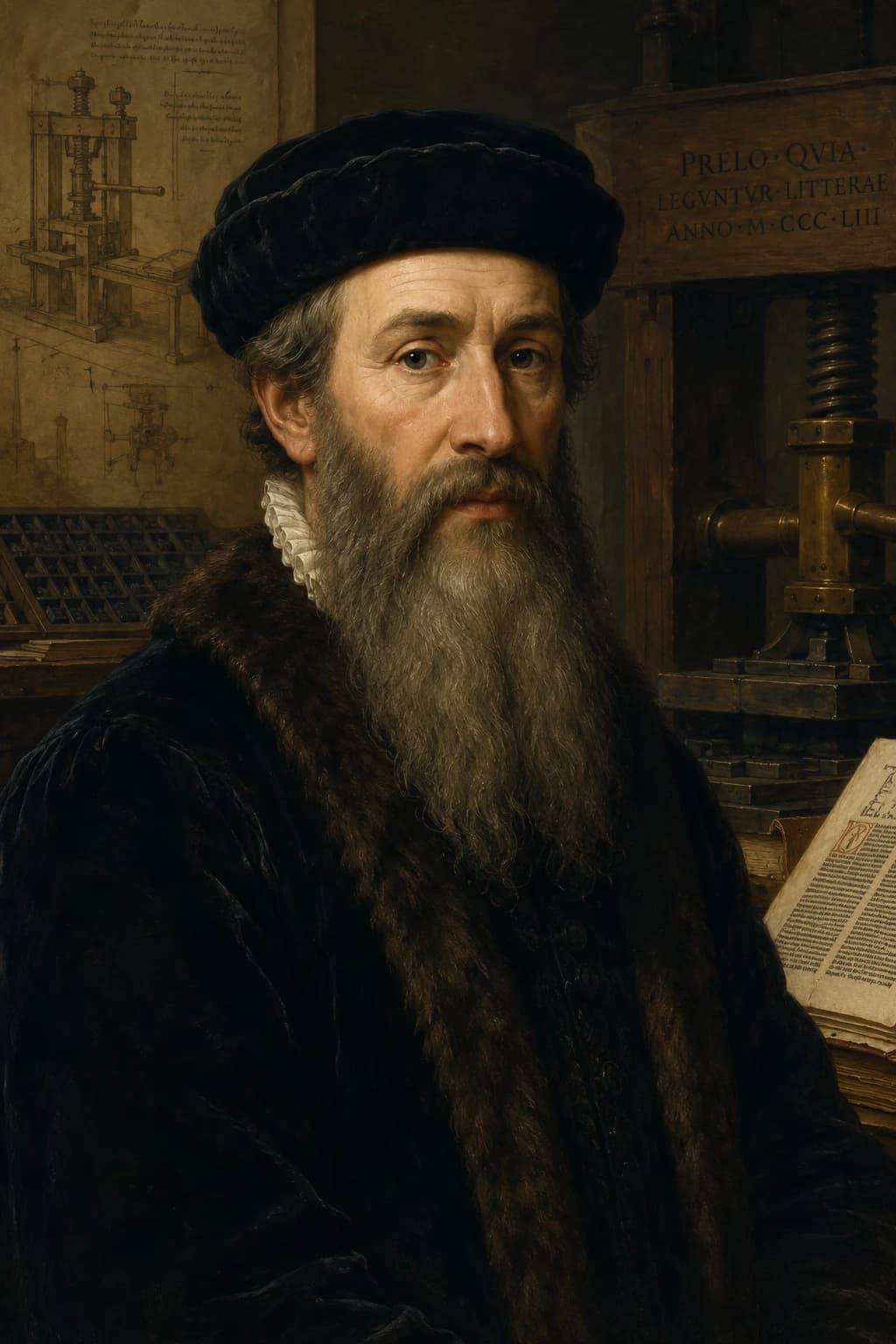
AI-generated portrait of Johannes Gutenberg with a printing press and movable type
AI-assisted historical reconstruction

An illustrative reconstruction based on historical context. It is not a photograph or documentary likeness. Image policy

Quick answer

Johannes Gutenberg was a German printer and innovator whose movable-type printing system, demonstrated in the 1450s, made books cheaper, more reproducible, and central to Renaissance and Reformation Europe.

Born
c. 1400 CE
Died
1468 CE
Role
German printer
Years
c. 1400-1468 CE
Quick facts

Profile details

Additional identity and tagging details that are not already covered in the introduction.

Also known as
Gutenberg
Facts

Johannes Gutenberg timeline facts

Selected specifics from this profile's life story.

c.1400
Mainz origins

Johannes Gutenberg was born in Mainz around 1400, in an urban world of trade, craft skill, and manuscript culture.

c.1455
Printed Bible

The Gutenberg Bible showed that printed books could be beautiful, accurate, and produced in multiple copies.

1460s-1500
Printing spreads

After Gutenberg, printing spread rapidly through European cities, changing education, religion, and scholarship.

After 1500
A new public for ideas

Gutenberg's legacy lies in making texts more reproducible, portable, and powerful as public arguments.

Life Journey

The press that changed how Europe learned

Follow Gutenberg from Mainz metalwork to a communications revolution that made Renaissance ideas move faster.

Complete chronology

c.1400

Mainz origins

Johannes Gutenberg was born in Mainz around 1400, probably into a patrician family connected to metalworking and local civic life. His early world still depended on manuscripts, copied by hand in monasteries, universities, and professional workshops. Books existed, but they were expensive, slow to produce, and vulnerable to copying errors. Gutenberg's later importance came from understanding that bookmaking could be reorganized as a technical system: metal, ink, paper, type, pressure, and business all had to work together.


1430s-1450s

Movable type system

Movable type had earlier histories in East Asia, but Gutenberg's breakthrough was a durable European system suited to alphabetic text and commercial production. Individual metal letters could be cast, arranged, inked, pressed, reused, and recombined. That sounds simple only after the fact. It required precision in metallurgy, type design, spacing, ink, paper, and pressure. The power of the system was reproducibility: once type was set, many copies could be made with far greater consistency than manuscript copying normally allowed.

c.1455

Printed Bible

The work most associated with Gutenberg is the Bible printed in the 1450s. It did not look like a crude replacement for manuscripts. Its pages were carefully designed to resemble prestigious handwritten books, proving that print could meet elite expectations while multiplying copies. The Bible mattered religiously, commercially, and symbolically. It showed that sacred and scholarly texts could enter a new material life, less dependent on the speed and accuracy of individual scribes.

1455

Legal trouble

Printing was not only an invention; it was a costly business. Gutenberg relied on investment, especially from Johann Fust, and legal conflict followed. A lawsuit in 1455 damaged Gutenberg's control over the enterprise and helped place parts of the printing operation in other hands. That dispute reminds us that transformative technologies are not born in clean heroic isolation. They require capital, materials, workshops, skilled labor, risk, and contracts that can fail.

1460s-1500

Printing spreads

After Gutenberg's system proved itself, printing spread from Mainz to cities across Europe. Printers, punchcutters, booksellers, scholars, and merchants created a new information economy. Classical texts, legal works, devotional books, maps, pamphlets, and scientific treatises could circulate more quickly and consistently. Print did not make Europe instantly literate or equal, but it widened access and accelerated debate. Renaissance humanism, religious reform, and scientific exchange all grew inside this new world of reproducible texts.

After 1500

A new public for ideas

Gutenberg did not invent reading, writing, paper, or every form of movable type. His significance lies in making a European printing system practical at a moment when demand for texts was rising. The result changed the conditions of knowledge. Errors could still spread, censorship could still operate, and books remained socially unequal, but argument had a new speed. To ask why Gutenberg matters is to see how technology can change not only what people know, but how communities argue about truth.

Continue in context

Connected stories

Move from the profile into the wider events and settings this figure belongs to.

Tertiary paths

Content note

This profile is written for educational use and connects to related Stories of History pages. The main portrait is an AI-assisted historical reconstruction, included as an illustrative aid rather than documentary evidence. Image policy

References

Sources & Further Reading

Reliable reference works, archives and reading paths connected to this profile.

Further reading

  1. Encyclopaedia Britannica, Search results for Johannes Gutenberg,” accessed June 2026.Open source
  2. WorldCat, Books and library holdings for Johannes Gutenberg,” accessed June 2026.Open source

Primary sources

  1. Library of Congress, Search results for Johannes Gutenberg,” accessed June 2026.Open source

Reviewed claim sources

Loading reviewed claim sources...

A weekly route through history

Find out first about the latest published stories, feature notes and occasional Premium offers in one weekly email.