People

Andreas Vesalius

Andreas Vesalius was a Renaissance anatomist whose De humani corporis fabrica used direct dissection and detailed illustrations to challenge Galenic anatomy and reshape medicine.

Born
1514 CE
Died
1564 CE
Role
Anatomist

Brabantian anatomist (1514-1564)

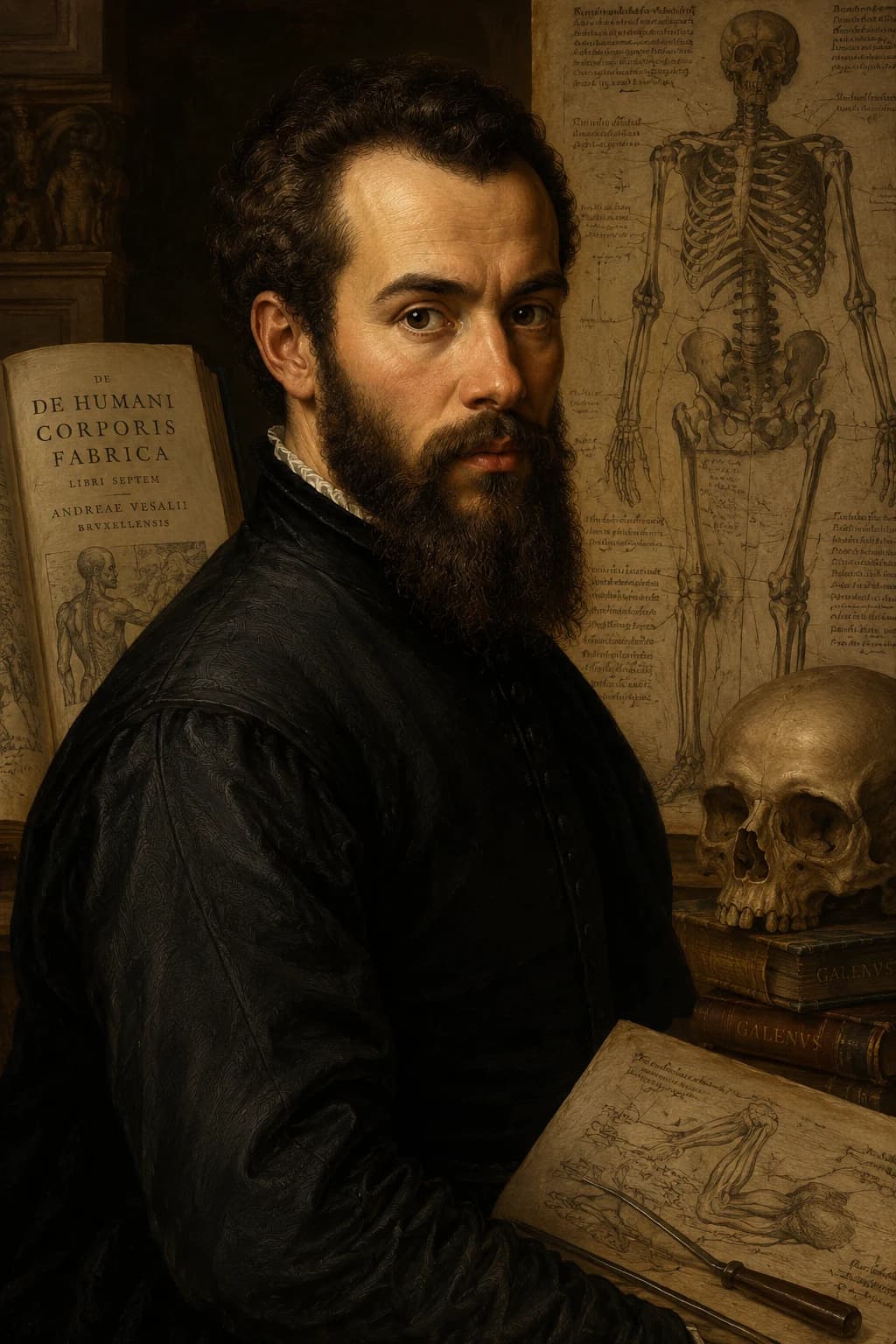
AI-generated portrait of Andreas Vesalius with anatomical drawings, books, and a skull
AI-assisted historical reconstruction

An illustrative reconstruction based on historical context. It is not a photograph or documentary likeness. Image policy

Quick answer

Andreas Vesalius was a Renaissance anatomist whose De humani corporis fabrica used direct dissection and detailed illustrations to challenge Galenic anatomy and reshape medicine.

Born
1514 CE
Died
1564 CE
Role
Anatomist
Years
1514-1564 CE
Quick facts

Profile details

Additional identity and tagging details that are not already covered in the introduction.

Also known as
Vesalius, Andries van Wesel
Facts

Andreas Vesalius timeline facts

Selected specifics from this profile's life story.

1514
Medical family

Andreas Vesalius was born in Brussels in 1514 into a family connected to medicine and imperial service.

1537
Anatomy professor

At Padua, Vesalius taught anatomy through direct dissection, making observation central to medical education.

1540s-1560s
Imperial physician

Vesalius later served as physician to Charles V and Philip II, moving from university anatomy into court medicine.

After 1564
Anatomy after authority

Vesalius died in 1564, but his work changed the authority of observation in medicine.

Life Journey

Anatomy rebuilt from observation

Follow Vesalius from medical training to the printed anatomy book that changed how Europe studied the body.

Complete chronology

1514

Medical family

Andreas Vesalius was born in Brussels in 1514, in the Habsburg Netherlands. His family had medical connections, and he grew up in a world where university medicine still leaned heavily on ancient authority, especially Galen. That inheritance was powerful, but not always accurate. Galen had worked largely from animal dissection, and medieval teaching often treated his texts as more authoritative than the body itself. Vesalius would make that tension the center of his career.


1530s

Paris and Padua

Vesalius studied at Paris and then Padua, two major centers of medical learning. Anatomy teaching often separated text from manual practice: professors lectured from authorities while assistants handled bodies. Vesalius moved against that division. He believed the anatomist had to see and dissect directly. The body was not merely an illustration of Galen. It was evidence. That shift in posture mattered as much as any single correction.

1537

Anatomy professor

Vesalius became professor of surgery and anatomy at Padua in 1537. There he staged anatomy as investigation. He dissected, demonstrated, corrected diagrams, and insisted that students attend to what could be seen. This did not mean rejecting all ancient learning. It meant changing the hierarchy between text and body. When inherited descriptions failed to match observation, observation had to count. That was a Renaissance method applied to medicine: return to the source, but in this case the source was the human body itself.

1543

The Fabrica

In 1543 Vesalius published De humani corporis fabrica, one of the most important books in the history of medicine. Its detailed illustrations and careful descriptions presented anatomy as something readers could inspect, compare, and verify. The book corrected important Galenic errors and showed how print could stabilize visual knowledge. It mattered that the work appeared the same year as Copernicus's De revolutionibus. Both books challenged inherited authority by reorganizing evidence in a form that could travel.

1540s-1560s

Imperial physician

After the Fabrica, Vesalius entered high-status medical service, becoming physician to Emperor Charles V and later Philip II of Spain. Court medicine offered prestige but less freedom for public anatomical research. His career therefore shows a common Renaissance pattern: innovation did not float above institutions. It had to move through universities, printers, patrons, courts, and religious expectations. Vesalius's book remained his central legacy because it preserved the investigative method even when his daily work changed.

After 1564

Anatomy after authority

Vesalius died in 1564 after a journey to the eastern Mediterranean. His legacy lies in changing what counted as anatomical knowledge. Ancient authorities still mattered, but they could no longer stand untouched when the body showed otherwise. The Fabrica made anatomy visual, comparative, and correctable. That did not create modern medicine overnight, but it changed the direction of medical learning. To ask why Vesalius mattered is to see the Renaissance method at work: inherited texts met direct observation, and observation began to win.

Continue in context

Connected stories

Move from the profile into the wider events and settings this figure belongs to.

Tertiary paths

Content note

This profile is written for educational use and connects to related Stories of History pages. The main portrait is an AI-assisted historical reconstruction, included as an illustrative aid rather than documentary evidence. Image policy

References

Sources & Further Reading

Reliable reference works, archives and reading paths connected to this profile.

Further reading

  1. Encyclopaedia Britannica, Search results for Andreas Vesalius,” accessed June 2026.Open source
  2. WorldCat, Books and library holdings for Andreas Vesalius,” accessed June 2026.Open source

Primary sources

  1. Library of Congress, Search results for Andreas Vesalius,” accessed June 2026.Open source

Reviewed claim sources

Loading reviewed claim sources...

A weekly route through history

Find out first about the latest published stories, feature notes and occasional Premium offers in one weekly email.