People

Mary I

Mary I was Queen of England and Ireland from 1553 to 1558, the first queen regnant of England. The daughter of Henry VIII and Catherine of Aragon, she restored Catholicism, married Philip of Spain, and became known as Bloody Mary for the Protestant burnings.

Born
1516 CE
Died
1558 CE
Role
First queen regnant of England

First queen regnant of England (1516–1558)

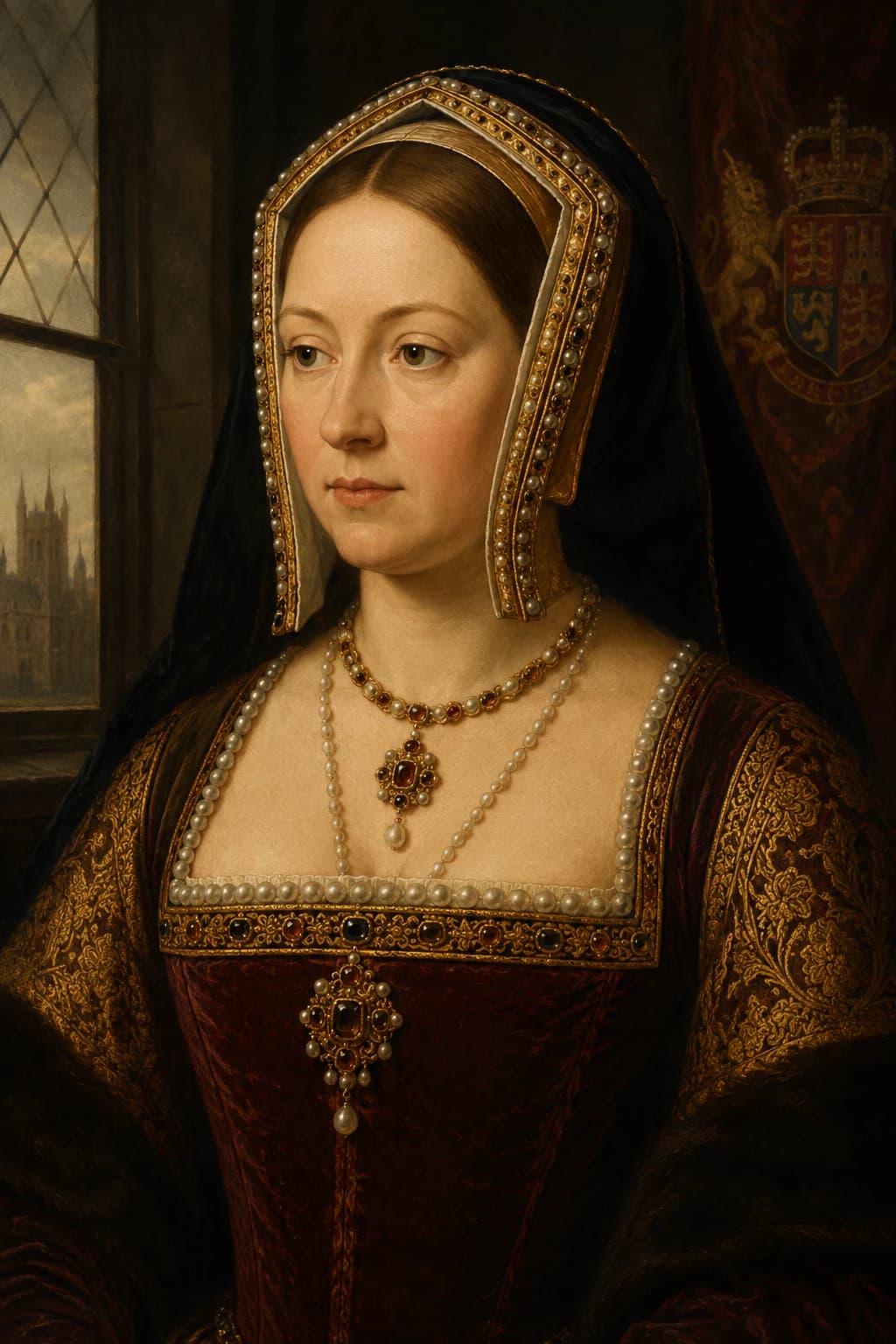
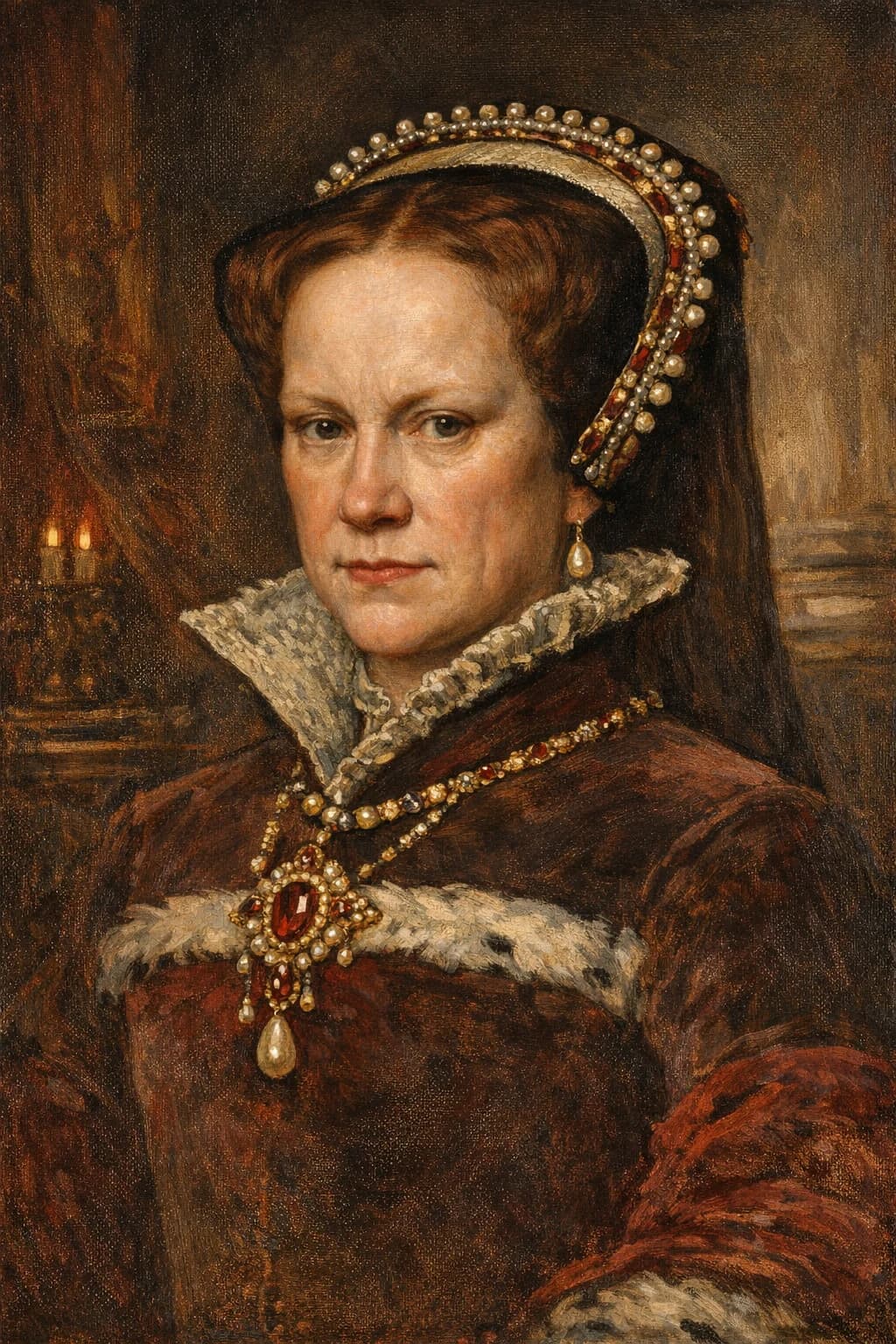
AI-generated portrait of Mary I in Tudor royal attire
AI-assisted historical reconstruction

An illustrative reconstruction based on historical context. It is not a photograph or documentary likeness. Image policy

Quick answer

Mary I was Queen of England and Ireland from 1553 to 1558, the first queen regnant of England. The daughter of Henry VIII and Catherine of Aragon, she restored Catholicism, married Philip of Spain, and became known as Bloody Mary for the Protestant burnings.

Born
1516 CE
Died
1558 CE
Role
First queen regnant of England
Years
1516-1558 CE
Quick facts

Profile details

Additional identity and tagging details that are not already covered in the introduction.

Also known as
Bloody Mary
Facts

Mary I timeline facts

Selected specifics from this profile's life story.

1516–1533
Princess and pawn

Born as the only surviving child of Henry VIII and Catherine of Aragon, Mary grew up as a prized princess before her father's annulment campaign overturned her world.

July 1553
Claiming her throne

When Edward VI's regime tried to replace her with Lady Jane Grey, Mary rallied support and won the throne in one of Tudor England's most dramatic reversals.

1557–1558
Loss of Calais

England's entry into Philip's war against France ended with the loss of Calais, England's last continental possession, a humiliation that amplified the gloom of the reign's final year.

Post-1558
Contested memory

Mary I's legacy was shaped almost entirely by Protestant historians, whose account of her burnings defined her reputation for centuries while her genuine political achievements were overlooked.

Life Journey

A queen who restored a faith and lost a reputation

Follow the story in a more continuous narrative, with a reading mode that matches how much depth you want.

Complete chronology

1516–1533

Princess and pawn

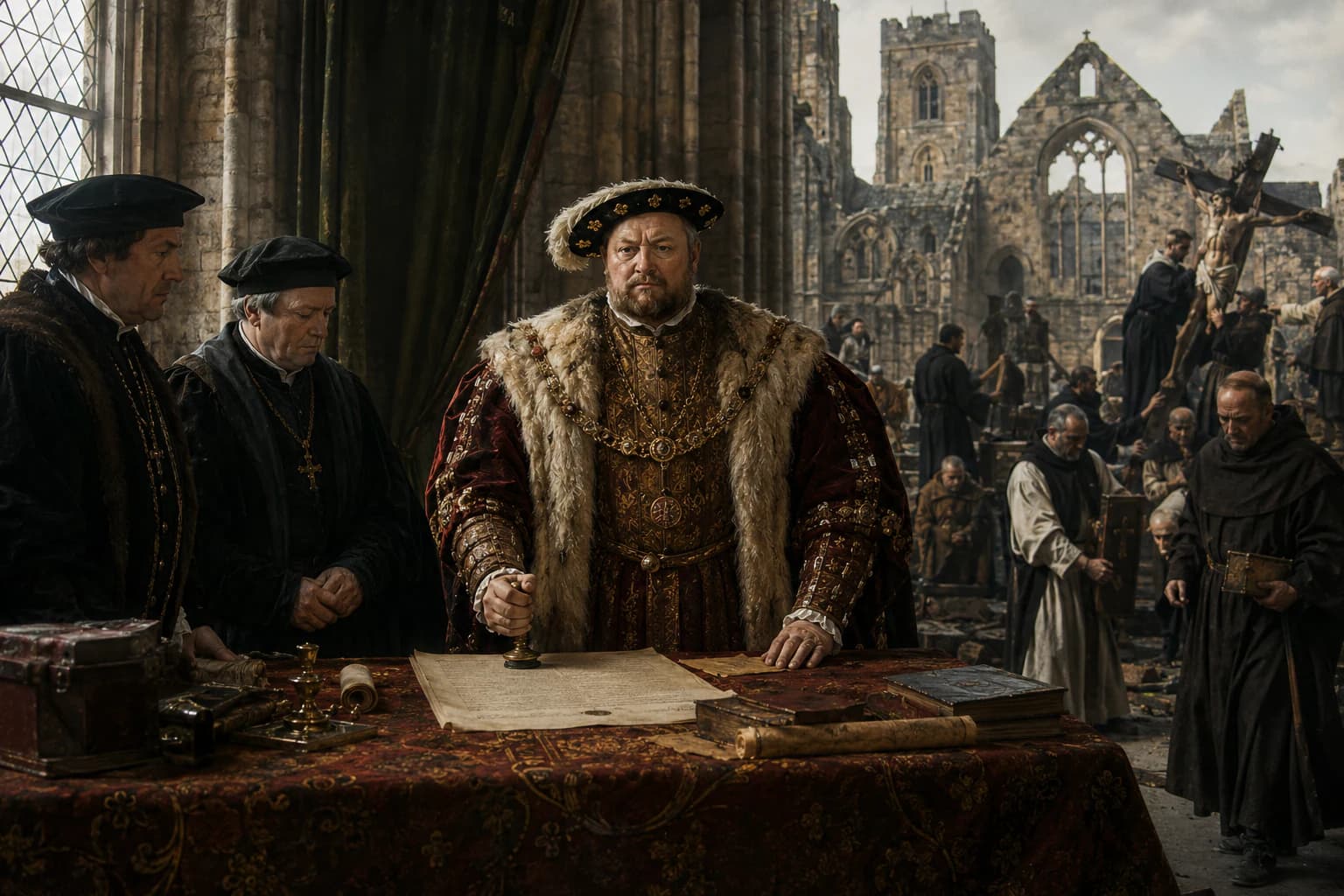
Mary Tudor was born in February 1516, the only surviving child of Henry VIII and his first queen, Catherine of Aragon. For the first fifteen years of her life she was treated as a significant princess: educated in languages, music and piety, proposed in marriage to European princes, and regarded by many as the most plausible heir if Henry produced no son. Her mother was the daughter of Ferdinand and Isabella of Spain, and Mary's household carried the seriousness of Spanish Catholic devotion. The catastrophe came through dynastic anxiety. Henry's desire for a male heir and his pursuit of Anne Boleyn transformed Mary from treasured daughter into a political obstacle. Before she ever ruled, she learned that legitimacy could be made and unmade by power.
1533–1536

Declared illegitimate

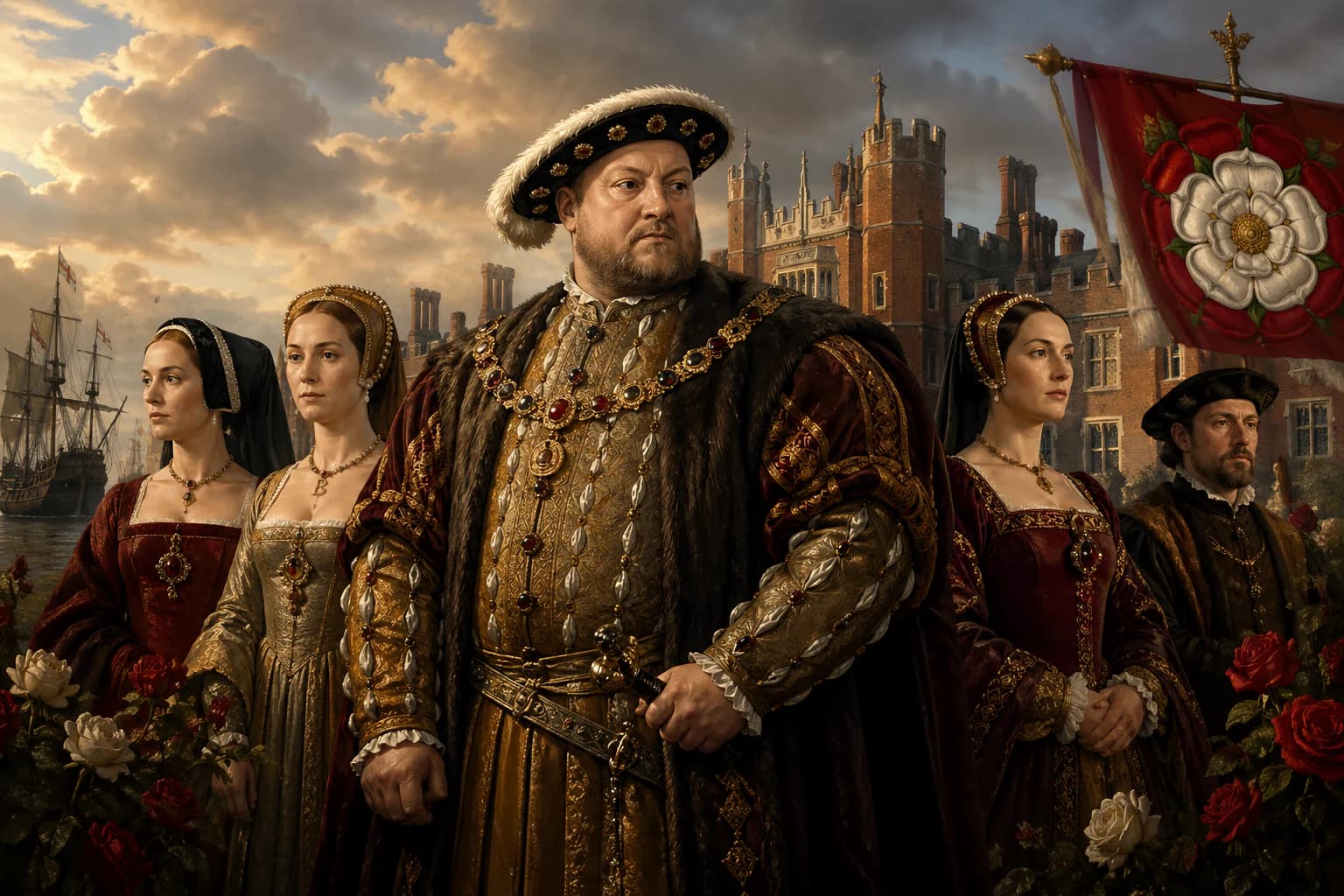
When Thomas Cranmer declared Henry's marriage to Catherine void in 1533, Mary became technically illegitimate and lost her status as heir to the throne. Anne Boleyn, now queen, had her own daughter Elizabeth, and Mary was demoted to lady-in-waiting to her half-sister, a calculated humiliation. She was separated from her mother, whom she never saw again before Catherine died in 1536. Henry and his ministers repeatedly pressured Mary to sign documents acknowledging both the annulment and the royal supremacy — acts that would have required her to repudiate her mother and her faith. She resisted with considerable courage for years, finally signing under intense pressure and in fear of execution. The years shaped her with a mixture of resilience and grievance.

1536–1547

Rehabilitation and patience

Anne Boleyn's arrest and execution in 1536 changed Mary's position at court. With Jane Seymour as the new queen, reconciliation with Henry became possible, though it required Mary's humiliating submission to the royal supremacy and the invalidity of her parents' marriage. She was restored to favour, placed back in the succession, and lived in reasonable comfort during her father's final decade. When her Protestant half-brother became king in 1547, she became the focus of Catholic hopes in England, quietly maintaining her own Mass in defiance of the new prayer books. The Edwardian government repeatedly pressed her to conform; she refused, and the standoff continued until Edward's death in 1553.

July 1553

Claiming her throne

Mary's successful seizure of the throne in July 1553 was one of the more remarkable political recoveries in English history. Northumberland's government proclaimed Lady Jane Grey in London, hoping to preserve the Protestant succession and exclude both Mary and Elizabeth. Mary acted quickly. She moved to East Anglia, where she had support among conservative gentry and Catholic-leaning communities, and issued letters asserting her lawful title. Support widened with astonishing speed, including from many people whose main concern was not Catholic restoration but lawful succession under Henry VIII's will and parliamentary statute. Northumberland's gamble collapsed within days, and Mary entered London in triumph. She had shown political nerve, command of legitimacy and personal courage before she ever wore the crown.

1553–1554

Restoring Catholicism

Mary's religious agenda was clear from the beginning of her reign, though she initially moved with more caution than her Protestant opponents feared. The Edwardian prayer books were abolished and the Mass restored in late 1553. Cardinal Reginald Pole returned from exile to lead the church's reconciliation with Rome, which was formally completed in 1554. Mary's approach was to restore the pre-Henrician church rather than impose Spanish-style inquisitorial methods. Yet the burning of heretics that began in early 1555 created a different public image. The approximately three hundred executions of Protestant men and women over the following three years became the defining feature of how posterity remembered her reign.

1554

Marriage to Philip of Spain

Mary's decision to marry Philip of Spain, son of her cousin Emperor Charles V, was entirely consistent with her upbringing and her vision of herself as a Catholic queen aligned with continental Christendom. To her English subjects, it raised the alarming prospect of England becoming a dependency of the Spanish empire. The marriage triggered Wyatt's Rebellion, a serious uprising in Kent that came close enough to London to create genuine fear. Mary showed personal courage during the crisis, remaining in London and addressing the citizenry directly. Philip and Mary were jointly crowned, but Philip spent little time in England and the marriage produced no children. Mary's emotional investment in the relationship was not reciprocated with warmth.

1557–1558

Loss of Calais

England was drawn into Philip's war against France in 1557, partly through Mary's continuing desire to serve her husband's interests and partly through genuine English concerns about the French threat. The campaign went badly. In January 1558, the French captured Calais, which had been in English hands since 1347. The loss was a serious blow to national pride, stripping England of its last foothold on the continent. Mary is reported to have said that when she died, Calais would be found written on her heart. Whether or not she said this, the loss added to the deep unpopularity of her final months. By this point, Mary was physically declining, possibly from uterine or ovarian cancer, and two phantom pregnancies had already delivered crushing disappointment.

1558

Final illness and death

Mary died on 17 November 1558, aged forty-two, from what most historians believe was uterine or ovarian cancer, though the influenza epidemic of 1558 may have contributed. In her final weeks she was aware that the Protestant settlement she had spent her reign dismantling would be restored by Elizabeth, and the knowledge was a form of final defeat. Cardinal Pole died the same day, ending the Catholic restoration's two leading figures simultaneously. The church she had rebuilt would begin to be taken apart within months. She had no children, no legacy that held, and a reputation fixed by her enemies in terms she could never have accepted. She had seen herself as a dutiful Catholic queen faithfully restoring true religion; she was remembered as Bloody Mary.

Post-1558

Contested memory

The image of Mary I that dominated for centuries was a direct product of Protestant martyrology, above all John Foxe's Acts and Monuments, which catalogued the burnings in vivid detail and framed them as Catholic persecution of godly Christians. The figure of Bloody Mary became a fixed reference point in English Protestant identity. More recent scholarship has attempted to reassess her reign on its own terms: she was the first woman to rule England in her own right, she governed with genuine political competence in her early years, and her religious programme had real popular support in many parts of the country. The burnings were on a scale comparable to continental precedents, though no less terrible for that. Her reputation remains one of history's most contested assessments of a real, complex person.

Continue in context

Connected stories

Move from the profile into the wider events and settings this figure belongs to.

British Monarchs lineage
Lineage42 rulers
British Monarchs
1066 CE–present

Trace the English and later British monarchy from William I to today.

View lineage
Tertiary paths

Content note

This profile is written for educational use and connects to related Stories of History pages. The main portrait is an AI-assisted historical reconstruction, included as an illustrative aid rather than documentary evidence. Image policy

References

Sources & Further Reading

Reliable reference works, archives and reading paths connected to this profile.

Further reading

  1. Encyclopaedia Britannica, Search results for Mary I,” accessed June 2026.Open source
  2. WorldCat, Books and library holdings for Mary I,” accessed June 2026.Open source

Primary sources

  1. Library of Congress, Search results for Mary I,” accessed June 2026.Open source

Reviewed claim sources

Loading reviewed claim sources...

A weekly route through history

Find out first about the latest published stories, feature notes and occasional Premium offers in one weekly email.