People

Edward V

Edward V was king of England for eleven weeks in 1483. He was placed in the Tower of London by his uncle Richard, Duke of Gloucester, and was never seen alive again.

Born
1470 CE
Died
1483 CE
Role
King of England

King of England (1470–c.1483)

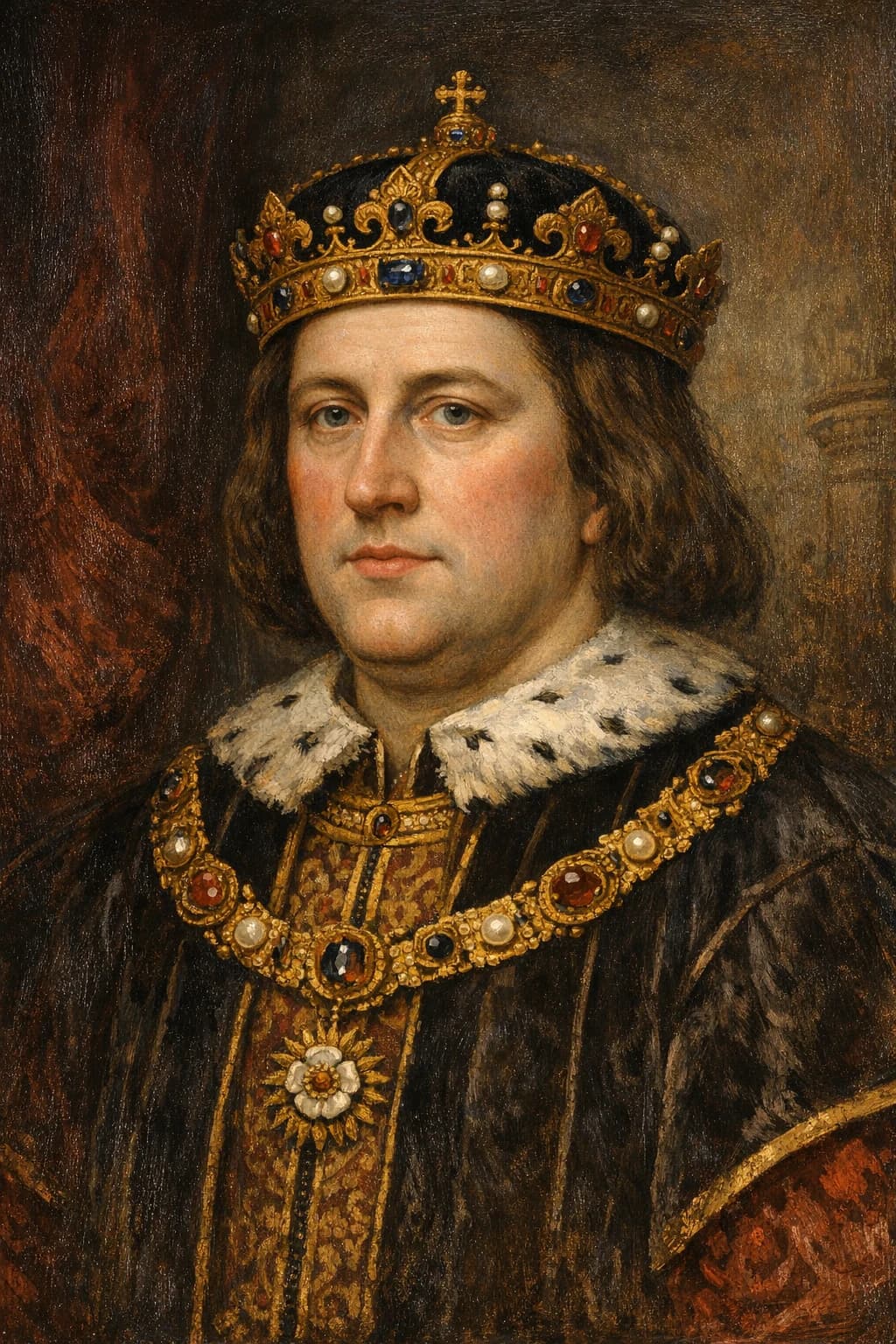
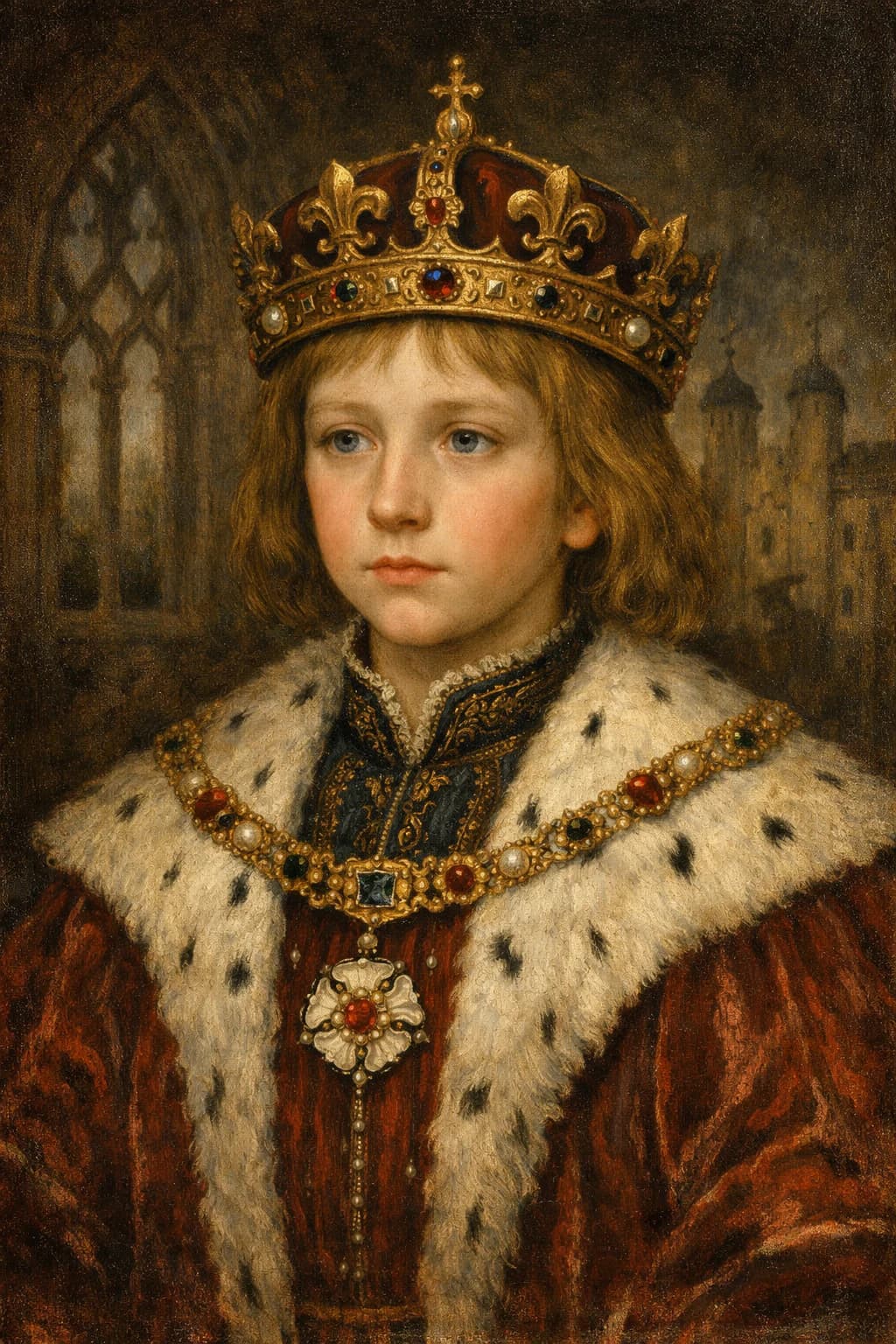
AI-generated portrait of Edward V as a young prince
AI-assisted historical reconstruction

An illustrative reconstruction based on historical context. It is not a photograph or documentary likeness. Image policy

Quick answer

Edward V was king of England for eleven weeks in 1483. He was placed in the Tower of London by his uncle Richard, Duke of Gloucester, and was never seen alive again.

Born
1470 CE
Died
1483 CE
Role
King of England
Years
1470-1483 CE
Facts

Edward V timeline facts

Selected specifics from this profile's life story.

1470–1483
Prince of Wales

Born as the heir to Edward IV, he was raised at Ludlow as Prince of Wales, educated for kingship in a structured household away from the London court.

May–June 1483
Tower confinement

Edward V was housed in the Tower while preparations for his coronation were repeatedly postponed, his circle of companions and advisers steadily stripped away.

Late 1483
Disappearance

By the autumn of 1483, Edward V and his brother had vanished from all record, almost certainly dead, in what became one of history's most debated crimes.

Post-1483
The Princes in the Tower

The fate of Edward V and his brother became one of the most enduring mysteries of English history, shaping how later generations remembered Richard III and the end of the Yorkist dynasty.

Life Journey

A reign of eleven weeks and an unsolved disappearance

Follow the story in a more continuous narrative, with a reading mode that matches how much depth you want.

Complete chronology

1470–1483

Prince of Wales

Edward was born in sanctuary at Westminster in November 1470, during the brief period when his father had been deposed and Henry VI temporarily restored. He entered the world already entangled in political crisis, though the family's fortunes would stabilise quickly after his father's return. He spent most of his childhood at Ludlow Castle, which served as the administrative centre for the Council of Wales and the Marches. His household was well run and his education carefully supervised, preparing him for the kingship that seemed likely but never arrived. He was described as serious and capable for his age, with a strong memory and genuine interest in learning.
April 1483

Father's death

When Edward IV died in April 1483, the transition should have been managed by the royal council and the boy's guardians. Instead, it immediately became a contest between two power centres: the Woodville family of the boy's mother, Queen Elizabeth, who surrounded him at Ludlow, and his uncle Richard, Duke of Gloucester, who was the most powerful lord in the north of England. Both sides understood that whoever controlled the young king effectively controlled England. The council was divided, and Richard moved swiftly, intercepting the royal party as it travelled toward London. Within days, the dynamics of the reign had changed entirely.

May 1483

Seized on the road

At Stony Stratford on 30 April 1483, Richard of Gloucester made his decisive move. He met the king's party, dismissed or arrested the Woodville lords accompanying him, including his uncle Anthony Rivers and his half-brother Richard Grey, and took personal charge of the young king. The action was framed as protecting the boy from dangerous influence, but it effectively removed any independent Woodville power from the equation. Edward was brought to London and initially lodged in the Bishop of London's palace, then moved to the royal apartments in the Tower of London, which in that period were also used as royal lodgings before coronations. That ambiguity mattered: the Tower could be presented as preparation for kingship even as it became the place where his freedom disappeared.

May–June 1483

Tower confinement

The weeks in the Tower saw Edward's position steadily diminish. His mother, sensing danger, had already taken sanctuary at Westminster with his younger brother Richard. Preparations for the coronation were made and then delayed. Richard of Gloucester consolidated his hold over the council, arresting and executing key figures including Lord Hastings, a former ally of Edward IV who had apparently resisted Gloucester's growing ambitions. The young king was described by one observer as becoming visibly anxious, saying that he had put his trust in his uncle and hoped he would not be deceived. The atmosphere around him was shifting from protective custody toward something more ominous.

June 1483

Declared illegitimate

In late June 1483, a petition was presented to Richard of Gloucester arguing that Edward IV's marriage to Elizabeth Woodville had been invalid because of a pre-contract with another woman, Lady Eleanor Butler. If true, this made both Edward V and his younger brother illegitimate and incapable of inheriting the throne. The argument was of dubious legal strength, but it served its political purpose. Parliament — or a body acting in parliament's name — accepted the petition, and the boys were formally set aside. Richard was then invited to take the crown. Edward V, not yet crowned and only weeks into his reign, was king no longer.

July 1483

Richard III takes the throne

Richard III's coronation on 6 July 1483 left the two princes in an impossible position. Still alive and still with a claim, however now formally denied, they represented the most obvious focus for any opposition to the new king. They were still being seen in the Tower grounds in the early summer, but sightings become progressively rarer as the weeks passed. The Italian diplomat Dominic Mancini, who left England shortly after the coronation, wrote that the princes had been seen less and less frequently and that people were already fearing the worst. The window in which they might have been freed or acknowledged was closing.

Late 1483

Disappearance

No reliable account records when Edward V died or precisely how. By the time Buckingham's rebellion in October 1483 appealed to him as a Yorkist claimant, he appears to have been already gone. The most widely accepted view is that both princes were killed sometime in the summer or autumn of 1483, on the orders of or with the knowledge of Richard III, who had the clearest motive and opportunity. The discovery of bones beneath a staircase in the Tower in 1674, reinterred in Westminster Abbey, added physical texture to the story without resolving it. Other theories have pointed to Henry Stafford Duke of Buckingham or even Henry Tudor, but these remain minority views.

1483–1485

The princes' absence

Even without confirmation of their deaths, the princes' absence from public life created a persistent cloud over Richard III's rule. Their mother and sisters remained in sanctuary at Westminster for a period, a visible expression of distrust. Rumours of their deaths circulated widely both in England and abroad, and the moral weight of the charge attached itself to Richard's reign even when no one could prove it. When Henry Tudor invaded in 1485 and offered himself as the man who would restore stability, the princes' fate — and the suspicion around it — was already part of the political atmosphere. A king suspected of killing children finds it very difficult to build lasting loyalty.

Post-1483

The Princes in the Tower

The story of the Princes in the Tower has never lost its hold on the historical imagination. Edward V's brief reign and sudden disappearance encapsulate many of the most disturbing features of medieval politics: the vulnerability of children in succession crises, the ruthlessness of dynastic ambition, and the ease with which power can override justice. Later tradition, shaped heavily by Tudor writers including Sir Thomas More and later William Shakespeare, fixed Richard III as the unambiguous villain. Modern historians are more cautious about evidence, motive, and the reliability of hostile sources, but the fundamental uncertainty remains. Edward V is remembered not for anything he did, which was almost nothing, but for what was done to him and what his disappearance revealed about the end of Yorkist rule.

Continue in context

Connected stories

Move from the profile into the wider events and settings this figure belongs to.

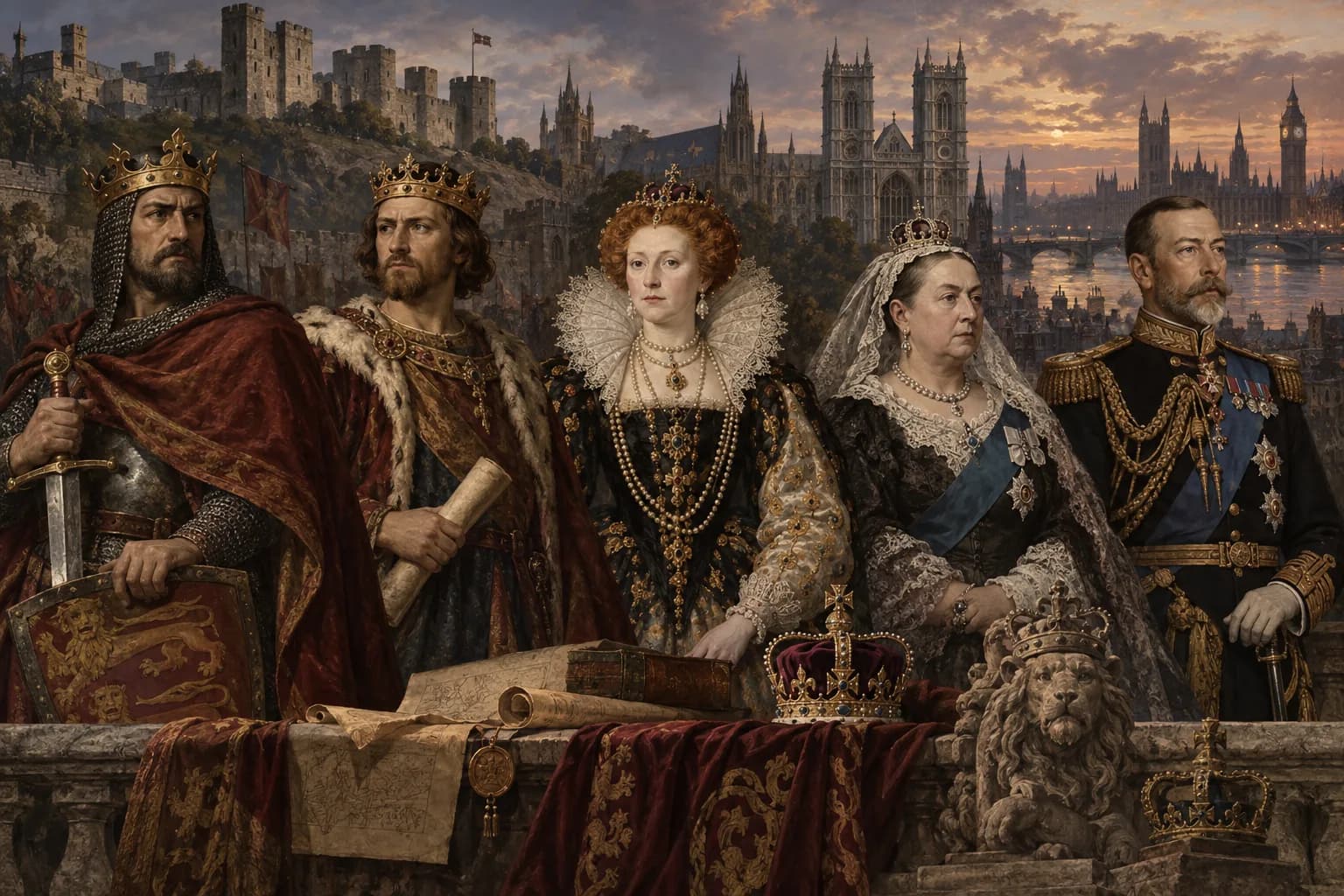
British Monarchs lineage
Lineage42 rulers
British Monarchs
1066 CE–present

Trace the English and later British monarchy from William I to today.

View lineage
Tertiary paths

Content note

This profile is written for educational use and connects to related Stories of History pages. The main portrait is an AI-assisted historical reconstruction, included as an illustrative aid rather than documentary evidence. Image policy

References

Sources & Further Reading

Reliable reference works, archives and reading paths connected to this profile.

Further reading

  1. Encyclopaedia Britannica, Search results for Edward V,” accessed June 2026.Open source
  2. WorldCat, Books and library holdings for Edward V,” accessed June 2026.Open source

Primary sources

  1. Library of Congress, Search results for Edward V,” accessed June 2026.Open source

Reviewed claim sources

Loading reviewed claim sources...

A weekly route through history

Find out first about the latest published stories, feature notes and occasional Premium offers in one weekly email.