People

Claudius Ptolemy

Claudius Ptolemy was an Alexandrian astronomer, geographer, and mathematician whose Almagest and geocentric model dominated astronomy until the Copernican revolution.

Born
c. 100 CE
Died
c. 170 CE
Role
Astronomer and geographer

Alexandrian astronomer (c. AD 100-c. AD 170)

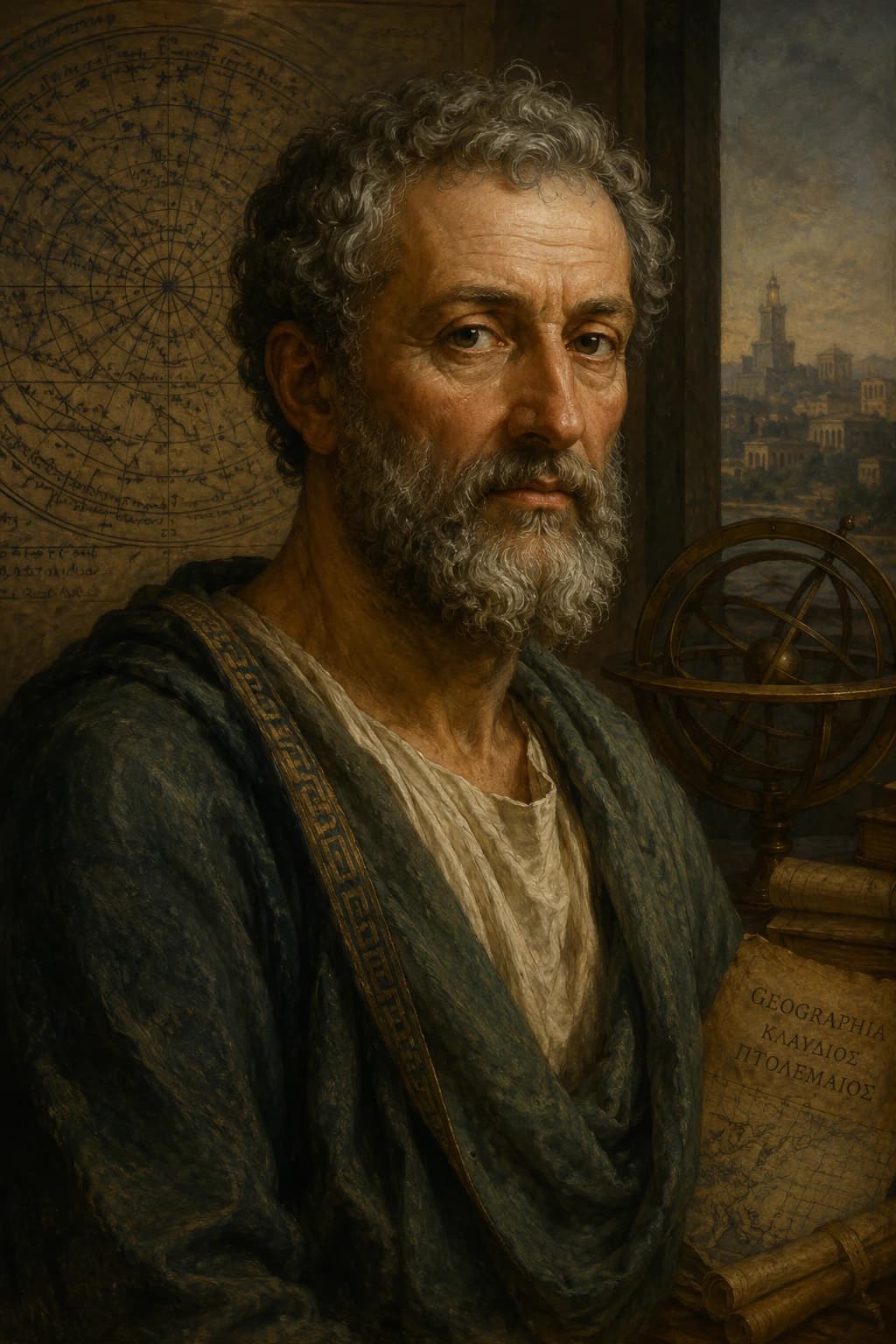
AI-generated portrait of Claudius Ptolemy with an astronomical chart and armillary sphere
AI-assisted historical reconstruction

An illustrative reconstruction based on historical context. It is not a photograph or documentary likeness. Image policy

Quick answer

Claudius Ptolemy was an Alexandrian astronomer, geographer, and mathematician whose Almagest and geocentric model dominated astronomy until the Copernican revolution.

Born
c. 100 CE
Died
c. 170 CE
Role
Astronomer and geographer
Years
c. 100-c. 170 CE
Quick facts

Profile details

Additional identity and tagging details that are not already covered in the introduction.

Also known as
Ptolemy, Klaudios Ptolemaios, Claudius Ptolemaeus
Region
Egypt, Greek world, Roman Empire, Alexandria
Facts

Claudius Ptolemy timeline facts

Selected specifics from this profile's life story.

c. AD 100
Working in Alexandria

Claudius Ptolemy worked in Roman Egypt, probably in Alexandria, one of the ancient world's great centers of scholarship.

second century AD
The Almagest

In the Almagest, Ptolemy presented a mathematical account of the heavens with Earth at the center.

After antiquity
A durable authority

Ptolemy's astronomy passed through Byzantine, Islamic, and Latin scholarship, becoming a central authority for medieval learning.

1543 and after
The challenge

Copernicus, Kepler, Galileo, and Newton all worked in a world shaped by Ptolemy, even as they moved beyond him.

Life Journey

The ancient model later science had to confront

Follow Ptolemy through Alexandria, mathematical astronomy, geography, and the long afterlife of the geocentric cosmos.

Complete chronology

c. AD 100

Working in Alexandria

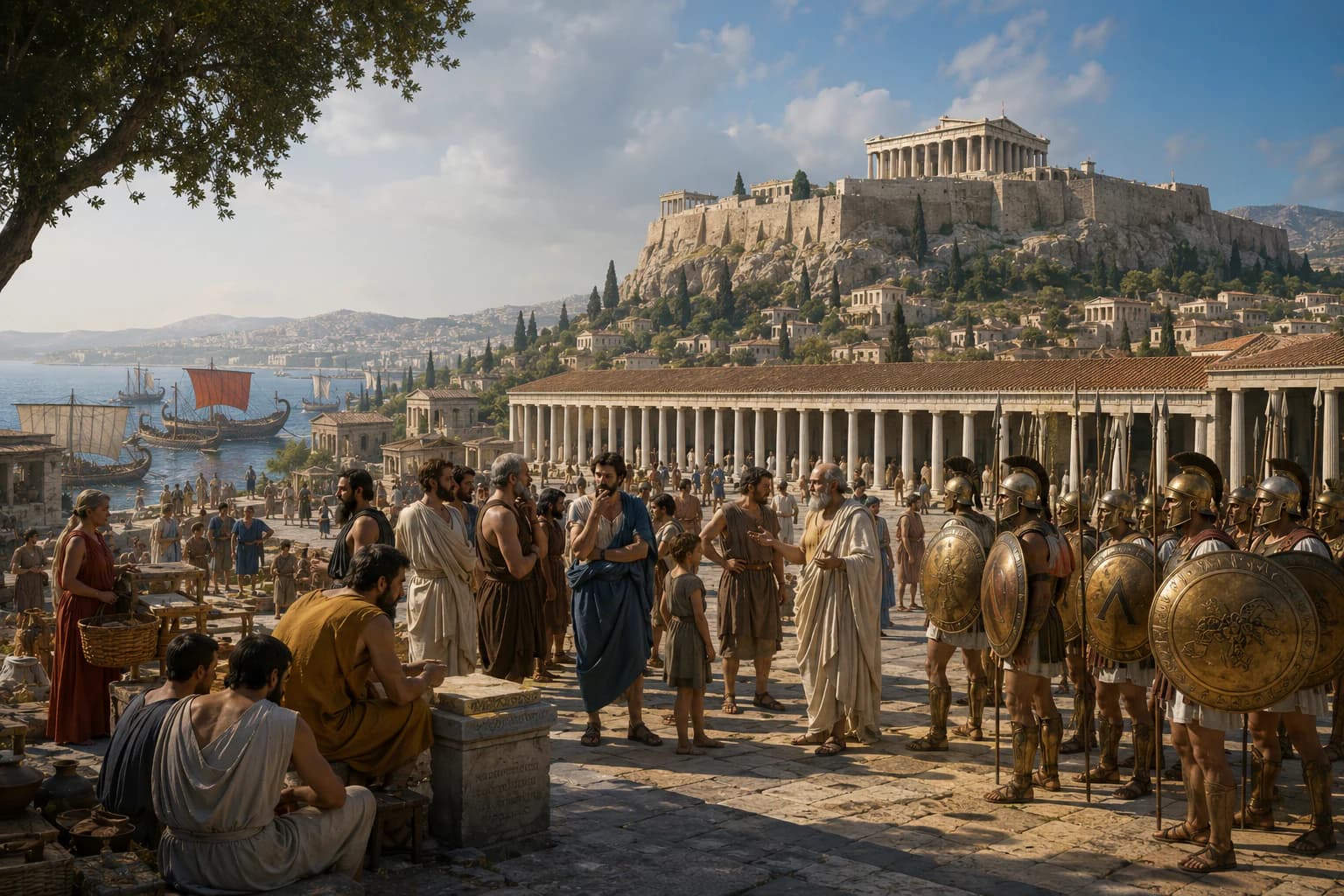
Claudius Ptolemy lived and worked in the Greek-speaking scholarly world of Roman Egypt, probably in Alexandria. The details of his life are sparse, but his writings show access to mathematical astronomy, observation records, geography, optics, and philosophical traditions. Alexandria mattered because it preserved and organized older Greek science while connecting it to new calculation. Ptolemy was not starting from nothing. He inherited centuries of astronomical work and turned it into a system so comprehensive that later scholars could not ignore it.

second century AD

The Almagest

Ptolemy's Almagest became the most influential astronomical work of antiquity. It treated the Earth as stationary at the center of the cosmos and used mathematical devices such as deferents, epicycles, and the equant to explain the observed motions of the Sun, Moon, and planets. The system was complicated, but it was powerful. It could generate predictions and gave astronomers a shared technical language. Its success helps explain why it lasted: Ptolemaic astronomy was not a simple mistake. It was a serious model built from the best tools available.

second century AD

Mapping the world

Ptolemy's Geography offered another kind of order. It gathered place names, coordinates, map projections, and instructions for representing the known world mathematically. Many of its coordinates were inaccurate, and later mapmakers had to correct its limits, but the ambition was extraordinary. Ptolemy treated space as something that could be measured, listed, projected, and compared. His geography later mattered deeply to Renaissance Europe, where recovered ancient texts helped scholars imagine and redraw the world.

After antiquity

A durable authority

Ptolemy's work survived because later scholars copied, translated, tested, criticized, and extended it. Islamic astronomers made major refinements and identified weaknesses in Ptolemaic models. Latin Europe later received this tradition through translation, where it became central to university astronomy. By the late Middle Ages, Ptolemy's technical astronomy and Aristotle's natural philosophy were often read together as a coherent account of the cosmos. That made the system intellectually powerful, but also made it a target when observation and mathematics began to strain against it.

1543 and after

The challenge

The Scientific Revolution did not simply sweep Ptolemy away in a moment. Copernicus challenged the Earth-centered arrangement, but still used much inherited astronomical mathematics. Kepler replaced circular perfection with ellipses. Galileo supplied telescopic evidence that the old cosmos could not explain. Newton later provided a physical theory that unified heavenly and earthly motion. Ptolemy mattered in that story because his model gave the revolution something exact to test. Modern astronomy emerged not from forgetting him, but from discovering where his system no longer matched nature.

Continue in context

Connected stories

Move from the profile into the wider events and settings this figure belongs to.

Tertiary paths

Content note

This profile is written for educational use and connects to related Stories of History pages. The main portrait is an AI-assisted historical reconstruction, included as an illustrative aid rather than documentary evidence. Image policy

References

Sources & Further Reading

Reliable reference works, archives and reading paths connected to this profile.

Further reading

  1. Encyclopaedia Britannica, Search results for Claudius Ptolemy,” accessed June 2026.Open source
  2. WorldCat, Books and library holdings for Claudius Ptolemy,” accessed June 2026.Open source

Primary sources

  1. Library of Congress, Search results for Claudius Ptolemy,” accessed June 2026.Open source

Reviewed claim sources

Loading reviewed claim sources...

A weekly route through history

Find out first about the latest published stories, feature notes and occasional Premium offers in one weekly email.