People

Charles III

Charles III has been King of the United Kingdom since 8 September 2022, after spending more than seventy years as heir to Queen Elizabeth II. Before his accession he was Prince of Wales, founder of the Prince's Trust, a long-standing advocate on climate, architecture and rural life, and a royal figure whose public views had to be reshaped into the constitutional restraint of kingship.

Born
1948 CE
Role
King of the United Kingdom since 2022

King of the United Kingdom since 2022 (born 1948)

Official portrait photograph of King Charles III at the State Opening of Parliament
Licensed archival image

A real historical or editorial image is used here. Source, licence and transformation details are publicly recorded. Image policy Attribution

Quick answer

Charles III has been King of the United Kingdom since 8 September 2022, after spending more than seventy years as heir to Queen Elizabeth II. Before his accession he was Prince of Wales, founder of the Prince's Trust, a long-standing advocate on climate, architecture and rural life, and a royal figure whose public views had to be reshaped into the constitutional restraint of kingship.

Born
1948 CE
Role
King of the United Kingdom since 2022
Years
Born 1948 CE
Facts

Charles III timeline facts

Selected specifics from this profile's life story.

1948
Royal Birth

Charles Philip Arthur George was born at Buckingham Palace in 1948, the first child of Princess Elizabeth and Prince Philip in a Britain still emerging from war.

1970s–2000s
Public Advocacy

As heir, Charles used his platform for environmental protection, organic farming, architecture, interfaith work and youth opportunity through the Prince's Trust.

2022
Becoming King

When Elizabeth II died on 8 September 2022, Charles became king immediately, inheriting the Crown at a moment of mourning and institutional transition.

Present
Ongoing Legacy

Charles III's legacy is still being written, but it already rests on the unusual contrast between an outspoken heir and a constitutionally restrained king.

Life Journey

From heir apparent to modern monarch

Follow the story in a more continuous narrative, with a reading mode that matches how much depth you want.

Complete chronology

1948

Royal Birth

Charles was born on 14 November 1948 into a monarchy that was trying to modernise without losing its inherited authority. Britain was still rationed, the empire was changing shape, and the royal family had become a symbol of continuity after the Second World War. When his grandfather George VI died in 1952 and his mother became Elizabeth II, the three-year-old Charles became heir apparent. That made his childhood both intensely privileged and unusually constrained. His life would unfold under public expectation before he could understand what expectation meant. The central fact of his biography is duration: he spent longer as heir than any previous British monarch, learning the monarchy as an institution before he could embody it himself.

1950s–1970

Education and Formation

Charles's education broke with some royal habits. He attended Cheam and Gordonstoun rather than being educated entirely by private tutors, spent time at Timbertop in Australia, and later studied at Trinity College, Cambridge, where he read archaeology, anthropology and history before graduating in 1970. The experience did not make him ordinary, but it did expose him to institutions beyond the court and to the pressures of public comparison. Gordonstoun in particular became part of the mythology of his formation: demanding, austere and not always happy. He also trained in Welsh before his investiture as Prince of Wales, a gesture that acknowledged the politics of union as well as ceremony. His education created a more intellectual heir than many expected, one drawn to history, landscape, faith, architecture and the social consequences of modernity.

1969

Becoming Prince of Wales

The investiture of Charles as Prince of Wales on 1 July 1969 was a carefully choreographed act of monarchy in the television age. It connected him to medieval titles, Welsh identity and the modern United Kingdom, while also drawing protest from some Welsh nationalists who saw the ceremony as an assertion of English-dominated power. For Charles, it marked the beginning of adult public duty. He served in the Royal Navy and Royal Air Force, represented the Crown overseas, and gradually built a portfolio of causes. The role was paradoxical. He was expected to be visible but not powerful, active but not political, distinctive but not disruptive. That tension would define his decades as heir.

1970s–2000s

Public Advocacy

Charles did not spend his long wait as a silent constitutional figurehead. In 1976 he founded the Prince's Trust, which became one of the most significant youth charities in Britain. He spoke early and persistently about pollution, climate change, organic farming, traditional crafts and the built environment, often before these concerns sat comfortably in mainstream politics. His interventions on architecture, especially his criticism of modernist planning and his support for Poundbury, made him admired by some and dismissed by others as nostalgic or meddlesome. The controversy mattered because the heir to the throne is not an elected campaigner. Charles's public voice tested the boundary between royal influence and political neutrality. Over time, some of the causes once mocked as eccentric came to look prescient, especially on environmental questions, but the constitutional unease never entirely disappeared.

1980s–1990s

Personal Challenges

Charles married Lady Diana Spencer in 1981 in a ceremony watched globally, but the marriage became one of the defining public dramas of late twentieth-century monarchy. The birth of Prince William in 1982 and Prince Harry in 1984 secured the direct succession, yet the relationship deteriorated under emotional incompatibility, media pressure and Charles's continuing attachment to Camilla Parker Bowles. The separation, divorce and Diana's death in 1997 did lasting damage to Charles's public standing. For many people, he seemed distant beside Diana's emotional accessibility. Over the following decades, his image recovered gradually through charitable work, consistency and his marriage to Camilla in 2005. The episode changed the monarchy as much as it changed him: private unhappiness could no longer be hidden behind ceremony, and public sympathy became a force the Crown had to understand.

1970s–2022

Long Wait to Reign

The length of Charles's apprenticeship was historically unusual. He represented the Crown across the Commonwealth, read state papers, met ministers, supported charities and watched his mother practise a model of monarchy built on restraint, endurance and duty. Yet preparation brought its own problem. The longer he waited, the more his opinions, habits and controversies became public before he reached the throne. He entered old age not as a blank symbol but as a known personality with decades of speeches, letters, friendships and causes behind him. That made his eventual transition more delicate. To reign successfully, he would have to convert an activist heir's voice into a monarch's constitutional discipline. The waiting did not merely prepare him for kingship; it forced him to shed parts of the public role he had spent a lifetime constructing.

2022

Becoming King

Charles's accession was instant in constitutional terms and emotionally immense in public terms. Elizabeth II had reigned for more than seventy years; for most people in Britain and many Commonwealth realms, she had been the only monarch they had known. Charles therefore had to begin his reign by leading national mourning for his mother while introducing himself as sovereign. His first addresses emphasised service, continuity and constitutional limits. The coronation on 6 May 2023 at Westminster Abbey combined ancient rite with efforts at broader representation, including attention to other faiths and the modern Commonwealth. The early challenge was not to reinvent monarchy overnight, but to reassure a public accustomed to Elizabeth's style that the institution could survive a change of character at its centre.

2022–present

Early Reign

As king, Charles III has had to govern his own visibility. Environmental concern, support for communities and interest in faith remain part of his public identity, but they are expressed more cautiously than when he was Prince of Wales. The monarchy he leads faces pressures very different from those of 1952: a smaller empire-shaped world, stronger scrutiny of wealth and privilege, republican debates in some Commonwealth realms, and a media landscape that rewards conflict. His early reign has also unfolded amid personal and family strain, including public attention to the Duke and Duchess of Sussex, the position of the Prince of Wales and the health of senior royals. Charles's task is institutional as much as personal: to maintain the monarchy's usefulness as a symbol of continuity while accepting that deference can no longer be assumed.

Present

Ongoing Legacy

Because Charles III is a living monarch, any final judgement must remain provisional. His historical importance already has two layers. As Prince of Wales, he helped move environmental issues, youth opportunity, interfaith dialogue and debates over architecture into public conversation, sometimes awkwardly but often with persistence. As king, he represents the first major test of the British monarchy after Elizabeth II's long stabilising reign. The central question is whether his reign can translate a lifetime of conviction into a form compatible with constitutional monarchy. If he succeeds, he may be remembered as a transitional monarch who made inherited institutions feel serious about service in a less deferential age. If he struggles, the very qualities that once made him distinctive may appear ill-suited to the throne. For now, his significance lies in that tension: a king formed by waiting, advocacy and scrutiny, ruling an institution whose future depends on adaptation without overstatement.

Continue in context

Connected stories

Move from the profile into the wider events and settings this figure belongs to.

British Monarchs lineage
Lineage42 rulers
British Monarchs
1066 CE–present

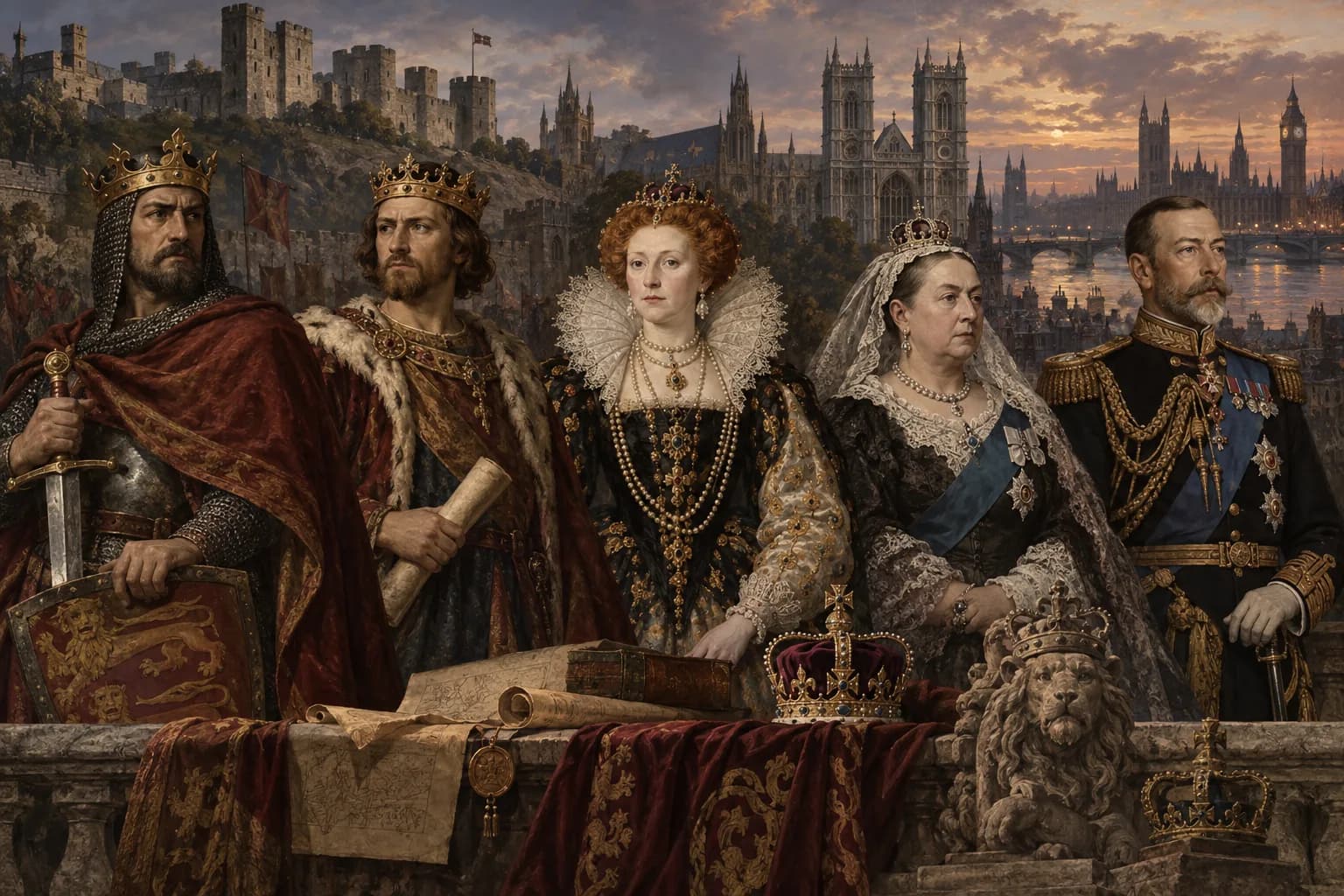
Trace the English and later British monarchy from William I to today.

View lineage
Tertiary paths

Content note

This profile is written for educational use and connects to related Stories of History pages. The main portrait uses a real historical or editorial image, with source and licence details recorded for attribution review. Image policy Image attribution

References

Sources & Further Reading

Reliable reference works, archives and reading paths connected to this profile.

Further reading

  1. Encyclopaedia Britannica, Search results for Charles III,” accessed June 2026.Open source
  2. WorldCat, Books and library holdings for Charles III,” accessed June 2026.Open source

Primary sources

  1. Library of Congress, Search results for Charles III,” accessed June 2026.Open source

Reviewed claim sources

Loading reviewed claim sources...

A weekly route through history

Find out first about the latest published stories, feature notes and occasional Premium offers in one weekly email.