Related Moment
The Day a King Lost His Head
The axe did not only strike a man. It struck an ancient idea.
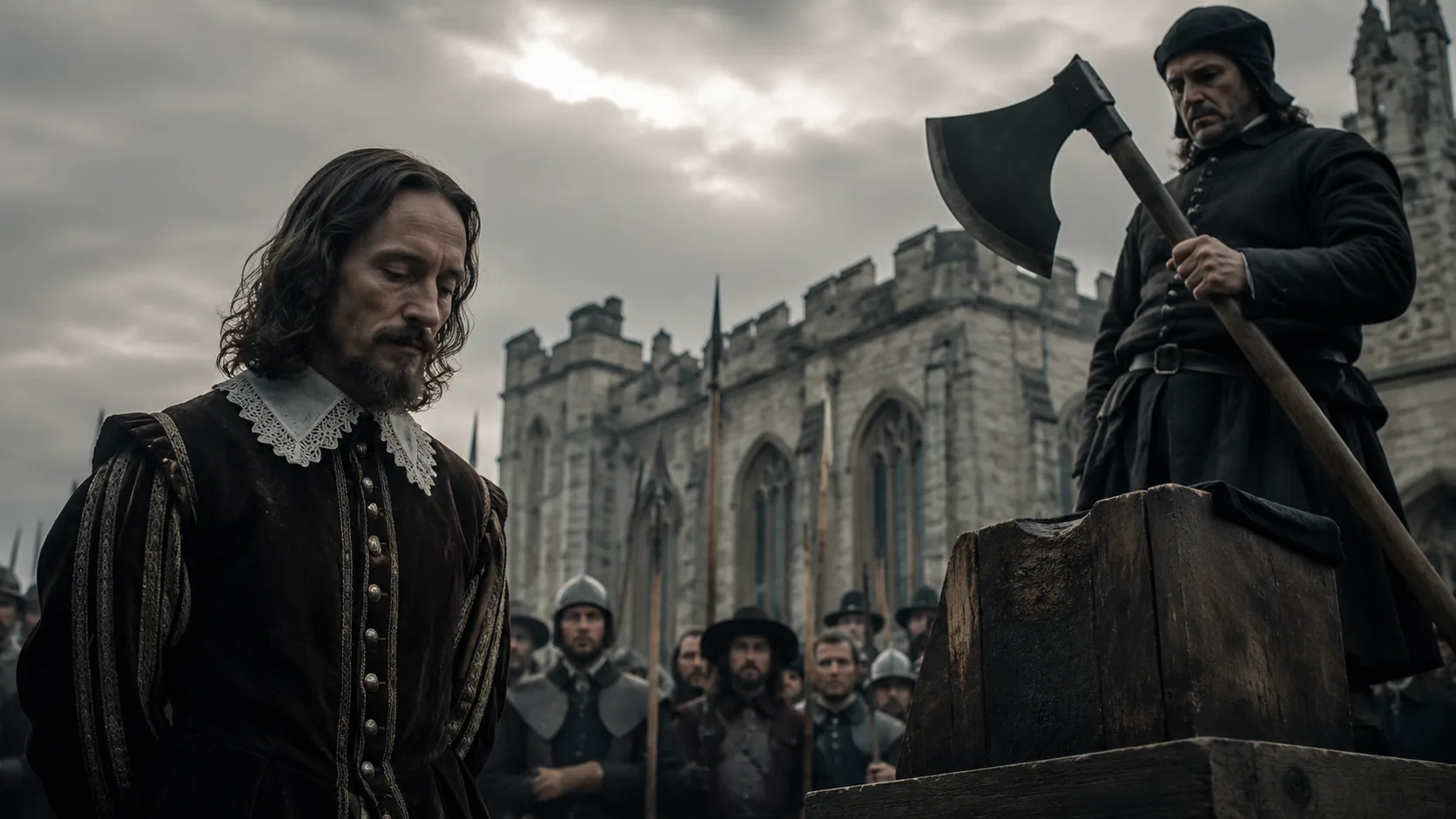
On 30 January 1649, England executed Charles I outside Whitehall and shattered the belief that a king stood beyond earthly judgment.
A cold January wind swept across as thousands gathered in uneasy silence. They had not come to watch the punishment of a criminal or a defeated rebel. They had come to see a reigning king die in public.
Charles I stepped onto a scaffold outside wearing an extra shirt beneath his clothes. He wanted to prevent shivering, not simply for warmth, but because he feared the crowd might mistake cold for fear.
By the late 1640s, England had been torn apart by civil war. Charles I believed deeply in the divine right of kings. Parliament increasingly insisted that the king was bound by the laws of the kingdom and accountable to its political community.
The dispute began in arguments over taxation, religion, and the limits of royal authority. It hardened when Charles governed without Parliament, then became war when he raised an army against his own subjects.
Parliamentary forces, including Oliver Cromwell and , gradually gained the upper hand. Charles surrendered in 1646, but even in captivity he continued negotiating with rival factions in the hope that division would restore him.
When Royalist risings and a Scottish invasion triggered a Second Civil War in 1648, many within the army concluded that the king had broken his word too often to be trusted with any settlement.
Putting a king on trial presented an extraordinary problem. No English court had ever claimed authority over a reigning monarch. If kings ruled by divine appointment, who could judge one?
The answer came through force as much as law. After soldiers removed members of Parliament who opposed the trial, created a special High Court of Justice. It charged Charles with treason, not against the Crown, but against the people of England.
Charles refused to recognize the court's legitimacy. Again and again he asked by what lawful authority he was being judged. The judges never persuaded him, and his refusal to plead was treated as defiance rather than defense.
Charles was led through , a building designed to project royal magnificence. A temporary opening had been cut through the wall so he could step directly onto the scaffold outside.
The platform was draped in black. The executioners concealed their faces. Charles spoke calmly to those close enough to hear, insisting that he died defending the liberties of England as he understood them: law and monarchy against rule by shifting factions.
Then he removed his cloak, handed over the insignia of the Order of the Garter, and knelt before the block. He stretched out his hands as the agreed signal that he was ready.
The axe fell in one clean stroke. A low groan moved through the crowd. There was no simple celebration. Spectators understood that England had done something unprecedented: it had executed its own sovereign.
Within weeks, the monarchy was abolished. The House of Lords soon followed. England was declared a , a republic without a king, though real power rested heavily with the army that had made the revolution possible.
Oliver Cromwell emerged as the dominant figure, but the republic struggled with division, military campaigns in Ireland and Scotland, and the challenge of governing without the institution that had anchored English politics for centuries.
After Cromwell's death in 1658, instability returned. In 1660, Charles II crossed the Channel and entered London to cheering crowds. The monarchy had been restored, but England was no longer the same country his father had ruled.
Charles I's death did not instantly create modern democracy, and it did not settle the balance between Crown and Parliament. It opened a turbulent new chapter in which political authority increasingly had to justify itself through institutions, consent, and law.
The struggles that culminated at continued through the Restoration and the Glorious Revolution of 1688, helping establish the principle that English, and later British, monarchs governed under law rather than above it.