Related Moment
The Night Abraham Lincoln Was Silenced
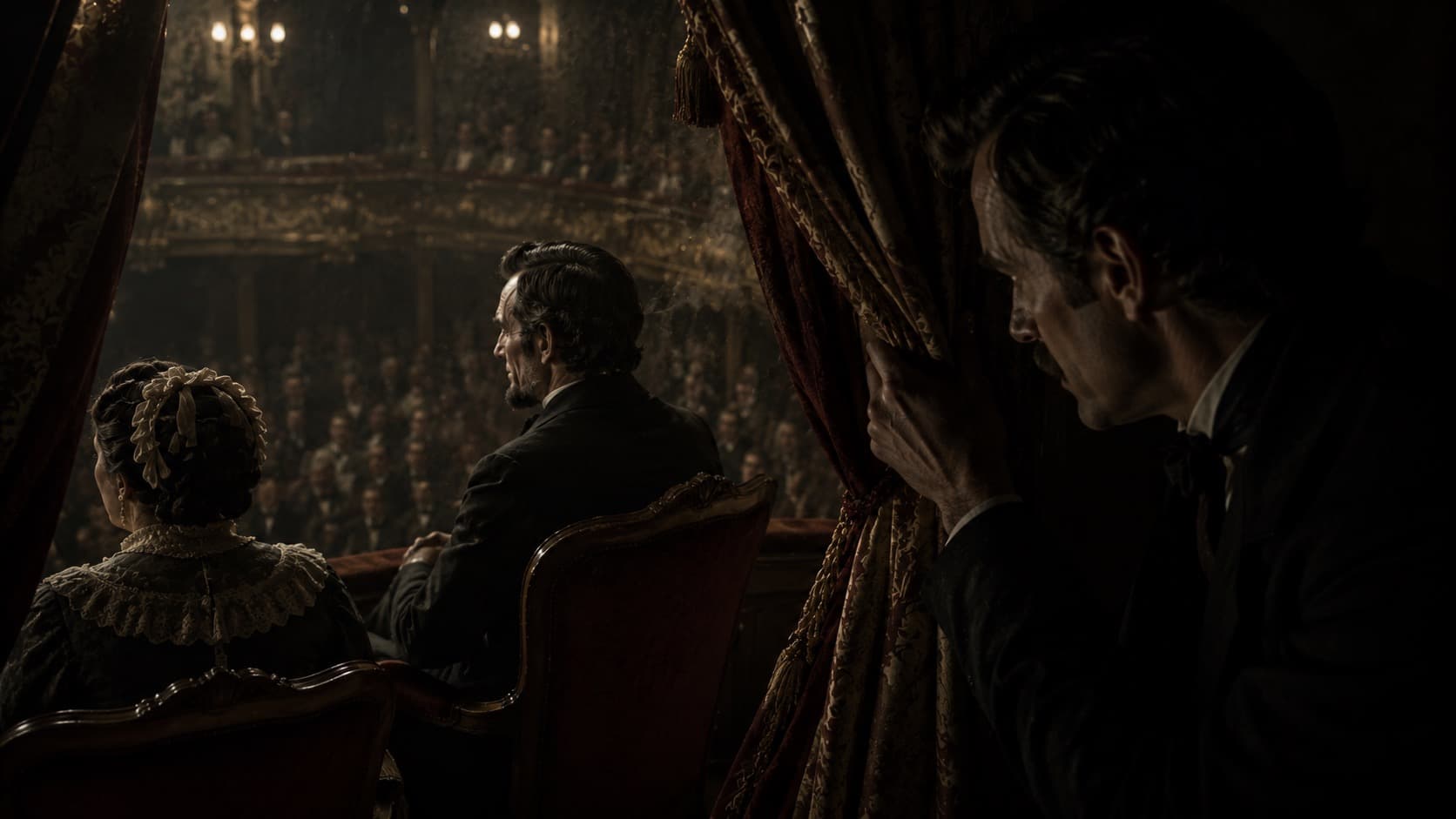
The applause had barely faded when a single gunshot shattered the laughter.
On 14 April 1865, John Wilkes Booth shot Abraham Lincoln at Ford's Theatre, turning Union victory into national mourning.
The applause had barely faded when a single gunshot shattered the laughter inside . For an instant, many in the audience thought the noise belonged to the play. Then confusion moved through the packed hall.
A man vaulted from the presidential box to the stage, caught his spur on the draped bunting, landed awkwardly, raised a knife, and vanished through the backstage passages. Above him, Abraham Lincoln sat mortally wounded beside .
By the spring of 1865, the American Civil War was effectively ending. On 9 April, Robert E. Lee surrendered the Army of Northern Virginia to Ulysses S. Grant at Appomattox Court House, signaling the collapse of Confederate military power.
Victory belonged to the Union, but peace had not yet been defined. The country faced immense questions: how the former Confederate states would return, what rights formerly enslaved people would receive, and how a nation torn apart by civil war could become one political community again.
Lincoln favored a comparatively generous approach to reunion, while insisting that slavery must end and the Union must be restored. His call for malice toward none reflected a belief that reconciliation, however difficult, had to accompany justice.
did not see Lincoln as the president who had preserved the United States. A celebrated actor and passionate Confederate sympathizer, he saw him as the destroyer of the Southern cause.
Earlier in the war, had considered kidnapping Lincoln to exchange him for Confederate prisoners. As Confederate defeat became unavoidable, the scheme darkened. On 14 April 1865, Booth and his conspirators planned to strike multiple leaders at once: Lincoln, Andrew Johnson, and .
knew well. He slipped into the corridor leading to the presidential box carrying a single-shot .44 caliber derringer pistol and a knife. A guard was not stationed immediately outside the door at that moment. Booth entered and fired from only a few feet away.
Major Henry Rathbone lunged toward him, and slashed Rathbone's arm before escaping over the railing. His leap to the stage likely injured his leg, but he still fled through the backstage area, mounted a waiting horse, and disappeared into Washington's night streets.
Doctors in the audience rushed to the presidential box and quickly understood that Lincoln could not survive a journey back to the White House. Instead, he was carried across Tenth Street to , a modest boarding house opposite .
There, in a small bedroom, cabinet members, military officers, and grieving friends gathered through the night. moved in and out of the room, overcome with grief. took charge of the crisis, organizing the manhunt while trying to keep the government steady.
Outside, crowds filled the streets in silence. The celebration of Union victory had become a vigil. At 7:22 a.m. on 15 April 1865, Abraham Lincoln died. He was fifty-six years old.
The wider conspiracy unraveled quickly. Lewis Powell brutally attacked in his home, leaving him gravely wounded but alive. The conspirator assigned to kill Andrew Johnson lost his nerve and never carried out the attack.
Federal investigators launched one of the largest manhunts in American history. fled through southern Maryland into Virginia, helped by Confederate sympathizers. Twelve days after the assassination, Union cavalry cornered him inside a tobacco barn.
When refused to surrender, the barn was set on fire. During the confrontation he was shot and died soon afterward. Several conspirators were arrested, tried before a military commission, and convicted. Four were executed, including Mary Surratt, whose boarding house had served as a meeting place for the conspirators.
Lincoln's funeral became a national procession. His coffin traveled by train through numerous cities before reaching Springfield, Illinois, retracing much of the route he had taken to Washington four years earlier as president-elect.
His death removed the central political figure who had led the Union through war and hoped to shape the peace. proceeded under Andrew Johnson, whose priorities and political authority differed sharply from Lincoln's. Historians still debate how much might have changed had Lincoln lived, but his absence profoundly affected the nation's postwar course.
More than a century and a half later, the image remains stark: a theatre filled with laughter, a single gunshot, and a nation forced to confront the cost of preserving its union.
