Related Moment
The Last Day of Byzantium
Before dawn, the bells began to ring.
On 29 May 1453, Constantinople fell to Mehmed II, ending the Byzantine Empire and turning the old Roman capital into the heart of Ottoman power.
Before dawn, the bells began to ring. Across , in churches blackened by candle smoke and streets scarred by siege engines, the sound rolled over the city like a warning from another world.
Men woke beside the walls. Priests whispered prayers. Families huddled indoors and listened. Outside the city, the Ottoman camp was already moving.
After more than a thousand years, had reached its final morning.
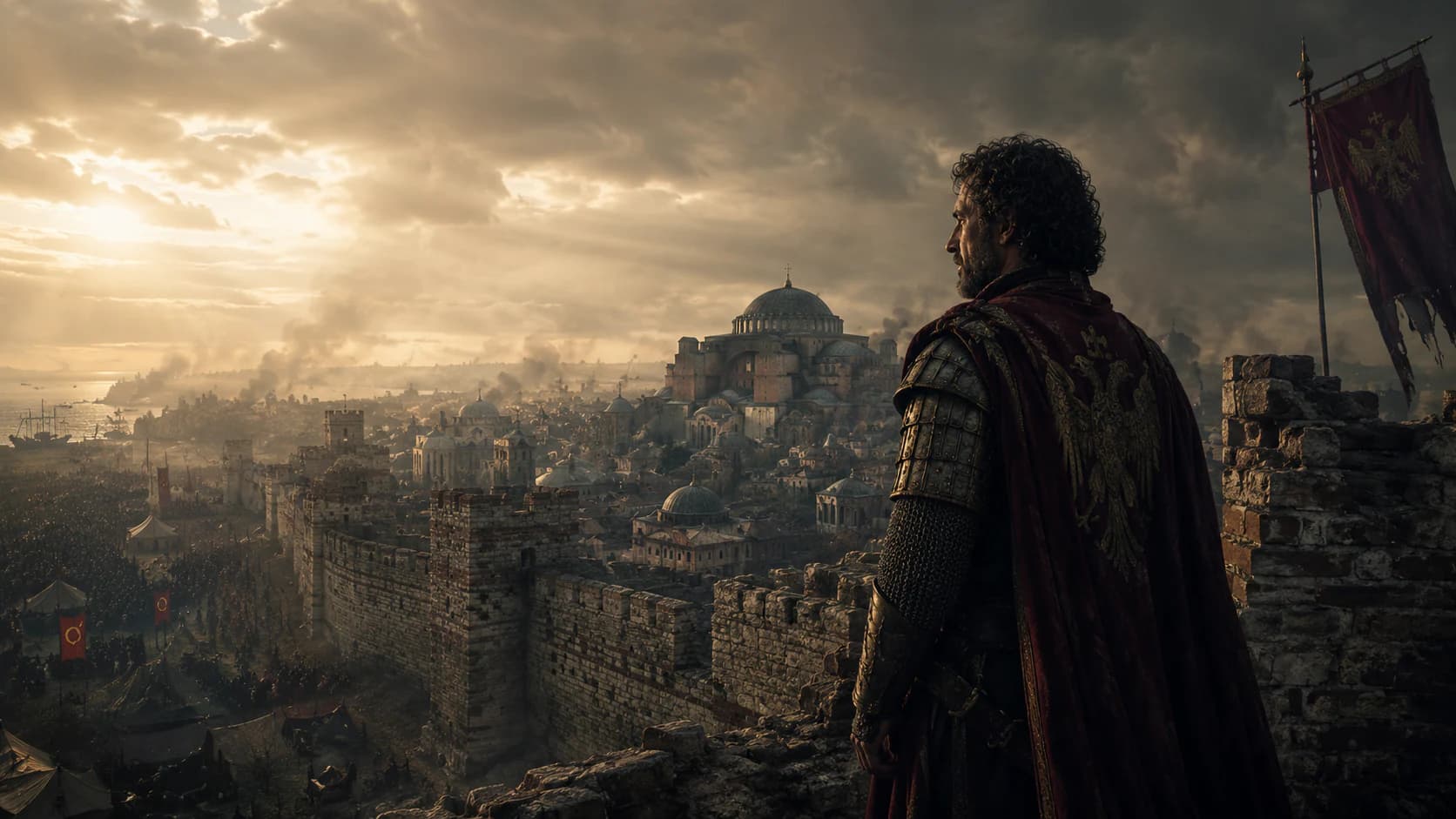
was no longer the mighty capital that had once ruled the eastern Mediterranean. By 1453, the was little more than the city itself: ancient, proud, exhausted, and surrounded.
Its emperor, Constantine XI Palaiologos, ruled over fragments of a vanished world. The walls still stood. The memories still stood. But the empire behind them had almost disappeared.
Beyond the walls waited Sultan Mehmed II, young, ambitious, and determined to take the city that had resisted conquerors for centuries. He brought cannon, ships, infantry, cavalry, engineers, and patience.
For nearly two months, the defenders had endured bombardment, hunger, fear, and sleeplessness. The great Theodosian Walls, once thought nearly unbreakable, had been battered day after day by Ottoman artillery. Still, the city held.
The final attack came in waves. First came irregular troops, rushing toward the damaged walls with ladders, shields, hooks, and hope. The defenders drove them back with arrows, stones, fire, and blades.
Then came more disciplined Anatolian troops. They pressed harder. Smoke drifted across the ditches. The wounded cried out beneath the battlements. Still, resisted.
At the most vulnerable point near the Gate of St. Romanus, Constantine XI fought among his men. He was not watching from a palace. He was at the broken edge of his empire, where stone, blood, and history met.
Beside him stood foreign volunteers, including the Genoese commander Giovanni Giustiniani, whose troops had been essential to the defense. For hours, they held the breach.
Then Giustiniani was badly wounded. His removal shook the defenders. Some saw him being carried away and thought the line was collapsing. In a siege, panic could travel faster than any messenger.
The Janissaries advanced after the earlier waves had exhausted the defenders. At the shattered walls, the fighting became desperate and close.
Somewhere in the chaos, Ottoman soldiers found a way in. Tradition points to a small postern gate, the Kerkoporta, left open or forced, though the exact details remain debated. What mattered was not the size of the opening, but the meaning of it.
Ottoman banners appeared on the walls. For the defenders, that sight was devastating. For the attackers, it was proof that the impossible had become real.
Constantine XI is said to have cast off imperial signs and rushed into the fighting. His exact death was never securely recorded. No final speech can be trusted. No last words survive with certainty.
But the emperor disappeared in battle. 's last ruler died somewhere in the storm, not as a distant symbol, but as one more man swallowed by the fall of his city.
By morning, belonged to Mehmed II. The fighting gave way to the terrible realities of conquest. Soldiers poured through streets that had once carried Roman emperors, Orthodox processions, merchants, scholars, and refugees.
The Hagia Sophia, the greatest church of , filled with terrified people seeking sanctuary. Soon it too passed into Ottoman hands.
Mehmed entered the city not merely as a conqueror, but as a ruler claiming inheritance. was not to be destroyed and abandoned. It was to be transformed. The old Byzantine capital would become the heart of a new empire.
did not vanish. It became . But ended on that morning: at the breach, beneath the banners, with its last emperor lost in the crowd of the final assault.