Related Moment
The Fall of Saigon
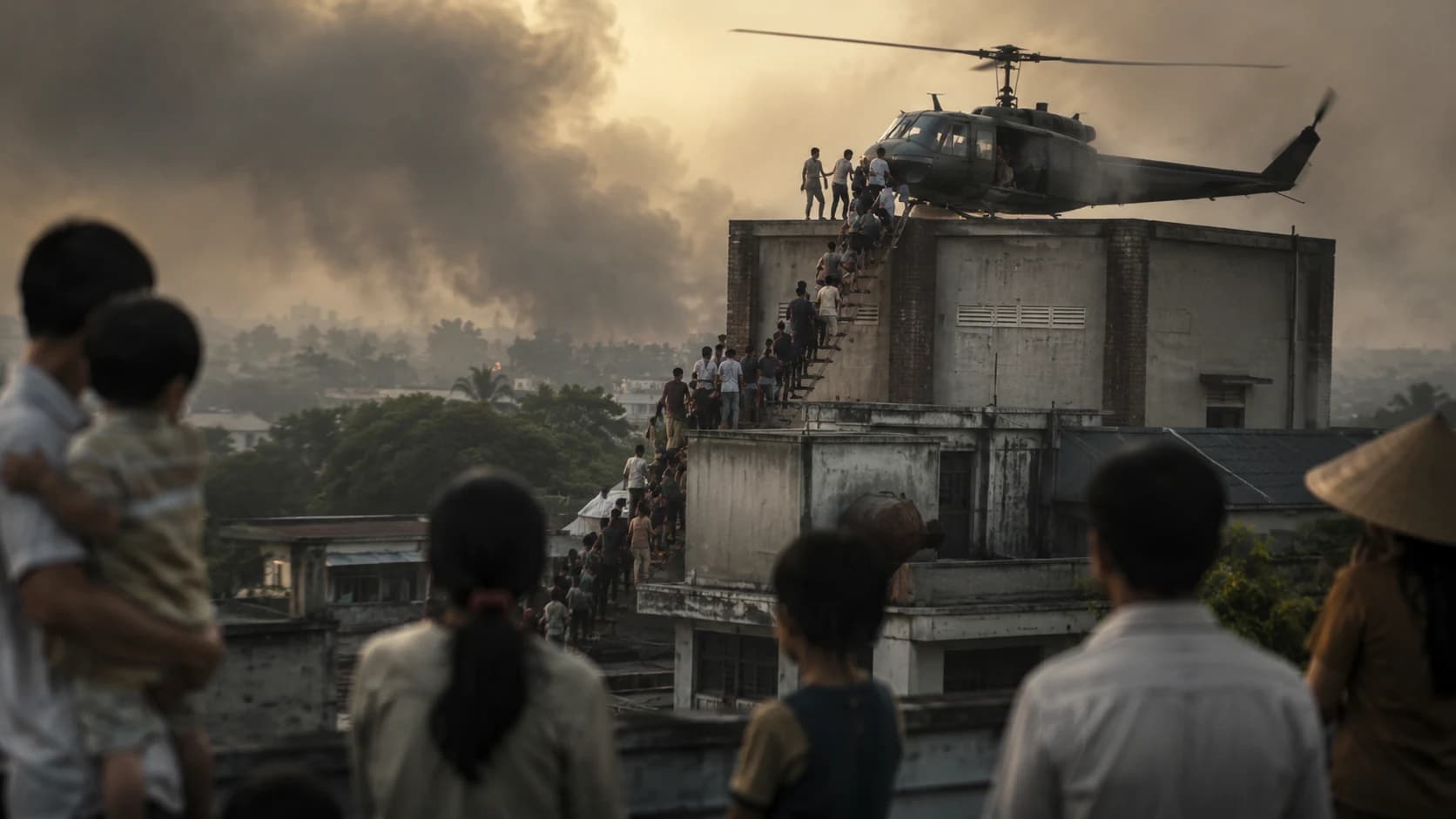
The helicopters never stopped coming.
On 30 April 1975, South Vietnam collapsed as helicopters lifted evacuees from Saigon and North Vietnamese tanks entered the presidential palace.
Above the American embassy in Saigon, rotor blades beat the hot April air into a roar. Crowds surged against the gates. Families clutched children. South Vietnamese officials held up desperate documents, hoping for a place aboard one of the last flights out.
On the morning of , Saigon was no longer waiting to learn whether it would fall. It was waiting to see who could escape first.
Within hours, the war that had consumed Vietnam for decades and drawn in the world's greatest superpower would end not with a climactic battle, but with abandoned embassies, deserted streets, and tanks crashing through the gates of a presidential palace.
Each helicopter lifted off overloaded. Each departure left behind even larger crowds.
By the spring of 1975, South Vietnam was collapsing with astonishing speed. The United States had withdrawn its combat troops two years earlier under the Paris Peace Accords, hoping a strengthened South Vietnamese military could defend itself while diplomacy preserved a fragile peace.
Instead, the agreement bought time mostly for North Vietnam. Backed by years of planning and supplied through the Ho Chi Minh Trail, the People's Army of Vietnam launched a massive offensive in early 1975. Attacks in the Central Highlands became an avalanche.
Entire South Vietnamese divisions dissolved during chaotic retreats. Cities expected to hold for months fell within days. Refugees clogged the roads south, turning military withdrawals into humanitarian disaster. President Nguyen Van Thieu resigned on 21 April, a sign that many believed the republic itself had only days left.
American officials faced an impossible calculation. Thousands of U.S. citizens remained in the city, alongside tens of thousands of South Vietnamese who had worked with American forces as soldiers, interpreters, intelligence officers, and civil servants. Many feared brutal reprisals if communist forces captured them.
When North Vietnamese artillery struck near Saigon and Tan Son Nhut air base came under attack, fixed-wing evacuation became too dangerous. Helicopters would instead ferry people from rooftops, embassy compounds, and collection points to American ships waiting offshore in the South China Sea.
On 29-, became the largest helicopter evacuation ever attempted.
Marine guards struggled to hold order as thousands gathered outside the U.S. embassy. Some climbed walls. Others begged to be let through. Inside the compound, embassy staff destroyed classified documents, smashed sensitive equipment, and burned papers in barrels as smoke drifted above the city.
By dawn on 30 April, communist tanks were entering Saigon from multiple directions. At 10:24 a.m., newly appointed President Duong Van Minh addressed the nation and ordered South Vietnamese forces to stop fighting. Further resistance, he said, would only bring more bloodshed.
Not everyone heard the order immediately. Some soldiers continued firing. Others removed their uniforms and tried to disappear into the civilian population. Families who had believed American support would ultimately save the republic suddenly faced a future no one could predict.
Just after midday, North Vietnamese Tank 390 smashed through the gates of the Presidential Palace. Soldiers rushed inside expecting resistance. Instead, they found officials waiting. The government of South Vietnam surrendered, and the Republic of Vietnam ceased to exist.
The iconic rooftop helicopter became the enduring image of the war's final hours, even though many famous photographs were taken from nearby buildings rather than the embassy itself. What they captured was larger than geographical precision: the unmistakable sense of a superpower's hurried departure.
More than 7,000 people were evacuated during in less than twenty-four hours. Thousands more escaped independently by boat or aircraft. Many never found a way out. Former South Vietnamese officials were sent to reeducation camps, property was confiscated, and political life was remade under the new communist government.
In the years that followed, hundreds of thousands of Vietnamese fled by sea, packed into overcrowded boats bound for neighboring countries and new lives in the United States, Canada, Australia, France, and elsewhere. Others vanished in storms or fell victim to pirates.