Related Moment
The Explosion That Started Japan's Road to War
A charge too weak to stop a train helped derail an international order.
On 18 September 1931, a small blast near Mukden gave Japan's Kwantung Army the pretext it wanted to seize Manchuria.
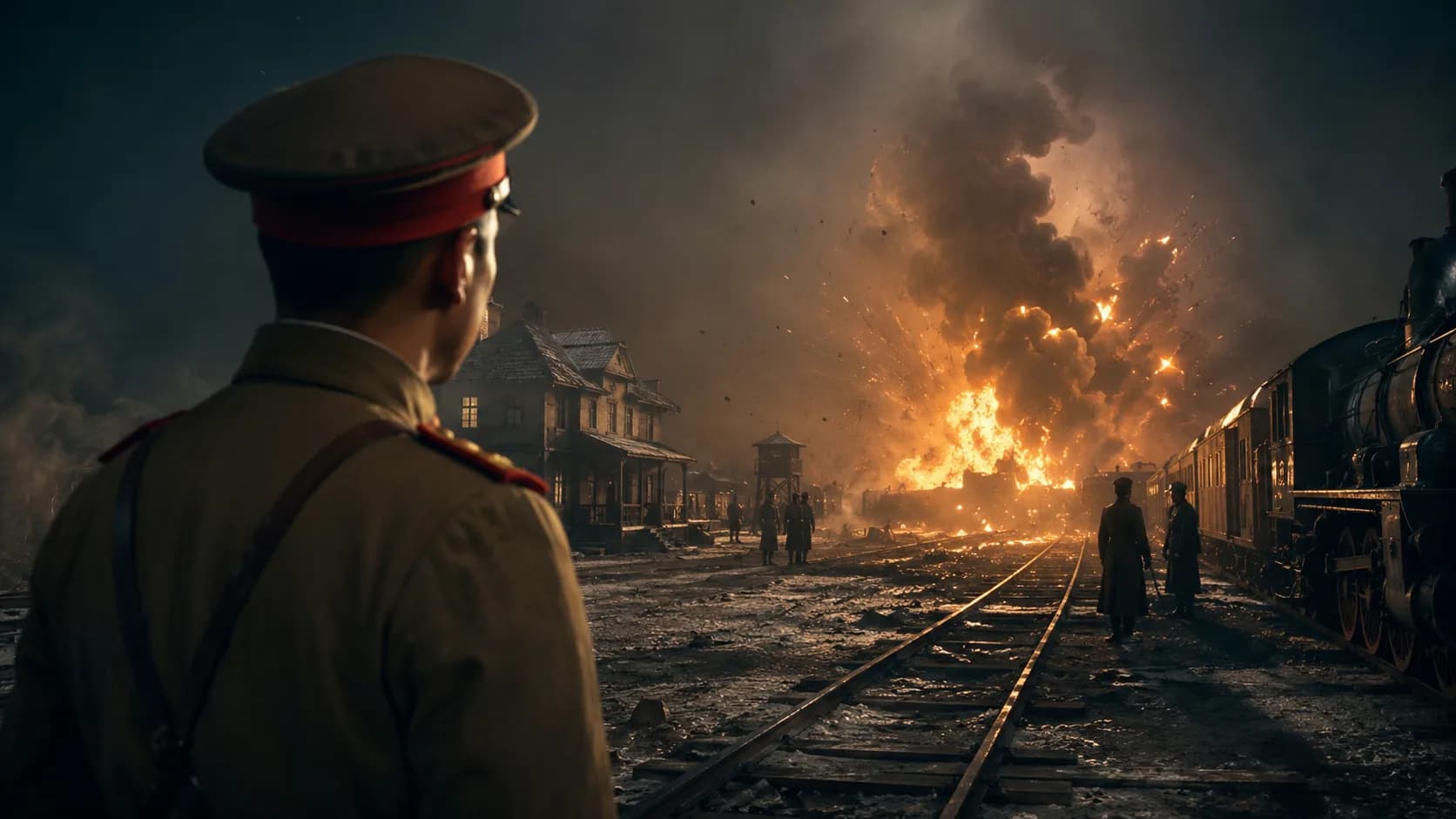
A small explosion ripped through a railway line outside the Chinese city of on the night of 18 September 1931.
The blast was so weak that the tracks remained usable. Within minutes, a train passed safely over the damaged section.
Yet before dawn, the claimed China had sabotaged . Troops were already advancing. Cities were falling. A war had begun.
The explosion itself barely mattered. The story built around it changed the course of Asia and helped set the world on the path toward the Second World War.
In the early twentieth century, was one of the most coveted regions in East Asia. Stretching across northeastern China, it possessed rich farmland, vast forests, coal, iron, and an expanding railway network.
Japan had spent decades increasing its influence there. Victory in the Russo-Japanese War had secured control of the , which became far more than a transportation route. Stations grew into settlements, businesses followed the tracks, and thousands of Japanese citizens settled throughout .
Protecting these interests was the , originally stationed to defend . Over time, however, the force developed ambitions far beyond its official mission.
Meanwhile, China was fragmented. The Nationalist government under Chiang Kai-shek sought to unify the country, but regional warlords still wielded significant power. itself remained under the control of , the , whose forces were substantial but politically isolated.
Within Japan, civilian leaders often favored diplomacy and economic cooperation. Many officers in the believed those policies showed dangerous weakness. They argued that Japan needed direct control of to secure resources, guarantee national security, and protect itself from instability in China and perceived Soviet influence.
Some officers became convinced that if Tokyo would not authorize expansion, events could be engineered to make expansion unavoidable.
Late on the evening of 18 September, explosives detonated beneath a section of the near , today's Shenyang. The damage was remarkably slight.
Postwar investigations concluded that officers within the had almost certainly planted the explosive themselves. Their objective was not destruction but justification.
Within moments, announced that Chinese soldiers had attacked . Without waiting for permission from Tokyo, units launched carefully prepared operations across .
This was no improvised retaliation. Plans had already been drafted, supply lines organized, and targets selected. The explosion merely activated them.
Japanese forces quickly seized . Other cities followed in rapid succession. Chinese troops, many operating under orders to avoid large-scale confrontation, often withdrew rather than risk devastating defeats against better-equipped Japanese units.
Within days, vast portions of were under Japanese military control. The speed of the campaign stunned observers abroad.
Even Japan's civilian government had not fully anticipated the scale of the offensive. Rather than punishing the officers responsible for exceeding their authority, political leaders found themselves confronting a military success that had become difficult to reverse.
Public opinion at home, fueled by reports portraying Japan as the victim of Chinese aggression, largely celebrated the victories. The officers who had ignored orders were rewarded not with disgrace but with influence.
It marked a dangerous shift in Japan's balance of power. Military commanders had demonstrated that decisive action could create political reality. Civilian leaders increasingly found themselves reacting to events rather than directing them.
By early 1932, Japan had completed its occupation of nearly all . Instead of formally annexing the territory, it established the state of Manchukuo, presenting it as an independent nation.
In reality, Manchukuo functioned under Japanese control. To strengthen the illusion of legitimacy, Japan installed Puyi, the last emperor of China's Qing dynasty, as its ruler. Though he carried the prestige of imperial history, real authority rested with Japanese officials and military commanders.
The conquest of gave Japan vital industrial resources, strategic depth, and a base for further military campaigns into China. It also transformed Japanese politics, because officers who had acted independently proved that military initiatives could dictate national policy.
International reaction was swift but ultimately ineffective. China appealed to of Nations, the international organization created after the First World War to prevent aggression between states.
The League dispatched the Lytton Commission, which spent months investigating conditions on the ground. Its report concluded that Japan possessed legitimate economic interests in but that the invasion could not be justified as self-defense. It refused to recognize Manchukuo as an independent state.
Japan rejected the findings. In 1933, rather than accept condemnation, Japan withdrew from of Nations altogether.
The episode exposed the organization's greatest weakness. It could investigate. It could debate. It could condemn. But it possessed no practical means of compelling a powerful nation to reverse its actions.
Around the world, other governments watched carefully. The lesson many drew was unsettling: determined military aggression could succeed if potential opponents lacked the will to intervene.
The was far more than a local border clash or a manufactured excuse for occupying one province. It marked the beginning of Japan's sustained expansion across mainland Asia.
Civilian authority weakened while militarism gained momentum, shaping Japan's decisions throughout the 1930s. Internationally, the crisis dealt a severe blow to confidence in collective security. The failed its first major test against a great power.
Six years later, full-scale war erupted between Japan and China after the Marco Polo Bridge Incident. Eight years after , Europe descended into the Second World War.
The small explosion outside did not cause those conflicts by itself. The deeper forces driving imperial ambition, nationalism, economic insecurity, and political instability were already present. But revealed how a carefully staged provocation could unleash them.
