People

Yaroslav the Wise

Yaroslav the Wise was Grand Prince of Kiev from 1019 to 1054, remembered for the Russkaya Pravda, Saint Sophia Cathedral, and marriage alliances across Europe.

Born
978 CE
Died
1054 CE
Role
Grand Prince of Kiev

Grand Prince of Kiev (c. 978-1054)

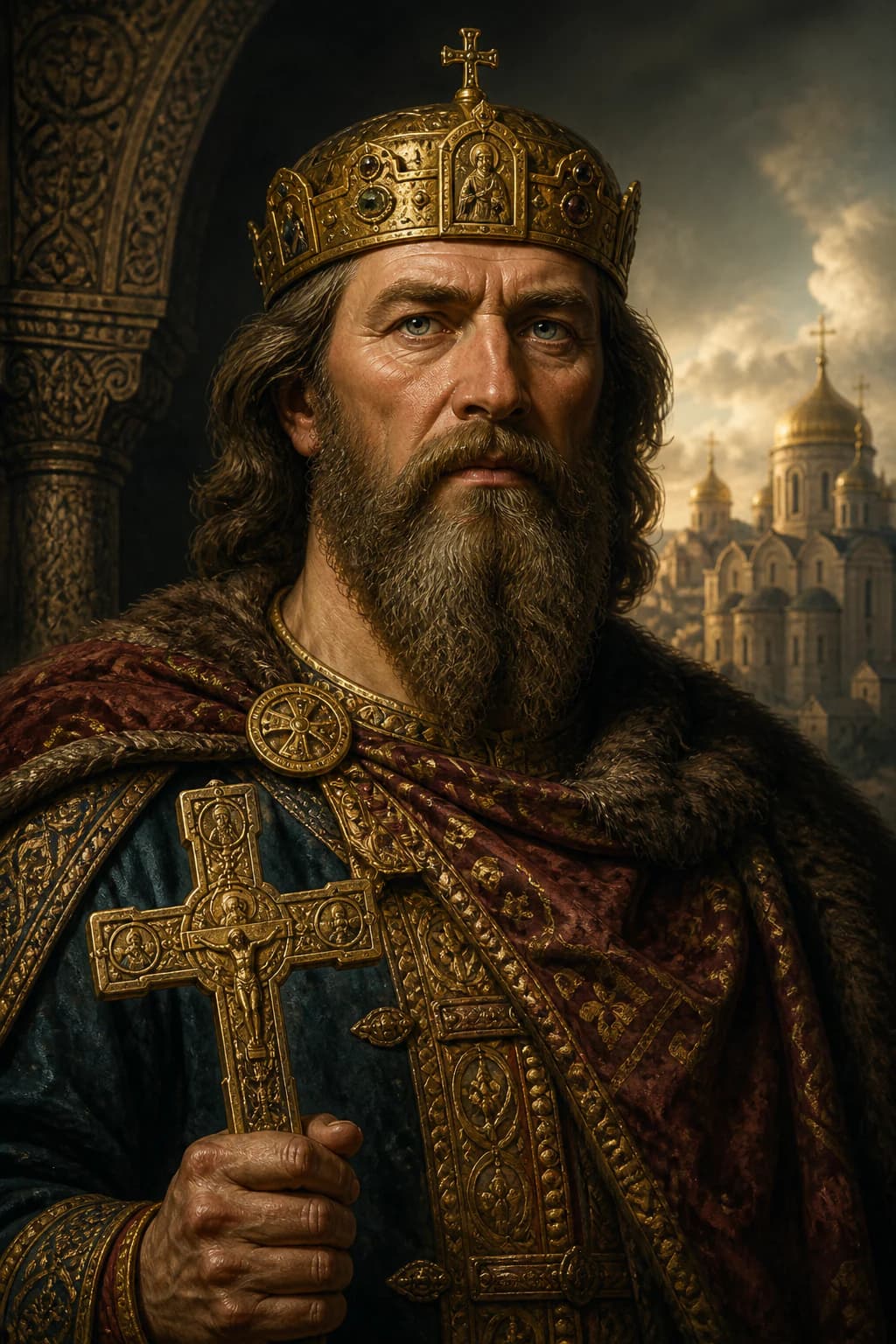
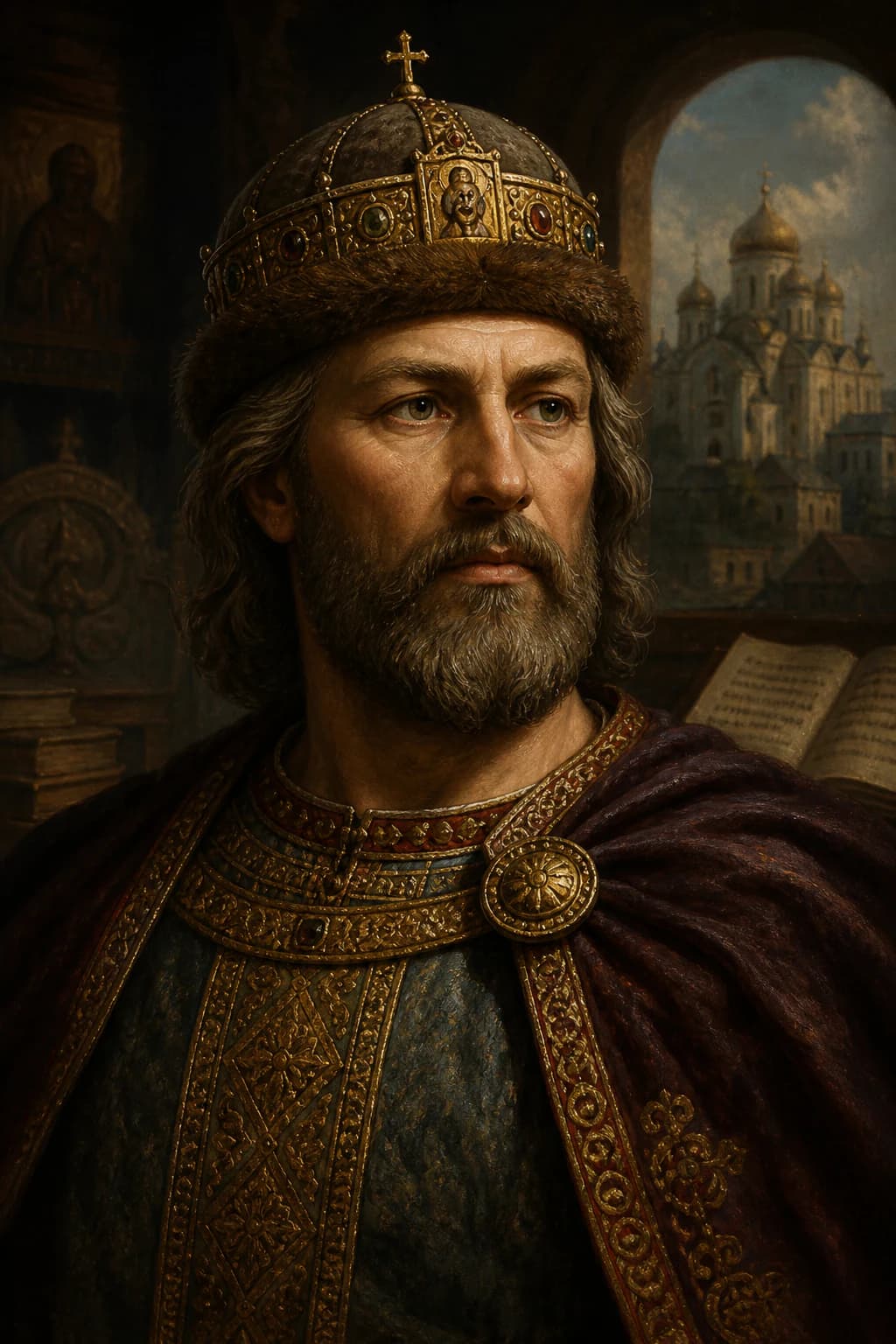
AI-generated portrait of Yaroslav the Wise in princely regalia
AI-assisted historical reconstruction

An illustrative reconstruction based on historical context. It is not a photograph or documentary likeness. Image policy

Quick answer

Yaroslav the Wise was Grand Prince of Kiev from 1019 to 1054, remembered for the Russkaya Pravda, Saint Sophia Cathedral, and marriage alliances across Europe.

Born
978 CE
Died
1054 CE
Role
Grand Prince of Kiev
Years
978-1054 CE
Quick facts

Profile details

Additional identity and tagging details that are not already covered in the introduction.

Full name
Yaroslav Vladimirovich
Also known as
Iaroslav the Wise
Facts

Yaroslav the Wise timeline facts

Selected specifics from this profile's life story.

c. 978
Princely origins

Yaroslav was a son of Vladimir the Great, raised inside a dynasty whose regional appointments often became rehearsal grounds for civil war.

1030s
Law and order

Yaroslav is closely associated with the Russkaya Pravda, the early Rus legal tradition that shaped justice, compensation, and princely authority.

1030s-1050s
Dynastic diplomacy

Yaroslav married his children into royal houses across Europe, making Kiev a dynastic partner of France, Norway, Hungary, Poland, and Byzantium.

1054
Succession and fragmentation

Yaroslav died in 1054 after trying to arrange succession among his sons, but his system could not prevent later division.

Life Journey

Why Yaroslav the Wise matters

Follow the story in a more continuous narrative, with a reading mode that matches how much depth you want.

Complete chronology

c. 978

Princely origins

Yaroslav Vladimirovich, later called Yaroslav the Wise, was born into the generation after the Christianization of Rus. His father, Vladimir the Great, had remade the religious identity of Kiev; his sons inherited the benefits and dangers of that transformation. Yaroslav was appointed to rule in regional centres, including Rostov and later Novgorod, where he built an independent base of support. The system was meant to distribute authority across the dynasty, but it also gave ambitious sons troops, revenue, and local loyalties. Yaroslav's early career therefore combined education in governance with preparation for conflict. He belonged to a Christian princely house, but its politics remained intensely competitive.

1015-1019

Struggle for supremacy

Vladimir's death in 1015 triggered a succession crisis that became central to Rus sacred and political memory. Boris and Gleb were killed and later venerated as passion-bearer saints. Sviatopolk, remembered as the Accursed, was blamed in the tradition, while Yaroslav fought from Novgorod to claim Kiev. The struggle ended with Yaroslav's victory in 1019, though rivalry with his brother Mstislav continued until Mstislav's death in 1036. Only then did Yaroslav enjoy undivided supremacy over Kiev. His rise was not the smooth ascent of a philosopher-king. It was forged through war, alliance with Novgorod, and the careful use of dynastic legitimacy after a crisis that exposed how fragile Vladimir's settlement had been.

1030s

Law and order

One of Yaroslav's most important legacies is legal. The Russkaya Pravda, or Rus Justice, is a complex text with layers from different periods, but its earliest core is traditionally linked to Yaroslav. It did not create a modern law code, and it did not remove violence from society. Instead, it helped regulate injury, theft, compensation, status, debt, and the authority of princely agents. Its emphasis on fines and restitution reveals a society seeking to contain feud and channel conflict through recognized payments. For students asking what Yaroslav the Wise did, this is essential: he helped give Rus political life a more durable legal vocabulary. Law became part of princely memory, not merely a tool of punishment.

1037-1050s

Christian Kiev

Yaroslav's Kiev was a city of deliberate Christian display. He sponsored Saint Sophia Cathedral in Kiev, associated with the celebration of victory and the glory of divine wisdom, and supported monasteries, literacy, translation, and church organization. Under his rule, the first known native metropolitan of Kiev, Hilarion, emerged, signalling growing confidence within the Rus church even while Byzantine influence remained powerful. Yaroslav collected books and promoted a court culture that connected scripture, law, architecture, and princely prestige. His building programme was not decoration. It announced that Kiev belonged among the Christian capitals of Europe. The city became a place where dynastic power could be seen in stone, mosaic, liturgy, and written memory.

1030s-1050s

Dynastic diplomacy

Yaroslav's diplomacy was astonishingly wide. His daughter Anne married Henry I of France and became queen of France. Anastasia married Andrew I of Hungary. Elizabeth married Harald Hardrada of Norway, the warrior king later killed at Stamford Bridge in 1066. Other family connections linked Kiev to Poland, Byzantium, and the German world. These marriages were not ornamental. They show that eleventh-century Kiev was not isolated on Europe's edge but integrated into elite politics across the continent. Yaroslav used kinship as a foreign policy instrument, projecting status while securing alliances and prestige. This is one reason his reign is remembered as the high point of Kievan Rus: Kiev was powerful enough for other royal houses to seek its bloodline.

1054

Succession and fragmentation

Yaroslav died in 1054, the same year remembered in wider Christian history for the deepening split between Rome and Constantinople. Before his death, he attempted to arrange a hierarchy among his sons, placing Iziaslav in Kiev and assigning other major centres to his brothers. The aim was to preserve dynastic cooperation, but the arrangement carried the seeds of rivalry. In the generations after Yaroslav, Kievan Rus became increasingly fragmented among competing branches of the Rurikid family. That outcome should not reduce his achievement. It clarifies it. Yaroslav presided over a peak of legal, cultural, religious, and diplomatic development, but he could not solve the structural problem of shared dynastic rule. His reign was a summit, not a permanent settlement.

Continue in context

Connected stories

Move from the profile into the wider events and settings this figure belongs to.

Tertiary paths

Content note

This profile is written for educational use and connects to related Stories of History pages. The main portrait is an AI-assisted historical reconstruction, included as an illustrative aid rather than documentary evidence. Image policy

References

Sources & Further Reading

Reliable reference works, archives and reading paths connected to this profile.

Further reading

  1. Encyclopaedia Britannica, Search results for Yaroslav the Wise,” accessed June 2026.Open source
  2. WorldCat, Books and library holdings for Yaroslav the Wise,” accessed June 2026.Open source

Primary sources

  1. Library of Congress, Search results for Yaroslav the Wise,” accessed June 2026.Open source

Reviewed claim sources

Loading reviewed claim sources...

A weekly route through history

Find out first about the latest published stories, feature notes and occasional Premium offers in one weekly email.