People

Xi Jinping

Xi Jinping is China's president, Communist Party general secretary and Central Military Commission chairman. His biography includes Cultural Revolution exile, provincial leadership, anti-corruption campaigns, term-limit abolition, military purges and global assertiveness.

Born
1953 CE
Role
Chinese President and General Secretary

Chinese President and General Secretary (born 1953)

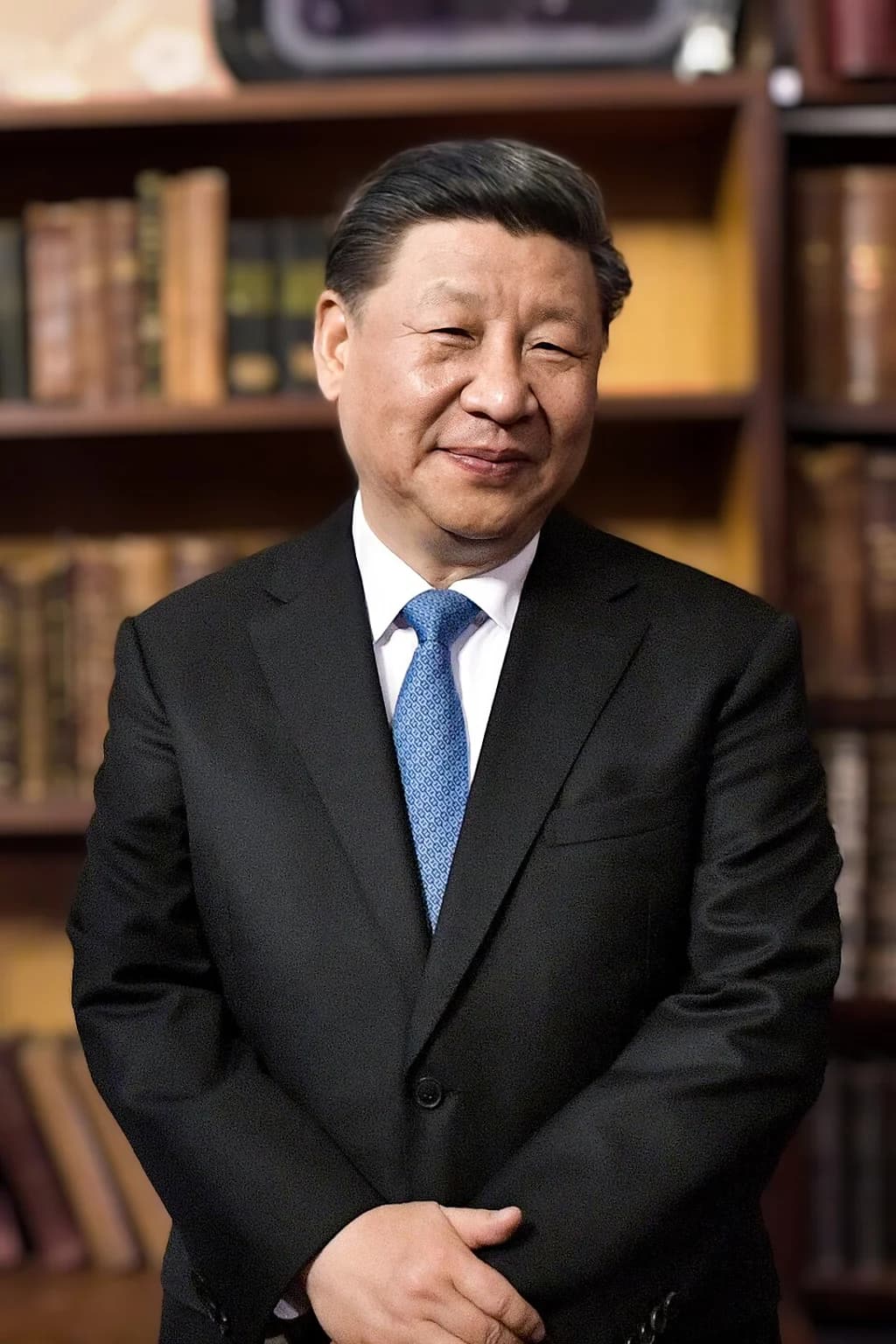
Licensed portrait photograph of Xi Jinping
Licensed archival image

A real historical or editorial image is used here. Source, licence and transformation details are publicly recorded. Image policy Attribution

Quick answer

Xi Jinping is China's president, Communist Party general secretary and Central Military Commission chairman. His biography includes Cultural Revolution exile, provincial leadership, anti-corruption campaigns, term-limit abolition, military purges and global assertiveness.

Born
1953 CE
Role
Chinese President and General Secretary
Years
Born 1953 CE
Facts

Xi Jinping timeline facts

Selected specifics from this profile's life story.

1953
Revolutionary roots

Xi Jinping was born in Beijing in 1953, the son of revolutionary veteran Xi Zhongxun, placing him close to the Communist Party elite from childhood.

1980s
Local governance roles

Xi began as a military aide and then built a long local career in Hebei, Fujian, Zhejiang and Shanghai, learning how reform-era China worked below Beijing.

2012
Assumes top office

Xi became Communist Party general secretary in 2012 and president in 2013, launching anti-corruption campaigns and the language of national rejuvenation.

Present
Shaping modern China

Xi remains China's central leader in 2026, shaping its economy, party-state, military command and global role with consequences still unfolding.

Life Journey

Revolutionary lineage, party discipline, and consolidated power

Follow the story in a more continuous narrative, with a reading mode that matches how much depth you want.

Complete chronology

1953

Revolutionary roots

Xi Jinping entered the world of the People's Republic's founding generation. His father, Xi Zhongxun, was a veteran revolutionary and senior official who had helped build the Communist state. That background gave the young Xi access to privilege, political language and elite networks, but in Mao-era China proximity to power could become danger almost overnight. The party-state was not a stable ladder; it was a battlefield of campaigns, loyalty tests and ideological reversals. Xi's later emphasis on discipline, hierarchy and party control is often read through this childhood contrast: he saw both the advantages of revolutionary pedigree and the vulnerability of families caught on the wrong side of political struggle.

1966–1976

Cultural Revolution hardship

The Cultural Revolution broke the security of Xi's elite upbringing. His father was purged, his family suffered, and Xi was sent as a teenager to Liangjiahe, a poor village in Shaanxi province. Official narratives emphasise hardship, endurance and closeness to ordinary rural life; outside observers note that such stories also serve political legitimacy by presenting Xi as tempered by the people. Both can be true in different ways. The years in Liangjiahe exposed him to poverty, manual labour and the fragility of status. They also taught a lesson common to many survivors of Maoist upheaval: chaos could destroy families, institutions and trust. Xi's later politics would define stability as a supreme good.

1975

Return to study

Xi's route back into advancement was gradual. He reportedly applied to join the Communist Party multiple times before acceptance, a detail often used to underline persistence. In 1975 he entered Tsinghua University as a worker-peasant-soldier student, studying chemical engineering during the late Mao period when education remained heavily political. His later career was not technical, but Tsinghua restored institutional standing and connected him to networks that mattered. After Mao's death, China began moving away from ideological frenzy toward reconstruction. Xi belonged to a generation of cadres who had experienced the Cultural Revolution personally and then entered government as the party sought order, growth and renewed authority.

1980s

Local governance roles

Xi's early career included service as secretary to Geng Biao, a senior military figure, giving him exposure to defence and central politics. He then spent many years in local administration, beginning in Hebei and moving through Fujian and Zhejiang before a brief but important posting in Shanghai. These were not ceremonial assignments. Reform-era provinces had to attract investment, manage corruption, contain social tension and deliver growth while preserving party authority. Xi developed a reputation for caution, discipline and administrative steadiness rather than flamboyance. His long provincial apprenticeship later helped him present himself as a leader who understood both coastal development and grassroots governance.

1990s–2000s

Climbing the party

In Zhejiang, Xi presided over one of China's most dynamic provincial economies, encouraging private enterprise while stressing party control and clean government. His brief transfer to Shanghai in 2007 followed a corruption scandal, signalling central trust in his ability to steady a politically sensitive city. Xi's rise was aided by revolutionary pedigree, but pedigree alone was not enough. He avoided the public colour that could alarm rivals and built a record as a competent manager of economically important regions. Inside the Communist Party, reliability can be more valuable than charisma. By the time succession politics sharpened, Xi looked like a safe choice to many who did not yet foresee how thoroughly he would centralise power.

2007

National leadership entry

Xi's elevation to the Politburo Standing Committee in 2007 made succession visible. He became vice president in 2008 and took on roles connected to party building, Hong Kong and Macau affairs, and the Beijing Olympics. The late Hu Jintao years were often described as collective leadership, with power distributed among factions, ministries, state companies and local governments. Xi watched a system that had delivered growth but also corruption, inequality, environmental damage and policy drift. His later rule can be understood partly as a reaction against that diffusion. He concluded, or at least acted as if he concluded, that the party had to recentralise before it decayed.

2012

Assumes top office

Xi became general secretary of the Chinese Communist Party and chairman of the Central Military Commission in 2012, then president of the People's Republic in 2013. He moved quickly. The anti-corruption campaign punished both 'tigers and flies', removing corrupt officials while also eliminating rivals and disciplining the bureaucracy. Xi promoted the 'Chinese Dream' of national rejuvenation, linking party rule to prosperity, military strength, technological ambition and restored global status. Leading small groups and commissions expanded central oversight across policy areas. The message was unmistakable: the party would lead everything, and Xi would sit at the centre of the party.

2010s–2020s

Power centralisation

Xi's consolidation changed the norms of post-Mao politics. In 2018, China removed presidential term limits, clearing the way for rule beyond the two-term pattern associated with earlier leaders. Xi Jinping Thought was written into party and state documents, and the party's presence expanded across private firms, schools, media, technology and civil society. Abroad, the Belt and Road Initiative projected Chinese finance and infrastructure across continents, while China took a more forceful line in the South China Sea, toward Taiwan and in strategic competition with the United States. The same era brought severe repression in Xinjiang, tighter control in Hong Kong after the 2019 protests, expansive surveillance and pressure on dissent. Supporters present this as order and national strength; critics call it authoritarian consolidation.

Present

Shaping modern China

Xi's leadership is still a living historical process. His China is more centralised, more technologically ambitious, more internationally assertive and more politically controlled than the China he inherited. The continuing churn in the People's Liberation Army, including high-level corruption investigations and new senior promotions in 2026, shows that Xi's control of the military depends on discipline and loyalty as much as modernisation. China also faces difficult pressures: slower growth, demographic ageing, debt, youth unemployment, strategic rivalry and the challenge of maintaining innovation under tighter political supervision. Xi's legacy will depend not only on how long he rules, but on whether the system he has remade can adapt after being so closely organised around one leader.

Continue in context

Connected stories

Move from the profile into the wider events and settings this figure belongs to.

China Presidents lineage
Lineage8 heads of state
China Presidents
1949 CE–present

Heads of state of the People's Republic of China from Mao Zedong to Xi Jinping.

View lineage
Tertiary paths

Content note

This profile is written for educational use and connects to related Stories of History pages. The main portrait uses a real historical or editorial image, with source and licence details recorded for attribution review. Image policy Image attribution

References

Sources & Further Reading

Reliable reference works, archives and reading paths connected to this profile.

Further reading

  1. Encyclopaedia Britannica, Search results for Xi Jinping,” accessed June 2026.Open source
  2. WorldCat, Books and library holdings for Xi Jinping,” accessed June 2026.Open source

Primary sources

  1. Library of Congress, Search results for Xi Jinping,” accessed June 2026.Open source

Reviewed claim sources

Loading reviewed claim sources...

A weekly route through history

Find out first about the latest published stories, feature notes and occasional Premium offers in one weekly email.