People

René Descartes

René Descartes was a French philosopher and mathematician whose method of doubt, cogito argument, mechanical philosophy, and analytic geometry helped shape modern philosophy and science.

Born
1596 CE
Died
1650 CE
Role
Philosopher and mathematician

French philosopher and mathematician (1596-1650)

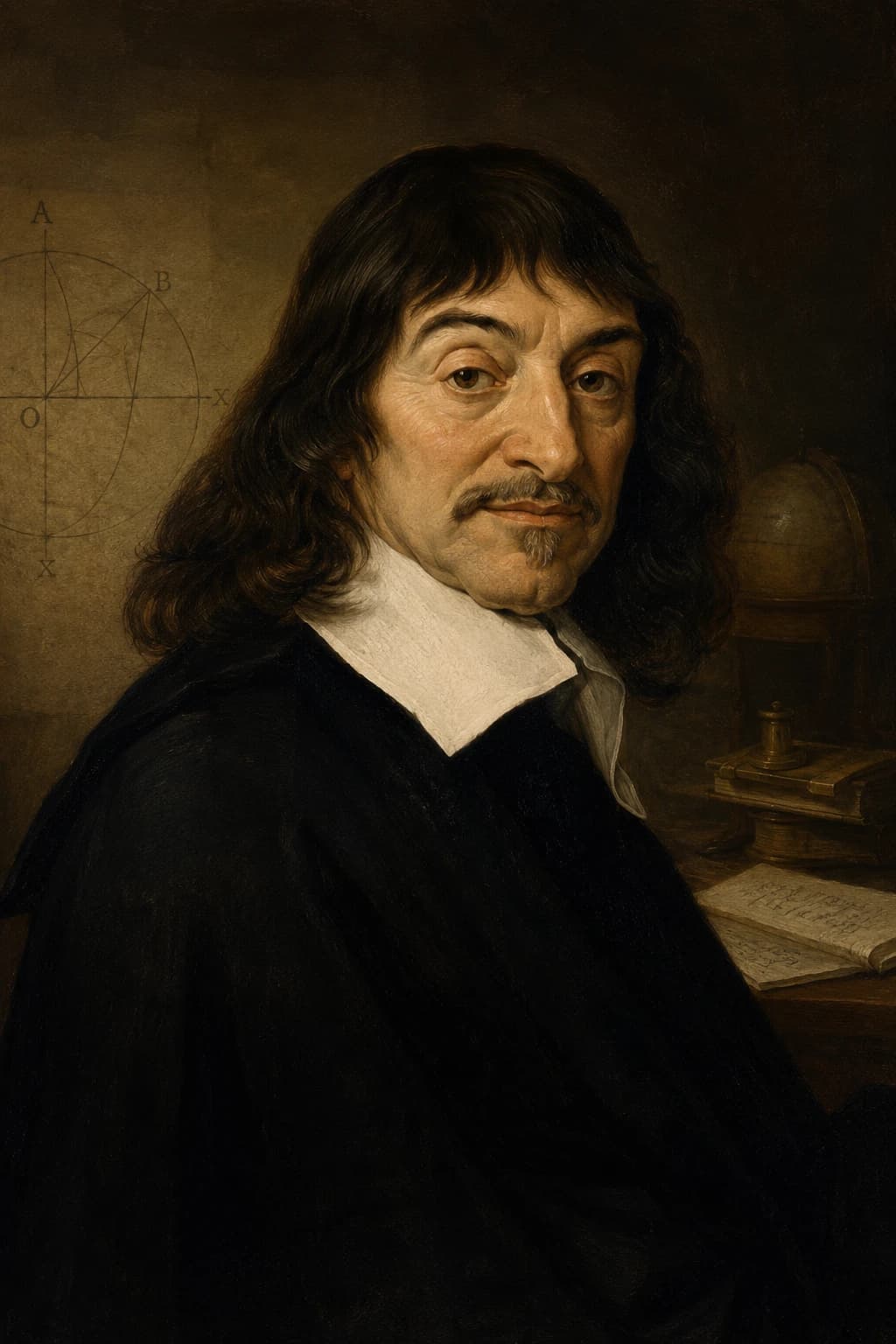
AI-generated portrait of René Descartes with geometric diagrams and manuscripts
AI-assisted historical reconstruction

An illustrative reconstruction based on historical context. It is not a photograph or documentary likeness. Image policy

Quick answer

René Descartes was a French philosopher and mathematician whose method of doubt, cogito argument, mechanical philosophy, and analytic geometry helped shape modern philosophy and science.

Born
1596 CE
Died
1650 CE
Role
Philosopher and mathematician
Years
1596-1650 CE
Quick facts

Profile details

Additional identity and tagging details that are not already covered in the introduction.

Also known as
Descartes, Rene Descartes
Region
France, Dutch Republic, Sweden, France and the Dutch Republic
Facts

René Descartes timeline facts

Selected specifics from this profile's life story.

1596
Born in Touraine

René Descartes was born in France in 1596 and educated in a world where classical learning still shaped intellectual life.

1637
Discourse on Method

In Discourse on Method, Descartes described a disciplined way of doubting uncertain beliefs and rebuilding knowledge.

1640s
Mechanical nature

Descartes pictured the physical world as matter in motion, governed by mechanical principles rather than hidden purposes.

1650 and after
Modern philosophy begins

Descartes died in Sweden in 1650, leaving ideas that reshaped philosophy, mathematics, and science.

Life Journey

Doubt, method, and a mechanical universe

Follow Descartes from education and war to the philosophical method that reshaped certainty.

Complete chronology

1596

Born in Touraine

René Descartes was born in 1596 at La Haye en Touraine, in France. His family belonged to the lesser nobility, giving him access to education and social independence. He studied at the Jesuit college of La Fleche, one of Europe's strongest schools, where he learned classical literature, scholastic philosophy, mathematics, and theology. The education was rigorous, but it left him dissatisfied. Descartes came to believe that much accepted knowledge rested on inherited authority rather than secure foundations.


1610s-1620s

Searching for certainty

As a young man, Descartes moved through military and intellectual circles during the tense early decades of the seventeenth century. He was less interested in soldierly glory than in observing the world and testing what counted as reliable knowledge. Mathematics offered him a model: clear starting points, disciplined steps, and conclusions that followed with necessity. That ideal shaped his later philosophy. Descartes wanted thought to stop leaning on habit and authority and to rebuild itself from what could not be doubted.

1637

Discourse on Method

Descartes published Discourse on Method in 1637. Its famous argument began with radical doubt: set aside anything that can be doubted and ask what remains. The answer was the thinking self. Even if every perception were mistaken, the act of doubting proved that there was a thinker doubting. This became the cogito, often rendered as 'I think, therefore I am.' Descartes did not stop with a slogan. He used the argument as a foundation from which to rebuild knowledge on clearer principles.

1637

Analytic geometry

The same intellectual project included a major mathematical achievement. Descartes's work on analytic geometry connected curves and shapes to algebraic equations. This gave later mathematicians a powerful way to represent space, motion, and change. The coordinate methods associated with his name did not simply tidy up geometry. They helped create a language in which physical problems could become mathematical ones. Newton and others would later work in a world transformed by that union.

1640s

Mechanical nature

Descartes's natural philosophy described matter as extended substance moving through space. He wanted physical events explained mechanically, through size, shape, motion, impact, and arrangement. This did not make him an atheist; God remained essential to his system. But it did change the explanatory ambition of natural philosophy. Bodies, animals, light, vortices, and motion could be described as parts of a vast machine. Many details of Cartesian science were later rejected, yet the mechanical ideal shaped seventeenth-century debates about nature.

1650 and after

Modern philosophy begins

Descartes spent much of his mature life in the Dutch Republic, where publishing and intellectual exchange were freer than in many parts of Europe. In 1649 he accepted an invitation to the Swedish court of Queen Christina and died in Stockholm in 1650. His legacy is vast and contested. Philosophers argued over mind and body, certainty, God, perception, and the limits of reason. Scientists used and challenged his mechanical explanations. Mathematicians built on his algebraic approach to geometry. Descartes matters because he made knowledge answerable to method, clarity, and justification in a new way.

Continue in context

Connected stories

Move from the profile into the wider events and settings this figure belongs to.

Tertiary paths

Content note

This profile is written for educational use and connects to related Stories of History pages. The main portrait is an AI-assisted historical reconstruction, included as an illustrative aid rather than documentary evidence. Image policy

References

Sources & Further Reading

Reliable reference works, archives and reading paths connected to this profile.

Further reading

  1. Encyclopaedia Britannica, Search results for René Descartes,” accessed June 2026.Open source
  2. WorldCat, Books and library holdings for René Descartes,” accessed June 2026.Open source

Primary sources

  1. Library of Congress, Search results for René Descartes,” accessed June 2026.Open source

Reviewed claim sources

Loading reviewed claim sources...

A weekly route through history

Find out first about the latest published stories, feature notes and occasional Premium offers in one weekly email.