People

Prince Henry the Navigator

Prince Henry the Navigator was a Portuguese prince who sponsored fifteenth-century Atlantic voyages along the West African coast. His patronage advanced Portuguese exploration, trade and cartography, but also helped begin the Atlantic slave trade.

Born
1394 CE
Died
1460 CE
Role
Portuguese prince

Portuguese prince (1394–1460)

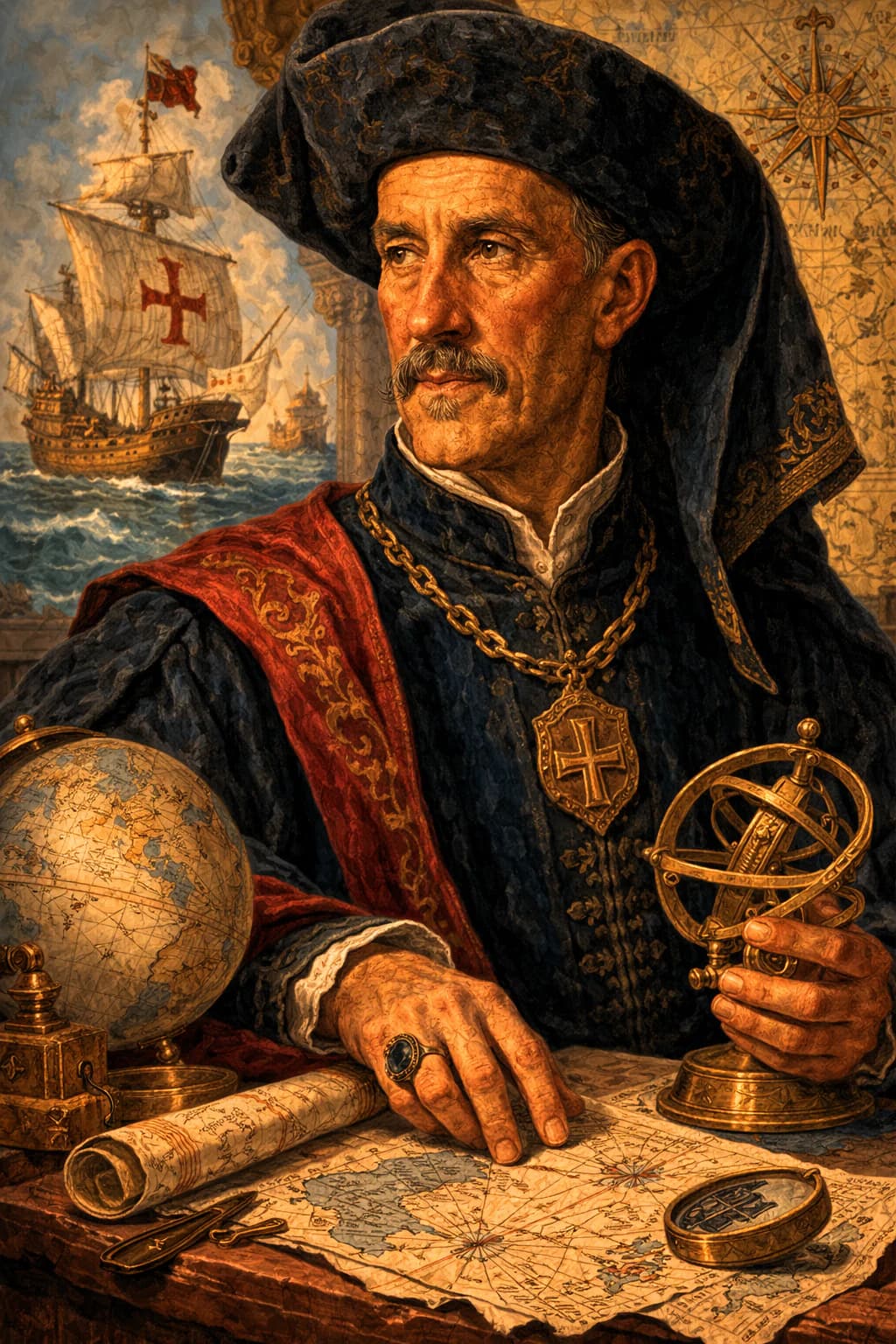
AI-generated portrait of Prince Henry the Navigator in 15th-century Portuguese royal attire
AI-assisted historical reconstruction

An illustrative reconstruction based on historical context. It is not a photograph or documentary likeness. Image policy

Quick answer

Prince Henry the Navigator was a Portuguese prince who sponsored fifteenth-century Atlantic voyages along the West African coast. His patronage advanced Portuguese exploration, trade and cartography, but also helped begin the Atlantic slave trade.

Born
1394 CE
Died
1460 CE
Role
Portuguese prince
Years
1394-1460 CE
Facts

Prince Henry the Navigator timeline facts

Selected specifics from this profile's life story.

1394
Royal Beginnings

Prince Henry was born in 1394, son of John I of Portugal and Philippa of Lancaster, inside a dynasty eager for crusade, trade and legitimacy.

1430s
Sagres Base

The famous 'school of Sagres' is partly legend, but Henry did gather maritime knowledge, pilots, charts and practical experience around his household.

mid 1400s
Moral Complexity

Henry's expeditions were deeply implicated in the early Atlantic slave trade, including raids and sales of captured Africans in Portugal.

after 1460
Enduring Impact

Prince Henry's legacy is the beginning of sustained Portuguese oceanic expansion, with all its knowledge, wealth, violence and exploitation.

Life Journey

A driving force behind the age of ocean exploration

Follow the story in a more continuous narrative, with a reading mode that matches how much depth you want.

Complete chronology

1394

Royal Beginnings

Prince Henry, later called the Navigator, was born in Porto in 1394 into the House of Aviz. His father John I had secured the Portuguese throne after a succession crisis, while his English mother Philippa of Lancaster connected Portugal to the wider politics of western Europe. Henry grew up in a court that combined chivalric crusading ideals with hard calculations about commerce, prestige and security. Portugal was small compared with Castile, but it faced the Atlantic and possessed a maritime culture ready to expand. Henry's later career cannot be reduced to curiosity. It grew from dynastic ambition, Christian warfare, access to African gold routes, and the desire to make Portugal matter beyond Iberia.

1415

Capture of Ceuta

Ceuta was Henry's formative public moment. In 1415 Portuguese forces captured the North African port from Muslim rule, presenting the campaign as crusade while also pursuing strategic and commercial advantage. Henry fought in the expedition and emerged with reputation. Ceuta exposed the Portuguese elite to the wealth moving through Saharan and Mediterranean networks: gold, enslaved people, textiles, spices and information from far beyond the Atlantic edge of Europe. The city did not become the commercial prize Portugal hoped, partly because trade routes shifted. But the lesson was powerful. If Portugal could not simply seize the wealth of Africa through one port, perhaps it could reach sources and partners by sea, moving around established Muslim and North African intermediaries.

1420s

Vision for Exploration

Henry's title can mislead. He was not a great working navigator who personally opened the seas. His importance lay in patronage, persistence and organisation. From his base in southern Portugal and through the resources of the Order of Christ, he supported expeditions to Atlantic islands and the West African coast. The aims were mixed: find gold, seek Christian allies, spread Christianity, attack Islamic power, gain captives and build Portuguese knowledge of winds, currents and coastlines. Progress was slow because fear, geography and technology mattered. Cape Bojador, long treated by Europeans as a dangerous limit, was passed by Gil Eanes in 1434. That breakthrough was symbolic as well as practical. The unknown coastline became a route.

1430s

Sagres Base

The old story of a formal navigation school at Sagres, with scientists and sailors gathered like a modern research institute, is overstated. The reality is more interesting because it is less tidy. Henry maintained a power base in the Algarve and patronised people who could make voyages possible: pilots, shipmasters, mapmakers, merchants and administrators. Portuguese success depended on accumulated practical knowledge of Atlantic wind systems, currents, coastal landmarks and ship design, especially the adaptable caravel. Returning sailors brought information that made later voyages less blind. Henry's role was not to invent navigation from a desk, but to create incentives and continuity so that experience from one voyage could become preparation for the next.

1440s

Reaching New Coasts

After Bojador, Portuguese sailors moved gradually southward: along the Sahara coast, toward the Senegal River, Cape Verde region and beyond. They encountered African polities with their own trade networks, diplomacy and military power. The voyages brought back gold dust, ivory, pepper, hides and enslaved people, as well as geographical knowledge that redrew European maps. These were not empty discoveries of empty places. They were contacts, raids, negotiations and commercial experiments along coasts already inhabited and connected. The Portuguese learned that Africa was not a single frontier but a series of societies with different languages, rulers and opportunities. Henry's sponsored expansion therefore widened European knowledge while beginning new forms of intrusion.

mid 15th century

Economic Motives

The economic logic of Henry's project was direct. Europe wanted gold, spices and luxury goods; Portugal wanted a route to them that did not depend entirely on Mediterranean and Saharan intermediaries. Henry secured rights and monopolies that tied exploration to his own income and to the Portuguese crown's ambitions. The Order of Christ, heir to some Templar resources in Portugal, gave religious colour and financial support to expansion. Exploration, crusade and commerce therefore fed one another. This mixture would become a pattern of European overseas expansion: maps and missions alongside violence, contracts, taxes and profit. Henry's importance lies in helping turn Atlantic probing into a sustained state-backed enterprise.

mid 1400s

Moral Complexity

No honest account of Prince Henry can treat exploration as pure heroic discovery. In the 1440s Portuguese expeditions began capturing and buying enslaved Africans, bringing them to Portugal and Atlantic islands. Chroniclers sometimes framed these acts as conversion or crusading triumph; they were also human trafficking and forced labour. The scale was not yet the plantation slavery of later centuries, but the structures were beginning: maritime routes, commercial incentives, racialised distance, legal permissions and moral justifications. Henry profited from and encouraged parts of this system. His legacy is therefore double from the start. The same voyages that expanded European geography also helped open one of the most destructive systems in Atlantic history.

1450s

Later Years

Henry died in 1460, before Bartolomeu Dias rounded the Cape of Good Hope and long before Vasco da Gama reached India. That matters because his achievements were preparatory rather than final. He did not discover a sea route to Asia, build a global empire or personally command the decisive voyages later attached to Portugal's Age of Discovery. What he did was help create continuity: sponsors, navigational habits, Atlantic bases, commercial expectation and a political culture that treated oceanic expansion as a royal project. By his final years, the voyages no longer depended on one moment of curiosity. They had become a system with momentum, and systems can outlive their founders.

after 1460

Enduring Impact

Prince Henry the Navigator became a symbol of European exploration partly because later generations wanted founders. The reality is more complex. He did not single-handedly launch modernity, and the Sagres legend exaggerates his scientific role. But he did matter. His patronage helped push Portuguese sailors beyond old mental and geographical limits, built knowledge of the Atlantic, intensified contact with West Africa and set precedents for crown-backed maritime expansion. Those precedents led toward Dias, da Gama, empire, missionary activity, trade and conquest. They also led toward slavery on a scale Henry could not have imagined but helped make possible. To ask why Prince Henry was important is to see exploration not as a clean adventure story, but as the start of a connected world built through courage, calculation and coercion.

Continue in context

Connected stories

Move from the profile into the wider events and settings this figure belongs to.

Tertiary paths

Content note

This profile is written for educational use and connects to related Stories of History pages. The main portrait is an AI-assisted historical reconstruction, included as an illustrative aid rather than documentary evidence. Image policy

References

Sources & Further Reading

Reliable reference works, archives and reading paths connected to this profile.

Further reading

  1. Encyclopaedia Britannica, Search results for Prince Henry the Navigator,” accessed June 2026.Open source
  2. WorldCat, Books and library holdings for Prince Henry the Navigator,” accessed June 2026.Open source

Primary sources

  1. Library of Congress, Search results for Prince Henry the Navigator,” accessed June 2026.Open source

Reviewed claim sources

Loading reviewed claim sources...

A weekly route through history

Find out first about the latest published stories, feature notes and occasional Premium offers in one weekly email.