People

Gil Eanes

Gil Eanes was a Portuguese navigator whose 1434 voyage beyond Cape Bojador broke a major psychological barrier in Atlantic exploration and opened the West African coast to sustained Portuguese voyages.

Born
1390 CE
Died
1460 CE
Role
Portuguese navigator

Portuguese navigator (1390–1460)

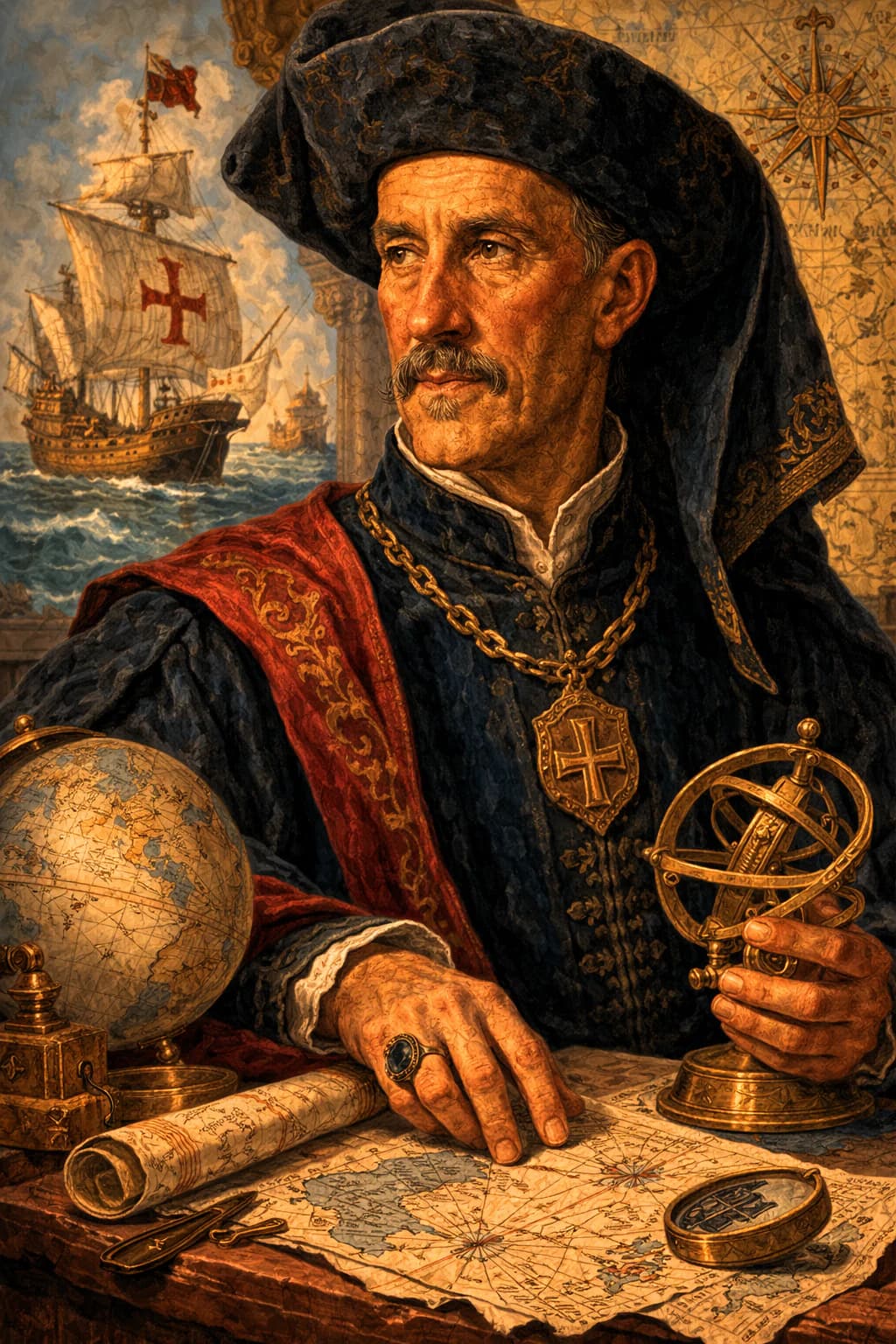
AI-generated portrait of Gil Eanes in 15th-century Portuguese maritime attire
AI-assisted historical reconstruction

An illustrative reconstruction based on historical context. It is not a photograph or documentary likeness. Image policy

Quick answer

Gil Eanes was a Portuguese navigator whose 1434 voyage beyond Cape Bojador broke a major psychological barrier in Atlantic exploration and opened the West African coast to sustained Portuguese voyages.

Born
1390 CE
Died
1460 CE
Role
Portuguese navigator
Years
1390-1460 CE
Facts

Gil Eanes timeline facts

Selected specifics from this profile's life story.

c.1390
Humble beginnings

Gil Eanes was born in Portugal as Atlantic navigation was becoming a royal project, though the coast beyond familiar waters still frightened many sailors.

1433
Initial failure

In 1433, Eanes approached Cape Bojador but turned back, a failure that showed how strongly fear still shaped Atlantic navigation.

1430s–1440s
Opening the route

After Eanes' success, Portuguese expeditions moved farther south, turning one breakthrough into a sustained advance along the African coast.

post-1460
Enduring legacy

Gil Eanes is remembered because his 1434 voyage broke the Cape Bojador barrier and changed how Portuguese sailors imagined the Atlantic.

Life Journey

A voyage that broke fear of the unknown sea

Follow the story in a more continuous narrative, with a reading mode that matches how much depth you want.

Complete chronology

c.1390

Humble beginnings

The details of Gil Eanes' childhood are uncertain, and later tradition preserves him more as a navigator than as a private person. What can be said is that he emerged from a Portugal increasingly organised around the sea. Fishing, coastal trade, warfare in North Africa, and royal ambition all encouraged practical maritime skill. Yet knowledge thinned rapidly beyond familiar routes. Sailors carried stories of reefs, contrary winds, monstrous creatures, and seas so hot they would destroy a ship. Such fears were not childish fantasies in context; they were attempts to explain a dangerous world with limited maps and instruments. Eanes grew into his career at precisely the point where Portugal needed men willing to test inherited boundaries.

1420s

Service to the crown

Eanes' importance is inseparable from the ambitions of Prince Henry, often called Henry the Navigator. Henry did not personally discover the African coast, but he helped sustain the patronage, pressure, and rewards that made repeated voyages possible. Captains were expected to return with information: winds, currents, coastal shapes, anchorages, peoples, goods, and risks. Eanes entered this world as a trusted mariner rather than a solitary adventurer. His work belonged to a larger pattern in which Portuguese rulers tried to turn scattered maritime experience into state-backed knowledge. That context matters, because Cape Bojador was not simply one captain's challenge. It was a test of whether organised exploration could overcome a boundary that fear had made politically and commercially expensive.

early 1430s

The Cape Bojador barrier

Cape Bojador mattered because it combined real navigational difficulty with a thick layer of legend. The coast around it involved shoals, surf, uncertain winds, and unfamiliar sailing conditions. Earlier mariners, hugging the coastline too closely, could easily believe the cape was a trap. Over time, practical caution hardened into myth. Bojador became the place where the known Atlantic ended and nightmare began: boiling water, impossible currents, and a return journey no ship could make. For Prince Henry's programme, this was a crippling barrier. As long as captains turned back there, every dream of reaching farther markets, Christian allies, gold routes, or new knowledge remained stuck at the same headland.

1433

Initial failure

Eanes' first attempt in 1433 ended like those before it: he did not pass the cape. The failure is important because it keeps the story human. The barrier was not broken by a captain who simply ignored danger. Eanes faced the same pressures as other mariners: responsibility for crew and vessel, unreliable information, and a coastline whose hazards were poorly understood. Returning without success may have disappointed Henry, but it also supplied experience. Eanes had seen the problem more closely and understood that repeating the old coastal approach would probably repeat the old result. The next voyage would need a different method, not merely more courage.

1434

Successful passage

The breakthrough came in 1434. Instead of creeping along the dangerous coast, Eanes sailed farther out into the Atlantic before turning south and then back toward land. The manoeuvre was simple in hindsight, but transformative in practice. By giving the cape sea-room, he avoided the most intimidating coastal conditions and proved that the feared waters beyond Bojador were not a supernatural zone of destruction. His safe return mattered as much as the outward passage. Exploration only becomes knowledge when someone comes back to report it. Eanes did, and his voyage converted a legend into a route.

1434

Proof of safety

The plants Eanes brought back from beyond Cape Bojador were humble evidence with enormous symbolic force. They showed that the coast beyond the cape was part of the same created world, not a monstrous exception to it. In an age when rumour could become navigational policy, such proof mattered. A plant could be held, inspected, and shown to doubters. It replaced inherited dread with observation. This was one of the quiet revolutions of early Atlantic exploration: the gradual replacement of imagined geography by tested experience. Eanes did not discover an empty world. He helped European sailors admit that their fear had made the world smaller than it was.

1430s–1440s

Opening the route

Once Bojador had been passed, it could be passed again. That was the true significance of Eanes' achievement. Portuguese captains began pushing beyond the old limit, recording coastlines, seeking trade, and testing the wind systems that would later make longer Atlantic voyages possible. The consequences were profound and morally complex. These routes opened new channels of knowledge and commerce, but they also became entangled with violence, conquest, and the Atlantic slave trade. Eanes himself belongs to the earlier stage of this expansion, before its full consequences unfolded, yet his voyage helped unlock the process. He removed the first great psychological obstruction from Portugal's southward movement.

1440s–1460

Later contributions

After 1434, Eanes' biography becomes less distinct, as often happens with early navigators whose lives survive through royal chronicles and voyage reports rather than personal papers. He appears to have continued within Portugal's maritime world, contributing experience to a programme that was quickly outgrowing any one captain. The heroic version of exploration tends to isolate a single moment; the historical reality was cumulative and administrative. Ships had to be financed, crews recruited, knowledge shared, and risks reassessed. Eanes' value lay not only in having passed Bojador once, but in helping demonstrate that the Atlantic could be learned through repeated practice.

post-1460

Enduring legacy

Gil Eanes did not sail as far as Dias, da Gama, or Magellan, and his name is less familiar than theirs. Yet their world depended on the kind of threshold he crossed. His achievement was not a conquest of distance but a conquest of assumption. By passing Cape Bojador and returning, he showed that fear could be investigated, that routes could be learned, and that the ocean beyond inherited maps was not automatically forbidden. That discovery helped launch Portugal's age of Atlantic expansion, with all its ingenuity, ambition, exploitation, and global consequence. Eanes' legacy is therefore both inspiring and sobering: he widened the map, and the world that followed was transformed.

Continue in context

Connected stories

Move from the profile into the wider events and settings this figure belongs to.

Tertiary paths

Content note

This profile is written for educational use and connects to related Stories of History pages. The main portrait is an AI-assisted historical reconstruction, included as an illustrative aid rather than documentary evidence. Image policy

References

Sources & Further Reading

Reliable reference works, archives and reading paths connected to this profile.

Further reading

  1. Encyclopaedia Britannica, Search results for Gil Eanes,” accessed June 2026.Open source
  2. WorldCat, Books and library holdings for Gil Eanes,” accessed June 2026.Open source

Primary sources

  1. Library of Congress, Search results for Gil Eanes,” accessed June 2026.Open source

Reviewed claim sources

Loading reviewed claim sources...

A weekly route through history

Find out first about the latest published stories, feature notes and occasional Premium offers in one weekly email.