People

Nur al-Din

Nur al-Din was a Zengid ruler of Aleppo and Damascus who strengthened Muslim resistance to the Crusader states and shaped the political world Saladin inherited.

Born
1118 CE
Died
1174 CE
Role
Ruler of Aleppo and Damascus

Zengid ruler of Syria (1118-1174)

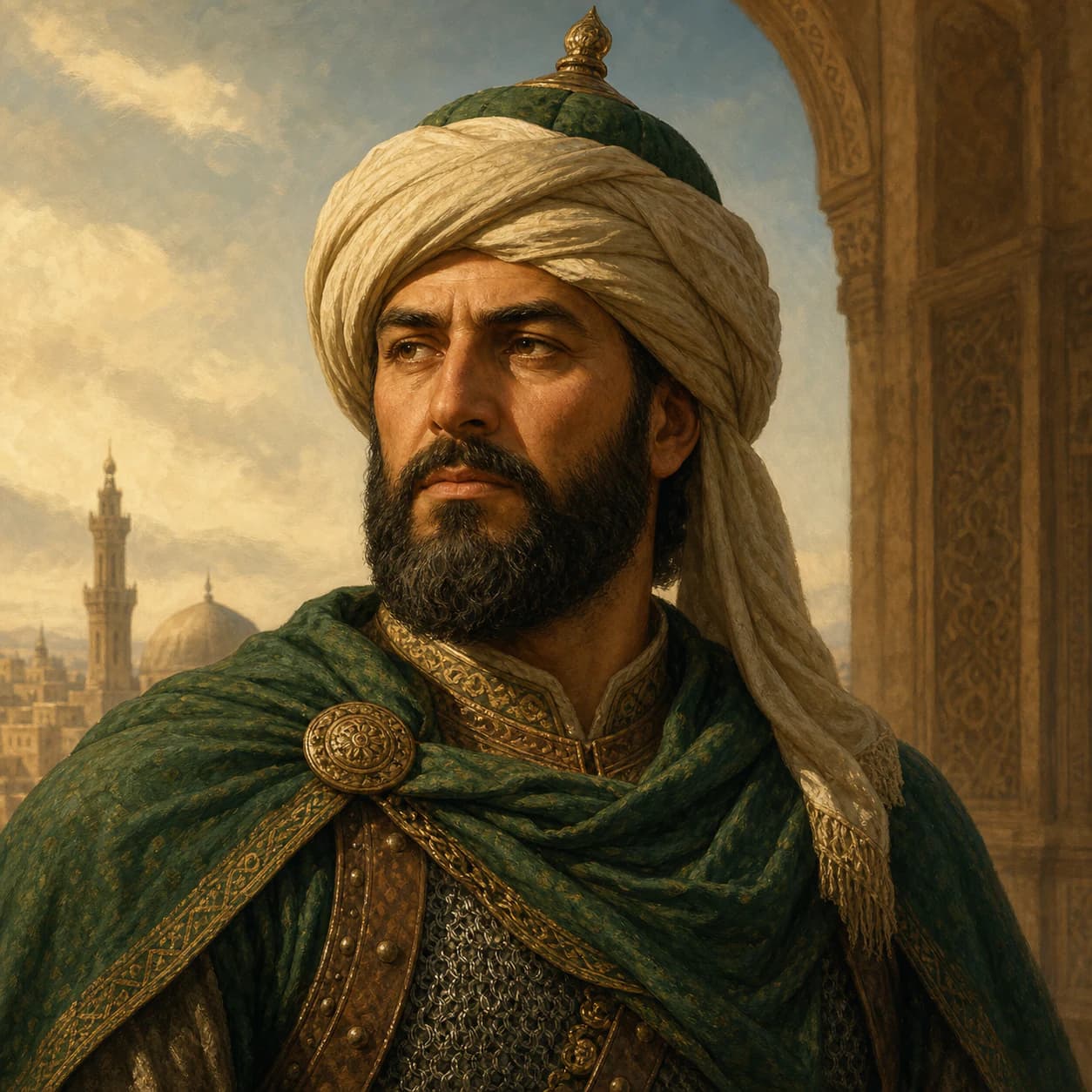
AI-generated portrait of Nur al-Din in medieval Islamic court and military attire
AI-assisted historical reconstruction

An illustrative reconstruction based on historical context. It is not a photograph or documentary likeness. Image policy

Quick answer

Nur al-Din was a Zengid ruler of Aleppo and Damascus who strengthened Muslim resistance to the Crusader states and shaped the political world Saladin inherited.

Born
1118 CE
Died
1174 CE
Role
Ruler of Aleppo and Damascus
Years
1118-1174 CE
Quick facts

Profile details

Additional identity and tagging details that are not already covered in the introduction.

Full name
Nur al-Din Mahmud ibn Zengi
Also known as
Nur al-Din Mahmud, Nur ad-Din, Nur ad-Din Mahmud
Facts

Nur al-Din timeline facts

Selected specifics from this profile's life story.

1118
Zengid heir

Nur al-Din was born into the Zengid ruling family, a military household operating between northern Iraq and Syria.

Late 1140s
A religious language of war

Nur al-Din presented war against the Crusader states in more explicitly religious terms than his father had done.

1160s
Egyptian struggle

Nur al-Din sent commanders, including Shirkuh and Saladin, into Egypt as the Fatimid caliphate became a strategic prize.

After 1174
Legacy before Saladin

Nur al-Din died before Jerusalem was recovered, but his politics and propaganda helped make Saladin's later success possible.

Life Journey

The ruler who turned resistance into a programme

Follow the story in a more continuous narrative, with a reading mode that matches how much depth you want.

Complete chronology

1118

Zengid heir

Nur al-Din Mahmud ibn Zengi was born in 1118 into the family of Imad ad-Din Zengi, the atabeg whose power stretched across Mosul, Aleppo and the frontier with the Crusader states. His childhood belonged to a world of competing Muslim rulers, vulnerable Latin Christian principalities and shifting alliances. The Zengid household was not a settled royal dynasty in the later sense. It was a military-political machine built through command, patronage, city control and opportunity. That world taught Nur al-Din that the struggle with the Crusader states could not be separated from the harder task of uniting Muslim power.


1146

Aleppo secured

Zengi was assassinated in 1146, only two years after his capture of Edessa had shocked the Crusader states and western Europe. The succession could easily have fractured his gains. Nur al-Din moved quickly to hold Aleppo, while his brother Sayf al-Din Ghazi controlled Mosul. Aleppo was crucial: it stood close to the northern Crusader principalities and gave Nur al-Din a base from which to pressure Antioch, Edessa's remaining territories and the Syrian interior. His first achievement was survival. Without that, Zengi's victory at Edessa might have remained a dramatic episode rather than the beginning of a longer counter-crusading movement.

Late 1140s

A religious language of war

Nur al-Din built on Zengi's military success but gave it a sharper ideological frame. He presented himself as a just Muslim ruler committed to jihad against the Frankish principalities and to the defence of sacred places. That language did not erase politics. Nur al-Din still fought, negotiated with and pressured other Muslim rulers when his interests required it. Yet the religious framing mattered because it gave a broader meaning to coalition-building. Resistance to the Crusader states became more than local rivalry; it could be described as a shared duty that linked rule, piety and military action.

1154

Damascus taken

The capture of Damascus in 1154 was Nur al-Din's decisive political achievement. Damascus had long balanced between fear of the Crusader kingdom of Jerusalem and suspicion of northern Syrian rulers. When Nur al-Din entered the city, he joined Aleppo and Damascus under Zengid authority and changed the strategic map of the Levant. The Crusader states had survived partly because Muslim power was divided among rival cities and dynasties. After 1154, the kingdom of Jerusalem faced a much stronger Syrian ruler to its north and east. The road toward Saladin's later encirclement of the Crusader states began here.

1150s-1160s

Rule and reform

Nur al-Din's authority rested on more than campaigning. He invested in institutions that projected Sunni legitimacy, including religious schools, mosques and charitable foundations. His patronage helped present him as a ruler of order and justice, not simply a warlord with a larger army. This image mattered in a fragmented political world where cities, scholars and soldiers all had to be persuaded that his leadership served a larger purpose. The sources that praise his piety should still be read with care, because rulers shaped their reputations deliberately. Even so, his public religious programme was central to how his power worked.

1160s

Egyptian struggle

By the 1160s, Egypt had become the great prize of eastern Mediterranean politics. The Fatimid caliphate was weakened, the Crusader kingdom of Jerusalem wanted influence there, and Nur al-Din understood that Egypt's wealth could transform the balance of power. He sent his commander Shirkuh on repeated campaigns, with Shirkuh's nephew Saladin among the officers who served in the struggle. In 1169, after Shirkuh's death, Saladin became vizier in Egypt. Nur al-Din had opened the route by which Egypt would become connected to the Syrian anti-crusader project, even though Saladin would soon become far more independent than a simple subordinate.

1171-1174

Unfinished authority

In 1171, Saladin ended the Fatimid caliphate in Cairo and restored formal allegiance to the Sunni Abbasid caliphate. This fulfilled a major part of Nur al-Din's religious and political programme, but it also created tension. Egypt was now in Sunni hands, yet the man holding it was building his own authority. Nur al-Din prepared to assert greater control over the relationship between Syria and Egypt, but he died in Damascus in 1174 before that question could be settled. His death opened the space in which Saladin moved from powerful lieutenant to independent ruler.

After 1174

Legacy before Saladin

Nur al-Din did not capture Jerusalem, and his reputation has often been overshadowed by Saladin's victory in 1187. Yet Saladin's achievement makes less sense without him. Nur al-Din strengthened the idea that Muslim rulers should overcome division in order to confront the Crusader states. He joined Aleppo and Damascus, projected Sunni legitimacy and drew Egypt into the same strategic contest. Saladin inherited parts of that world, challenged parts of it and enlarged it. Nur al-Din therefore stands as a bridge between Zengi's opportunistic conquest of Edessa and Saladin's more famous recovery of Jerusalem.

Continue in context

Connected stories

Move from the profile into the wider events and settings this figure belongs to.

Tertiary paths

Content note

This profile is written for educational use and connects to related Stories of History pages. The main portrait is an AI-assisted historical reconstruction, included as an illustrative aid rather than documentary evidence. Image policy

References

Sources & Further Reading

Reliable reference works, archives and reading paths connected to this profile.

Further reading

  1. Encyclopaedia Britannica, Search results for Nur al-Din,” accessed June 2026.Open source
  2. WorldCat, Books and library holdings for Nur al-Din,” accessed June 2026.Open source

Primary sources

  1. Library of Congress, Search results for Nur al-Din,” accessed June 2026.Open source

Reviewed claim sources

Loading reviewed claim sources...

A weekly route through history

Find out first about the latest published stories, feature notes and occasional Premium offers in one weekly email.