People

Saladin

Saladin was the founder of the Ayyubid dynasty and the Muslim ruler who defeated the Crusader kingdom at Hattin and recaptured Jerusalem in 1187.

Born
1137 CE
Died
1193 CE
Role
Sultan of Egypt and Syria

Ayyubid sultan (c. 1137-1193)

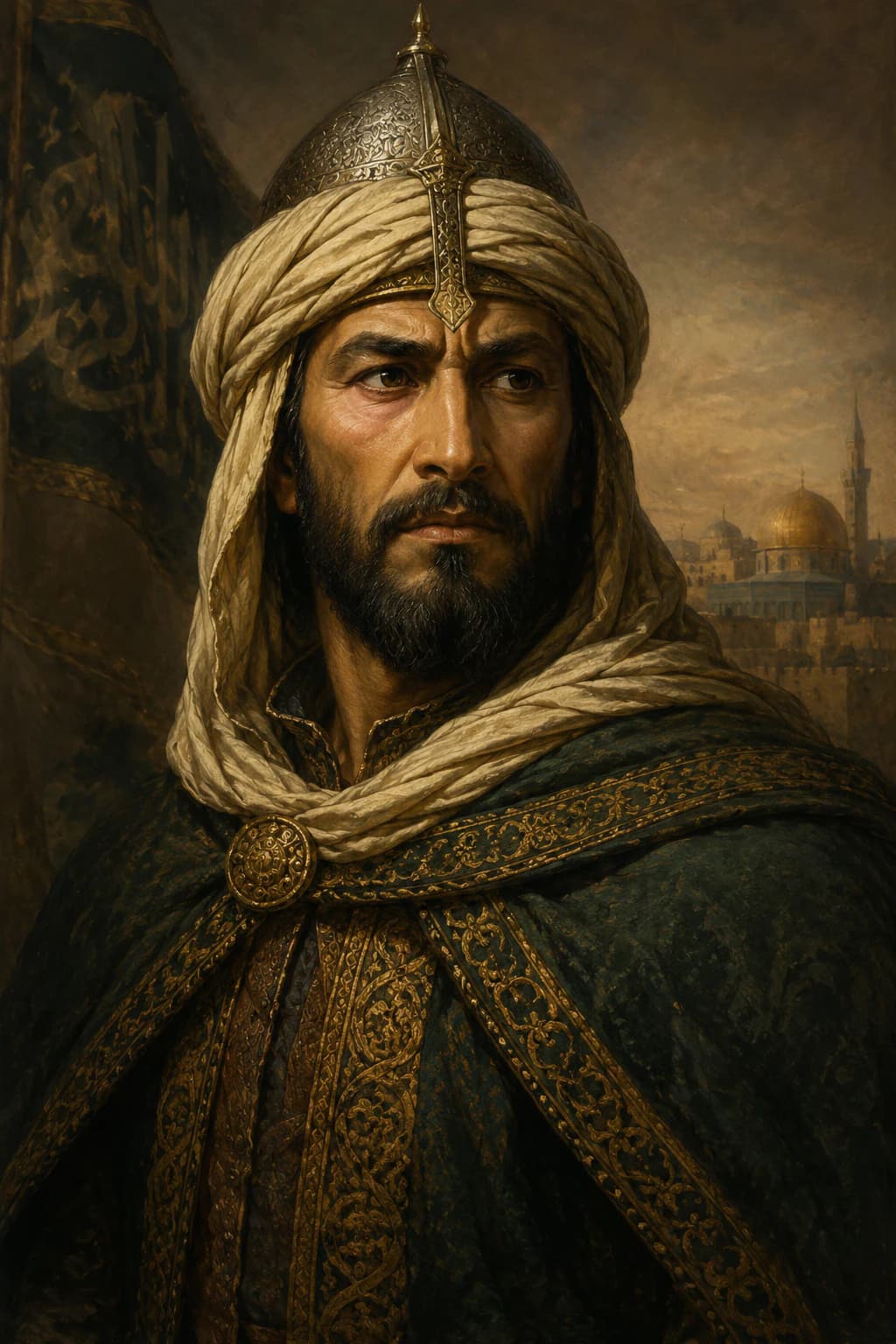
AI-generated portrait of Saladin in medieval Islamic royal attire
AI-assisted historical reconstruction

An illustrative reconstruction based on historical context. It is not a photograph or documentary likeness. Image policy

Quick answer

Saladin was the founder of the Ayyubid dynasty and the Muslim ruler who defeated the Crusader kingdom at Hattin and recaptured Jerusalem in 1187.

Born
1137 CE
Died
1193 CE
Role
Sultan of Egypt and Syria
Years
1137-1193 CE
Quick facts

Profile details

Additional identity and tagging details that are not already covered in the introduction.

Full name
Salah al-Din Yusuf ibn Ayyub
Also known as
Salah al-Din, Salah ad-Din Yusuf ibn Ayyub
Facts

Saladin timeline facts

Selected specifics from this profile's life story.

c. 1137
Kurdish origins

Saladin was born Yusuf ibn Ayyub into a Kurdish family connected to military service in the Islamic Near East.

1170s-1180s
Uniting fronts

Saladin gradually united Egypt, Syria and nearby territories, creating the strategic base for a major campaign against the Crusader kingdom.

1189-1192
Richard the Lionheart

During the Third Crusade, Saladin faced Richard I of England in a campaign of battles, sieges and negotiation.

Long-term
Enduring reputation

Saladin is remembered as a ruler, commander and symbol whose reputation crossed religious and cultural boundaries.

Life Journey

The sultan who reshaped the crusading world

Follow the story in a more continuous narrative, with a reading mode that matches how much depth you want.

Complete chronology

c. 1137

Kurdish origins

Saladin, known in Arabic as Salah al-Din Yusuf ibn Ayyub, was born around 1137, probably in Tikrit, into a Kurdish family serving the wider military world of northern Mesopotamia and Syria. His early life unfolded in the shadow of Zangi and Nur al-Din, rulers who worked to strengthen Muslim power against both rival Muslim states and the Crusader principalities. Saladin's family connections placed him inside the politics of service, loyalty and opportunity. He did not begin as a legendary conqueror; he rose through a military-administrative world where skill had to operate through patronage.
1169

Egyptian opportunity

In the 1160s, Egypt became the prize in a struggle involving the Fatimid caliphate, Syrian forces under Nur al-Din and the Crusader kingdom of Jerusalem. Saladin accompanied his uncle Shirkuh on campaigns there and, after Shirkuh's death in 1169, became vizier of Egypt. The appointment was extraordinary. A Sunni Kurdish officer now held power inside a Shi'a Fatimid state. Saladin moved carefully at first, consolidating authority while avoiding premature rupture. Egypt's wealth, grain and strategic position gave him the foundation from which his future power would grow.

1171-1174

Ayyubid power

In 1171, Saladin ended the Fatimid caliphate in Cairo and restored formal allegiance to the Sunni Abbasid caliphate. This was a religious and political turning point. It removed a rival caliphal structure and strengthened Saladin's legitimacy among Sunni elites. When Nur al-Din died in 1174, Saladin began extending authority into Syria, presenting himself as the defender of Muslim unity and the leader best able to confront the Crusader states. His expansion was not only anti-Crusader; much of it involved diplomacy and conflict with other Muslim rulers whose submission could not be assumed.

1170s-1180s

Uniting fronts

Saladin's reputation as a champion of jihad rested on years of political consolidation. He took Damascus, contested Aleppo and worked to bind Egypt and Syria into a workable military system. This was difficult, expensive and never perfectly stable. Rival Muslim leaders could be as challenging as Frankish opponents, and Saladin had to balance force with negotiation. The result, however, was a strategic transformation. The Crusader kingdom of Jerusalem, once able to exploit Muslim division, now faced a ruler who could apply pressure from multiple directions and sustain long campaigns.

1187

Hattin

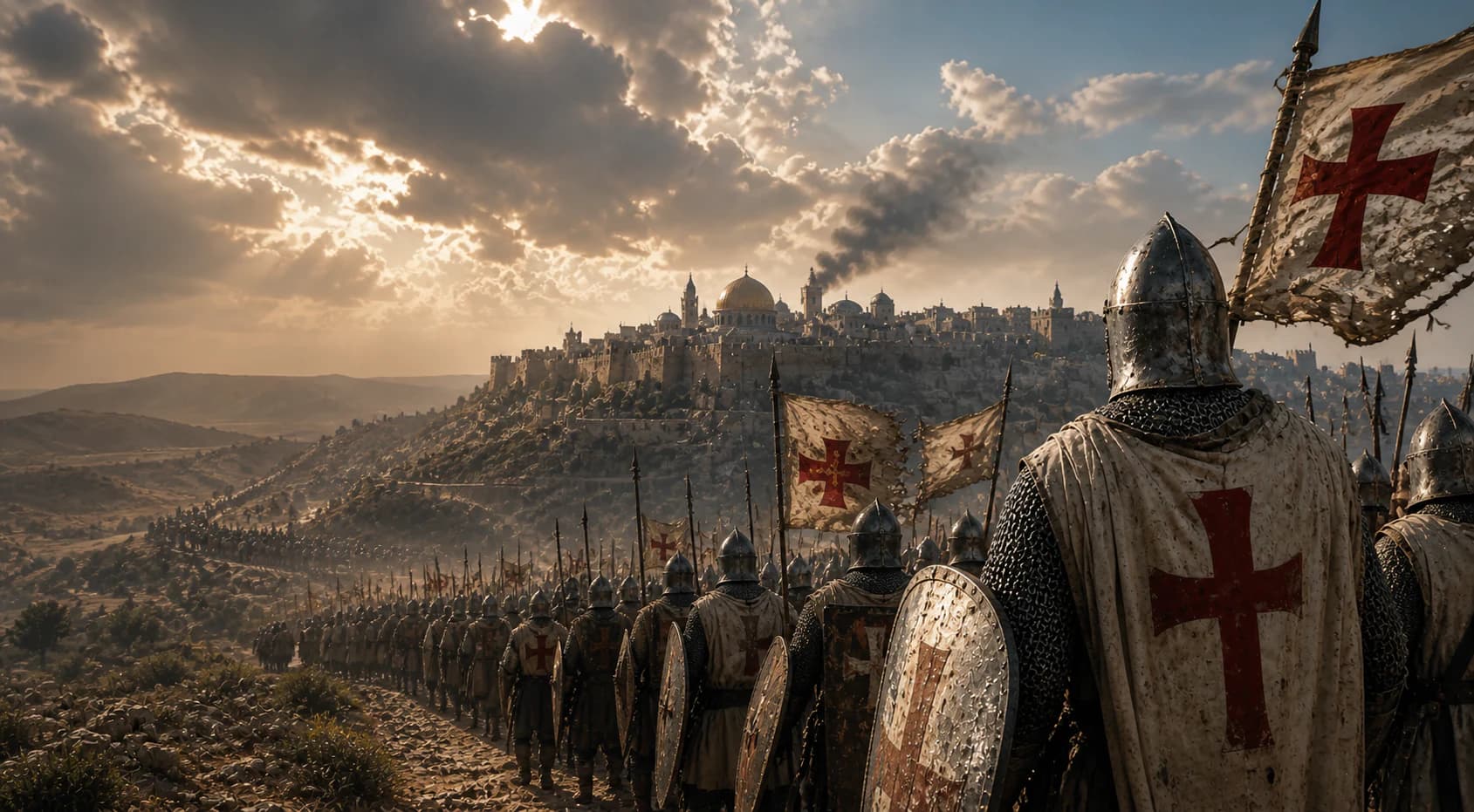
In July 1187, Saladin confronted the army of the Crusader kingdom near the Horns of Hattin. The Frankish force, drawn into harsh terrain and cut off from reliable water, was exhausted before decisive combat. Saladin's army surrounded and defeated it, capturing King Guy of Lusignan and many leading nobles. The True Cross, a major relic carried by the Crusaders, was also taken. Hattin was not just a battlefield success; it shattered the kingdom's ability to defend its towns and fortresses. Within months, much of the Latin East was exposed.

1187

Jerusalem retaken

In October 1187, Saladin took Jerusalem after negotiation rather than indiscriminate massacre. The memory of the Crusader conquest in 1099, when many inhabitants were killed, made the moment intensely charged. Saladin's settlement allowed many residents to ransom themselves, while others were enslaved; it was not modern mercy, but by the standards of medieval siege warfare it became central to his reputation for restraint. The recovery of Jerusalem electrified the Muslim world and shocked Latin Christendom. It directly helped provoke the Third Crusade, bringing Europe's most famous warrior-kings east.

1189-1192

Richard the Lionheart

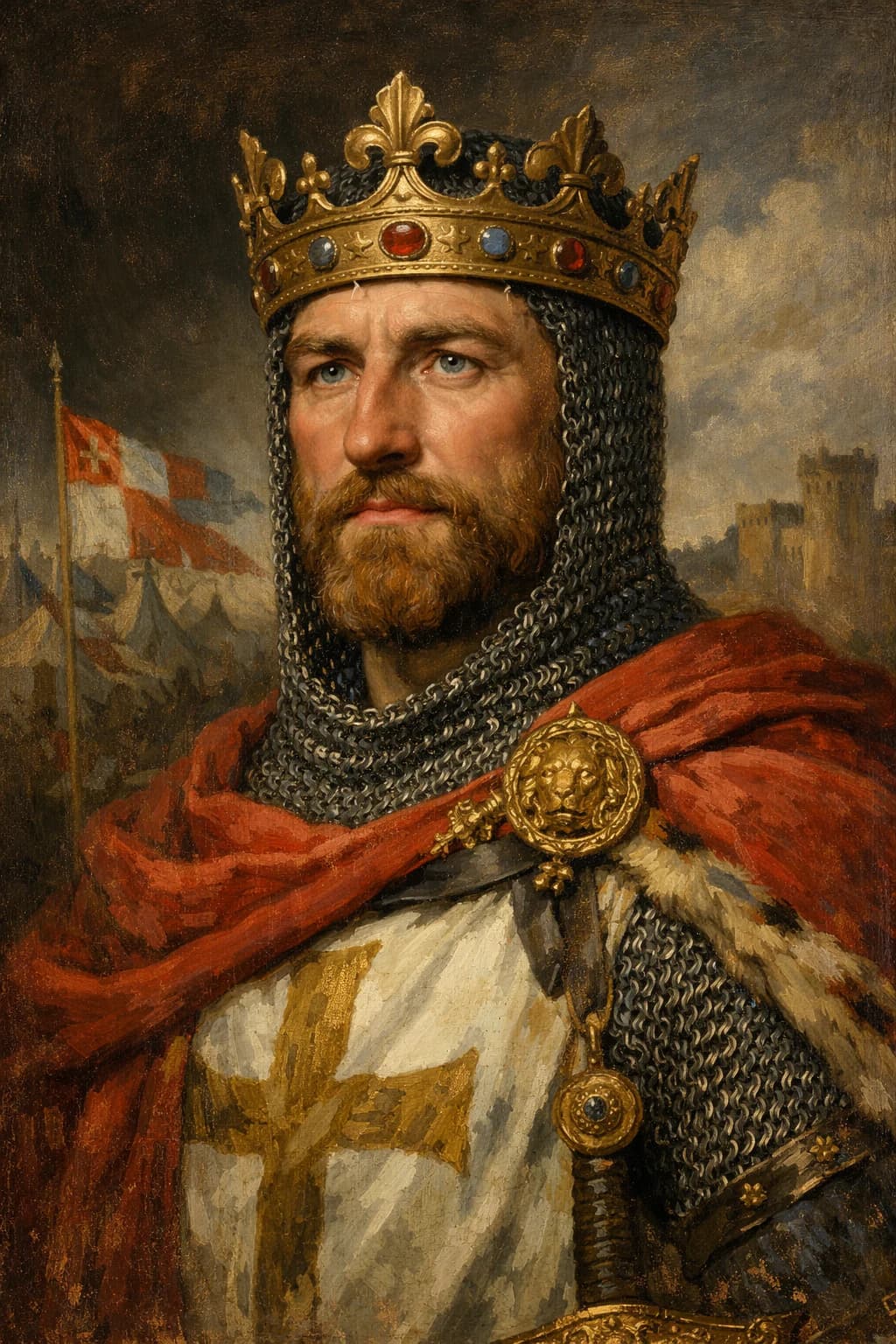
The Third Crusade tested Saladin against a new coalition led most effectively by Richard I of England. Acre fell to the Crusaders after a long siege, and Richard defeated Saladin's forces at Arsuf in 1191. Yet Richard could not securely retake Jerusalem, and Saladin could not drive the Crusaders entirely from the coast. The war became a contest of endurance as much as brilliance. Both leaders gained fame from the rivalry, though later chivalric legend often softened the brutality of the conflict. In 1192, they agreed to a truce that left Jerusalem under Muslim control while permitting Christian pilgrimage.

1193

Death in Damascus

Saladin died in Damascus in 1193, worn down by years of campaigning and rule. His generosity was famous enough that accounts stressed how little ready money remained for his burial. After his death, the Ayyubid realm was divided among relatives, revealing how much unity had depended on his personal authority. Yet the dynasty he founded endured, and his political achievement outlasted the immediate fragmentation. He had made Egypt and Syria central to the struggle for the eastern Mediterranean and had changed the future of the Crusader states.

Long-term

Enduring reputation

Saladin's legacy is unusually broad. In Islamic history, he stands as the ruler who restored Jerusalem and gave political force to the language of jihad against the Crusader states. In European memory, he became the noble enemy, praised for generosity and honour even by cultures that opposed him. Both traditions simplified him. The historical Saladin was pious, ambitious, pragmatic and sometimes ruthless, a medieval ruler operating in a violent world. His importance lies in the combination: he was a builder of states, a commander of consequence and a figure whose image became larger than the wars that produced it.

Continue in context

Connected stories

Move from the profile into the wider events and settings this figure belongs to.

Tertiary paths

Content note

This profile is written for educational use and connects to related Stories of History pages. The main portrait is an AI-assisted historical reconstruction, included as an illustrative aid rather than documentary evidence. Image policy

References

Sources & Further Reading

Reliable reference works, archives and reading paths connected to this profile.

Further reading

  1. Encyclopaedia Britannica, Search results for Saladin,” accessed June 2026.Open source
  2. WorldCat, Books and library holdings for Saladin,” accessed June 2026.Open source

Primary sources

  1. Library of Congress, Search results for Saladin,” accessed June 2026.Open source

Reviewed claim sources

Loading reviewed claim sources...

A weekly route through history

Find out first about the latest published stories, feature notes and occasional Premium offers in one weekly email.
