People

Marcus Tullius Cicero

Marcus Tullius Cicero was a Roman lawyer, consul, orator and philosopher whose speeches, writings and doomed defence of the Republic shaped ideas of rhetoric, law, duty and civic freedom.

Born
106 BCE
Died
43 BCE
Role
Roman statesman and orator

Roman statesman and orator (106 BC–43 BC)

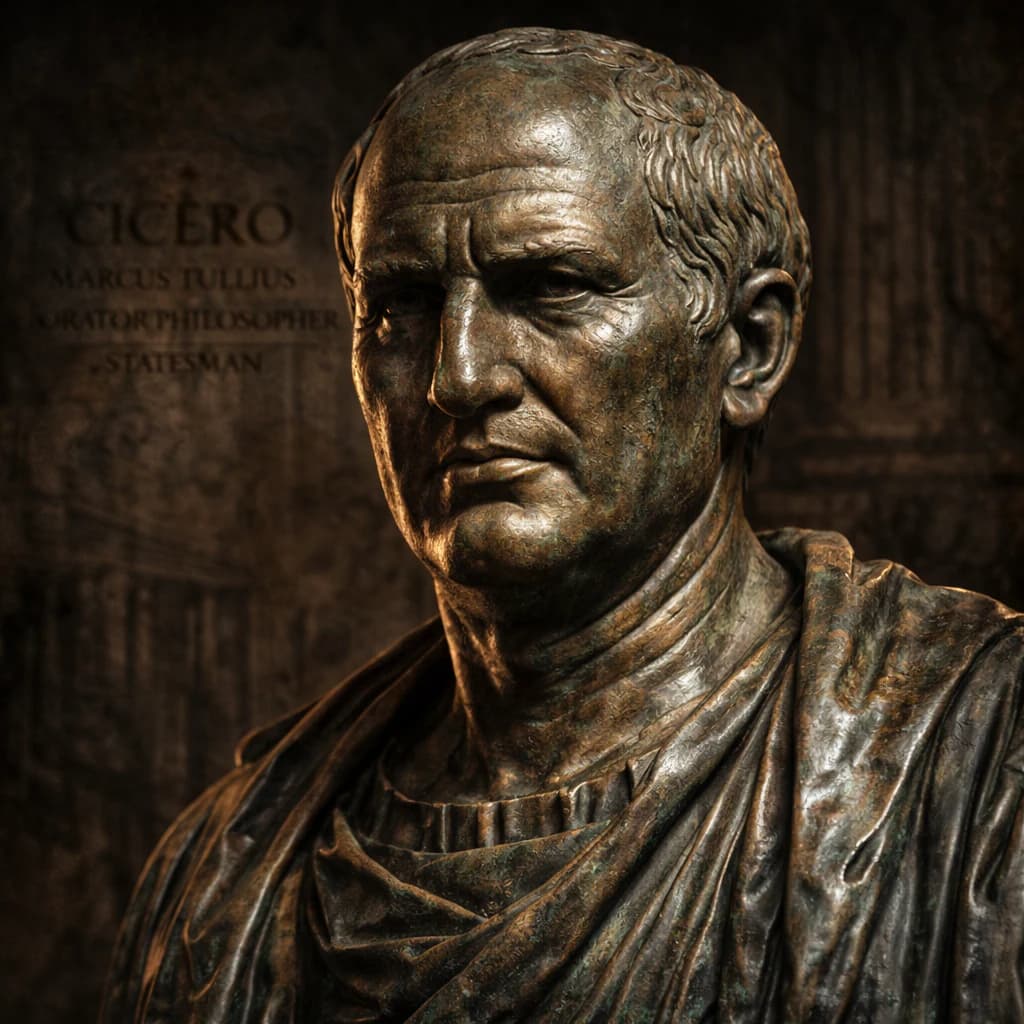
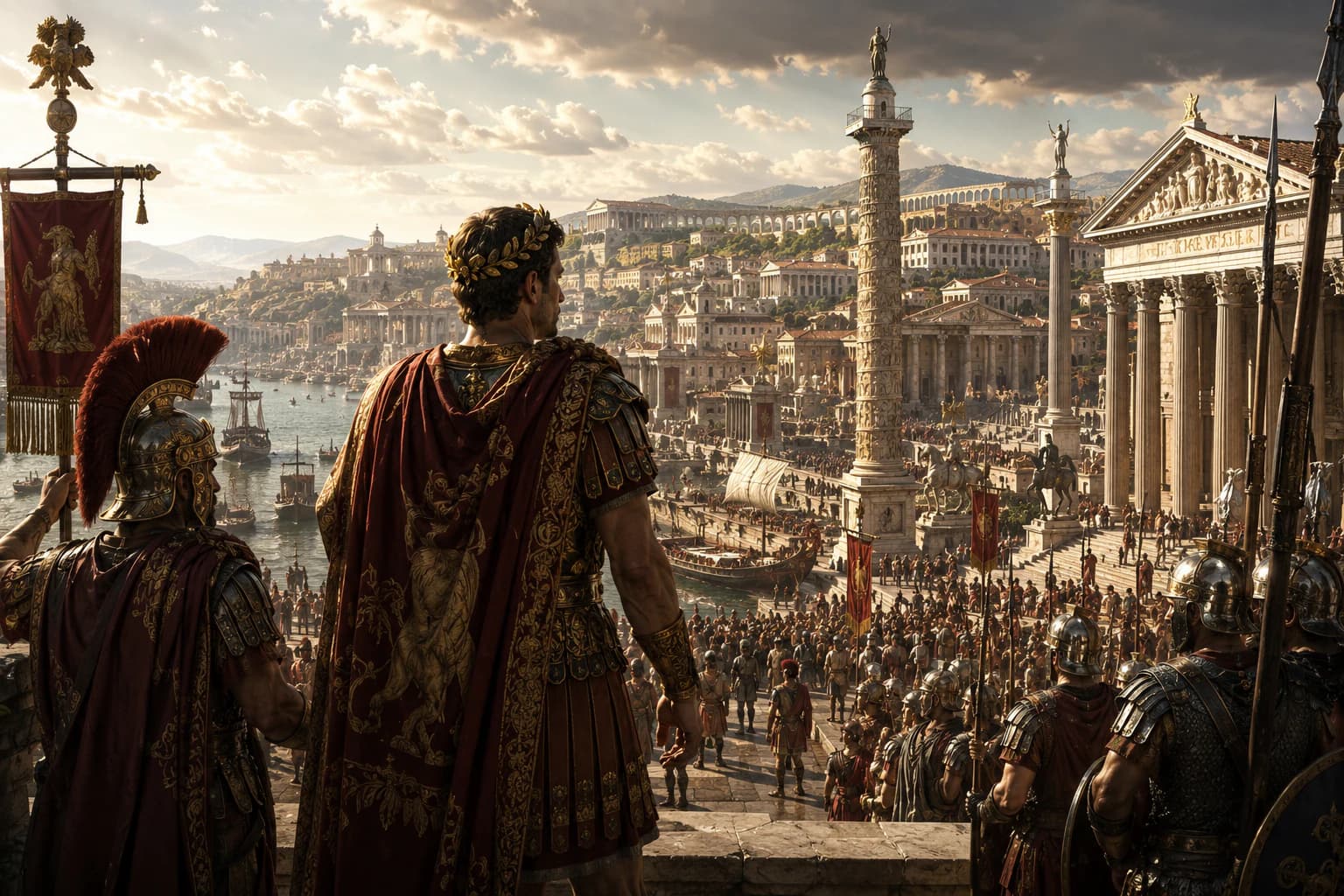
AI-generated portrait of Marcus Tullius Cicero in Roman senatorial attire
AI-assisted historical reconstruction

An illustrative reconstruction based on historical context. It is not a photograph or documentary likeness. Image policy

Quick answer

Marcus Tullius Cicero was a Roman lawyer, consul, orator and philosopher whose speeches, writings and doomed defence of the Republic shaped ideas of rhetoric, law, duty and civic freedom.

Born
106 BCE
Died
43 BCE
Role
Roman statesman and orator
Years
106-43 BCE
Facts

Marcus Tullius Cicero timeline facts

Selected specifics from this profile's life story.

-106
Humble Beginnings

Cicero was born at Arpinum in 106 BC, outside Rome's hereditary ruling elite, and made education, law and eloquence his route into public power.

-75 to -63
Rise Through Offices

Cicero climbed the cursus honorum with unusual speed for a new man, reaching the consulship in 63 BC through legal fame and careful alliances.

-50s
Philosophical Writing

During political frustration and civil war, Cicero wrote major works on the Republic, law, friendship, duty and ethics that carried Greek philosophy into Latin political culture.

-43
Death and Legacy

Cicero was killed in the proscriptions of 43 BC, but his speeches and philosophy became a foundation for later ideas of rhetoric, law and republican citizenship.

Life Journey

A voice of the Roman Republic

Follow the story in a more continuous narrative, with a reading mode that matches how much depth you want.

Complete chronology

-106

Humble Beginnings

Marcus Tullius Cicero was born in 106 BC at Arpinum, a Latin town southeast of Rome that had already produced one disruptive outsider, Gaius Marius. Cicero's family was locally important and wealthy enough to educate him well, but it did not belong to the small circle of noble families whose ancestors filled Rome's highest offices. That made him a novus homo, a new man, in a political culture obsessed with lineage. His path had to run through ability made visible: legal brilliance, disciplined study, social connection and a public reputation for service. This origin mattered throughout his career. Cicero admired the Republic's traditions, but he also knew its aristocratic gatekeeping from the outside. He wanted entry into the ruling class without surrendering the argument that merit and civic virtue should count for more than inherited names.
-80s

Training in Oratory

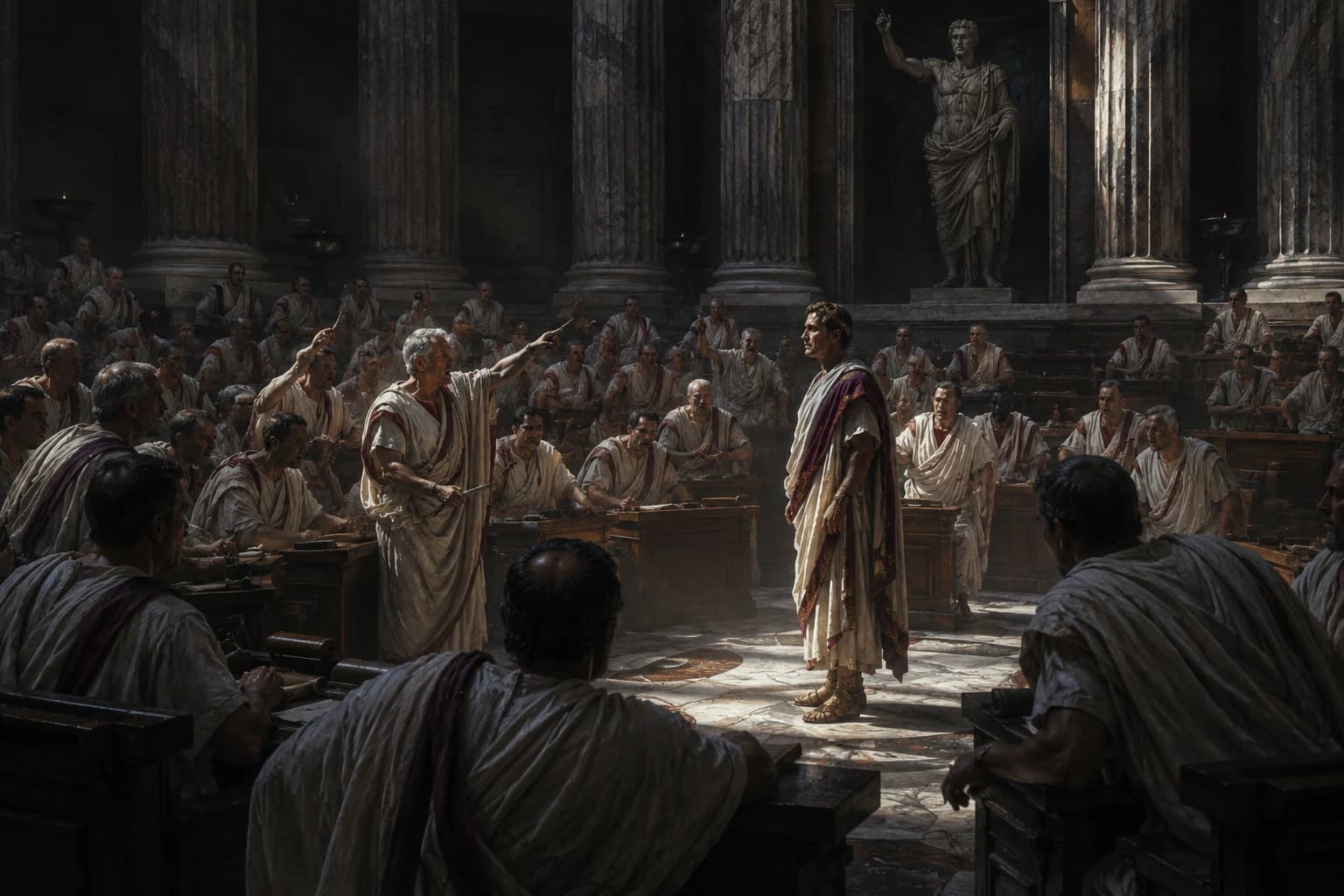
Cicero came of age when Rome's courts and assemblies rewarded men who could persuade crowds, judges and senators under pressure. He studied with leading Roman teachers, absorbed Greek rhetorical theory, and later travelled in the Greek east to refine his delivery after early strain on his voice. Philosophy was not a decorative addition for him. It gave his speeches a moral architecture: arguments about law became arguments about justice, public duty and the character of the state. He learned to vary speed, rhythm, indignation, humour and forensic detail until speech itself became a form of power. In a Republic where soldiers increasingly made politics by force, Cicero represented a different kind of authority: the belief that reasoned language could still expose wrongdoing and summon citizens to judgement.

-80

First Legal Success

Cicero's early fame came from the defence of Sextus Roscius of Ameria, accused of murdering his father. The case was dangerous because it touched the aftermath of Sulla's proscriptions, when property confiscation, political murder and opportunistic enrichment had blurred law and terror. Cicero did not attack Sulla directly, but he made the prosecution look like part of a corrupt scheme by men protected by the dictator's circle. The speech was bold, tactically careful and morally charged. It announced him as a lawyer capable of confronting power without simply inviting destruction. The victory helped launch his reputation, but it also showed the world he would return to repeatedly: a Republic whose legal forms still existed, yet could be bent by violence, money and political intimidation.

-75 to -63

Rise Through Offices

Roman public life moved through a ladder of magistracies, and Cicero advanced along it with remarkable success. As quaestor in Sicily he built a reputation for honesty; as prosecutor of the corrupt governor Verres he turned legal performance into a public spectacle of accountability. His speeches against Verres were so devastating that the defendant went into exile before the trial was complete. By the time Cicero sought the consulship, he had become the most famous advocate in Rome and a useful figure to conservatives who feared social unrest and aristocrats who could tolerate a talented outsider if he defended their order. His election for 63 BC was a personal triumph and a political signal. A new man had reached Rome's highest annual office without an army, an ancient name or a revolutionary programme.

-63

Consulship Crisis

Cicero's consulship was defined by Lucius Sergius Catilina, or Catiline, a failed aristocratic candidate who gathered debtors, disaffected nobles and armed supporters into a movement that Cicero presented as a mortal threat to the Republic. Through informants, Senate speeches and public theatre, Cicero forced the conspiracy into the open. The Catilinarian Orations made him the voice of emergency government: urgent, accusatory and convinced that delay meant ruin. Yet his decisive act was also his vulnerability. Several conspirators arrested in Rome were executed without full trial after a Senate debate. Many contemporaries praised Cicero as pater patriae, father of the fatherland. Others saw a consul who had violated citizen rights in the name of security. The episode gave him glory, but it also gave enemies a legal and moral weapon.

-58 to -57

Exile and Return

Cicero's exile grew out of the same deed that had made him famous. Publius Clodius Pulcher, a bitter enemy and tribune of the plebs, passed a law targeting anyone who had executed Roman citizens without trial. Cicero lacked reliable protection from Pompey, Caesar and Crassus, whose uneasy alliance dominated politics, and he left Italy in 58 BC. His house was destroyed, his property attacked and his public identity humiliated. Recall came the following year after political winds shifted, and his return to Rome was celebrated by crowds. But exile changed him. It taught him that applause was not security, that the Senate could be weak when organized force entered the streets, and that the Republic he loved could abandon even its most articulate defender when powerful men found it convenient.

-50s

Philosophical Writing

As Caesar and Pompey moved toward civil war, Cicero's political room narrowed. He disliked Caesar's domination, distrusted revolutionary violence and found Pompey's leadership disappointing. Writing became both retreat and intervention. In works such as De re publica, De legibus, De officiis and the Tusculan Disputations, he translated Greek philosophy into a Roman language of public duty. He was not simply preserving ideas; he was recasting them for magistrates, advocates, senators and educated citizens who needed moral vocabulary in a broken political world. His thought could be inconsistent, and he often wrote under personal pressure, especially after the death of his daughter Tullia. Yet his prose gave later Europe a language for natural law, mixed government, friendship, conscience and civic responsibility.

-44 to -43

Conflict with Power

Caesar's assassination in 44 BC opened a brief, dangerous space in which Cicero hoped the Republic might still be restored. He had not been part of the murder plot, but he welcomed the possibility that Caesar's dictatorship had ended. The real struggle soon centred on Mark Antony, Caesar's former lieutenant, and the teenage Octavian, Caesar's adopted heir. Cicero chose to use Octavian against Antony, a calculation that looked clever until it became catastrophic. His speeches against Antony, later called the Philippics after Demosthenes' attacks on Philip of Macedon, were ferocious performances of republican outrage. They also made compromise almost impossible. Cicero believed he could still marshal legitimacy through Senate, law and language. Antony and Octavian understood that armies now decided what speeches could not.

-43

Death and Legacy

When Octavian, Antony and Lepidus formed the Second Triumvirate in 43 BC, they legalised revenge through proscriptions. Cicero's name was included, reportedly at Antony's insistence. He was captured while attempting to flee and killed; his head and hands were displayed in the Forum, a brutal answer to the voice and pen that had attacked Antony. His death became one of the symbolic endings of the Roman Republic, though the Republic had been dying by stages for decades. Cicero's afterlife was larger than his political success. Students learned Latin through his prose, Renaissance humanists treated him as a model of eloquence, and later thinkers drew on his language of law, duty and mixed government. He failed to save the Republic, but he helped define what losing a republic could mean.

Continue in context

Connected stories

Move from the profile into the wider events and settings this figure belongs to.

Tertiary paths

Content note

This profile is written for educational use and connects to related Stories of History pages. The main portrait is an AI-assisted historical reconstruction, included as an illustrative aid rather than documentary evidence. Image policy

References

Sources & Further Reading

Reliable reference works, archives and reading paths connected to this profile.

Further reading

  1. Encyclopaedia Britannica, Search results for Marcus Tullius Cicero,” accessed June 2026.Open source
  2. WorldCat, Books and library holdings for Marcus Tullius Cicero,” accessed June 2026.Open source

Primary sources

  1. Library of Congress, Search results for Marcus Tullius Cicero,” accessed June 2026.Open source

Reviewed claim sources

Loading reviewed claim sources...

A weekly route through history

Find out first about the latest published stories, feature notes and occasional Premium offers in one weekly email.