People

Leonidas I

Leonidas I was the Spartan king who died at Thermopylae in 480 BC while resisting Xerxes I's Persian invasion. His last stand became a lasting symbol of courage, discipline and sacrifice.

Born
540 BCE
Died
480 BCE
Role
King of Sparta

King of Sparta (c. 540–480 BC)

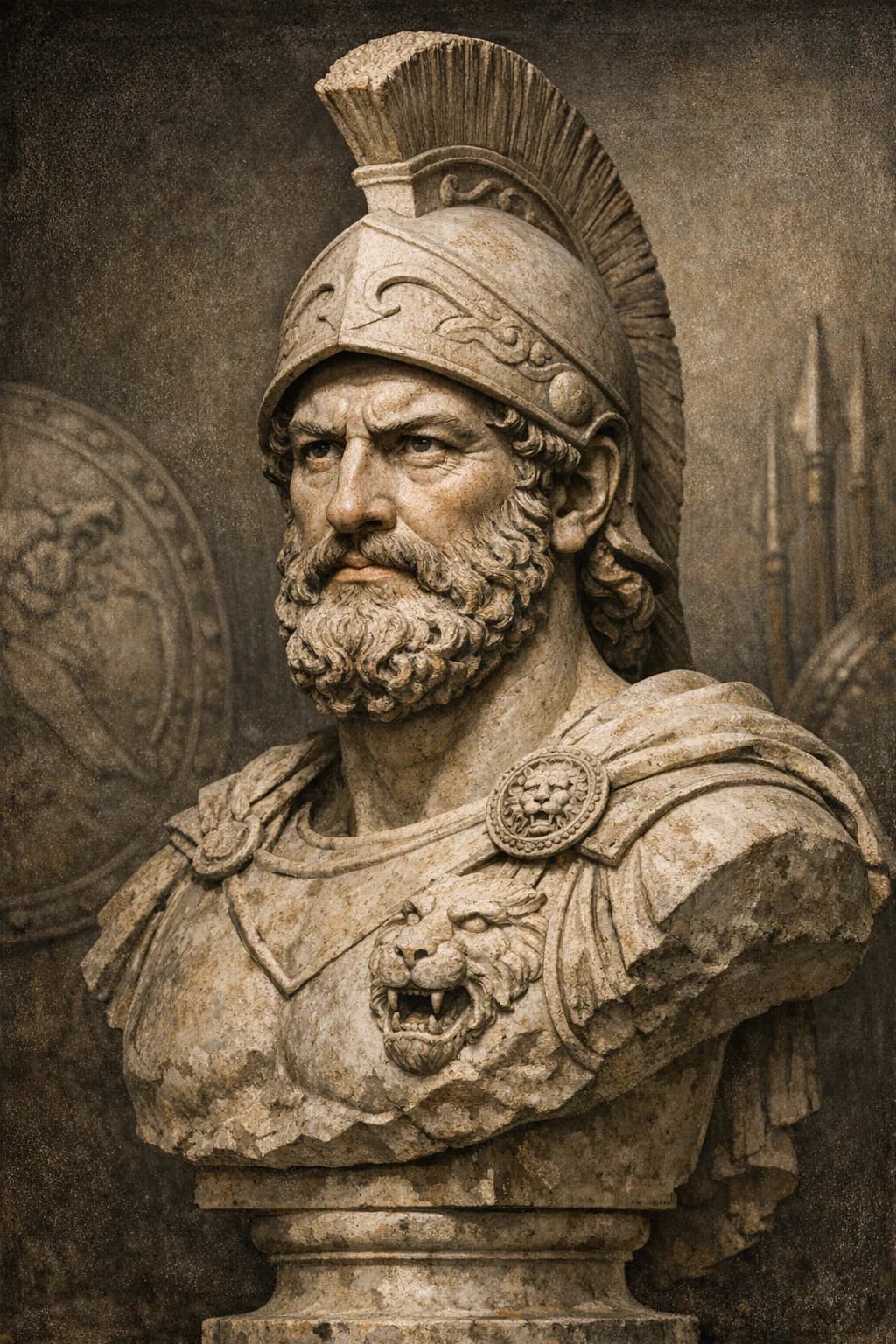
AI-generated portrait of Leonidas I, King of Sparta
AI-assisted historical reconstruction

An illustrative reconstruction based on historical context. It is not a photograph or documentary likeness. Image policy

Quick answer

Leonidas I was the Spartan king who died at Thermopylae in 480 BC while resisting Xerxes I's Persian invasion. His last stand became a lasting symbol of courage, discipline and sacrifice.

Born
540 BCE
Died
480 BCE
Role
King of Sparta
Years
540-480 BCE
Quick facts

Profile details

Additional identity and tagging details that are not already covered in the introduction.

Also known as
Leonidas of Sparta
Facts

Leonidas I timeline facts

Selected specifics from this profile's life story.

c. 540 BC–520 BC
The agoge

Leonidas was born into Sparta's Agiad royal house, but as a younger son he passed through the agoge and was shaped by the same hard training as other Spartan citizens.

480 BC
The decision to hold Thermopylae

The Greeks chose Thermopylae because its narrow pass could reduce Persian numerical superiority, and Leonidas led the advance force that held it.

480 BC
The last stand

Leonidas and the remaining defenders fought to the death on the final day, and his body became the centre of a fierce struggle before the Persians took the pass.

After 480 BC
An eternal stand

Leonidas's legacy rests on the power of a chosen last stand, though the legend often says as much about later societies as about Sparta itself.

Life Journey

Agoge, kingship, and the pass

Follow the story in a more continuous narrative, with a reading mode that matches how much depth you want.

Complete chronology

c. 540 BC–520 BC

The agoge

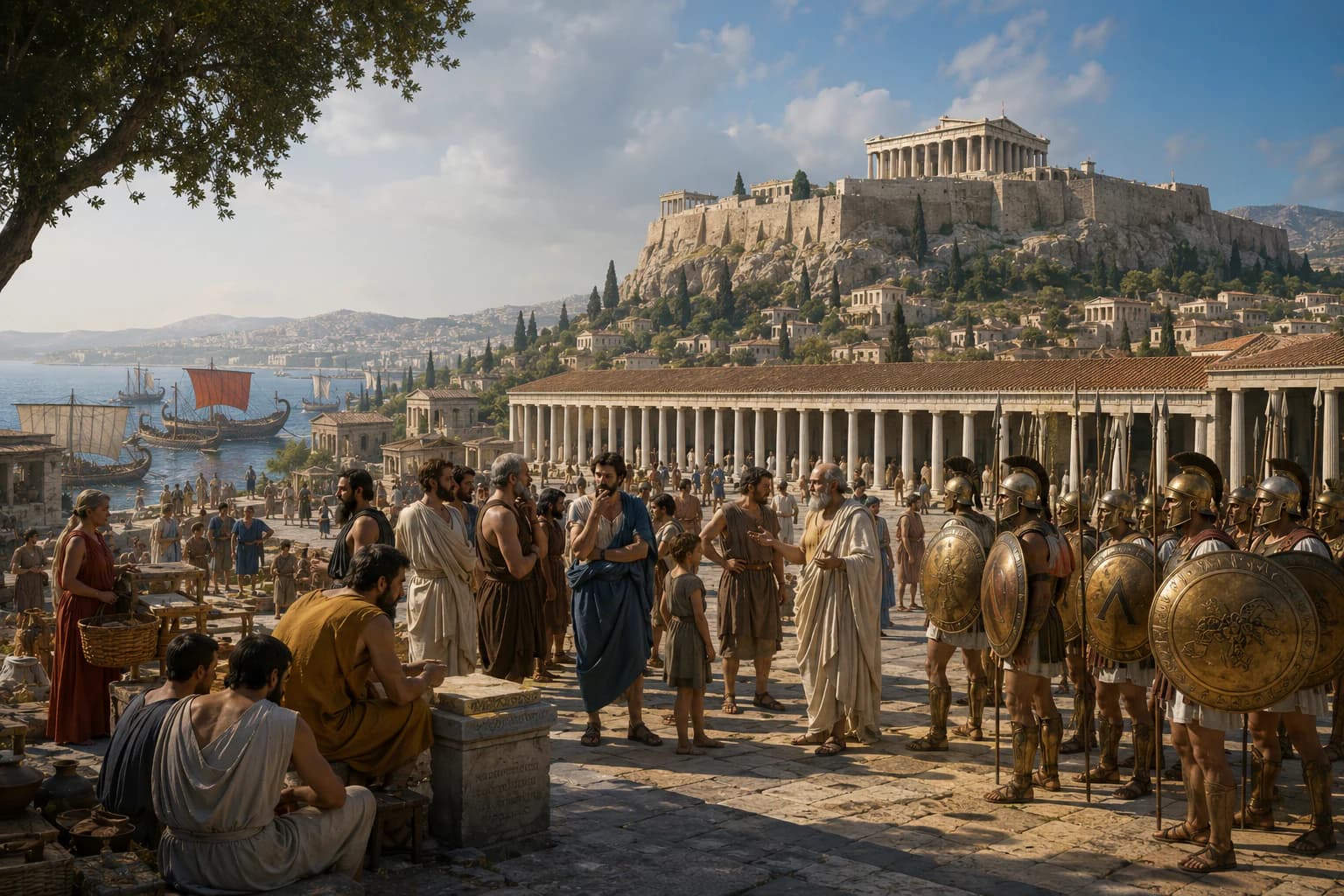
Leonidas I was born into Sparta's Agiad royal line around the middle of the sixth century BC, a period when Sparta's identity was already tied to discipline, military service and the subordination of the individual to the city. Because he was not originally expected to inherit the throne, Leonidas appears to have undergone the agoge, the demanding education and training system imposed on Spartan boys. That detail matters. He was royal, but his authority was not formed only by birth. It was formed in mess halls, drills, endurance tests and a culture that treated obedience to law as the core of honour. Later legend can make Sparta seem like a simple warrior machine, but its power rested on a complex social order: a small citizen elite supported by perioikoi and by helots, the unfree labourers whose exploitation made Spartan military life possible. Leonidas grew up inside both the pride and the violence of that system.
c. 490 BC

An unexpected accession

Leonidas's path to kingship was accidental. His father, Anaxandridas II, had other sons ahead of him, including Cleomenes I and Dorieus. Cleomenes became king but died without a male heir who could continue the Agiad line; Dorieus had already died abroad during attempts to carve out power in the western Mediterranean. Leonidas therefore inherited a throne he had not been raised to expect. His marriage to Gorgo, Cleomenes's daughter, reinforced his legitimacy and linked him directly to the previous king. Gorgo herself is unusually visible in the ancient sources, remembered for intelligence and political judgement in a world where most elite women remain silent in the record. Leonidas ruled within Sparta's unusual dual kingship, sharing authority with the Eurypontid royal house and with powerful civic institutions. His kingship was therefore never absolute. It required persuasion, religious legitimacy and the confidence of a warrior citizen body.

490 BC–480 BC

The Persian threat

The crisis that made Leonidas famous began before his reign reached its defining moment. In 490 BC, a Persian expedition sent by Darius I was defeated by the Athenians and Plataeans at Marathon. The victory was astonishing, but it did not end the threat. Darius's son Xerxes I inherited both the empire and the project of subduing mainland Greece. During the 480s he prepared a massive invasion by land and sea, bridging the Hellespont and assembling forces drawn from across the Persian Empire. Ancient Greek numbers are wildly inflated; modern estimates vary, but the invasion force was still enormous by Greek standards. The Greek response was divided. Some states submitted, some hesitated, and others formed a defensive league led by Sparta at sea and on land in uneasy partnership with Athens. Leonidas entered history at the moment when local rivalries had to be held in check by the larger question of survival.

480 BC

The decision to hold Thermopylae

Thermopylae, the Hot Gates, was chosen because geography could do what Greek numbers could not. The pass lay between mountain and sea, restricting how many Persian troops could fight at once and making hoplite discipline more valuable than imperial scale. Leonidas led three hundred Spartiates, but the famous number can mislead. The defending force included several thousand Greeks from other communities, including Thespians, Thebans, Phocians, Locrians and others. The limited Spartan contingent may have been connected to religious festivals and mobilisation constraints, though historians continue to debate exactly how much the Spartans intended the force as a delaying mission or a symbolic sacrifice. Leonidas reportedly selected men with living sons, suggesting he understood the danger. The decision to hold Thermopylae was strategic, but it was also theatrical in the ancient sense: a visible statement that Persia would meet organised resistance rather than uncontested submission.

480 BC

Two days of resistance

The first two days at Thermopylae showed why the position had been chosen. Persian forces attacked repeatedly but could not use their numbers effectively in the confined pass. Greek hoplites, protected by heavier armour and fighting in disciplined formation, held the line. Herodotus describes Xerxes watching with mounting frustration as wave after wave failed, including the elite troops Greeks called the Immortals. The details are filtered through Greek memory and pride, but the tactical logic is clear. In narrow terrain, the Persian advantage in numbers, cavalry and manoeuvre was restricted, while the Greeks could rotate contingents and keep formation. Leonidas's achievement was not merely courage. It was command under pressure: sustaining cohesion among allies, timing reliefs and maintaining morale when everyone knew the wider invasion was still advancing. Thermopylae became legendary because of the last day, but its first two days were a genuine defensive success.

480 BC

The betrayal

Thermopylae could be held only if the mountain track around it was guarded. That weakness became fatal when Ephialtes of Malis guided Persian troops along the Anopaia path. The Phocians assigned to defend the route were surprised and failed to stop the flanking movement. Ancient tradition turns Ephialtes into the archetype of the traitor, but his act also reveals the fragility of coalition warfare: a single local decision could undo the strongest tactical position. When Leonidas learned that the Persians were behind him, he faced a choice between withdrawal, continued resistance or some combination of both. The sources differ on motives and details. What seems clear is that many allied contingents left while Leonidas remained with the Spartans, Thespians who chose to stay, and Thebans whose role remains disputed. At that point the battle ceased to be about holding the pass indefinitely. It became about giving the withdrawal and the wider Greek cause a memory strong enough to use.

480 BC

The last stand

The last stand at Thermopylae has been retold so often that the historical battle can almost disappear behind the monument. Leonidas and the remaining Greeks fought knowing encirclement was inevitable. Herodotus presents them advancing into a wider part of the pass, perhaps to inflict maximum damage before being overwhelmed. Leonidas was killed in the fighting, and the struggle over his body became one of the battle's fiercest moments. Eventually Persian missile fire and encirclement ended the resistance. Xerxes, enraged by the cost and symbolism of the defiance, reportedly ordered Leonidas's body mutilated, a striking departure from Persian royal norms as Greeks understood them. The military result was a Persian victory. The moral result was more complicated. The Persians had taken the road south, but the Greeks had acquired a story of disciplined sacrifice that could be carried into the battles still to come.

480 BC–479 BC

The war that followed

Thermopylae was a defeat, and honest history has to begin there. The Persians passed through central Greece, Athens was evacuated and then sacked, and Xerxes still seemed capable of overwhelming resistance. Yet the delay mattered. It supported coordinated naval operations near Artemisium, helped give the Athenians time to move their population, and framed the coming struggle as one in which Greek communities could resist imperial scale. The decisive turn came at Salamis, where the Greek fleet, guided by Themistocles's strategy, defeated the Persian navy later in 480 BC. The following year, the Persian land force left in Greece was defeated at Plataea. Leonidas did not win the Persian Wars by dying at Thermopylae. That would give legend too much credit. But his stand became part of the psychological and political fabric that made continued resistance possible. It turned sacrifice into alliance memory.

After 480 BC

An eternal stand

The epitaph traditionally associated with Thermopylae asks the passer-by to tell the Spartans that the dead lie there obedient to their laws. That sentence captures why Leonidas endured. He became the figure through whom later cultures imagined courage against overwhelming odds, from ancient Greek commemoration to modern military rhetoric, literature and film. Yet the legend needs nuance. Sparta was not a democracy of free warriors; it was a militarised oligarchy built on helot labour. The Persian Empire was not simply barbarism against freedom; it was a sophisticated imperial system. The real Leonidas lived inside those complexities. His importance does not require a cartoon version of East and West. It rests on a narrower and more powerful fact: at Thermopylae, a king and his companions chose to remain when survival was still imaginable. That choice made a tactical defeat into a cultural monument, and it is why the question 'who was Leonidas?' still leads back to one narrow pass in 480 BC.

Continue in context

Connected stories

Move from the profile into the wider events and settings this figure belongs to.

Tertiary paths

Content note

This profile is written for educational use and connects to related Stories of History pages. The main portrait is an AI-assisted historical reconstruction, included as an illustrative aid rather than documentary evidence. Image policy

References

Sources & Further Reading

Reliable reference works, archives and reading paths connected to this profile.

Further reading

  1. Encyclopaedia Britannica, Search results for Leonidas I,” accessed June 2026.Open source
  2. WorldCat, Books and library holdings for Leonidas I,” accessed June 2026.Open source

Primary sources

  1. Library of Congress, Search results for Leonidas I,” accessed June 2026.Open source

Reviewed claim sources

Loading reviewed claim sources...

A weekly route through history

Find out first about the latest published stories, feature notes and occasional Premium offers in one weekly email.