People

Pericles

Pericles was the leading Athenian statesman of the fifth century BC. He expanded Athenian democracy, oversaw the Parthenon and Acropolis building programme, dominated the Delian League, and shaped Athens during the early Peloponnesian War.

Born
495 BCE
Died
429 BCE
Role
Athenian statesman

Athenian statesman (c. 495–429 BC)

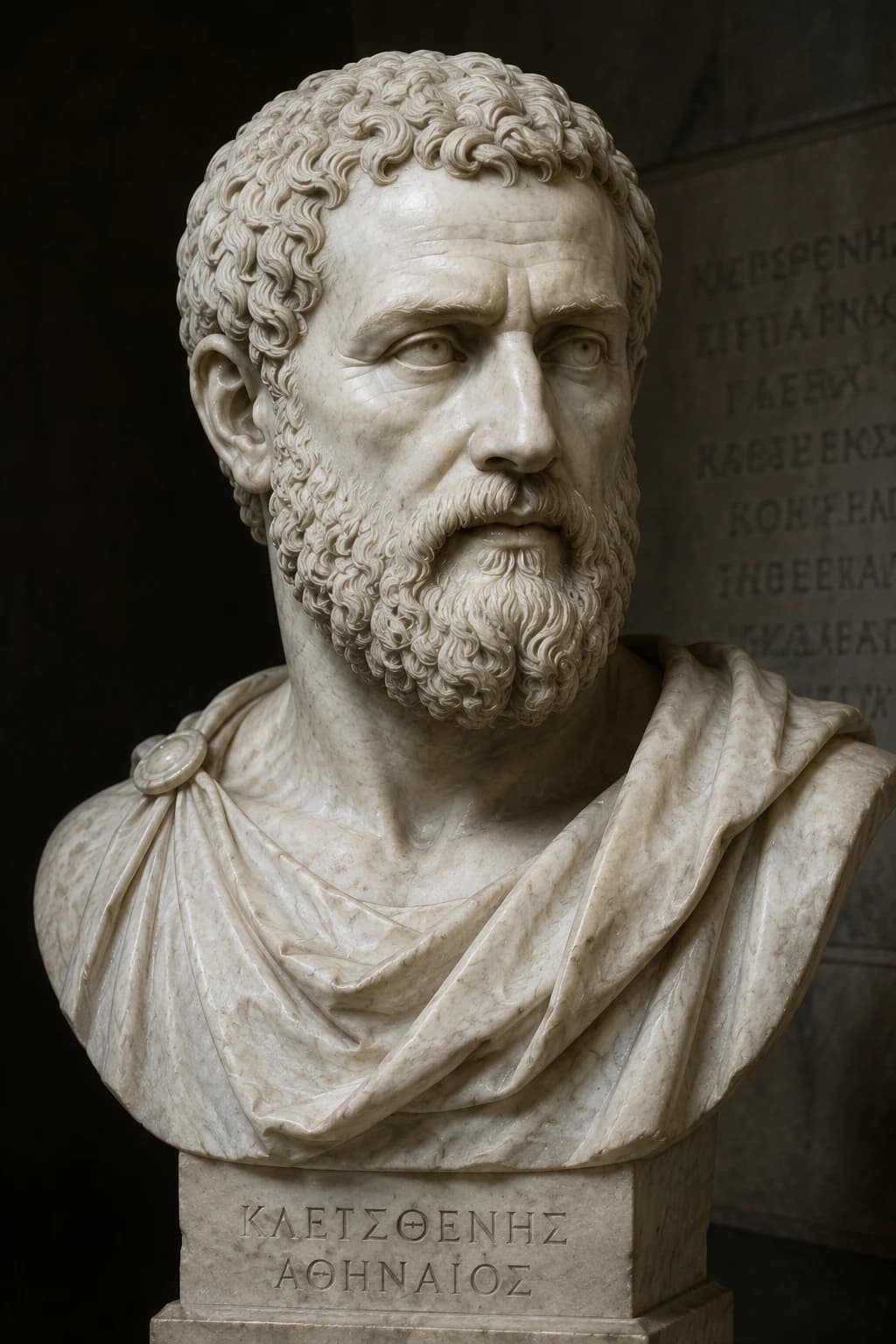
AI-generated portrait of Pericles, Athenian statesman
AI-assisted historical reconstruction

An illustrative reconstruction based on historical context. It is not a photograph or documentary likeness. Image policy

Quick answer

Pericles was the leading Athenian statesman of the fifth century BC. He expanded Athenian democracy, oversaw the Parthenon and Acropolis building programme, dominated the Delian League, and shaped Athens during the early Peloponnesian War.

Born
495 BCE
Died
429 BCE
Role
Athenian statesman
Years
495-429 BCE
Facts

Pericles timeline facts

Selected specifics from this profile's life story.

c. 495 BC–470 BC
Aristocratic roots

Pericles was born into an elite Athenian family, with a war-hero father and Alcmaeonid connections to democratic reform.

c. 447 BC–432 BC
The Acropolis building programme

Pericles directed the construction of the Parthenon and the other monuments of the Acropolis, commissioning the sculptor Pheidias and creating a complex that remains the most celebrated in the ancient world.

430 BC–429 BC
Plague and political crisis

A devastating plague struck Athens in 430, killing perhaps a quarter of the population; Pericles himself was fined by the assembly and removed from office before being re-elected, dying of the plague in 429.

After 429 BC
The age of Pericles

The Age of Pericles became the shorthand for Athens's golden age, but its brilliance rested on democracy, empire and exclusion at once.

Life Journey

Democracy, empire, and the golden age

Follow the story in a more continuous narrative, with a reading mode that matches how much depth you want.

Complete chronology

c. 495 BC–470 BC

Aristocratic roots

The Athens of Pericles's youth was still absorbing the extraordinary experience of the Persian Wars. Marathon, Salamis, Plataea and Mycale had transformed the city's self-understanding and laid the groundwork for Athenian confidence. His father Xanthippus commanded Athenian forces at Mycale in 479; his mother Agariste came from the Alcmaeonid clan, the family of Cleisthenes, whose reforms had shaped Athenian democracy. Pericles therefore grew up where aristocratic birth, democratic opportunity and military glory overlapped. His education was exceptional, associated with Damon, Zeno of Elea and especially Anaxagoras. That combination produced a rare political figure: an aristocrat who could lead a democracy, a democrat who ruled through personal prestige, and an imperial statesman who spoke the language of civic freedom.
c. 470 BC–461 BC

Rise to prominence

Pericles's entry into politics was shaped by factional calculation as much as by principle. He supported the prosecution of Cimon — the leading conservative politician of the period — when evidence of Cimon's Spartan sympathies made him vulnerable. He aligned himself with Ephialtes, the radical democrat who in 462–461 stripped the conservative Council of the Areopagus of most of its powers. When Ephialtes was assassinated, Pericles emerged as the leading figure in Athenian democratic politics. He held the office of strategos — general — repeatedly, effectively governing Athens through his influence in the assembly rather than through a formal executive position. His authority rested on his ability to persuade.

c. 454 BC–445 BC

Transforming the Delian League

The Delian League had been formed in 478 BC as a voluntary alliance against Persia, with member states contributing either ships or money. Over time, most states found it easier to contribute money, and the Athenian navy absorbed their function. When the league's treasury was moved from Delos to Athens in 454, the transformation was complete: what had been an alliance was now, in practice, an empire. Athens controlled the money, dictated foreign policy, and punished members who tried to leave. Pericles used a substantial portion of this tribute to fund the building programme on the Acropolis. His opponents in Athens attacked this as theft from the allies; Pericles argued that Athens had fulfilled its obligation of protection and was entitled to spend the surplus as it chose.

c. 447 BC–432 BC

The Acropolis building programme

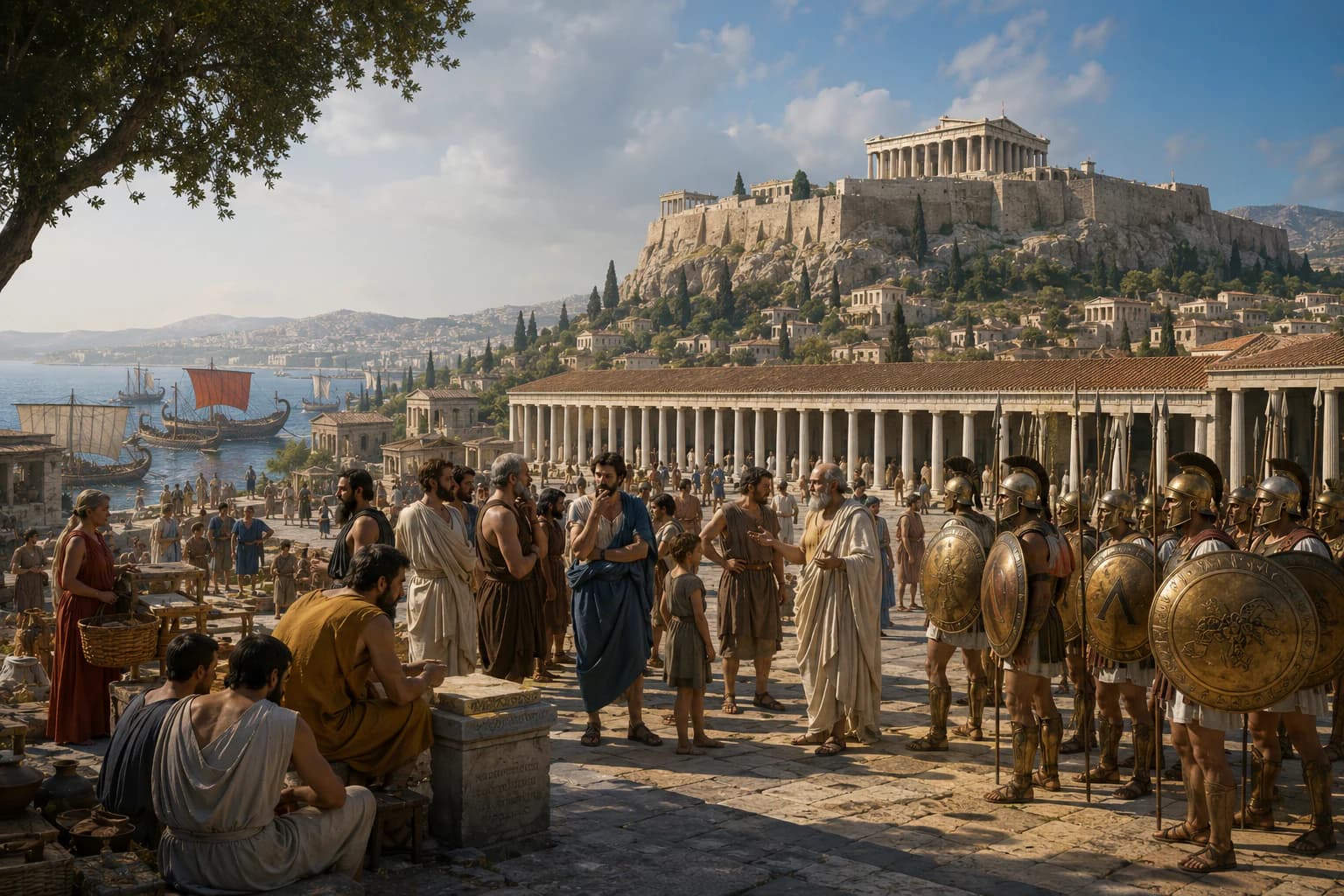
The construction programme on the Athenian Acropolis was an act of ideological as much as architectural ambition. Pericles presented it as a monument to Athenian power and divine favour, using the surplus of the Delian League's treasury to fund it. The Parthenon, designed by Ictinus and Callicrates with sculpture overseen by Pheidias, was completed in 432 BC and housed a colossal gold-and-ivory statue of Athena forty metres tall. The broader complex included the Propylaea gateway, the Erechtheion, and the temple of Athena Nike. The buildings were constructed with an obsessive attention to visual perfection — columns slightly curved to correct optical distortion, spacing adjusted to eliminate the visual effects of perspective. Nothing like this concentration of architectural and sculptural excellence had been achieved before.

c. 451 BC

Democracy and citizenship

Pericles's relationship with democracy was both genuine and self-serving. He extended democratic participation by introducing state pay for jurors, allowing citizens who needed income to participate in the legal system rather than being confined to the wealthy. He was a brilliant orator who dominated the assembly through persuasion rather than coercion. Yet in 451 he also sponsored a law restricting Athenian citizenship to those born of two citizen parents — a law that, after his Milesian companion Aspasia bore him a son, he had to ask the assembly to waive for his own child. The citizenship law effectively closed Athenian democracy at the moment of its greatest power, preventing the integration of the empire's subjects into the city that governed them.

431 BC

The Peloponnesian War

When the Peloponnesian War began in 431, Pericles had a clear strategic vision: Athens should not fight Sparta's superior land forces in open battle. Instead, it should use its naval superiority and the empire's tribute to sustain a long war of attrition, conducting coastal raids while allowing Sparta to devastate Attica without being engaged. The psychological cost of this strategy was enormous: Athenian citizens, including many who had grown up in the countryside, had to watch their farms and villages burned from the safety of the city walls. Pericles knew the war would be long and argued in the assembly for patience. He was right that it would be long. He did not live to see that Athens would not win it.

430 BC–429 BC

Plague and political crisis

The plague that struck Athens in 430 — possibly typhoid fever or a haemorrhagic disease, still debated by modern scholars — swept through the overcrowded city at a catastrophic rate. Pericles's strategy of concentrating the rural population within the city walls had inadvertently created the conditions for its worst possible spread. The assembly, traumatised and looking for someone to blame, fined Pericles and removed him from office. He was re-elected, but the personal costs were devastating: he had already lost two sons to the plague, and in the autumn of 429 he died of it himself. His death removed the one figure capable of managing Athenian democracy during a long war, and his successors pursued shorter-term and more reckless strategies that would eventually lose the conflict.

429 BC

Death and its consequences

Thucydides, who was deeply hostile to the democratic leaders who succeeded Pericles, presents his death as the moment when Athenian democracy began to go wrong — replaced by men who sought popular favour rather than truth, who followed the crowd rather than leading it. This assessment is partisan but not without foundation. The years after Pericles's death saw the rise of Cleon, a demagogue whose aggressive strategy Thucydides despised, and eventually the catastrophic Sicilian Expedition of 415, in which Athens sent its largest naval force in history to conquer Sicily and lost it entirely. Pericles had argued that Athens should not seek to acquire more territory while at war; the temptation to do so proved too strong for his successors.

After 429 BC

The age of Pericles

The cultural output of Athens in the age of Pericles is staggering in retrospect: Aeschylus, Sophocles, Euripides and Aristophanes were writing; Socrates was questioning in the agora; Thucydides was turning war into political history; Herodotus was shaping historical inquiry; Pheidias was sculpting; the Parthenon rose above the city. This was not coincidence. It came from wealth, naval power, civic competition, public festivals, democratic participation and imperial extraction converging in one place. Pericles did not create all of it, but he directed resources and confidence toward a vision of Athens as the school of Greece. The irony is permanent. The same democracy that produced extraordinary public culture denied political rights to women, enslaved people, resident foreigners and subject allies. Athens's golden age was real gold, but not everyone was allowed to touch it.

Continue in context

Connected stories

Move from the profile into the wider events and settings this figure belongs to.

Tertiary paths

Content note

This profile is written for educational use and connects to related Stories of History pages. The main portrait is an AI-assisted historical reconstruction, included as an illustrative aid rather than documentary evidence. Image policy

References

Sources & Further Reading

Reliable reference works, archives and reading paths connected to this profile.

Further reading

  1. Encyclopaedia Britannica, Search results for Pericles,” accessed June 2026.Open source
  2. WorldCat, Books and library holdings for Pericles,” accessed June 2026.Open source

Primary sources

  1. Library of Congress, Search results for Pericles,” accessed June 2026.Open source

Reviewed claim sources

Loading reviewed claim sources...

A weekly route through history

Find out first about the latest published stories, feature notes and occasional Premium offers in one weekly email.