People

John Quincy Adams

John Quincy Adams was the 6th U.S. President, son of John Adams, a major diplomat, architect of the Monroe Doctrine and later anti-slavery congressman.

Born
1767 CE
Died
1848 CE
Role
6th President of the United States and son of a president

6th President of the United States and son of a president (1767–1848)

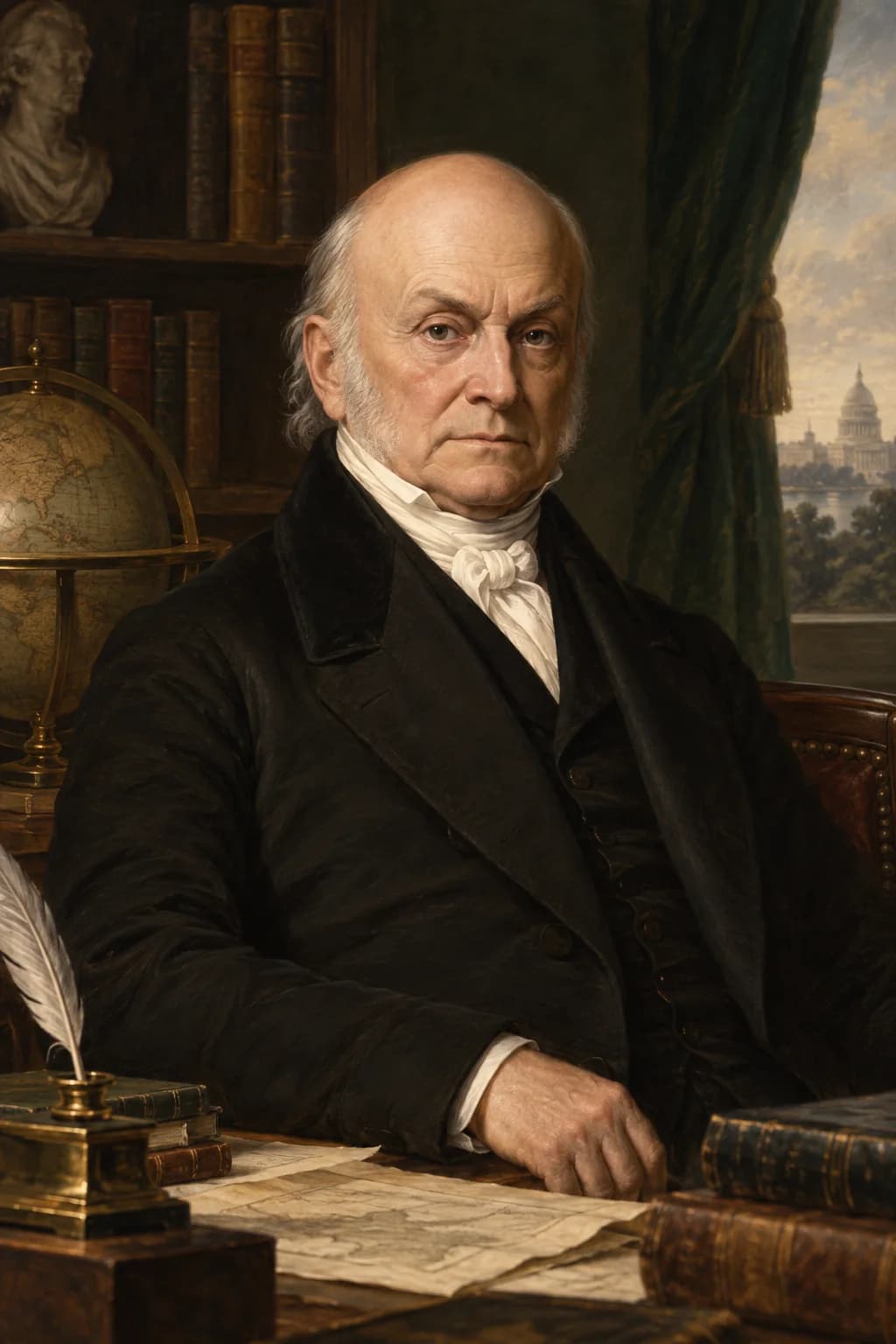
AI-generated portrait of John Quincy Adams in formal presidential attire
AI-assisted historical reconstruction

An illustrative reconstruction based on historical context. It is not a photograph or documentary likeness. Image policy Attribution

Quick answer

John Quincy Adams was the 6th U.S. President, son of John Adams, a major diplomat, architect of the Monroe Doctrine and later anti-slavery congressman.

Born
1767 CE
Died
1848 CE
Role
6th President of the United States and son of a president
Years
1767-1848 CE
Facts

John Quincy Adams timeline facts

Selected specifics from this profile's life story.

1767–1781
Revolutionary childhood

John Quincy Adams was born in Massachusetts in 1767 and grew up inside the American Revolution as the son of John and Abigail Adams.

1801–1811
Return to America

In the Senate, Adams broke with Federalists over national interest, showing the independence that made him admired and isolated.

1825–1829
Presidential agenda

As president, Adams proposed roads, canals, education and scientific institutions, but Jacksonian opposition crippled his agenda.

1848
Final years

Adams collapsed in the House chamber in 1848 and died in the Capitol, leaving a legacy larger than his one-term presidency.

Life Journey

A lifetime of diplomacy, principle and public service

Follow the story in a more continuous narrative, with a reading mode that matches how much depth you want.

Complete chronology

1767–1781

Revolutionary childhood

John Quincy Adams was born on 11 July 1767 in Braintree, Massachusetts, into a family already moving toward revolution. His father, John Adams, became one of independence's central advocates; his mother, Abigail Adams, gave him a moral and intellectual education as demanding as any school. As a boy he watched the Battle of Bunker Hill from a distance and absorbed the idea that public life required sacrifice. Childhood did not shield him from politics. It conscripted him into it. He learned early that the American republic was not an inheritance to enjoy, but an argument to sustain.

1781–1787

Education and discipline

Adams's education was international because the Revolution made his father a diplomat. He travelled to France and the Netherlands, studied languages, observed European courts and even served as a teenage secretary to the American envoy Francis Dana in Russia. He later returned to the United States and graduated from Harvard. This childhood of diplomacy gave him confidence and loneliness in equal measure. Adams held himself to punishing standards, recording failures, ambitions and spiritual anxieties in a diary that became one of the great documents of American public life. Duty was not a slogan for him. It was a burden he carried almost daily.

1790–1801

Early diplomacy

George Washington saw Adams's ability and appointed him minister to the Netherlands in 1794. Adams later served in Prussia and became known for precision, seriousness and command of European politics. He was not socially easy, but he was formidable. He believed the United States had to avoid becoming a pawn in European power struggles while still defending its sovereignty. His diplomatic career matured during the wars of the French Revolution and Napoleon, when neutrality, trade and national honor were constantly tested. Long before his presidency, Adams had become one of the republic's clearest strategic thinkers.

1801–1811

Return to America

Adams entered the U.S. Senate as a Federalist from Massachusetts, but party loyalty sat uneasily on him. He supported Thomas Jefferson's Louisiana Purchase and later backed measures associated with the Republican administration when he thought national interest required it. Massachusetts Federalists saw betrayal; Adams saw duty. He resigned and eventually joined the Republican political world of Jefferson, Madison and Monroe. The episode revealed a pattern that would follow him for life. Adams could be principled to the point of political self-harm, unwilling to soften conviction for coalition comfort.

1811–1825

Diplomatic achievements

Adams's highest achievements came before he became president. He helped negotiate the Treaty of Ghent that ended the War of 1812 without territorial loss. As James Monroe's Secretary of State, he negotiated the Adams-Onis Treaty of 1819, by which Spain ceded Florida and the United States clarified its western boundary claims. He also shaped the Monroe Doctrine in 1823, insisting that the United States speak independently rather than as Britain's junior partner. Adams's foreign policy was continental, disciplined and unsentimental. He wanted expansion and security, but also warned against going abroad in search of monsters to destroy.

1824

Presidential election

The 1824 election shattered the old Republican consensus. Andrew Jackson won the most popular and electoral votes but not a majority in the Electoral College. Under the Constitution, the decision went to the House of Representatives. Henry Clay, eliminated from contention but influential as Speaker, backed Adams, who then appointed Clay Secretary of State. Jackson's supporters denounced the result as a corrupt bargain. Evidence of an explicit deal remains disputed, but the political damage was immediate. Adams entered the White House legally, but under a cloud that his opponents never allowed to lift.

1825–1829

Presidential agenda

Adams's presidency from 1825 to 1829 was intellectually ambitious and politically unsuccessful. He wanted the federal government to support internal improvements, a national university, scientific exploration, observatories and economic development. He imagined a republic strengthened by knowledge and infrastructure. But the age was moving toward mass party politics, suspicion of centralized planning and Andrew Jackson's democratic insurgency. Adams refused to flatter, bargain or build a popular machine. His agenda sounded visionary to later ears, but in his own moment it appeared elitist and overreaching to many voters. He lost decisively to Jackson in 1828.

1831–1848

Congressional return

Adams's post-presidential career was extraordinary. Elected to the House of Representatives in 1830, he served for seventeen years and found the moral clarity that had eluded his presidency. He opposed the gag rule that blocked antislavery petitions, arguing that the right of petition could not be sacrificed to protect slaveholders from criticism. He did not begin as a full abolitionist in the modern sense, but he became a ferocious opponent of the slave power's reach into national politics. In the Amistad case, he argued before the Supreme Court on behalf of Africans who had seized the ship carrying them into illegal enslavement. This was the most heroic phase of his public life.

1848

Final years

John Quincy Adams collapsed at his desk in the House of Representatives in February 1848 and died two days later in the Capitol. His career had stretched from the American Revolution to the brink of the Civil War. He was president, but the presidency was not his finest work. His legacy rests on diplomatic brilliance, constitutional seriousness and late-life resistance to slavery's domination of national politics. He was difficult, cold to some, morally severe and often politically maladroit. Yet he gave public service an almost sacred intensity. To ask why John Quincy Adams was important is to see a man whose defeats in power prepared him for greatness in opposition.

Continue in context

Connected stories

Move from the profile into the wider events and settings this figure belongs to.

American Presidents lineage
Lineage47 presidents
American Presidents
1789 CE–present

The succession of American presidents from George Washington to today.

View lineage
Tertiary paths

Content note

This profile is written for educational use and connects to related Stories of History pages. The main portrait is an AI-assisted historical reconstruction, included as an illustrative aid rather than documentary evidence. Image policy Image attribution

References

Sources & Further Reading

Reliable reference works, archives and reading paths connected to this profile.

Further reading

  1. Encyclopaedia Britannica, Search results for John Quincy Adams,” accessed June 2026.Open source
  2. WorldCat, Books and library holdings for John Quincy Adams,” accessed June 2026.Open source

Primary sources

  1. Library of Congress, Search results for John Quincy Adams,” accessed June 2026.Open source

Reviewed claim sources

Loading reviewed claim sources...

A weekly route through history

Find out first about the latest published stories, feature notes and occasional Premium offers in one weekly email.