People

J. Robert Oppenheimer

J. Robert Oppenheimer was an American theoretical physicist and scientific director of the Los Alamos laboratory during the Manhattan Project. He helped build the first atomic bombs, oversaw the Trinity test in 1945, opposed the hydrogen bomb program, lost his security clearance in 1954, and became a lasting symbol of science, war and nuclear responsibility.

Born
1904 CE
Died
1967 CE
Role
Theoretical physicist and scientific director of Los Alamos

American theoretical physicist (1904-1967)

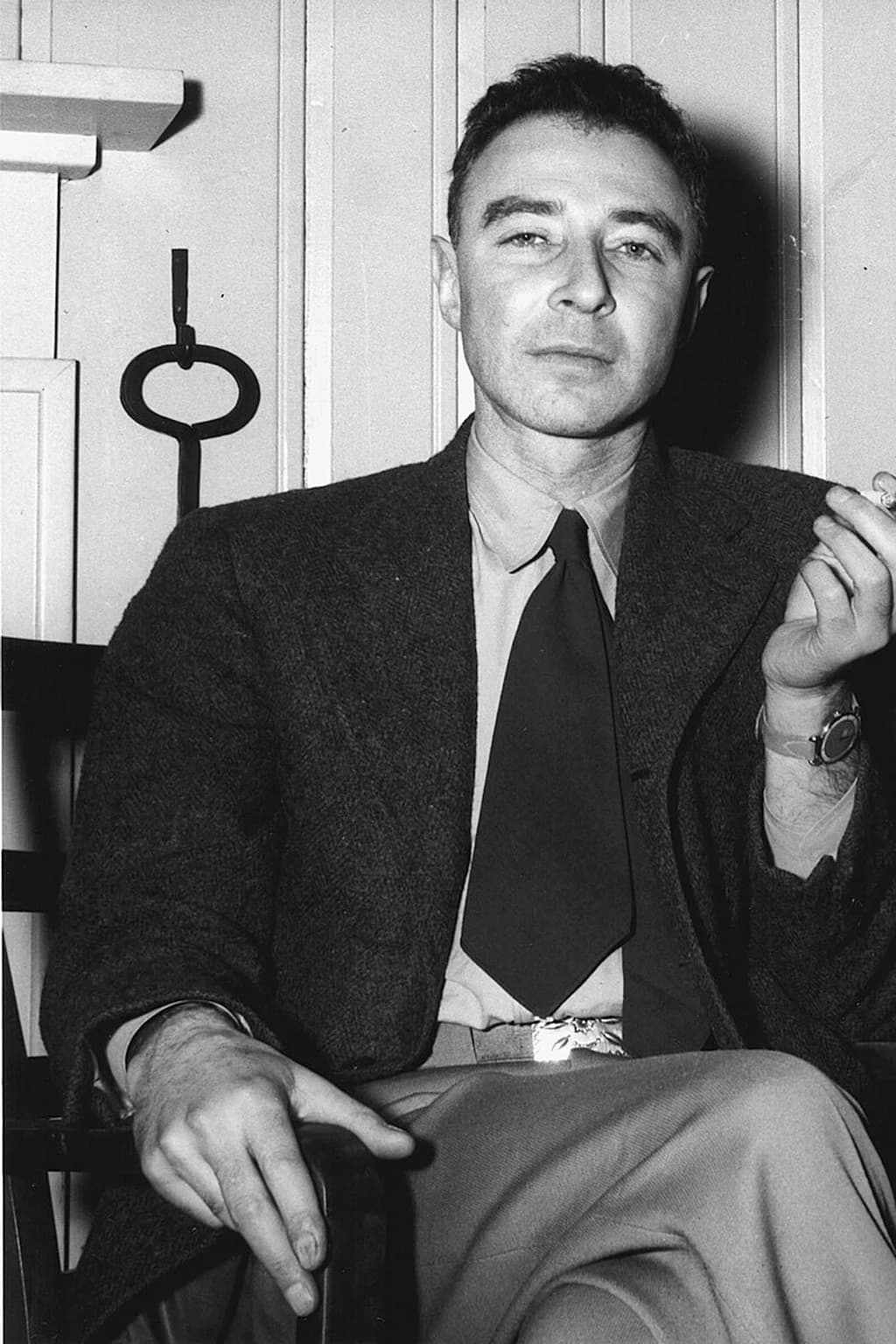
Portrait photograph of J. Robert Oppenheimer
Historical photograph

A real historical or editorial image is used here. Source, licence and transformation details are publicly recorded. Image policy Attribution

Quick answer

J. Robert Oppenheimer was an American theoretical physicist and scientific director of the Los Alamos laboratory during the Manhattan Project. He helped build the first atomic bombs, oversaw the Trinity test in 1945, opposed the hydrogen bomb program, lost his security clearance in 1954, and became a lasting symbol of science, war and nuclear responsibility.

Born
1904 CE
Died
1967 CE
Role
Theoretical physicist and scientific director of Los Alamos
Years
1904-1967 CE
Quick facts

Profile details

Additional identity and tagging details that are not already covered in the introduction.

Also known as
Robert Oppenheimer, Julius Robert Oppenheimer
Facts

J. Robert Oppenheimer timeline facts

Selected specifics from this profile's life story.

1904-1921
New York beginnings

Julius Robert Oppenheimer was born in New York City in 1904 into a wealthy, educated Jewish family that encouraged art, science, languages and intellectual ambition.

1930s
Politics and danger

During the Depression and the rise of fascism, Oppenheimer moved in left-wing circles, supported anti-fascist causes, and formed associations that later made him vulnerable in Cold War America.

1945-1949
Atomic victory and moral unease

After Hiroshima and Nagasaki, Oppenheimer became a national figure, advising on atomic policy while warning that nuclear weapons had changed politics as well as warfare.

1954-1967
Later years and legacy

After losing his clearance, Oppenheimer led the Institute for Advanced Study, received partial public rehabilitation, and died in 1967 as a symbol of the nuclear age's unresolved conscience.

Life Journey

A mind at the threshold of the nuclear age

Follow the story in a more continuous narrative, with a reading mode that matches how much depth you want.

Complete chronology

1904-1921

New York beginnings

Julius Robert Oppenheimer was born in New York City on 22 April 1904. His father, Julius Oppenheimer, was a German-born textile importer who had prospered in the United States, and his mother, Ella Friedman, was an artist from a cultured New York family. Oppenheimer grew up in comfort, but not laziness. He was educated at the Ethical Culture School, where moral seriousness, social responsibility and intellectual curiosity were treated as connected habits. He collected minerals, read widely, learned languages and developed the intensity that later made him both magnetic and difficult. His background placed him at a crossing point in modern American life: wealthy but still shaped by Jewish outsider status, cosmopolitan but deeply drawn to the American landscape of New Mexico, brilliant but never emotionally simple. Long before the atomic bomb, Oppenheimer was learning to live inside contradiction.
1922-1929

Becoming a physicist

Oppenheimer studied at Harvard and then moved into the European centers where modern physics was being remade. His time at Cambridge was troubled; he was gifted but unhappy in experimental laboratory work. At Gottingen, however, he found the intellectual atmosphere that suited him. Under Max Born, and alongside a generation of extraordinary physicists, he worked in the new language of quantum mechanics. Oppenheimer was not the sole creator of the quantum revolution, but he became one of its sharpest American interpreters. He absorbed ideas quickly, moved between problems with speed, and developed the ability to make difficult physics feel alive to students. In 1929, after earning his doctorate, he returned to the United States at a moment when American physics was still building its confidence. He helped make it serious.

1929-1941

Berkeley and a school of physics

Oppenheimer divided his academic life between the University of California, Berkeley, and the California Institute of Technology. At Berkeley, especially, he became the center of a demanding intellectual circle. Students found him dazzling, severe, generous, cutting and unforgettable. He could move from Sanskrit to poetry to quantum theory, then reduce a student's weak argument with a sentence. His own research ranged across quantum theory, cosmic rays, nuclear physics and astrophysics, including work connected to what later became the theory of black holes. Yet his greatest prewar achievement may have been institutional. He helped create an American school of theoretical physics at a time when many of the field's leading figures were still in Europe. The United States would soon need that scientific depth urgently.

1930s

Politics and danger

The 1930s pulled Oppenheimer toward politics. The Great Depression, the Spanish Civil War, the rise of Nazi Germany and the persecution of Jews in Europe made detachment difficult. He donated to left-wing causes, supported anti-fascist efforts and knew people connected to the Communist Party, including his brother Frank and his future wife, Katherine Puening. Oppenheimer himself was never proven to have been a Soviet agent, and his precise political commitments remain debated. What matters historically is the collision between the open, urgent politics of the 1930s and the security culture of the 1940s and 1950s. Associations that seemed part of anti-fascist engagement before and during the war later became evidence used against him. His political past did not prevent the U.S. government from trusting him with Los Alamos, but it never stopped haunting him.

1942-1945

Los Alamos

Oppenheimer was an unusual choice to direct the weapons laboratory of the Manhattan Project. He had never managed anything on the scale Los Alamos required, and his political background worried security officials. General Leslie Groves chose him anyway because Oppenheimer understood the science, the scientists and the urgency. At Los Alamos, Oppenheimer's gifts became administrative power. He could translate between military command and theoretical argument, persuade difficult personalities to work together, and keep the central problem in view: how to turn nuclear fission from possibility into weapon. The laboratory gathered figures such as Enrico Fermi, Hans Bethe, Richard Feynman, Edward Teller and many others into a secret town in New Mexico. Oppenheimer did not build the bomb alone. The Manhattan Project was an immense military-industrial-scientific system. But he gave its most concentrated intellectual site a human center.

16 July 1945

Trinity

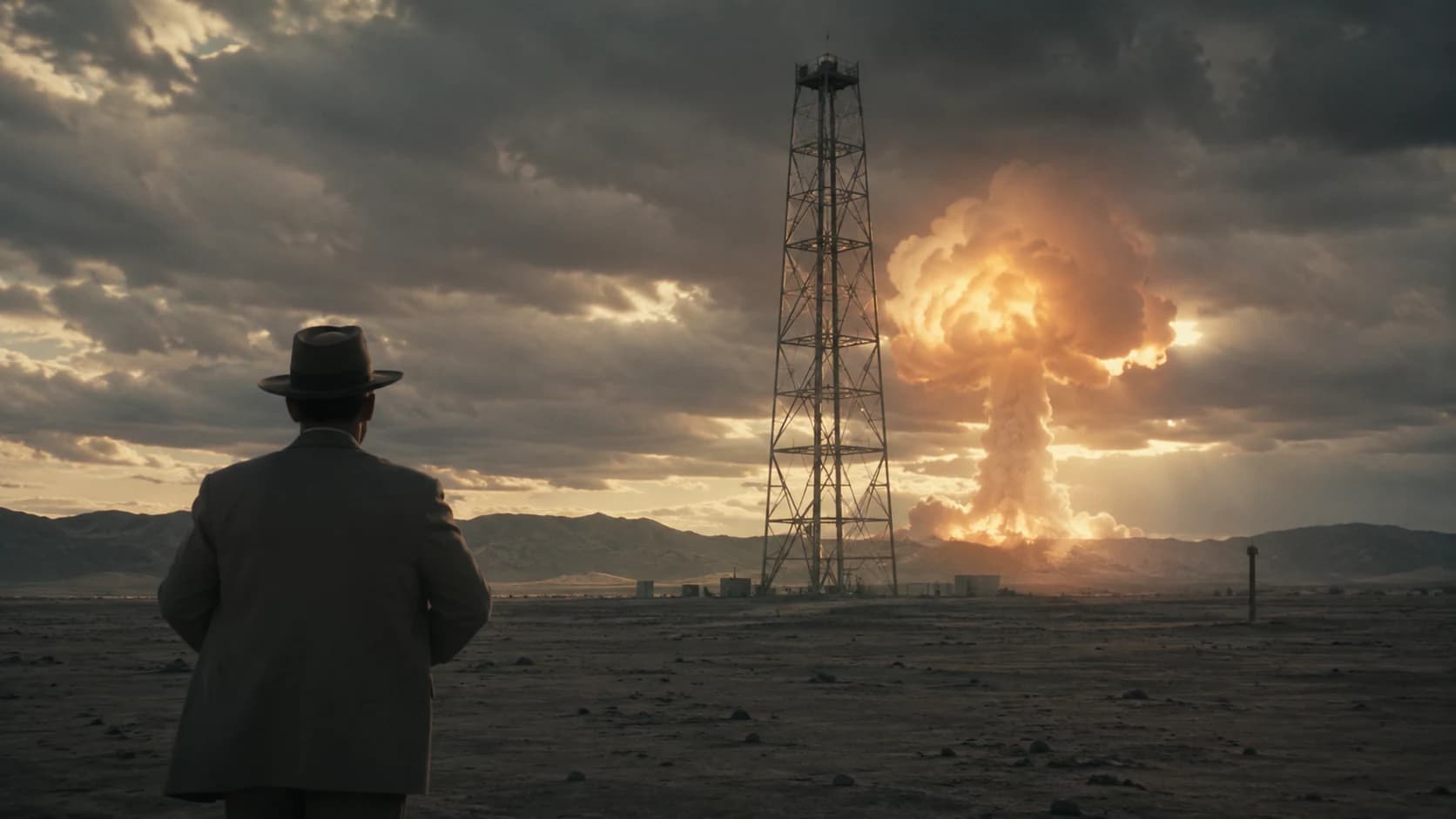
Before dawn on 16 July 1945, the Trinity device stood on a tower in the Jornada del Muerto desert of New Mexico. The test carried practical uncertainty and moral weight. If it failed, years of secret work would remain unproven. If it succeeded, humanity would possess a weapon unlike any used before. At 5:29 a.m., the device detonated. The blast vaporized the tower, fused desert sand into glassy trinitite and sent a mushroom cloud into the sky. Oppenheimer later recalled thinking of a line from the Bhagavad Gita: 'Now I am become Death, the destroyer of worlds.' The quotation became inseparable from his public image, though the moment itself contained more than one emotion. Relief, awe, fear, pride and dread were all present. Trinity proved the bomb worked. It also proved that the modern world had entered the nuclear age.

1945-1949

Atomic victory and moral unease

The atomic bombings of Hiroshima and Nagasaki in August 1945 helped force Japan's surrender, but they also placed Oppenheimer inside a new public role. He became the most recognizable scientific voice of the atomic age. He served as chair of the General Advisory Committee to the Atomic Energy Commission and argued that nuclear weapons required international control, sober policy and moral seriousness. He was not a simple pacifist, and he did not deny his wartime role. Yet he understood that atomic weapons could not be treated as ordinary arms. They altered diplomacy, secrecy, public fear and the relationship between science and the state. His influence was real, but unstable. In Washington, scientific advice now lived beside military planning, Cold War rivalry and the growing suspicion that any hesitation about new weapons might be weakness.

1949-1954

The hydrogen bomb fight

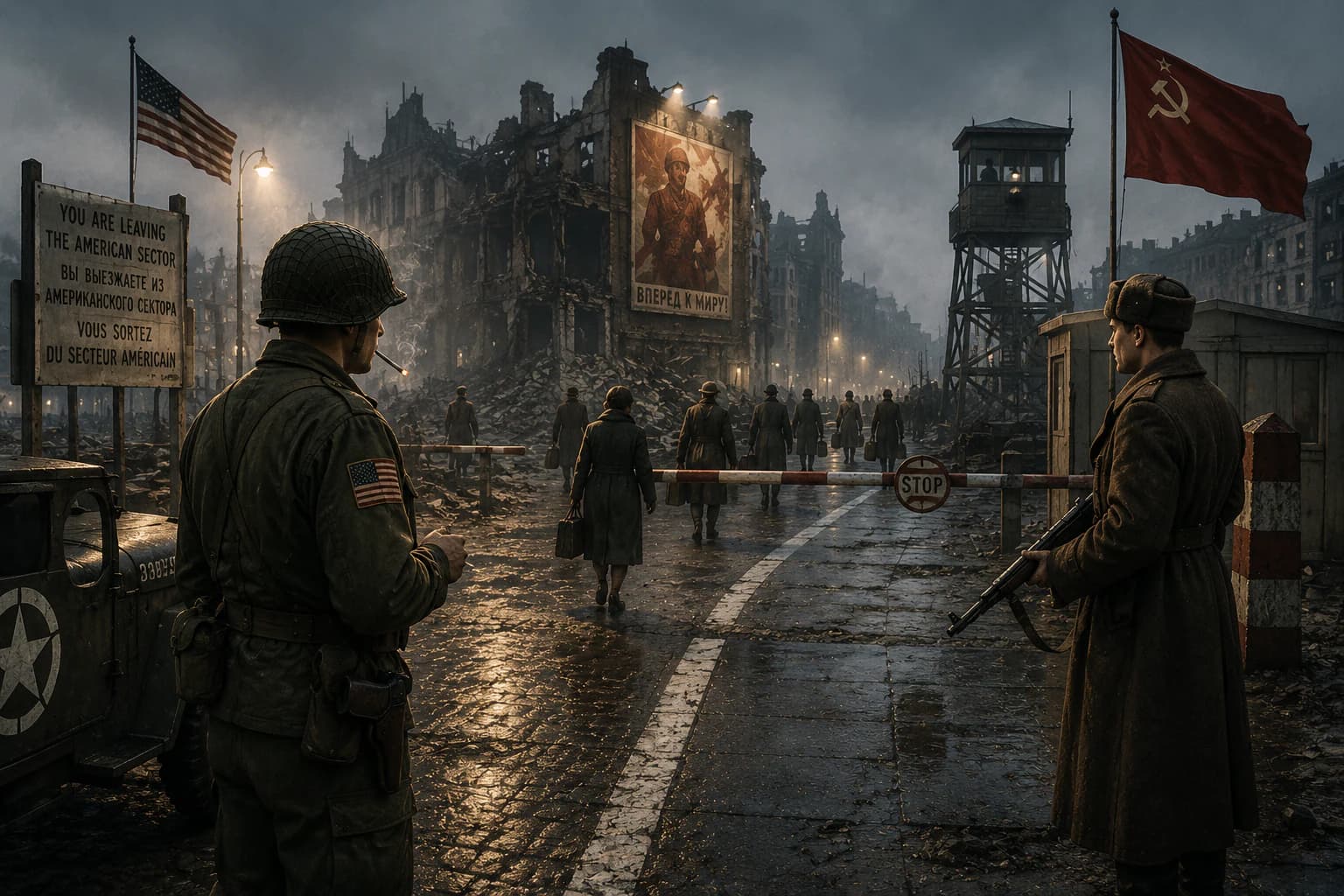
The Soviet Union tested its first atomic bomb in 1949, shocking American officials who had expected a longer monopoly. The question of the hydrogen bomb followed quickly. Edward Teller and others pushed for a thermonuclear weapon vastly more powerful than the bombs used in 1945. Oppenheimer and the General Advisory Committee opposed an immediate crash program, arguing that the weapon raised grave technical, strategic and moral questions. President Harry S Truman decided to proceed. The dispute did not end there. Oppenheimer's caution, his old left-wing associations, his personal enemies and the harsher atmosphere of Cold War anti-communism converged. In 1954, after a security hearing shaped by suspicion and rivalry, his security clearance was revoked. The decision publicly humiliated him and signaled that scientific prestige offered little protection when national security politics turned punitive.

1954-1967

Later years and legacy

Oppenheimer spent his later years as director of the Institute for Advanced Study in Princeton, a prestigious but changed figure. He remained intellectually active and publicly respected in some circles, but the 1954 hearing had damaged his authority and narrowed his role in government. In 1963, President Lyndon B. Johnson presented him with the Enrico Fermi Award, a gesture widely read as partial rehabilitation. It did not undo the earlier judgment, but it acknowledged the scale of his service. Oppenheimer died of throat cancer on 18 February 1967. His legacy remains difficult because it should be difficult. He helped build the weapon that ended one war and shaped the next era of fear. He was neither innocent prophet nor cold technocrat. He was a brilliant scientist who entered the machinery of wartime power, succeeded, and then spent the rest of his life in the shadow of that success.

Continue in context

Connected stories

Move from the profile into the wider events and settings this figure belongs to.

Tertiary paths

Content note

This profile is written for educational use and connects to related Stories of History pages. The main portrait uses a real historical or editorial image, with source and licence details recorded for attribution review. Image policy Image attribution

References

Sources & Further Reading

Reliable reference works, archives and reading paths connected to this profile.

Further reading

  1. Encyclopaedia Britannica, Search results for J. Robert Oppenheimer,” accessed June 2026.Open source
  2. WorldCat, Books and library holdings for J. Robert Oppenheimer,” accessed June 2026.Open source

Primary sources

  1. Library of Congress, Search results for J. Robert Oppenheimer,” accessed June 2026.Open source

Reviewed claim sources

Loading reviewed claim sources...

A weekly route through history

Find out first about the latest published stories, feature notes and occasional Premium offers in one weekly email.