People

Ito Hirobumi

Ito Hirobumi was a Meiji statesman from Choshu, architect of the Meiji Constitution, Japan's first prime minister and later Resident-General of Korea before his assassination in 1909.

Born
1841 CE
Died
1909 CE
Role
Prime Minister of Japan

Japanese statesman (1841-1909)

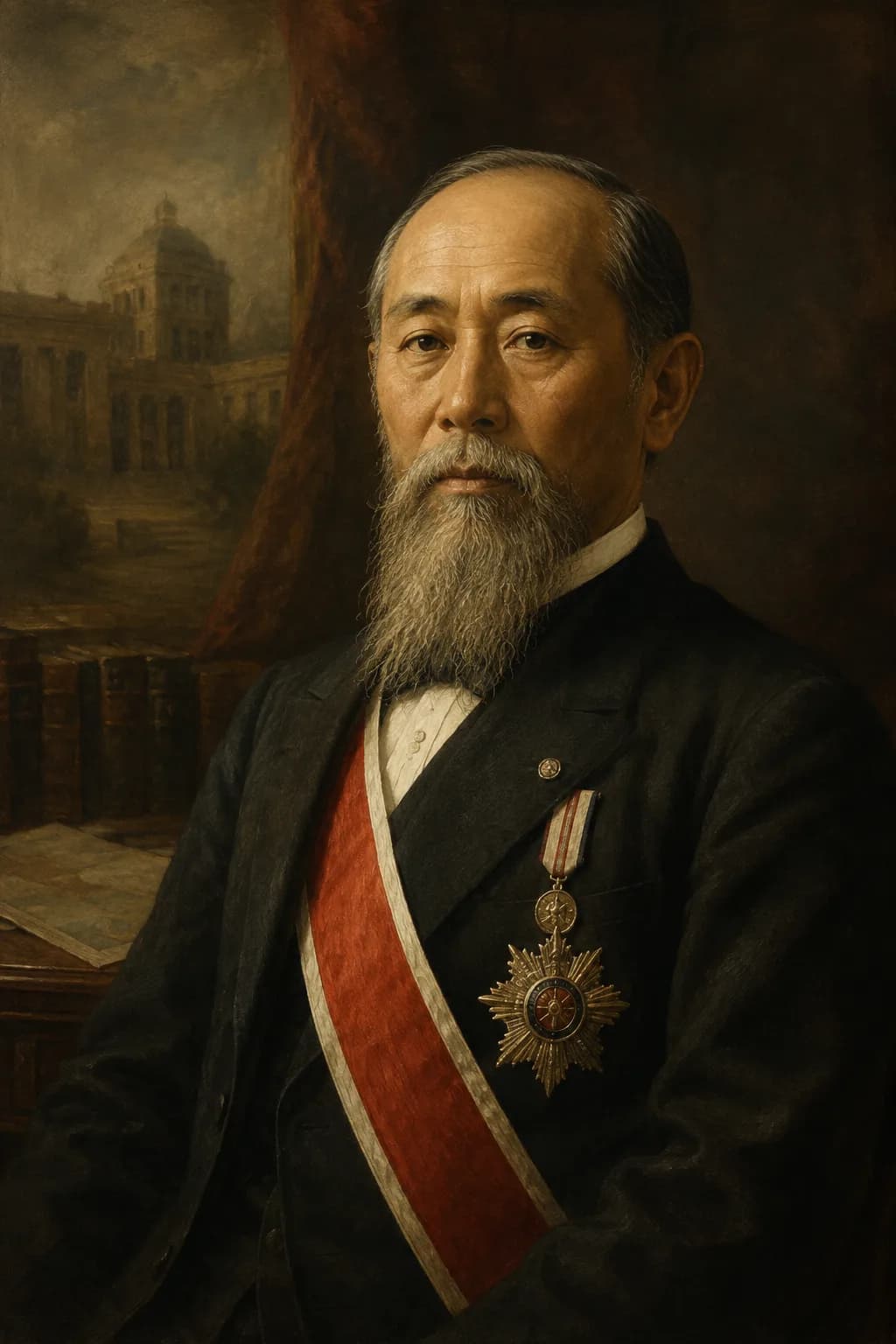
AI-generated portrait of Ito Hirobumi in formal statesman's dress
AI-assisted historical reconstruction

An illustrative reconstruction based on historical context. It is not a photograph or documentary likeness. Image policy

Quick answer

Ito Hirobumi was a Meiji statesman from Choshu, architect of the Meiji Constitution, Japan's first prime minister and later Resident-General of Korea before his assassination in 1909.

Born
1841 CE
Died
1909 CE
Role
Prime Minister of Japan
Years
1841-1909 CE
Quick facts

Profile details

Additional identity and tagging details that are not already covered in the introduction.

Also known as
Hirobumi Ito
Facts

Ito Hirobumi timeline facts

Selected specifics from this profile's life story.

1841
Choshu beginnings

Ito Hirobumi was born in Choshu, one of the domains that became central to the overthrow of Tokugawa rule.

1863
Learning from the West

Ito secretly travelled to Britain as part of the Choshu Five, gaining direct exposure to Western industry and power.

1885-1889
Constitution maker

Ito became Japan's first prime minister and helped draft the Meiji Constitution, balancing Western forms with imperial sovereignty.

1895-1909
Empire and assassination

Ito's later career tied constitutional Japan to imperial expansion, especially in Korea, before his assassination in 1909.

Life Journey

From Choshu activist to architect of Meiji government

Follow the story in a more continuous narrative, with a reading mode that matches how much depth you want.

Complete chronology

1841

Choshu beginnings

Ito Hirobumi was born in 1841 in the Choshu domain, far from the formal centre of Tokugawa power but close to the networks that would remake Japan. Choshu produced many young samurai and activists who combined anger at foreign pressure with a willingness to learn from foreign strength. Ito's origins were not those of a grand aristocrat. His rise depended on talent, patronage and the turbulence of the late shogunate. That mattered for the Meiji state: many of its builders came from domains that had challenged Edo and then used victory to construct a new national elite.
1863

Learning from the West

In 1863 Ito travelled secretly to Britain with other Choshu students in defiance of restrictions on overseas travel. The experience changed his view of foreign power. Western strength was not only ships and cannon; it was industry, finance, engineering, law, education and administrative capacity. Ito returned convinced that Japan had to learn quickly if it wanted to survive independently. This did not make him a simple Westerniser. Like many Meiji leaders, he wanted selective borrowing: take the institutions and techniques that strengthened the state while preserving Japanese sovereignty and political control.

1868-1880s

Meiji official

After 1868 Ito served in the new Meiji government as it abolished domains, sent missions abroad, built ministries and reshaped the state. He joined the Iwakura Mission, studied foreign institutions and became one of the leading interpreters of how Japan might modernise without surrendering control to mass politics. Ito's skill lay in institutional design. He understood that slogans of restoration were not enough. Japan needed offices, laws, budgets, schools, chains of command and procedures that could outlast the revolutionary generation. His career shows the administrative side of the Restoration: less dramatic than battle, but just as decisive.

1885-1889

Constitution maker

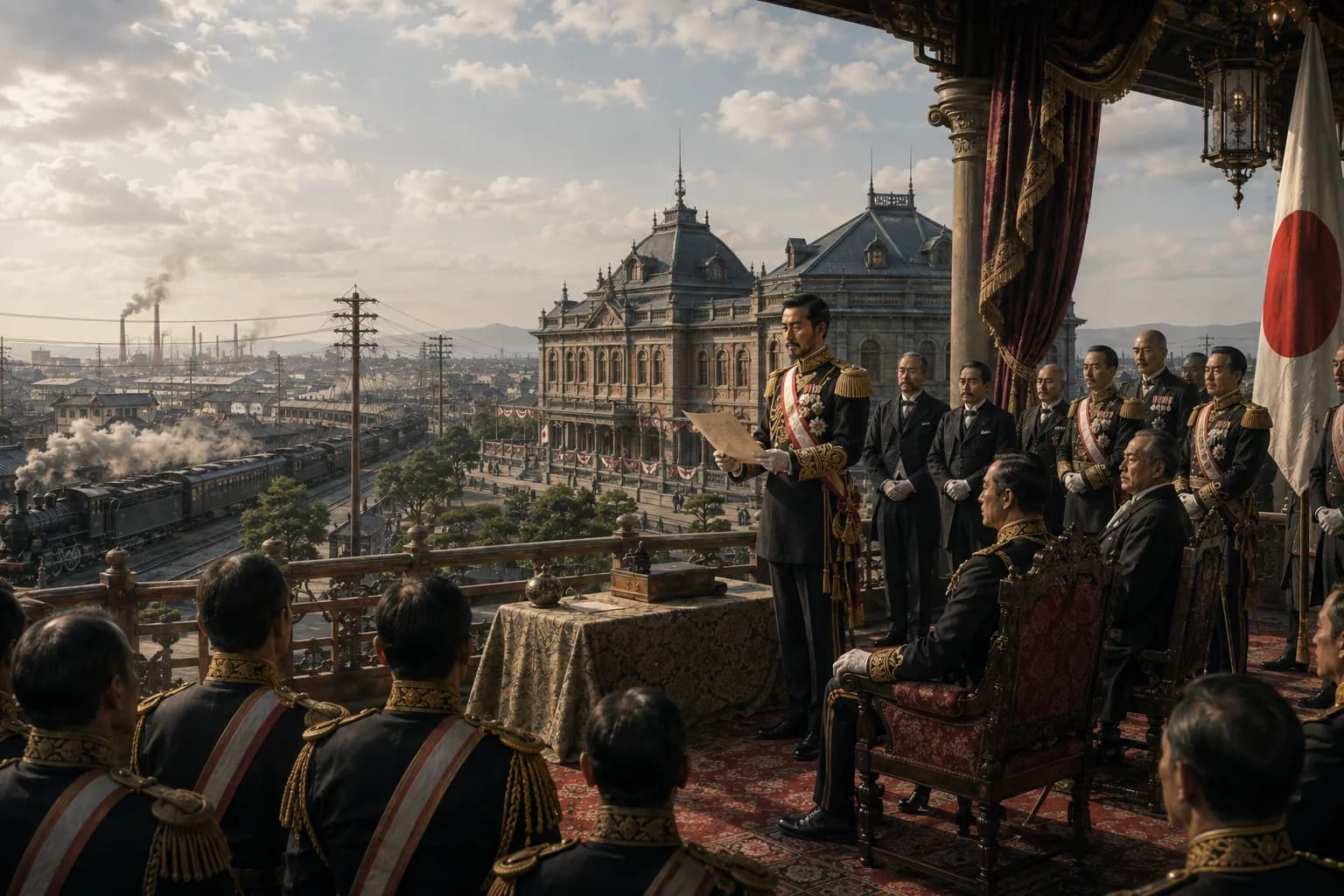
Ito became Japan's first prime minister in 1885 and played the central role in drafting the Meiji Constitution, promulgated in 1889. He studied European models, especially Prussian constitutionalism, because they seemed to offer modern state structure without full parliamentary supremacy. The result created an Imperial Diet, cabinet government and legal forms recognisable to Western powers, but sovereignty remained with the emperor. Ito's design reflected both ambition and fear. He wanted Japan accepted as a modern state, yet he also wanted political authority protected from party conflict and popular pressure.

1895-1909

Empire and assassination

Ito's later career moved with Japan's expanding power. Victory over China increased Japanese influence in Korea, and after the Russo-Japanese War Japan imposed protectorate status there. Ito served as Resident-General of Korea, a position that placed him at the centre of Japanese imperial control. In 1909 he was assassinated at Harbin by Korean independence activist An Jung-geun. His death exposed the darker side of the Meiji achievement. The state Ito helped build had secured Japan's independence and international status, but it had also become an imperial power restricting the independence of others.

Continue in context

Connected stories

Move from the profile into the wider events and settings this figure belongs to.

Tertiary paths

Content note

This profile is written for educational use and connects to related Stories of History pages. The main portrait is an AI-assisted historical reconstruction, included as an illustrative aid rather than documentary evidence. Image policy

References

Sources & Further Reading

Reliable reference works, archives and reading paths connected to this profile.

Further reading

  1. Encyclopaedia Britannica, Search results for Ito Hirobumi,” accessed June 2026.Open source
  2. WorldCat, Books and library holdings for Ito Hirobumi,” accessed June 2026.Open source

Primary sources

  1. Library of Congress, Search results for Ito Hirobumi,” accessed June 2026.Open source

Reviewed claim sources

Loading reviewed claim sources...

A weekly route through history

Find out first about the latest published stories, feature notes and occasional Premium offers in one weekly email.