People

Emperor Meiji

Emperor Meiji, born Mutsuhito, reigned from 1867 to 1912. His reign gave its name to the Meiji Restoration, the abolition of feudal domains, centralised reform, industrialisation, constitutional government and Japan's rise as a major power.

Born
1852 CE
Died
1912 CE
Role
Emperor of Japan

Emperor of Japan (1852-1912)

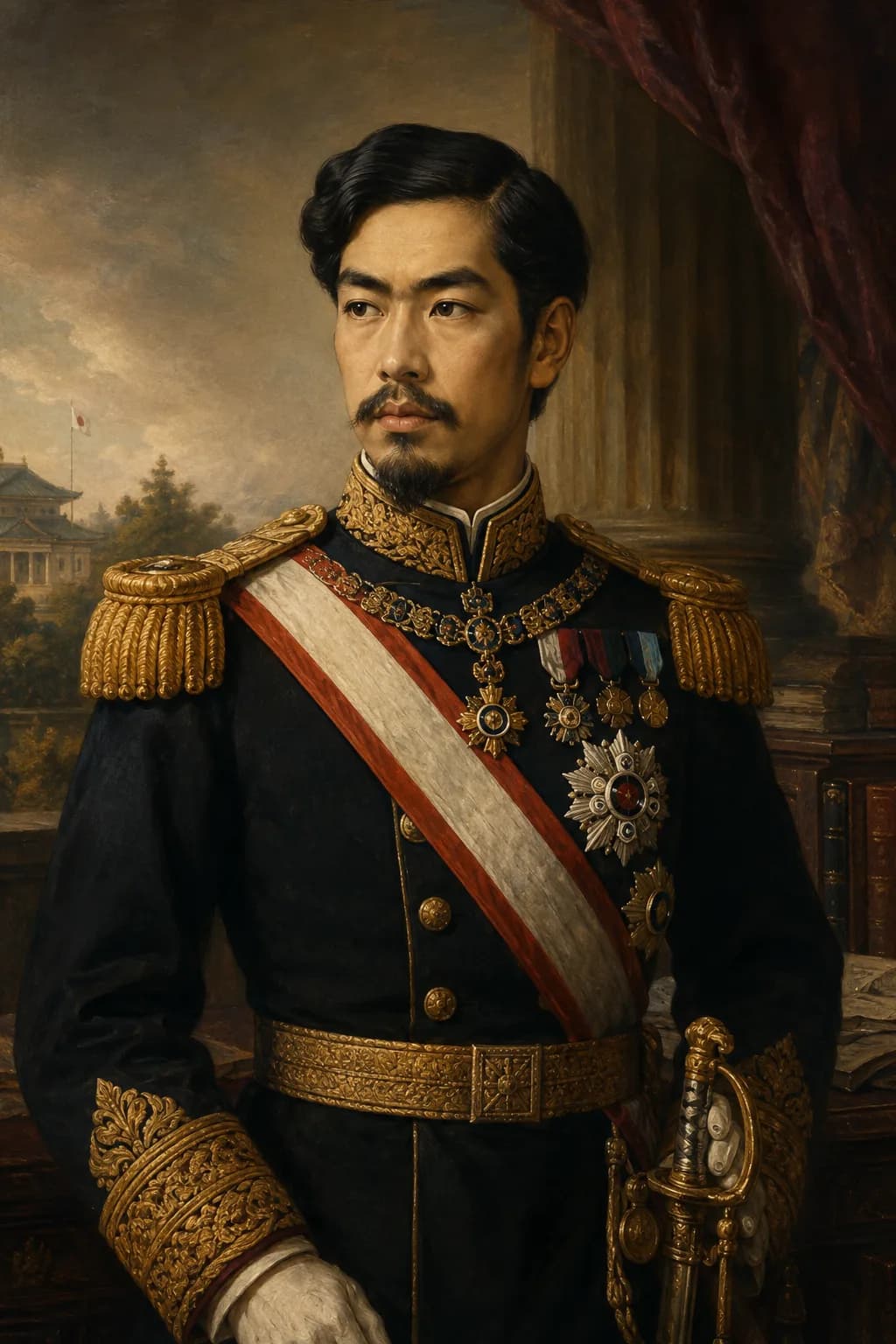
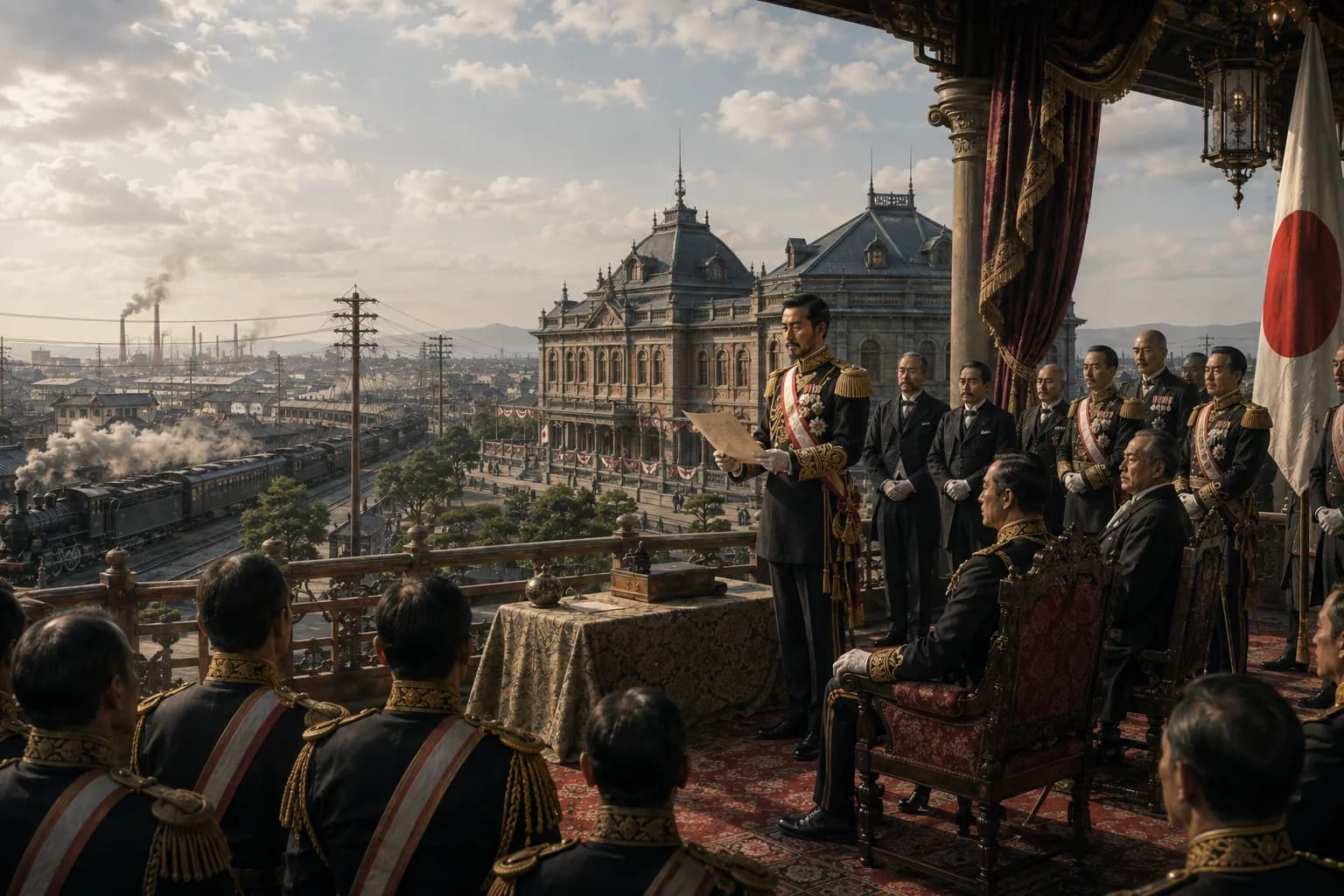
AI-generated portrait of Emperor Meiji in formal imperial military dress
AI-assisted historical reconstruction

An illustrative reconstruction based on historical context. It is not a photograph or documentary likeness. Image policy

Quick answer

Emperor Meiji, born Mutsuhito, reigned from 1867 to 1912. His reign gave its name to the Meiji Restoration, the abolition of feudal domains, centralised reform, industrialisation, constitutional government and Japan's rise as a major power.

Born
1852 CE
Died
1912 CE
Role
Emperor of Japan
Years
1852-1912 CE
Quick facts

Profile details

Additional identity and tagging details that are not already covered in the introduction.

Also known as
Mutsuhito, Meiji Tenno, Emperor Mutsuhito
Facts

Emperor Meiji timeline facts

Selected specifics from this profile's life story.

1852
Born into a hidden court

Mutsuhito was born in Kyoto while real political power still belonged to the Tokugawa shogunate in Edo.

1867-1868
Restoration in his name

After becoming emperor, Meiji became the public centre of the movement that overthrew Tokugawa rule.

1889
Modern monarchy

The Meiji Constitution created a political system that borrowed Western forms while preserving strong imperial authority.

1912
Imperial legacy

By the time Meiji died, Japan had become an industrialised military power with victories over China and Russia behind it.

Life Journey

From court symbol to centre of modern Japan

Follow the story in a more continuous narrative, with a reading mode that matches how much depth you want.

Complete chronology

1852

Born into a hidden court

Mutsuhito was born in Kyoto in 1852, heir to an imperial court that carried deep symbolic authority but little direct governing power. For more than two centuries, the Tokugawa shoguns had ruled Japan while emperors remained distant figures of legitimacy. That distance mattered. When foreign pressure shook the shogunate in the 1850s, opponents of Tokugawa rule could claim that restoring imperial authority was not rebellion but a return to rightful order. The future Emperor Meiji was still a child, but the institution around him became a language through which ambitious samurai and reformers could challenge the old regime.
1867-1868

Restoration in his name

Mutsuhito became emperor in 1867, taking the reign name Meiji. Within months, Tokugawa Yoshinobu returned governing authority to the court, and anti-shogunal forces from domains such as Satsuma and Choshu moved to secure a new political order. The Boshin War showed that restoration was not a quiet ceremonial transfer. It was a struggle over armies, offices and the future of the state. Meiji did not personally design every policy that followed, but his name gave legitimacy to leaders who dismantled the shogunate and claimed to act for a renewed imperial Japan.

1868-1873

A new capital and state

After the Restoration, Edo became Tokyo and the emperor's presence helped mark the old shogunal city as the capital of a new state. The government abolished the feudal domains in 1871, replaced them with prefectures and concentrated taxation, administration and military authority in national institutions. These changes reduced daimyo power and weakened hereditary privilege. They were presented as acts of imperial renewal, but they also created a more intrusive modern state. The emperor's image, ceremonies and proclamations helped make radical institutional change feel like national unity rather than mere factional victory.

1889

Modern monarchy

The Meiji Constitution of 1889 gave Japan a cabinet, bureaucracy, courts and Imperial Diet, but it placed sovereignty in the emperor rather than the people. This balance reflected the aims of the Meiji leadership. They wanted the strength and international recognition associated with constitutional government, yet they feared uncontrolled popular politics. Emperor Meiji stood at the centre of that settlement. He was not a modern party politician, but the constitution made imperial authority the formal source of command, legislation and legitimacy. Japan had adopted selected Western institutions without surrendering the sacred political language of the throne.

1912

Imperial legacy

Emperor Meiji died in 1912 after a reign that transformed Japan's place in the world. The country had built railways, factories, conscript armies, modern schools, a constitution and an expanding empire. Victory over China in 1895 brought Taiwan and influence in Korea; victory over Russia in 1905 stunned the world. The emperor's personal role should not be exaggerated: oligarchs, generals, bureaucrats and entrepreneurs drove much of the work. Yet the era took his name because the throne supplied the shared centre around which reformers organised change. Meiji's legacy is therefore both national reinvention and the imperial power that reinvention made possible.

Continue in context

Connected stories

Move from the profile into the wider events and settings this figure belongs to.

Tertiary paths

Content note

This profile is written for educational use and connects to related Stories of History pages. The main portrait is an AI-assisted historical reconstruction, included as an illustrative aid rather than documentary evidence. Image policy

References

Sources & Further Reading

Reliable reference works, archives and reading paths connected to this profile.

Further reading

  1. Encyclopaedia Britannica, Search results for Emperor Meiji,” accessed June 2026.Open source
  2. WorldCat, Books and library holdings for Emperor Meiji,” accessed June 2026.Open source

Primary sources

  1. Library of Congress, Search results for Emperor Meiji,” accessed June 2026.Open source

Reviewed claim sources

Loading reviewed claim sources...

A weekly route through history

Find out first about the latest published stories, feature notes and occasional Premium offers in one weekly email.