People

Augustine of Canterbury

Augustine of Canterbury was the Roman monk sent by Pope Gregory I in 597 to convert Anglo-Saxon England, becoming the first Archbishop of Canterbury.

Born
534 CE
Died
604 CE
Role
Benedictine monk sent by Pope Gregory I

Benedictine monk sent by Pope Gregory I (534–604)

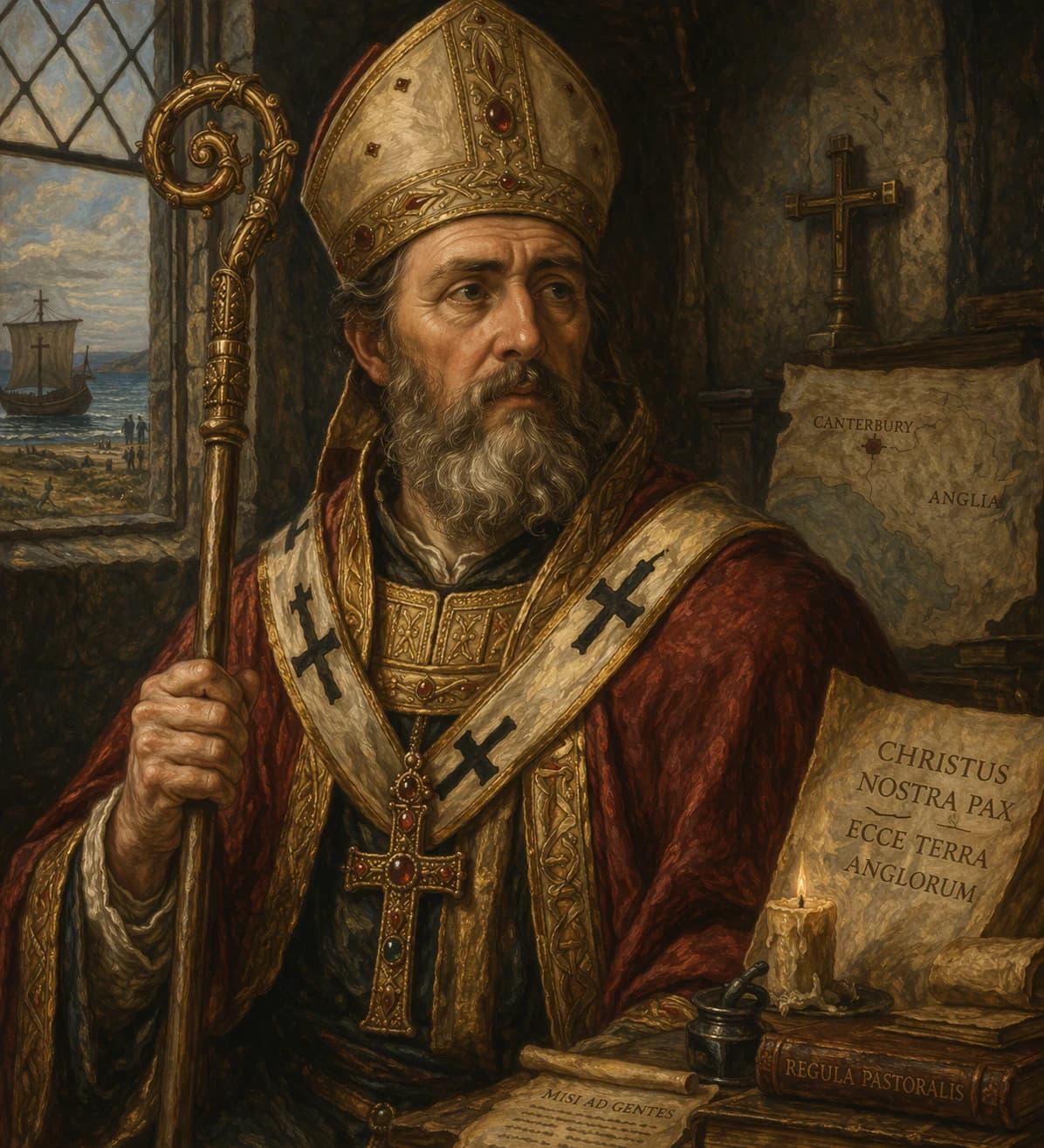
AI-generated portrait of Augustine of Canterbury in episcopal robes
AI-assisted historical reconstruction

An illustrative reconstruction based on historical context. It is not a photograph or documentary likeness. Image policy

Quick answer

Augustine of Canterbury was the Roman monk sent by Pope Gregory I in 597 to convert Anglo-Saxon England, becoming the first Archbishop of Canterbury.

Born
534 CE
Died
604 CE
Role
Benedictine monk sent by Pope Gregory I
Years
534-604 CE
Facts

Augustine of Canterbury timeline facts

Selected specifics from this profile's life story.

c. 534
Monastic beginnings

Augustine was born in Italy and entered monastic life early, shaping his discipline, beliefs, and readiness for future religious leadership.

596–597
Journey to Britain

Augustine and his companions traveled across Europe to reach Britain, facing uncertainty and hesitation along the way.

Late 590s
Expanding influence

He worked to spread Christianity beyond Kent, facing resistance and negotiating with existing Christian communities in Britain.

604 and beyond
Enduring legacy

After his death, Augustine’s foundations shaped the development of the English Church and its connection to wider European Christianity.

Life Journey

From quiet monk to architect of a new church

Follow the story in a more continuous narrative, with a reading mode that matches how much depth you want.

Complete chronology

c. 534

Monastic beginnings

Almost nothing certain is known about Augustine's childhood, including the exact year of his birth. What can be said is that he belonged to the Roman monastic world before he belonged to English history. He was a monk of the monastery of St Andrew on the Caelian Hill in Rome, a community associated with Gregory, who became Pope Gregory I. Monastic life trained Augustine in obedience, liturgy, scripture, hierarchy, and endurance. That background mattered because the mission to Britain was not a heroic solo adventure but an institutional project. Augustine had to carry Roman Christianity across language, sea, custom, and political uncertainty. His later importance came less from personal charisma than from disciplined reliability. He was a man formed by community, sent to build another one.

580s

Service in Rome

By the time Gregory chose him for Britain, Augustine was prior of the Roman monastery, a position requiring more than private holiness. A prior had to maintain discipline, manage people, preserve routines, and guide a community through ordinary frictions without losing spiritual purpose. Gregory valued that kind of tested steadiness. The late sixth-century papacy was not merely a religious office; it was a diplomatic, administrative, and pastoral institution trying to hold Christian life together after the collapse of imperial rule in the West. Augustine's service in Rome placed him inside that wider vision. He was not selected because he was already famous across Europe. He was selected because Gregory trusted him to obey instructions, lead companions, report back, and adapt without losing connection to Rome.

595

Chosen for mission

Gregory's decision to send a mission to the Anglo-Saxons around 596 was bold but not blind. Christianity already existed in parts of Britain, especially among Brittonic communities, but the Anglo-Saxon kingdoms that had emerged after Roman rule were largely outside Roman ecclesiastical structures. Kent offered the best opening. King Aethelberht was powerful, connected to continental politics, and married to Bertha, a Frankish Christian princess who already had a bishop and chapel. Augustine's task was therefore both spiritual and diplomatic: preach the Christian faith, win royal permission, establish a church, and reconnect part of Britain to the Roman Christian world. The mission changed his life completely. A monk who might have remained within Rome's walls became the leader of a dangerous journey to a kingdom at the edge of Latin Christendom.

596–597

Journey to Britain

The mission nearly failed before reaching Britain. Augustine and his companions became frightened by reports of the people and conditions ahead, and Augustine returned to Gregory seeking release from the assignment. Gregory refused to abandon the project. He encouraged the monks, wrote letters of support to Frankish rulers and bishops, and sent Augustine back toward the Channel. This hesitation is important because it makes Augustine more human and the mission more credible. The men sent to convert England were not fearless legends moving smoothly across a map. They were monks facing unknown languages, weather, sea-crossing, political risk, and the possibility of rejection or death. Their eventual arrival in Kent in 597 was therefore an act of obedience sustained after fear, not the effortless progress of certainty.

597

Meeting the king

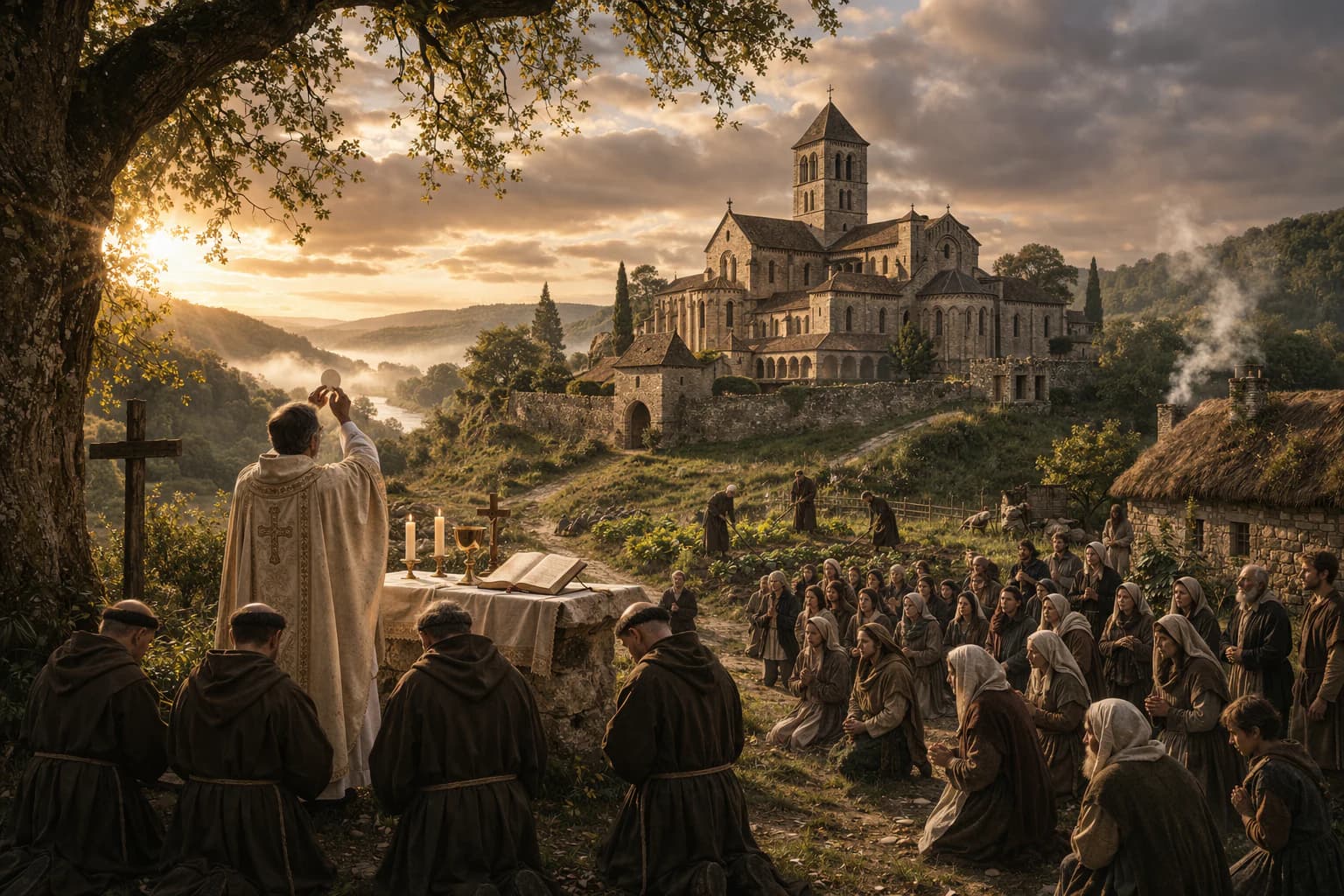
Augustine's first great advantage was Aethelberht of Kent. The king did not immediately surrender his kingdom to Roman instruction, but he allowed the missionaries to settle and preach, probably at Canterbury. Bertha's existing Christianity helped make the court more receptive, and Kent's links with the Frankish world meant the mission did not arrive in total isolation. Augustine and his companions processed with a cross and an image of Christ, using ritual as well as speech to announce their message. Aethelberht's eventual conversion gave the mission protection, resources, and prestige. This does not mean the people of Kent converted overnight from pure conviction. In early medieval kingdoms, royal patronage mattered enormously. Christianity advanced through preaching, but also through courts, marriages, law, buildings, and the political advantages of joining a wider Christian network.

597

First archbishop

Augustine was consecrated bishop and became the first Archbishop of Canterbury, giving the mission institutional shape. Canterbury became the Roman mission's base, and Augustine began establishing churches, organizing clergy, and asking Gregory practical questions about marriage law, bishops, liturgy, pagan temples, and discipline. Gregory's replies, preserved by Bede, show a striking missionary flexibility: temples could be purified and reused, customs could be adapted where they did not violate Christian teaching, and conversion should be guided rather than simply imposed. Augustine's work therefore involved translation in the broadest sense. He had to make Roman Christianity intelligible in an Anglo-Saxon royal world without severing it from Rome. The archbishopric mattered because it gave English Christianity a durable center, not merely a successful opening moment.

Late 590s

Expanding influence

Augustine's authority did not extend smoothly across Britain. Beyond Kent lay other Anglo-Saxon kingdoms with their own rulers, gods, alliances, and suspicions. There were also existing Brittonic Christian communities whose traditions differed from Roman practice, especially over issues such as the dating of Easter and ecclesiastical authority. Augustine's meetings with British bishops did not produce the unity Gregory hoped for. Later accounts are shaped by Northumbrian and Roman perspectives, so they should be read carefully, but the basic difficulty is clear: Augustine was not converting an empty island. He entered a religious landscape already marked by older Christian communities, pagan Anglo-Saxon power, and political division. His mission succeeded in founding a Roman base in Kent, but the wider Christianization of England took generations and involved many figures beyond him.

Early 600s

Final years

In his final years, Augustine's most important work was consolidation. He could not complete the conversion of all Anglo-Saxon England, but he could make sure the Kentish church survived him. He consecrated successors and helped establish a structure that linked Canterbury to Rome and to the developing Christian kingdoms of Europe. Churches associated with the mission, including the foundations that became Canterbury Cathedral and the monastery later known as St Augustine's Abbey, gave the new faith physical permanence. This mattered because early conversion was fragile. A king's death, a political reversal, or a hostile successor could undo years of work. Augustine's task was to make Christianity more than a court fashion. By the time he died, it had roots, clergy, buildings, and a memory of Roman authority behind it.

604 and beyond

Enduring legacy

Augustine died in 604, leaving a mission that was still small but historically decisive. He did not convert all England, and he did not create English Christianity alone. Irish, Brittonic, Frankish, Roman, and later Anglo-Saxon missionaries all shaped the story. His significance lies in founding the Canterbury line and giving the Roman church a permanent institutional foothold in Anglo-Saxon England. From that base grew one of the central offices in English religious history. Augustine's legacy also reveals how conversion actually worked: not as a single dramatic moment, but as a long process of royal patronage, teaching, adaptation, conflict, memory, and organization. To ask why Augustine of Canterbury was important is to ask how England became connected to Latin Christendom. His answer was not conquest, but a mission that turned a Kentish opening into an enduring church.

Continue in context

Connected stories

Move from the profile into the wider events and settings this figure belongs to.

Tertiary paths

Content note

This profile is written for educational use and connects to related Stories of History pages. The main portrait is an AI-assisted historical reconstruction, included as an illustrative aid rather than documentary evidence. Image policy

References

Sources & Further Reading

Reliable reference works, archives and reading paths connected to this profile.

Further reading

  1. Encyclopaedia Britannica, Search results for Augustine of Canterbury,” accessed June 2026.Open source
  2. WorldCat, Books and library holdings for Augustine of Canterbury,” accessed June 2026.Open source

Primary sources

  1. Library of Congress, Search results for Augustine of Canterbury,” accessed June 2026.Open source

Reviewed claim sources

Loading reviewed claim sources...

A weekly route through history

Find out first about the latest published stories, feature notes and occasional Premium offers in one weekly email.