Complete chronology
Full overview and deeper context for every journey step.
1809
Frontier childhood
Abraham Lincoln's biography began far from the world of national office. He was born on 12 February 1809 in Hardin County, Kentucky, to Thomas and Nancy Hanks Lincoln, a farming family with little security and few possessions. His childhood moved through Kentucky, Indiana, and Illinois as the family searched for workable land and a more stable future. Frontier life meant clearing fields, splitting rails, hauling goods, and learning early that survival depended on effort as much as hope. Formal schooling was brief, but Lincoln became a determined reader, borrowing books, copying passages, and teaching himself through repetition. The death of his mother in 1818, when he was nine, added private grief to an already hard upbringing. These years mattered because they gave Lincoln more than a humble origin story. They formed the voice, patience, humor, and sympathy for ordinary labor that later made him intelligible to voters who distrusted polish and inherited privilege.
Hardship in early life can foster both empathy and determination that shape future leadership.
1820s
Self-taught mind
Lincoln's self-education was not romantic accident but daily labor. He read the Bible, Shakespeare, poetry, grammar, legal manuals, newspapers, and political speeches, then tested what he learned in conversation and debate. After moving to New Salem, Illinois, he worked as a store clerk, postmaster, surveyor, and militia captain during the Black Hawk War. These jobs put him in direct contact with farmers, merchants, veterans, debtors, and ambitious young men trying to make a place in a changing country. Law became his route upward. He studied independently, entered the Illinois bar, and built a practice that required close reasoning, clear language, and the ability to persuade juries without sounding remote. This mattered enormously. Lincoln's later speeches worked because they combined moral seriousness with plain explanation. He could reduce a constitutional crisis to a question ordinary citizens could understand without making the issue small.
A disciplined curiosity can compensate for limited formal opportunity.
1830s
Entering politics
Lincoln first entered politics through the Illinois state legislature, where he aligned with the Whig Party and supported banks, canals, railroads, internal improvements, and a more active economic role for government. He was not yet the national liberator of later memory. He was a young politician learning how bills moved, how coalitions formed, and how public trust was earned over time. His single term in the U.S. House of Representatives from 1847 to 1849 gave him a sharper national profile, especially through his criticism of President James K. Polk's handling of the Mexican-American War. That position was politically risky and not universally popular at home. The episode shows a Lincoln often flattened by legend: ambitious, partisan, cautious, principled, and willing to challenge executive power when he believed the facts demanded it.
Reputation built on consistency often carries more weight than sudden prominence.
1858
National attention
The crisis over slavery's expansion pulled Lincoln back toward the center of public life. The Kansas-Nebraska Act of 1854, which opened western territories to possible slavery through popular sovereignty, convinced him that a dangerous line had been crossed. In 1858 he challenged Stephen A. Douglas for the U.S. Senate and met him in a series of debates across Illinois. Lincoln did not argue for immediate racial equality in the way modern readers might wish; he remained a man of his century. But he insisted that slavery was morally wrong, that the founders had placed it on a path toward ultimate extinction, and that the nation could not permanently endure half slave and half free. Douglas won the Senate seat, but Lincoln won national attention. The debates made clear why he mattered: he could connect constitutional structure, moral language, and political strategy without losing the thread.
Influence can grow even in apparent defeat when ideas resonate widely.
1860
Presidential victory
Lincoln's election in 1860 transformed a political crisis into a constitutional rupture. He won as the candidate of the new Republican Party, which opposed the spread of slavery into the territories but did not campaign on immediate abolition where slavery already existed. To white southern leaders, even that restriction threatened the future of their slaveholding order. South Carolina seceded in December 1860, followed by other Deep South states before Lincoln even took office. His first inaugural address tried to calm the crisis without conceding the central point: secession was unlawful, and the Union was perpetual. Lincoln inherited a government losing forts, officers, revenue, and legitimacy across the South. His presidency began not with a normal transfer of power but with the question of whether the United States could survive an election its losers refused to accept.
Leadership is often tested most severely at the moment it begins.
1861
Civil War begins
The firing on Fort Sumter in April 1861 forced Lincoln into decisions no American president had faced at such scale. He called for troops, expanded the army and navy, authorized emergency measures, and worked to prevent the slaveholding border states from joining the Confederacy. His early war leadership was uneven because the war itself was unlike anything the country had known. Generals hesitated, armies were improvised, and northern opinion ranged from abolitionist impatience to deep racism and war-weariness. Lincoln learned in public. He replaced commanders, pressed for movement, absorbed military maps and reports, and slowly clarified the Union's strategic advantage: manpower, industry, railroads, naval power, and the ability to make slavery itself a target of war. His greatness lay partly in growth. He became a stronger commander in chief because he was willing to learn what events were teaching.
Adaptability becomes essential when circumstances change faster than plans.
1863
Redefining the war
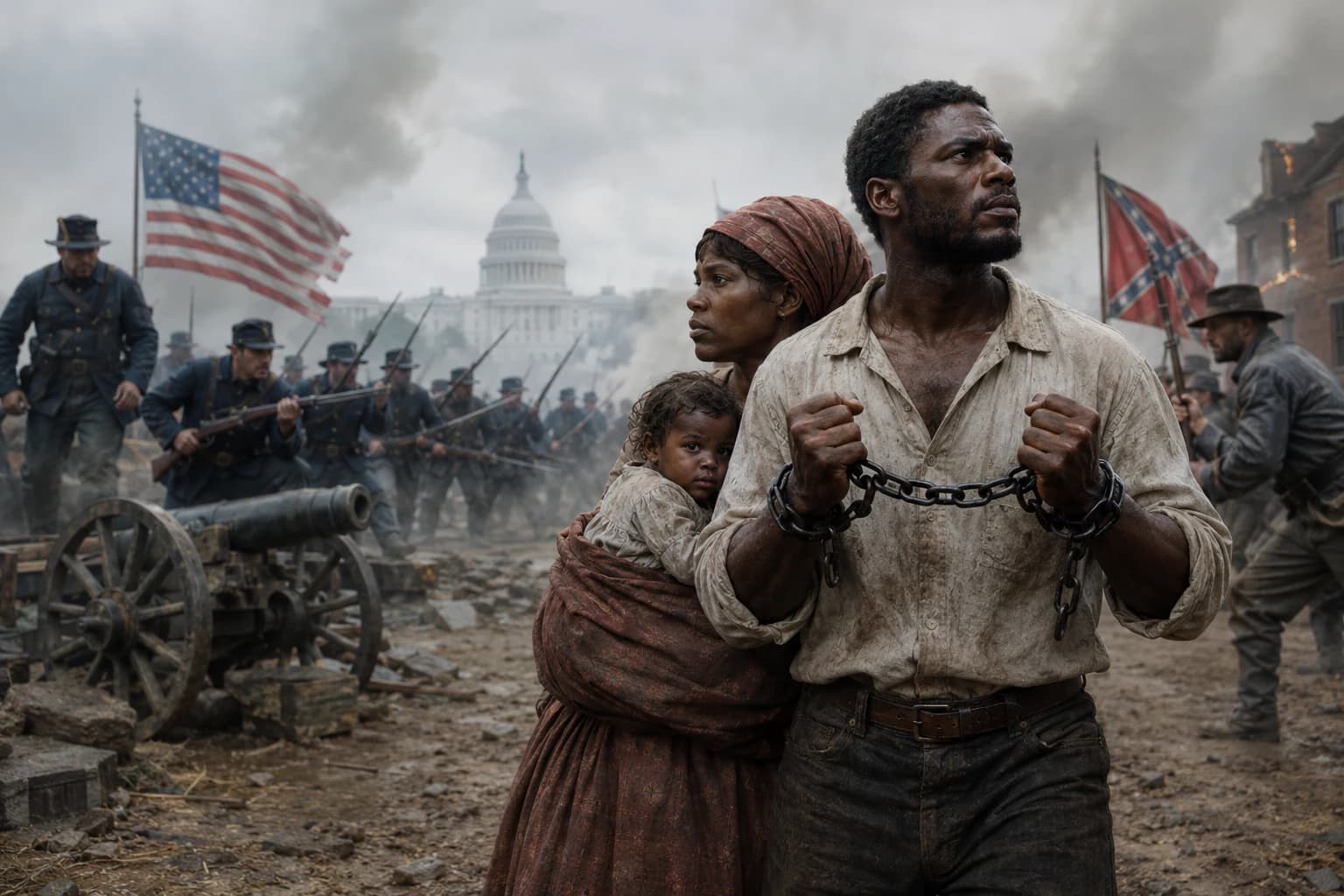
Lincoln's road to emancipation was strategic, constitutional, and moral all at once. He had long opposed slavery, but as president he initially framed the war around preserving the Union. Enslaved people, abolitionists, Radical Republicans, military necessity, and Confederate dependence on slave labor changed the situation. After the Union victory at Antietam gave him the moment he needed, Lincoln issued the preliminary Emancipation Proclamation and then the final order on 1 January 1863. It did not free every enslaved person immediately; it applied to areas in rebellion, not loyal slave states. But its significance was immense. It redefined the war, undermined the Confederate labor system, discouraged European recognition of the Confederacy, and allowed Black men to enlist in the Union Army. Lincoln then backed the Thirteenth Amendment, understanding that proclamation alone could be vulnerable after the war. The shift from containment to abolition became the central turning point of his presidency.
A single decision can transform the purpose of an entire conflict.
1865
Union preserved
The final months of the Civil War revealed Lincoln at his most politically powerful and most exposed. Union armies under Ulysses S. Grant, William Tecumseh Sherman, and others had broken Confederate capacity to continue the war. Lincoln won reelection in 1864, a result that confirmed northern commitment despite staggering casualties. In his Second Inaugural Address, he refused triumphalism. Instead, he described the war as a judgment on slavery and called for a peace made with 'malice toward none' and 'charity for all.' That language did not mean he had solved Reconstruction. He had begun to think beyond reunion toward the status of formerly enslaved people, including limited Black suffrage for some men, especially soldiers and the educated. His final public speech on 11 April 1865 gestured in that direction. The war had preserved the Union, but Lincoln understood that victory without a new birth of freedom would leave the deepest cause of the conflict alive in another form.
Victory can resolve one crisis while revealing many others beneath it.
1865 and beyond
End and remembrance
Lincoln was shot at Ford's Theatre in Washington, D.C., on 14 April 1865 and died the next morning, only days after Robert E. Lee's surrender at Appomattox. John Wilkes Booth, a Confederate sympathizer and actor, killed him as part of a broader conspiracy against Union leadership. The assassination turned Lincoln instantly into a martyr, but it also changed the political future of the country. Reconstruction passed to Andrew Johnson, whose conflicts with Congress and leniency toward former Confederates helped shape a turbulent and incomplete settlement. Lincoln's legacy has never been simple. He preserved the Union by using immense federal power, moved from antislavery restriction to emancipation, and spoke about democracy in language that later generations repeatedly claimed for their own struggles. To ask why Abraham Lincoln was important is to ask what the United States became after its greatest internal crisis. His answer was unfinished, but the standard he set remains one of the central measures of American political life.
The impact of leadership often becomes clearest only after it is gone.