Complete chronology
Full overview and deeper context for every journey step.
1822
Ohio beginnings
Grant was born Hiram Ulysses Grant in Point Pleasant, Ohio, and raised in Georgetown, where his father Jesse worked as a tanner. He disliked the tannery but had an exceptional feel for horses, a skill that later mattered in army life. His upbringing was modest, disciplined and unsentimental. Grant did not look like a man destined to command armies. He was quiet, sometimes awkward, and more comfortable with practical tasks than self-promotion. That lack of theatricality became central to his strength. In war, he would not waste energy performing command; he would simply keep moving toward the objective.
A restrained and ordinary upbringing gave him the steady mindset that later proved crucial in moments of national crisis.
1839–1843
West Point training
Grant did not seek West Point out of romantic military ambition; his father helped secure the appointment. At the academy, he ranked in the middle of his class and became known especially for horsemanship. The institution gave him mathematics, engineering, discipline and a network of officers who would later appear on both sides of the Civil War. It also gave him a name. Registered mistakenly as Ulysses S. Grant, he accepted the identity history handed him. West Point did not reveal genius, but it prepared a mind that valued clarity, movement, supply and the practical mechanics of command.
Even without early ambition, structured training prepared him for responsibilities he had not yet imagined.
1846–1848
Mexican War experience
The Mexican-American War gave Grant his first serious education in battle. He served bravely, but he also watched how campaigns actually worked: roads, wagons, rivers, timing, morale and the difference between bold command and reckless display. He admired Zachary Taylor's plain steadiness and Winfield Scott's operational skill. He also came to regard the war itself as unjust, a conquest that expanded slaveholding interests. That moral discomfort did not erase the military lessons. When civil war came, Grant understood that victory required coordinated movement and sustained pressure, not simply gallant battlefield moments.
Exposure to real conflict taught him that success in war depends as much on organization as on courage.
1854–1861
Struggles in civilian life
Grant's prewar civilian life was painfully difficult. Isolated army postings had separated him from his wife Julia, and in 1854 he resigned under a cloud, with drinking accusations part of the story. Civilian work brought little relief. He farmed near St Louis, sold firewood, tried real estate and finally worked in his family's leather goods store in Galena, Illinois. These years are often described as failure, and in worldly terms they were. Yet they also stripped Grant of vanity. He knew debt, humiliation and dependence. When war returned him to uniform, he brought neither glamour nor entitlement, but a rare steadiness under pressure.
Failure in peacetime quietly prepared him to handle responsibility when circumstances suddenly changed.
1861
Return to service
Grant began modestly, helping organise Illinois volunteers before receiving command. He quickly distinguished himself by acting. At Belmont, Fort Henry and Fort Donelson, he showed a willingness to move against the enemy rather than wait for perfect conditions. His demand for 'unconditional and immediate surrender' at Donelson made him famous and gave the Union a badly needed victory. Grant's style was not reckless simplicity. He understood rivers, railroads, morale and momentum. He also understood that the Confederacy could not be defeated by occupying ground alone; its armies had to be broken.
Opportunity arrived in crisis, and his readiness to act distinguished him from more hesitant peers.
1862–1863
Major victories
Grant's rise was not smooth. The bloody surprise at Shiloh in 1862 nearly ruined him politically, but Abraham Lincoln refused to discard a general who fought. Grant then produced one of the war's great campaigns at Vicksburg, using manoeuvre, river power and siege operations to split the Confederacy along the Mississippi. Later, at Chattanooga, he broke a dangerous Confederate grip in Tennessee. These victories revealed his strategic gift: he could see separate theatres as parts of one war. He was persistent, but not mindless. He adapted, absorbed losses and kept the enemy under pressure until options disappeared.
Relentless pressure, rather than dramatic maneuver, became his defining path to success.
1864–1865
Command of all armies
Grant's 1864 strategy was national in scale. William Tecumseh Sherman would drive into Georgia; Philip Sheridan would strike in the Shenandoah; other forces would pin Confederate armies elsewhere; Grant himself would stay with the Army of the Potomac against Lee. The Overland Campaign was horrific, with vast casualties at the Wilderness, Spotsylvania and Cold Harbor. Critics called Grant a butcher, but the label misses the strategic reality: unlike previous Union commanders, he did not retreat after bloody contact. He manoeuvred south, trapped Lee at Petersburg and forced the final surrender at Appomattox in April 1865. Grant made Union superiority decisive.
Unified strategy turned scattered efforts into a decisive and irreversible outcome.
1869–1877
Presidency challenges
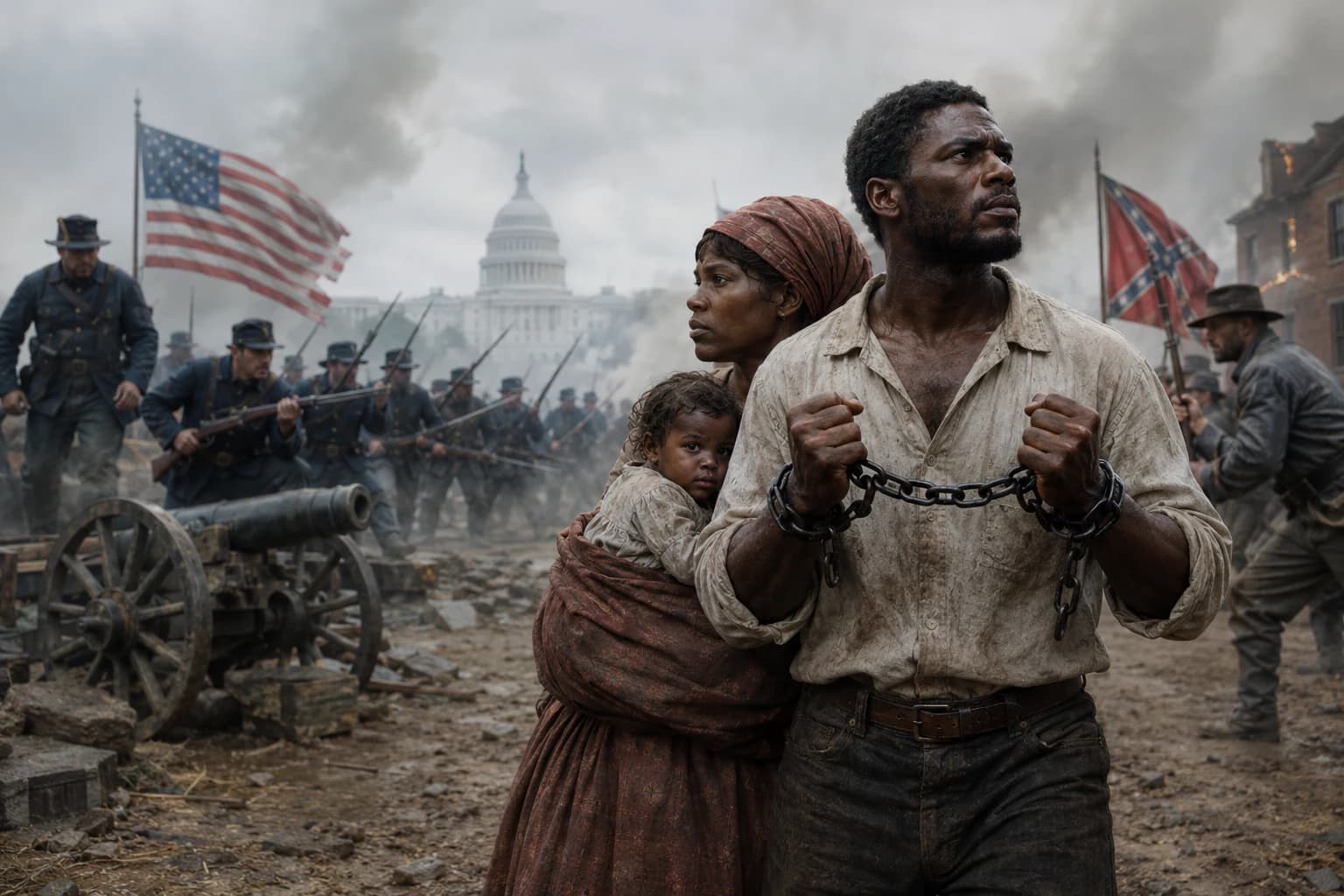
Grant's presidency has been reassessed sharply. For generations it was remembered mainly for corruption scandals involving men around him, and those scandals were real. But Grant also used federal power to enforce Reconstruction more seriously than many contemporaries. His administration supported the Fifteenth Amendment, created the Justice Department, used Enforcement Acts against the Ku Klux Klan and defended Black voting rights in the former Confederacy. He also pursued a flawed but significant Peace Policy toward Native nations, while western expansion continued to bring dispossession and war. Grant was not always politically skilful, but he understood that Appomattox meant little if white terror could undo emancipation.
Leadership in peace demanded different skills, revealing both his strengths and his limitations.
1877–1885
Final years and legacy
Grant left office popular but not untouched by disappointment. A world tour restored some prestige, but a fraudulent investment partnership later ruined him financially. Diagnosed with throat cancer, he raced to finish his Personal Memoirs so Julia would have income after his death. Published by Mark Twain's firm, the memoirs became a masterpiece of clear military prose: direct, unsentimental and strategically perceptive. Grant died at Mount McGregor in 1885. His legacy is now larger than the old caricature of failed president and blunt general. He preserved the Union, helped destroy slavery's armed defence and tried, imperfectly but seriously, to protect Reconstruction's promise.
By telling his own story, he shaped how history would remember both his victories and his struggles.