Complete chronology
Full overview and deeper context for every journey step.
1818
Birth in bondage
Frederick Douglass was born Frederick Augustus Washington Bailey on Maryland's Eastern Shore, probably in February 1818, though the exact day was denied to him by slavery's record-keeping. Separated early from his mother, Harriet Bailey, and uncertain of his father's identity, he grew up inside a system designed to break family memory and personal claim. Childhood for an enslaved boy was not a protected stage of life. It meant hunger, surveillance, forced labor and the constant knowledge that law recognized him as property. Douglass later made that erasure central to his argument against slavery. The system did not merely exploit labor; it attacked names, kinship, time and selfhood.
His earliest years reveal how systems of control begin by denying identity and family connection.
1820s
Learning to read
Douglass's move to Baltimore changed his life because it brought him into contact with literacy. Sophia Auld began teaching him the alphabet, but her husband stopped the lessons, explaining with brutal clarity that reading would make an enslaved person unfit for bondage. Douglass understood the lesson better than the master intended. Literacy was dangerous because it created inward independence. He learned secretly, exchanging bread with white boys for help, studying newspapers, shipyard marks and political speeches. Reading did not comfort him at first. It made slavery more hateful because he could now name its contradictions. But it also gave him the tools that would become his weapons: language, memory, argument and the ability to answer a nation in its own vocabulary of liberty.
Education became both his burden and his liberation, sharpening his awareness while guiding his escape.
1830s
Defiance and resistance
As a teenager Douglass was sent to Edward Covey, a man with a reputation for breaking resistant enslaved people. Covey's violence, surveillance and calculated humiliation pushed Douglass close to despair. The turning point came when Douglass fought him in a long physical struggle and refused to be subdued. The encounter did not legally free him, and it should not be romanticized as simple triumph. He remained enslaved and vulnerable. But in Douglass's own understanding, it restored something essential: the conviction that he was not inwardly defeated. That mattered because slavery depended on psychological domination as well as physical force. Resistance became the foundation of his later public voice.
A single act of resistance can transform how a person understands their own power.
1838
Escape to freedom
In September 1838 Douglass escaped from slavery by train and steamboat, using borrowed protection papers and the clothing of a sailor to move through a world built to detect fugitives. The journey from Baltimore to the free states required nerve, timing and luck. Soon after reaching New York, he married Anna Murray, a free Black woman whose support had helped make the escape possible, and the couple settled in New Bedford, Massachusetts. There he took the surname Douglass. Freedom, however, was not safety. Slave catchers and federal law still threatened him, and racism in the North limited work and belonging. His new life began with joy, but also with the knowledge that freedom had to be defended publicly.
Freedom was not a single moment but the start of a lifelong effort to secure and defend it.
1840s
Finding his voice
Douglass first spoke in abolitionist circles in Massachusetts, where audiences quickly recognized that he was not simply a witness but a formidable interpreter of American hypocrisy. He could describe the lash, the auction block and family separation with personal authority, then widen the argument to the Declaration of Independence, Christianity, law and natural rights. White abolitionists sometimes tried to keep formerly enslaved speakers within the role of testimony, but Douglass would not remain a symbol managed by others. His intelligence, irony and command of the platform made him one of the most important public speakers of the nineteenth century. He turned biography into political force without allowing suffering to be consumed as spectacle.
Personal testimony can carry a force that abstract argument alone cannot achieve.
1845
Publishing his story
The 1845 Narrative of the Life of Frederick Douglass, an American Slave made his story impossible to dismiss as abolitionist invention. He named people, places and methods, giving readers a map of slavery's ordinary operations. The book was brief, controlled and devastating. It sold widely, strengthened the abolitionist movement and placed Douglass in danger because he was still legally vulnerable to recapture. His travels in Britain and Ireland gave him international audiences and exposed him to forms of public respect rarely granted to Black Americans at home. Supporters there helped purchase his legal freedom. Douglass later revised and expanded his life story, but the first Narrative remains one of the great works of political autobiography.
Writing allowed him to turn his personal history into a lasting public argument.
1850s
Expanding activism
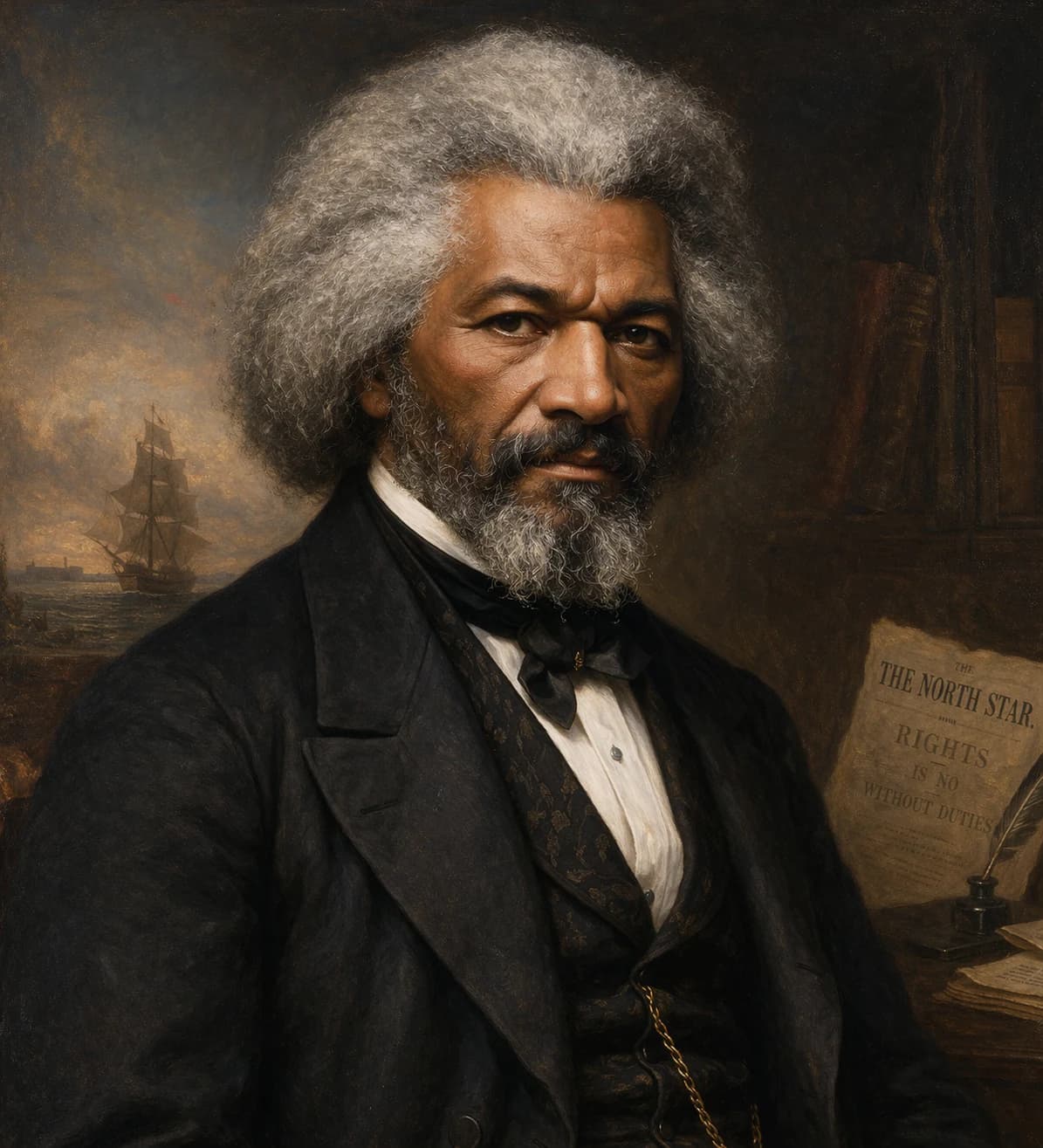
Douglass refused to let abolition be separated from a broader democratic vision. He founded and edited newspapers, including The North Star, insisting that Black voices should control Black advocacy rather than depend permanently on white reformers. He supported women's rights and attended the Seneca Falls Convention in 1848, arguing that the logic of liberty could not be rationed by sex. He also broke with some abolitionist allies over the Constitution, eventually treating it not as an inherently proslavery document but as a weapon that could be used against slavery. These shifts show a thinker in motion, not a statue. Douglass tested strategies against events and kept asking how freedom could become power in law, citizenship and daily life.
He understood that freedom loses meaning if it is not shared across society.
1860s
Civil War era
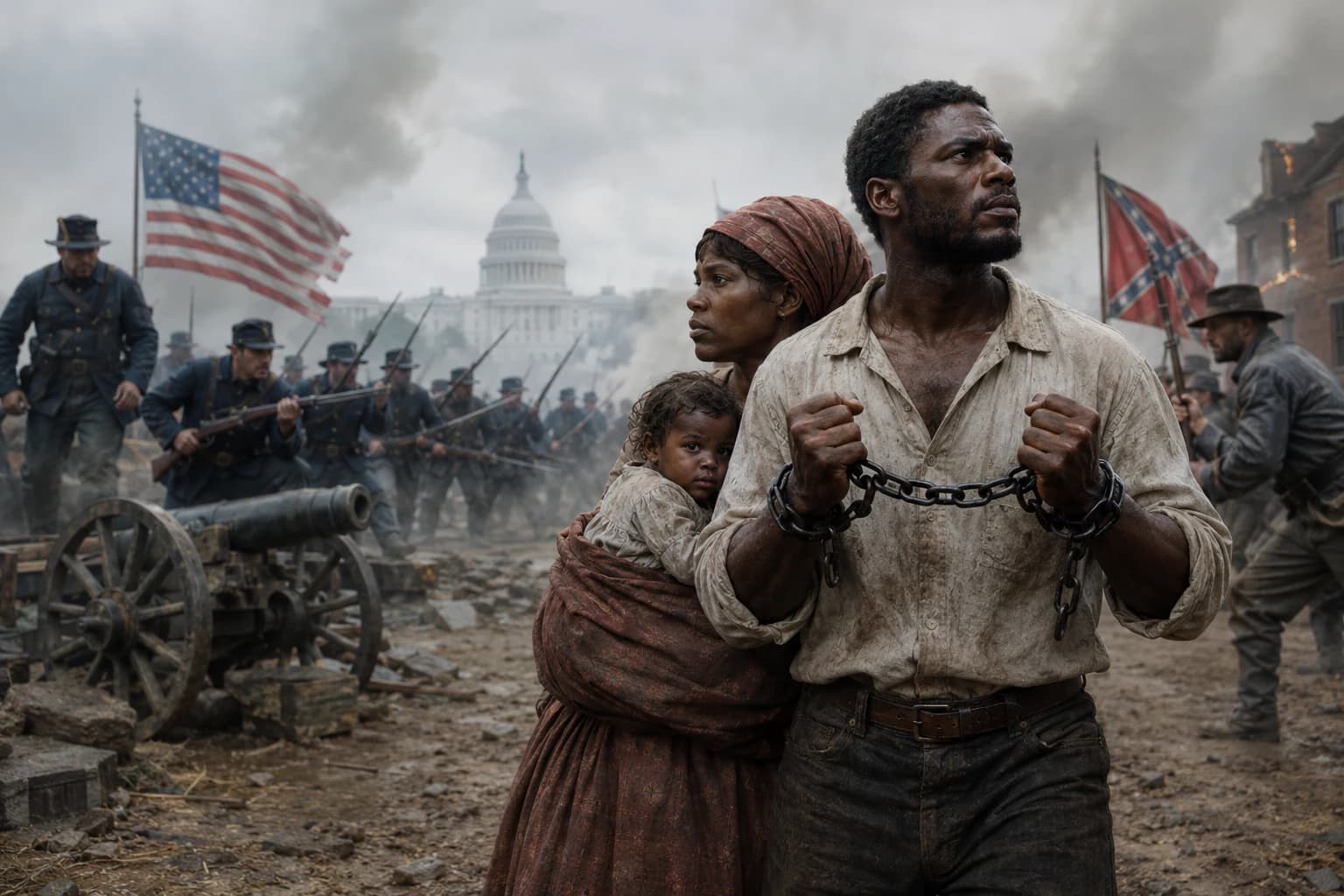
The Civil War gave Douglass the crisis he believed could remake the republic. He pushed Abraham Lincoln and the Union government to treat slavery as the cause and target of the war, not merely as a background issue. After the Emancipation Proclamation, he recruited Black soldiers, including for the 54th Massachusetts Infantry, and argued that military service would make claims to citizenship impossible to deny. His relationship with Lincoln was serious but not uncritical. Douglass pressed him on pay, treatment of Black prisoners and the pace of emancipation. He understood victory as more than Union restoration. If slavery ended but Black Americans remained politically powerless, the old domination would return under new forms.
He recognized that political change must be paired with continued advocacy to have lasting impact.
1895
Enduring legacy
After the Thirteenth Amendment, Douglass did not declare the struggle finished. He campaigned for the Fourteenth and Fifteenth Amendments, denounced racial terror, defended Black voting rights and warned against the retreat from Reconstruction. He held public offices, including U.S. marshal for the District of Columbia, recorder of deeds and minister resident to Haiti, but his greatest office remained moral witness. His later years also reveal tensions: he celebrated constitutional progress while watching white supremacy rebuild itself through violence and law. Douglass died in 1895 after attending a women's rights meeting, still connected to the reform causes that had shaped his life. His legacy rests on a rare combination of lived experience, literary power and political endurance. To ask who Frederick Douglass was is to meet one of democracy's sharpest judges.
His legacy shows that lasting change depends on sustained effort across a lifetime.