Related Moment
When the Vikings Reached North America
The sailors expected another island. They found another continent.
Around the year 1000, Norse explorers crossed the Atlantic to North America, built a short-lived base at L'Anse aux Meadows, and proved what saga memory had preserved.
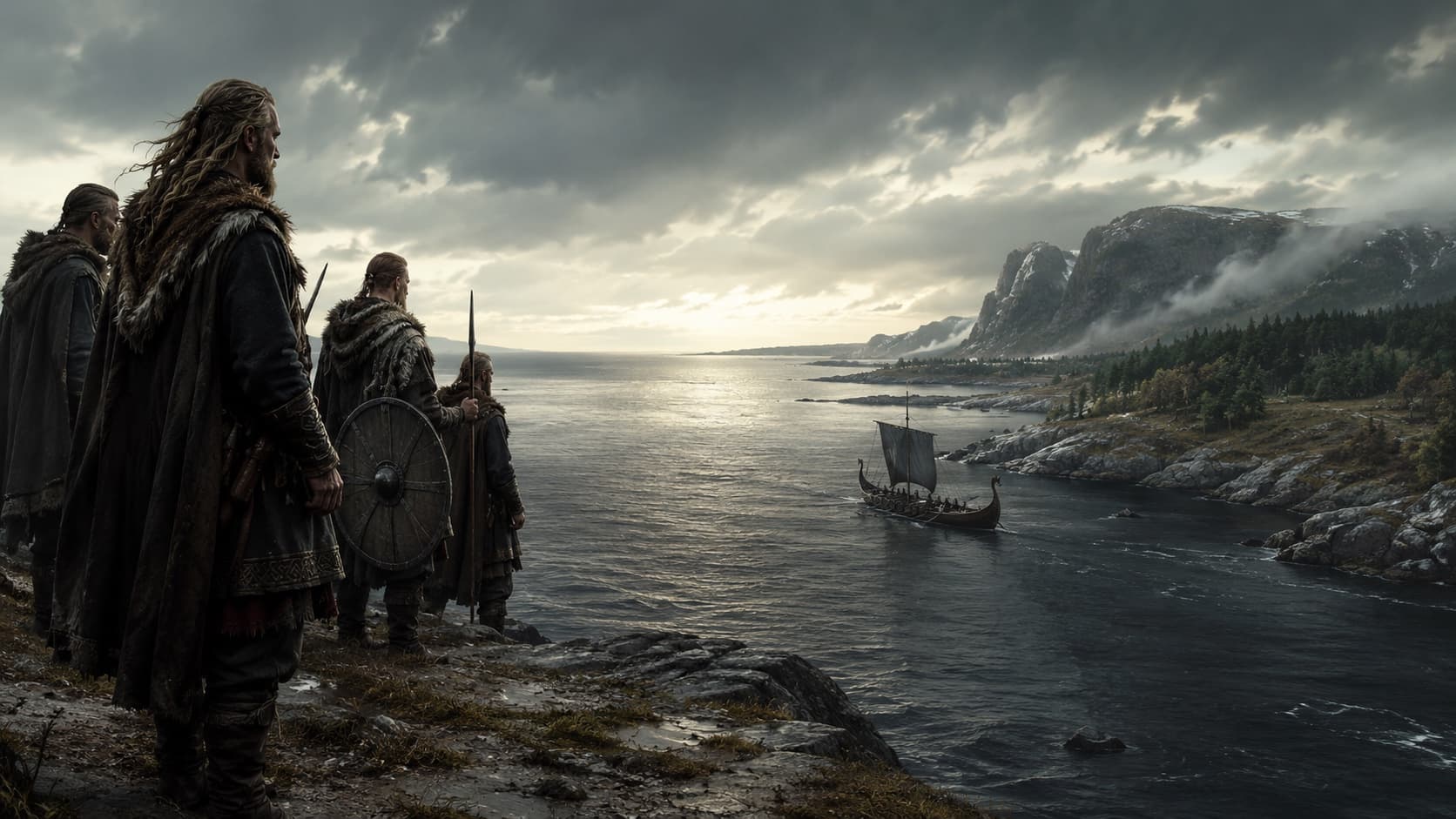
The sailors expected another island.
Instead, they found a coastline that seemed to stretch forever. Dense forests reached the edge of the sea, rivers poured into broad bays, and wild grapes grew farther south than any of them had seen before. After weeks crossing the cold Atlantic, they had reached a world no European had ever described in writing.
For a brief moment around the turn of the eleventh century, Viking explorers stood on the shores of , almost five centuries before Columbus. Their discovery was extraordinary. Their settlement was real. And yet it vanished so completely that the story survived only as legend until archaeology proved it true.
The Viking expansion was one of the great movements of the medieval world. From their Scandinavian homelands, Norse sailors crossed seas that many contemporaries considered impassable. They settled Iceland in the late ninth century and, around a century later, established colonies on after being outlawed from Iceland.
was harsh but habitable. Its fjords offered pasture for livestock, while walrus ivory became a valuable export to Europe. Yet the colony remained isolated, dependent on difficult sea routes and vulnerable to changing climates.
Among Erik's children was Leif Erikson, a navigator remembered in Icelandic sagas as calm, capable, and adventurous. According to these accounts, Leif learned of lands farther west after hearing the story of a merchant named , who had been blown off course and glimpsed unfamiliar shores without landing.
Curiosity, and perhaps opportunity, did the rest. Leif acquired Bjarni's ship and sailed west to investigate.
The sagas describe a sequence of new lands. First came a barren coast of flat stones, later called , likely somewhere on Baffin Island. Farther south lay a wooded region named , probably along the coast of Labrador. Timber alone made this discovery immensely valuable. possessed little forest, forcing settlers to treasure every usable tree.
Then came the most famous destination: .
Its exact meaning remains debated. Some scholars interpret it as Wine Land, inspired by wild grapes reportedly found there. Others suggest it referred to meadows or fertile pastures. Whatever the name originally meant, the place represented abundance unlike anything the Greenlanders knew.
Modern archaeology has transformed what once sounded like myth into established history.
At the northern tip of Newfoundland lies , where excavations beginning in the 1960s uncovered unmistakable evidence of a Norse settlement. Turf buildings matched Icelandic construction techniques. Iron-working debris showed that Viking smiths repaired tools there. Rivets from clinker-built ships, a bronze cloak pin, spindle whorls, and other artifacts confirmed that Scandinavian visitors had crossed the Atlantic around the year 1000.
It remains the earliest confirmed European site in . Yet this was no thriving colony. The settlement appears to have functioned as a seasonal base or expedition camp rather than a permanent town. Crews likely repaired ships, gathered timber, explored surrounding coasts, and prepared for voyages farther south.
The sagas suggest the Norse encountered Indigenous peoples, whom they called Skraelingar. Exactly which communities they met remains uncertain, but the encounters appear to have alternated between cautious trade and violent conflict.
One story tells of exchanging red cloth for animal pelts until fear and misunderstanding escalated into fighting. Another recounts attacks that convinced the Norse their new lands, however rich, would be difficult to hold.
The sagas were written centuries after the events they describe, blending history with literary tradition, so individual episodes cannot be accepted uncritically. Yet they consistently portray the same underlying reality: the Norse were vastly outnumbered.
A few dozen settlers could not dominate an enormous continent already inhabited by diverse Indigenous societies with deep knowledge of the land.
Distance compounded every problem. Every nail, every replacement sail, every additional settler required another Atlantic crossing. itself was only tenuously connected to Europe. Supporting an even more distant outpost demanded resources the Norse world struggled to provide.
The remarkable achievement was not that the colony failed. It was that it existed at all.
Imagine the scale of the journey. Viking ships, open to the elements, navigated using experience, weather, stars, coastlines, birds, and the rhythms of the sea. There were no magnetic compasses in common Norse use, no accurate maps of the Atlantic, and no certainty that land lay beyond the horizon.
Yet they crossed one of the world's greatest oceans repeatedly.
The settlement at was eventually abandoned. Whether the decision came after repeated conflict, disappointing returns, logistical exhaustion, or some combination of all three remains uncertain. Archaeology cannot reveal every reason, and the sagas offer only partial answers.
The colonies continued for centuries, maintaining limited contact with Europe before disappearing during the fifteenth century. Their fate was shaped by environmental change, economic decline, and isolation.
Meanwhile, the memory of survived mainly in Icelandic manuscripts. For generations, many outside Scandinavia dismissed the stories as fanciful tales. Some accepted that Vikings reached but doubted they had gone farther. Others regarded Vinland as symbolic rather than geographic.
Only in the twentieth century did archaeology settle the debate. The discoveries at confirmed that the sagas preserved a genuine historical memory. Although they embellished details and compressed events, they contained the core truth: Norse explorers had reached centuries before later European voyages.
The finding fundamentally changed historians' understanding of medieval exploration.
The Viking arrival in did not trigger permanent European colonization. It reshaped neither Indigenous civilizations nor medieval Europe in the way Columbus's voyages eventually would. Its significance lies elsewhere.
It demonstrated that the Atlantic could be crossed long before the great age of exploration. It revealed the extraordinary maritime capabilities of Norse sailors, whose network stretched from to the Byzantine Empire and the Middle East.
Perhaps most importantly, it reminds us that history is not simply a story of firsts. Reaching a new land is one achievement. Establishing lasting connections is another entirely.
The Norse accomplished the first but not the second. For nearly five hundred years, their voyage remained an isolated chapter, a remarkable expedition that left little lasting footprint beyond a handful of turf walls, scattered iron fragments, and stories preserved in distant Iceland.
Those quiet remains speak loudly today. Around a thousand years ago, Viking ships crossed the Atlantic, landed on North American shores, and briefly linked two continents that would not become permanently connected again for centuries.
Sometimes history's greatest discoveries are not the ones that changed the world immediately. Sometimes they are the ones that proved what humanity was already capable of.
