Related Moment
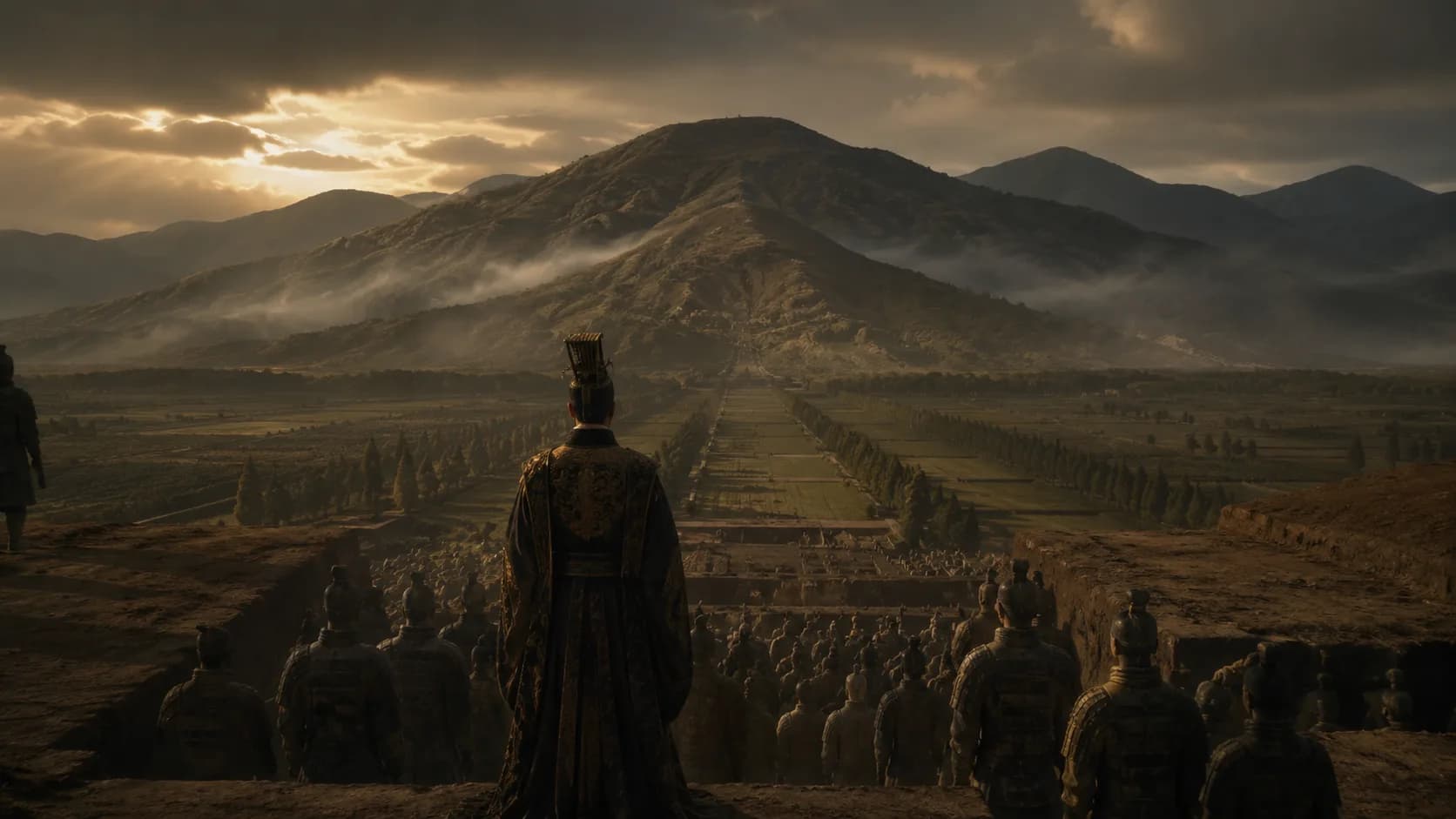
The Mountain That Guards China's Greatest Secret
The tomb is known. The door remains closed.
Beneath a quiet mound near Xi'an, Qin Shi Huang's unopened burial chamber keeps one of archaeology's most tantalising mysteries sealed beneath the earth.
Beneath a quiet hill in central China lies a chamber no archaeologist has entered. Not because they cannot find it, but because they have chosen not to.
For more than two thousand years, of China's first emperor has remained sealed. Ancient writers described rivers of liquid mercury, ceilings that mirrored the stars, deadly traps waiting for intruders, and unimaginable treasures hidden at the heart of an underground empire.
The result is one of history's greatest archaeological mysteries: a royal tomb known to exist, yet still almost completely untouched.
In 221 BCE, Qin Shi Huang achieved what generations of rulers had failed to do. After decades of relentless warfare, he defeated rival kingdoms and united China under a single imperial government. Roads, laws, currency, measures, and even the written script were standardised across the new empire.
But the man who united China was haunted by one fear above all others: death. Historical accounts describe an emperor obsessed with immortality, sending expeditions in search of magical islands and accepting elixirs that may have contained mercury.
If he could not escape death, he would prepare to rule beyond it. Construction of the mausoleum reportedly began soon after he became king of Qin, decades before he took the title of First Emperor.
In 1974, farmers digging a well near struck fragments of fired clay. Their discovery led archaeologists to one of the greatest finds in modern history: thousands of life-sized standing silently beneath the earth.
Each warrior was different. Some carried stern expressions, others youthful faces or neatly trimmed beards. Officers wore elaborate armour. Archers knelt in formation. Horses strained against invisible reins. Bronze weapons lay where they had been placed more than two millennia earlier.
The transformed understanding of Qin Shi Huang's burial complex. These figures were not isolated statues. They were part of a planned military force intended to defend the emperor forever.
Yet the soldiers were only the outer guardians. Roughly a kilometre away rises a tree-covered mound believed to conceal the emperor's actual burial chamber. That has never been opened.
Sima Qian wrote that inside, craftsmen recreated the empire in miniature. Rivers and seas supposedly flowed with liquid mercury, mechanical systems moved through the chamber, stars shone above, and crossbows were set to fire at anyone who broke in.
For centuries, these descriptions sounded like legend. Then modern surveys around the mound detected unusually high concentrations of mercury in the soil. The evidence does not prove that underground mercury rivers still exist, but it aligns strikingly with the ancient account.
Archaeologists also know that opening could destroy what it reveals. When the was first excavated, painted surfaces exposed to air dried, curled, and flaked away within minutes. Sometimes discovering history can also erase it.
Chinese archaeologists have therefore largely chosen patience. Ground-penetrating radar, remote sensing, and other non-invasive techniques continue to map the site while conservation methods improve. The greatest treasure may still be safest where it has rested for twenty-two centuries.
Today, visitors can stand near the and look across a peaceful landscape that gives little hint of the colossal complex beneath. Excavations continue to reveal soldiers, officials, entertainers, bronze chariots, and signs of an entire imperial court prepared for eternity.
The , however, remains untouched. It has become something rare in archaeology: a deliberate absence, preserved not by ignorance but by restraint.
If is ever opened, it will almost certainly rank among the defining archaeological events of the modern era. Until then, the First Emperor's greatest secret remains where he intended it to be: guarded by an army of clay, protected by centuries of caution, and concealed beneath a mountain that still refuses to surrender all of its mysteries.
