Related Moment
The Last Canoe of Tenochtitlan
The war ended on the water.
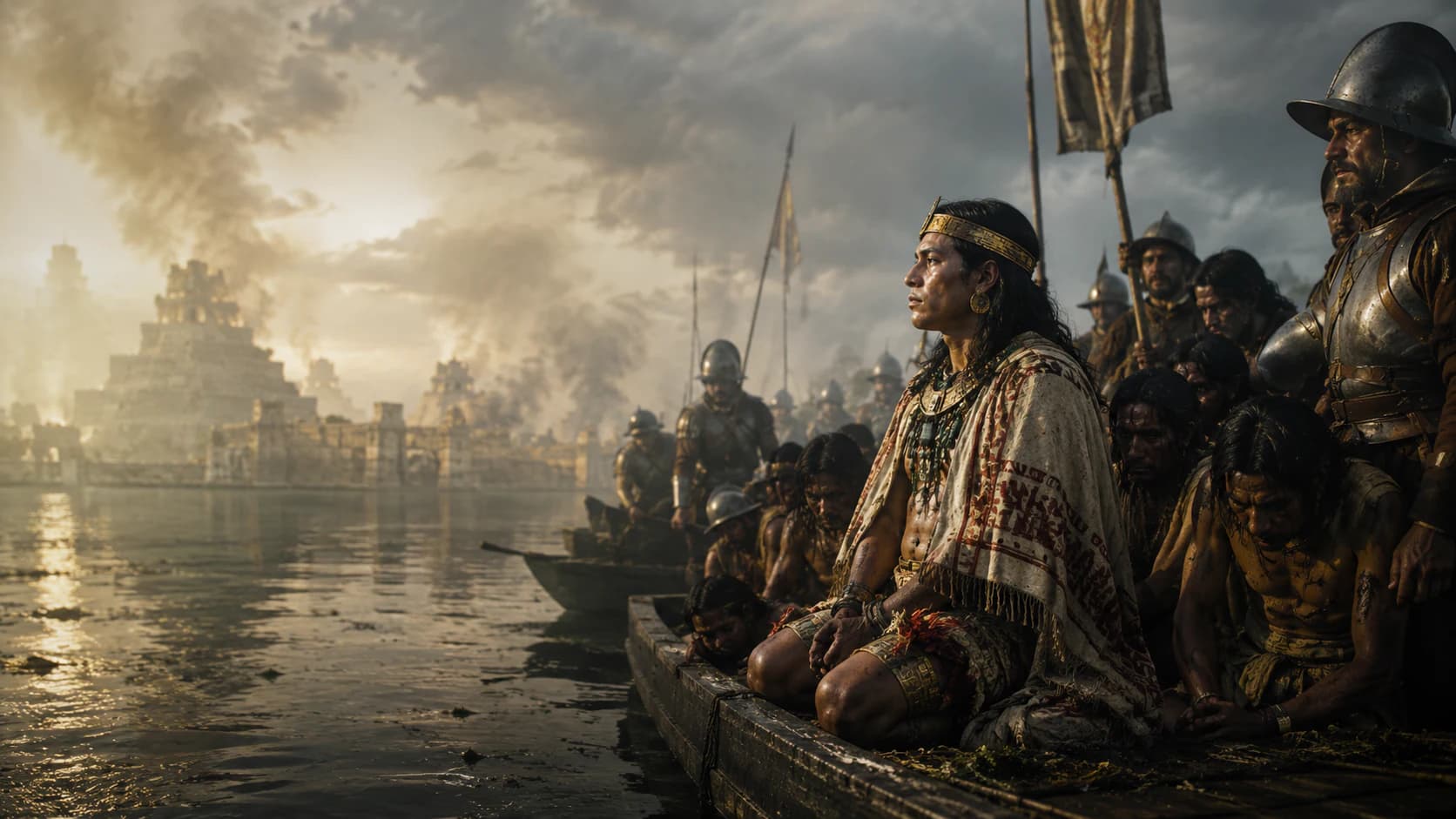
On 13 August 1521, Cuauhtemoc was captured on Lake Texcoco, ending the organised defence of Tenochtitlan.
The war for did not end with a final charge on a pyramid or a treaty beneath painted banners. It ended in a canoe slipping across the broken waters of on 13 August 1521.
Inside it was , the young ruler of and the last defender of a city already dying. For months, the capital had been strangled by siege, disease, hunger, and the control of the lake.
and his Spanish soldiers had returned after their earlier flight from the city, this time with thousands of Indigenous allies, especially Tlaxcalans. Brigantines built in sections and assembled on gave the besiegers control of the water. Causeways were cut. Aqueducts were broken. Food vanished.
Smallpox had already weakened the capital before the siege tightened. inherited not an empire at its height, but a capital under sentence. Still, he fought on.
Street by street and canal by canal, Mexica defenders retreated into the northern district of Tlatelolco. The city that had astonished the Spaniards with markets, temples, gardens, and shining causeways became a ruin of smoke, hunger, bodies, and shattered stone.
By mid-August, organised resistance had narrowed to a last pocket of survival. tried to leave by canoe with nobles and companions, perhaps seeking escape, perhaps hoping to continue resistance elsewhere.
Spanish brigantines intercepted the canoe and took alive. When he was brought before , the symbolism was unmistakable: the man who had held the city together through starvation and destruction now stood as a prisoner before the invader he had resisted.
Later accounts remember asking for death and placing his fate in 's hands. The exact wording is uncertain, preserved through Spanish accounts. The meaning of the moment is clearer: the war for had no more centre.
declared the city taken that same day. was looted, its sacred spaces broken, and its survivors searched, displaced, or absorbed into the new colonial order. was kept alive for a time as a captive symbol of submission. Later, Cortes had him executed during an expedition to Honduras.
The capture did not erase Indigenous resistance in Mexico. It did not end memory, culture, language, or survival. But it ended the organised defence of the and gave the capital, the symbol, and the political foundation for New Spain.
A world did not vanish in one afternoon. But on that canoe, surrounded by enemies on the water, its last sovereign defence came to an end.