Related Moment
The Ice Axe in Coyoacan
The walls held. The betrayal walked through the door.
On 20 August 1940, Leon Trotsky was attacked in his Mexico City study by Ramon Mercader, a Soviet-trained assassin who had gained access through trust.
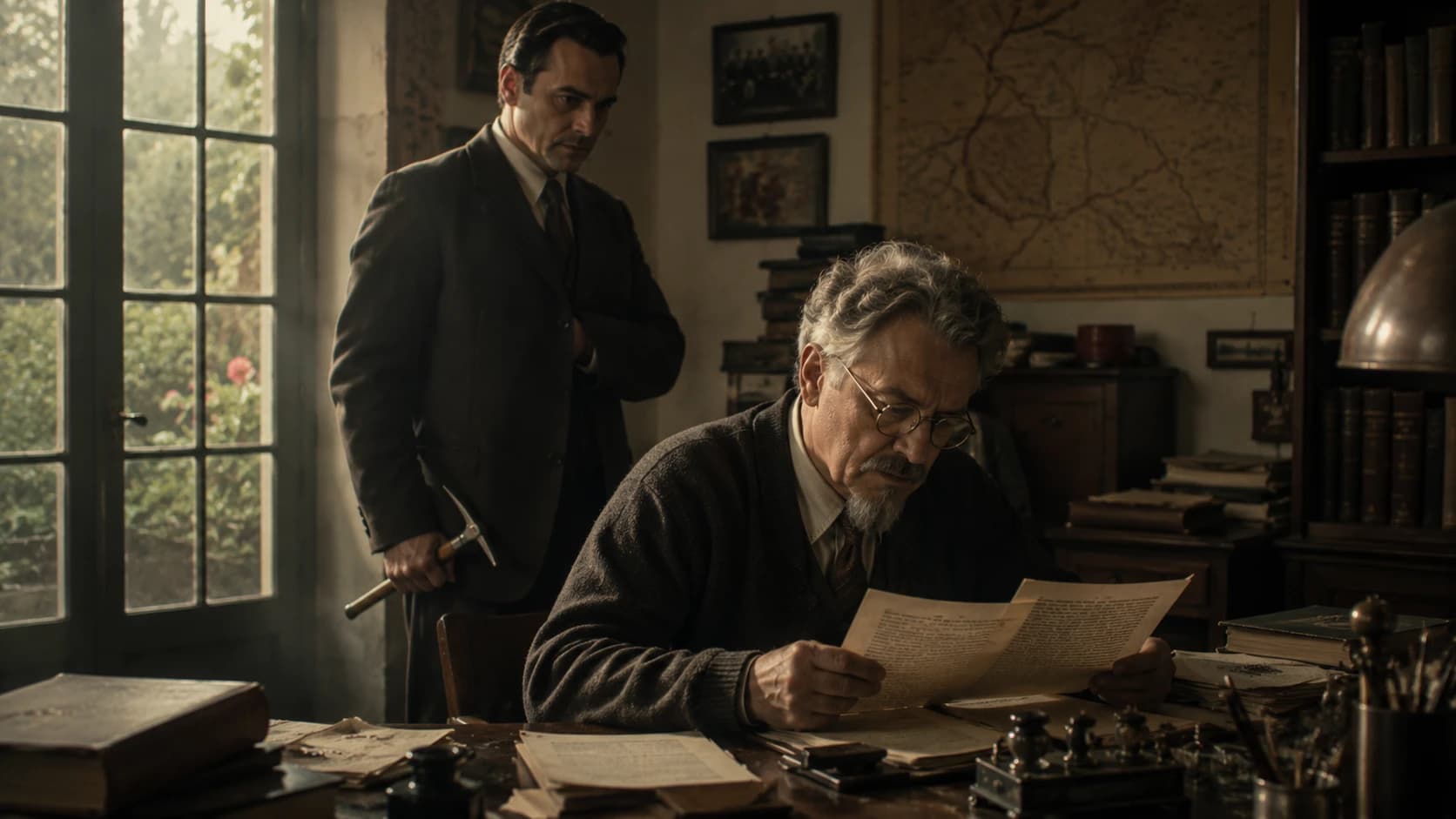
The old revolutionary bent over his desk, reading. Outside, the garden in shimmered beneath the Mexican sun. Inside, guards stood watch behind high walls, convinced they had finally made the exiled leader safe.
Leon Trotsky had survived prison, civil war, assassination attempts, and the relentless pursuit of Joseph Stalin. Then a trusted visitor stepped quietly into the room.
Seconds later, Trotsky lay on the floor with an ice axe buried in his skull. He was not killed instantly, but he was mortally wounded. His assassin expected an easy escape. Instead, Trotsky did something almost unimaginable. He fought back.
By the summer of 1940, Trotsky had become history's most famous political exile. Once one of the architects of the Russian Revolution alongside Vladimir Lenin, he had helped build the Red Army that secured Bolshevik victory in the Russian Civil War.
Brilliant, charismatic, and fiercely intellectual, Trotsky seemed destined to inherit Lenin's leadership. Instead, he lost a bitter power struggle to Stalin.
As Stalin consolidated control over the Soviet Union during the 1920s, Trotsky became his most dangerous rival. He criticised the growing dictatorship, denounced the bureaucracy consuming the revolution, and argued that socialism could not survive within a single country.
Stalin saw more than a political opponent. He saw a living alternative, a reminder that Soviet history might have taken another path. Trotsky was expelled from the Communist Party, stripped of influence, and eventually forced into exile. His journey carried him across Turkey, France, and Norway before Mexico granted him asylum in 1937.
Even thousands of miles from Moscow, Trotsky remained a target. Stalin's , the , maintained an international network dedicated to eliminating perceived enemies. Defectors, former officials, military officers, and political opponents disappeared across Europe. Trotsky occupied the top of that list.
His home in the suburb of resembled a fortress. Watchtowers overlooked thick walls. Steel doors protected the entrances. Armed guards patrolled constantly.
Earlier in 1940, gunmen led by Mexican muralist had stormed the compound with machine guns, riddling Trotsky's bedroom with bullets. Trotsky and his wife survived by rolling beneath their bed. The failed raid only strengthened security.
But walls could not stop betrayal. The abandoned brute force in favour of deception.
Their chosen assassin was , a Spanish communist recruited and trained by . Patient and disciplined, he adopted false identities and slowly worked his way into Trotsky's circle.
began courting , an American supporter of Trotsky. Through her, he gained access to the household. He presented himself as an unremarkable admirer, avoiding political arguments and never appearing overly eager.
Over many months, became familiar enough that his presence no longer raised alarm. On 20 August 1940, he arrived carrying an article he claimed Trotsky should review. The request seemed ordinary. Trotsky invited him into his study.
As the elderly revolutionary leaned forward to read the manuscript, reached beneath his coat. Hidden there was a mountaineer's ice axe with a shortened handle, selected because it could be concealed more easily than a knife or firearm.
He swung. The blow struck Trotsky's head but failed to kill him instantly. The ice axe penetrated his skull, yet Trotsky remained conscious. Instead of collapsing in silence, he cried out.
His scream brought guards rushing toward the study. At the same time, Trotsky grappled with his attacker, preventing him from escaping or delivering another fatal strike. later admitted he had expected his victim to die without resistance.
When the guards burst into the room, they began beating . Bleeding heavily, Trotsky reportedly urged them not to kill him. The assassin, he insisted, should be questioned.
Even in those final moments, Trotsky understood that the attack was larger than the man holding the weapon. Doctors rushed him to hospital, where surgeons attempted to save him. Despite extensive treatment, the injury proved catastrophic.
Trotsky died the following day, 21 August 1940, at the age of sixty. News of the assassination spread rapidly around the world. For supporters, it marked the destruction of the last major leader of the original Bolshevik Revolution who remained outside Stalin's control.
For Stalin, it represented the culmination of a campaign that had stretched across continents and lasted more than a decade.
initially concealed his true identity, spinning elaborate stories about personal motives and political disputes. Only years later did investigators fully uncover the depth of his connection to .
After serving twenty years in a Mexican prison, was quietly welcomed in the Soviet Union. There he received one of the state's highest honours: the title Hero of the Soviet Union. The award remained secret until after his release, reflecting both the sensitivity and significance Moscow attached to the operation.
Trotsky's home in survived almost unchanged. Today it serves as a museum, preserving the study where the attack occurred. The walls, gardens, and watchtowers remain silent witnesses to one of the twentieth century's most infamous political assassinations.
Trotsky's assassination was more than the murder of a political exile. It demonstrated the extraordinary reach of Stalin's regime, showing that geographical distance offered little protection against a determined security apparatus.
The killing also extinguished the most prominent surviving voice of revolutionary opposition to Stalinism. Trotsky's followers continued to organise internationally, but none possessed his stature or influence. His death helped cement Stalin's dominance over the global communist movement during the Second World War.
The struggle between Trotsky and Stalin did not conclude on a battlefield or in a courtroom. It ended with a single concealed weapon, wielded thousands of miles from the revolution that had first brought them both to power.