Complete chronology
Full overview and deeper context for every journey step.
1028
Difficult birthright
William's beginning was both privileged and precarious. He was the son of Robert I, Duke of Normandy, and Herleva of Falaise, but his illegitimacy gave enemies a permanent weapon. When Robert died on pilgrimage in 1035, the boy inherited Normandy in theory while ambitious nobles fought over it in practice. Guardians were murdered, castles became private strongholds, and ducal authority nearly collapsed around him. William survived because key churchmen, loyal magnates and eventually the French king Henry I found it useful to support him. Childhood under threat shaped the adult conqueror: he learned that legitimacy had to be defended with speed, punishment and political theatre.
Early insecurity taught him that authority must be defended, not assumed.
1040s
Securing Normandy
William's adolescence and early adulthood were a campaign to make the title Duke of Normandy mean something again. The rebellion of western Norman lords in the 1040s could have destroyed him, but with help from King Henry I he won at Val-es-Dunes in 1047. After that, he moved with increasing confidence: dismantling rebel castles, rewarding loyalty, using the church as a stabilising partner and marrying Matilda of Flanders despite papal objections that were later resolved. Normandy became one of the best-governed and most militarily effective principalities in western Europe. The man who crossed the Channel in 1066 was not an adventurer improvising greatness. He was a hard political survivor commanding a state he had spent decades tightening.
Authority gained through struggle tends to be exercised with greater resolve.
1050s–1066
Claim to England
The English succession crisis gave William his opening. Edward the Confessor had spent years in Norman exile before becoming king of England, and William later insisted Edward had named him heir. He also claimed that Harold Godwinson, the most powerful English nobleman, had sworn an oath to uphold that promise after being shipwrecked in Normandy. English evidence is thinner and more complicated: on Edward's deathbed in January 1066, the English elite accepted Harold as king. William framed Harold's accession as oath-breaking and usurpation, securing papal approval and recruiting men with the promise of land. Whether his legal claim was strong is debatable; his ability to turn it into an international cause was not.
Ambition combined with opportunity can turn a disputed claim into a decisive conflict.
1066
Invasion of England
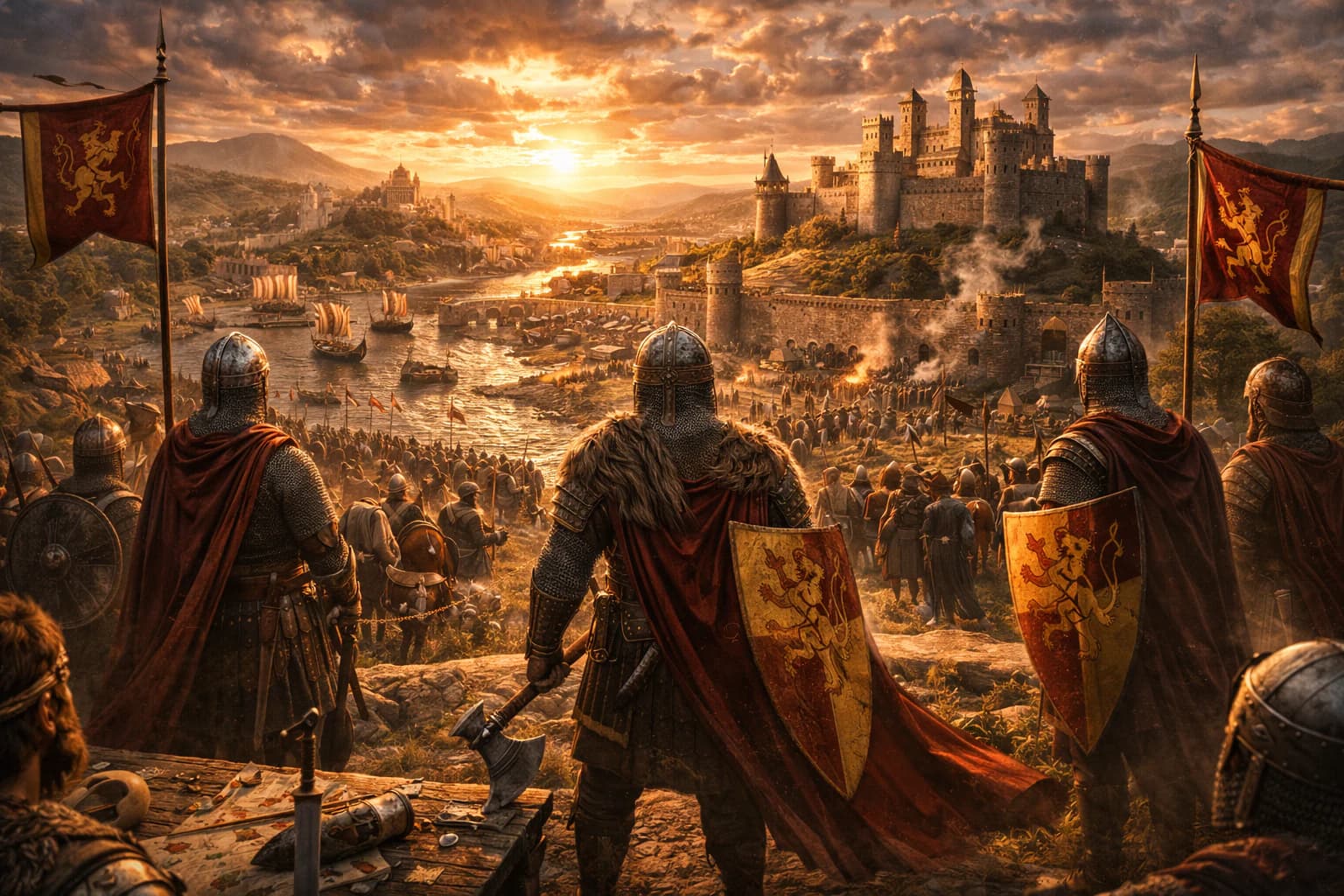
The invasion required enormous preparation: ships, horses, supplies, papal banners, noble commitments and the patience to wait for favourable winds. William's chance improved dramatically when Harold had to march north to defeat Harald Hardrada and Tostig at Stamford Bridge on 25 September 1066. Days later William landed at Pevensey and fortified his position. Harold rushed south, unwilling to let the Normans ravage Sussex and consolidate. The campaign became a test of speed, exhaustion and nerve. William had placed himself across the sea with no easy retreat; Harold had to defend a crown won only months earlier after one major battle already fought.
Bold action transformed a distant claim into an immediate and unavoidable contest.
1066
Battle victory
The Battle of Hastings was brutal, long and uncertain. Harold's housecarls and fyrd held a strong ridge position behind a shield wall, while William used cavalry, archers and infantry in repeated attacks. Later tradition emphasised feigned retreats, and while the details are debated, Norman tactical flexibility eventually broke English cohesion. Harold was killed, perhaps by an arrow, perhaps in close combat; the exact manner matters less than the political result. With Harold dead and his brothers also fallen, organised English leadership was shattered. Hastings did not instantly conquer England, but it removed the man most capable of stopping William from becoming king.
A single decisive victory can reshape the direction of an entire nation.
1066
Crowned king
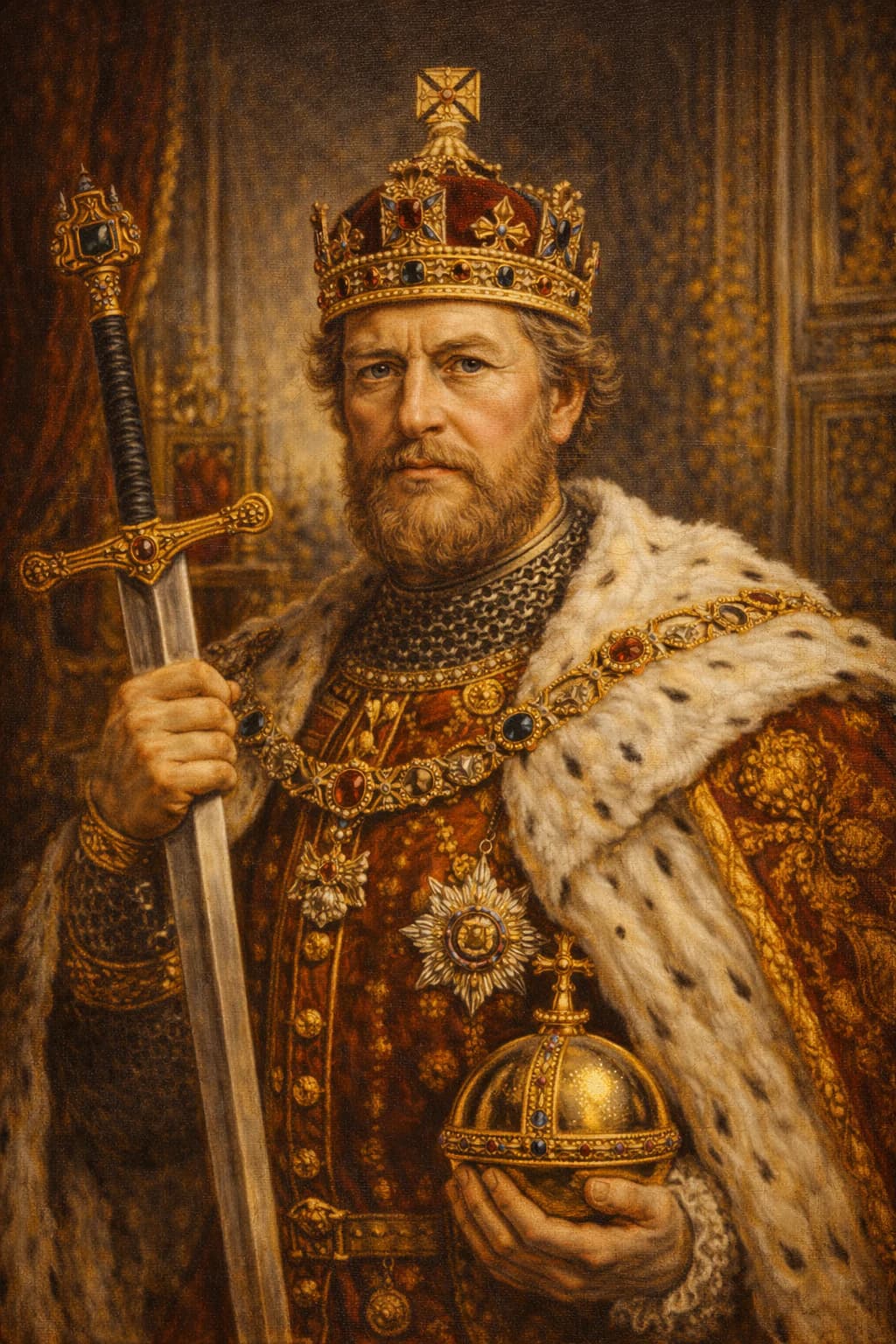
William's coronation at Westminster Abbey gave sacred form to military victory, but much of England remained unconvinced. London submitted after manoeuvre rather than affection, and the north, the west and the fenlands repeatedly resisted. William first tried to govern through some existing English structures, preserving shires, sheriffs and much royal administration. Yet rebellion steadily hardened his rule. Castles rose in strategic towns as visible instruments of occupation. Norman followers expected reward, and English landowners who resisted were displaced. The new king used old English machinery with new Norman masters, a combination that made his authority both recognisable and alien.
Taking power is only the first step; maintaining it demands continuous effort.
1067–1070s
Consolidating rule
The most violent phase came after northern rebellions and Danish intervention in 1069. William's response, later remembered as the Harrying of the North, devastated Yorkshire and neighbouring regions through destruction of food, settlements and means of survival. Medieval sources describe famine and depopulation on a terrible scale. Across the kingdom, land passed from English aristocrats to Norman, Breton and French followers, creating a new ruling class tied to the king by obligation and dependence. Castles at places such as London, York, Warwick and Norwich projected control into the landscape. William did not merely win a throne; he rebuilt the social architecture beneath it.
Lasting control often requires reshaping structures, not just defeating opponents.
1085–1086
Domesday survey
The Domesday Book was born from royal anxiety and administrative ambition. Facing external threats and needing to know what his conquest could sustain, William ordered commissioners to investigate who held land, who had held it under Edward the Confessor, what it was worth and what obligations attached to it. The result was not a modern census, but it was a formidable instrument of lordship. It fixed claims, exposed resources and made the kingdom legible to the crown. Few medieval rulers possessed such detailed knowledge of their realm. Domesday shows William's conquest at its most bureaucratic: violence translated into record, ownership and taxable fact.
Knowledge of resources became a key instrument of power in governing a complex realm.
1087
Enduring legacy
William died after injury during a campaign in France, still fighting to defend the cross-Channel power he had built. His inheritance was divided: Normandy went to Robert Curthose, England to William Rufus, a split that ensured further conflict. The deeper legacy endured. The Norman Conquest transformed English aristocracy, church leadership, language, architecture, law and landholding. It did not erase Anglo-Saxon institutions; in many areas it fused Norman lordship with existing English administrative strength. That fusion made the post-conquest monarchy unusually powerful. William matters because 1066 was not just a change of dynasty. It was a forced reorientation of England's ruling class, political culture and European position.
His greatest impact lay not just in conquest, but in the lasting transformation that followed.