Complete chronology
Full overview and deeper context for every journey step.
1952
Leningrad beginnings
Putin's childhood unfolded in postwar Leningrad, a city whose identity was inseparable from suffering and endurance. His parents had survived the Second World War and the siege years, and the family lived modestly in communal housing. Putin later cultivated stories of toughness, street fights, judo and self-control, turning early insecurity into a political vocabulary of strength. Soviet patriotism, wartime sacrifice and suspicion of weakness formed part of the atmosphere around him. This background does not explain everything, but it helps explain the emotional force of order in his public persona. Chaos, humiliation and vulnerability became conditions to be mastered, not debated.
His early environment fostered a belief that strength and order are essential for survival.
1970–1975
Legal studies
Putin's legal education was less a liberal apprenticeship in rights than a route into state service. At Leningrad State University, he studied in a system where law, party authority and security power were tightly connected. He later joined the KGB, fulfilling an ambition he had held since youth. The path suited his temperament: disciplined, secretive and institutionally loyal. It also placed him within a worldview that treated political conflict as something managed through information, leverage and control. The habits of security thinking would remain visible long after the Soviet Union disappeared.
His legal education became less about law itself and more about understanding authority.
1975–1991
KGB service
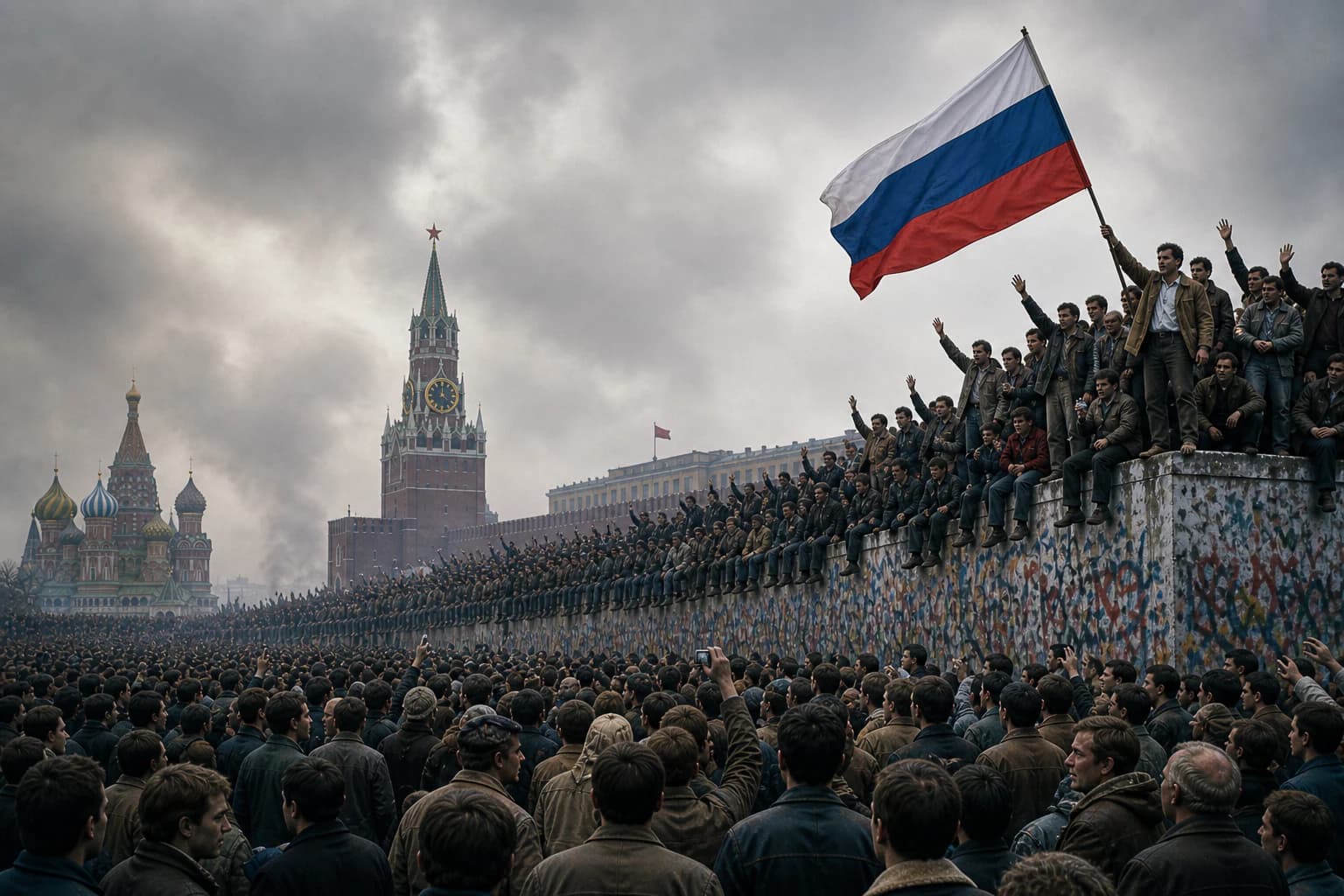
Putin's KGB career was not that of a legendary spymaster, but it was formative. Posted to Dresden in East Germany, he watched the Soviet bloc unravel in 1989 as crowds challenged communist authority and Moscow failed to intervene decisively. His later accounts dwell on the feeling of abandonment and state paralysis. When the Soviet Union collapsed in 1991, Putin experienced it not as liberation but as disintegration: institutions broken, borders redrawn, status lost. This memory became central to his politics. He would later present himself as the man who restored state capacity after the weakness and humiliation of the 1990s.
Witnessing state collapse convinced him that weakened authority invites chaos.
1991–1996
Post-Soviet shift
Putin's post-Soviet rise began not in Moscow but in St Petersburg. Under reformist mayor Anatoly Sobchak, he worked on external relations, foreign investment and licensing in a city struggling with privatisation, corruption, scarcity and opportunity. These years taught him how the new Russia worked: property could be redistributed quickly, law was weak, personal networks mattered, and reform rhetoric often coexisted with informal power. Putin gained a reputation for loyalty and discretion. When Sobchak lost power, Putin's move to Moscow saved and accelerated his career. The St Petersburg network would later become one of the foundations of his national elite.
He learned to navigate instability while quietly building influence.
1996–1999
Moscow ascent
Putin's Moscow ascent was extraordinarily fast. He entered the presidential administration, became head of the FSB, then secretary of the Security Council, and in August 1999 was appointed prime minister by Boris Yeltsin. To many Russians he was still obscure. To the Yeltsin circle, he appeared disciplined, loyal and capable of protecting continuity after a decade of upheaval. The second Chechen war and apartment bombings of 1999 transformed his public profile, as he adopted a hardline security posture that resonated with a frightened and exhausted society. His rise fused elite succession planning with a broader public desire for order.
His quiet competence made him a trusted figure in uncertain times.
1999–2000
Becoming president
Yeltsin's resignation made Putin acting president at the turn of the millennium. The symbolism was powerful: a new leader for a new century after a decade many Russians associated with collapse, oligarchs and uncertainty. Putin promised state restoration, economic stability and victory in Chechnya. He won the 2000 election and moved quickly to discipline regional governors, television networks and oligarchs who had grown powerful under Yeltsin. Some Russians experienced the early Putin years as recovery after disorder, helped by rising energy revenues. The price was the steady narrowing of political competition and independent institutions.
Opportunity and timing allowed him to transform proximity to power into control of it.
2000–2012
Power consolidation
Putin's system kept elections, parties, courts and media, but gradually hollowed out their independence. Governors were brought under tighter federal control. National television became loyal or cautious. Oligarchs learned that wealth was safe only if it avoided political challenge, with the destruction of Mikhail Khodorkovsky's Yukos empire serving as a warning. Putin stepped into the prime minister's office from 2008 to 2012 while Dmitry Medvedev served as president, but few doubted where ultimate power lay. The system rested on economic growth, security-service influence, patriotic messaging and the promise that stability mattered more than pluralism.
Stability was pursued through concentration of authority rather than pluralism.
2012–2022
Global tensions
Putin's return to the presidency in 2012 was met by major urban protests over elections and political stagnation. The response was tighter control: pressure on NGOs, opposition figures, media and public protest. Abroad, his Russia became more openly revisionist. The 2008 war in Georgia had already signalled willingness to use force in the post-Soviet space. In 2014 Russia annexed Crimea and supported war in eastern Ukraine, triggering sanctions and a deep break with the West. Intervention in Syria from 2015 projected Russian power into the Middle East. Putin presented these moves as defence against Western encroachment and restoration of sovereignty; critics saw imperial revision and authoritarian consolidation.
Foreign policy became a key arena for asserting national identity and power.
2022–present
Enduring influence
The full-scale invasion of Ukraine in February 2022 transformed Putin's rule and Russia's place in the world. The war brought massive casualties, destruction in Ukraine, international sanctions, mobilisation and a more militarised Russian state. Domestically, remaining independent media and anti-war activism were crushed or driven abroad, while opposition leader Alexei Navalny died in prison in 2024 after years of persecution. Putin won another presidential term in 2024 in a tightly controlled political environment, and official Russian sources continue to list him as president in 2026. His legacy is still unfolding, but its central features are clear: restored state capacity, personalist rule, weakened freedoms, imperial war and a future Russia heavily shaped by the choices of one man.
His legacy is still unfolding, shaped by decisions that carry long-term consequences.